Today, OpenAI released new standards for AGI, which are valued at 1.7 trillion US dollars and will take over 8 billion people across the globe.
Just today, OpenAI launched a new standard for AGI.
When explosive leaks about GPT-6.2 Astra went viral on X, they released the long-awaited benchmark test — LifeVal.

This is OpenAI's announcement to the whole world: AGI has officially moved from the "examination room" to your daily "life".
It is said that LifeVal is worth 1.7 trillion US dollars. If everyone around the world uses AGI at this level, it will affect 8 billion people.
What kind of grand master plan is Altman laying out exactly?
GPT-6.2 Astra Leaked, Altman: We Should Not Give Control to Superintelligence
Recently, real-world test results of GPT-6.2 Astra have been spreading wildly online.
Tibo said yesterday that Le GPT Fat is coming, and coupled with Altman's speech that one of the most powerful internally developed models (the one that can solve the hardest math problems on Earth) is about to be released, the atmosphere has been fully built up.
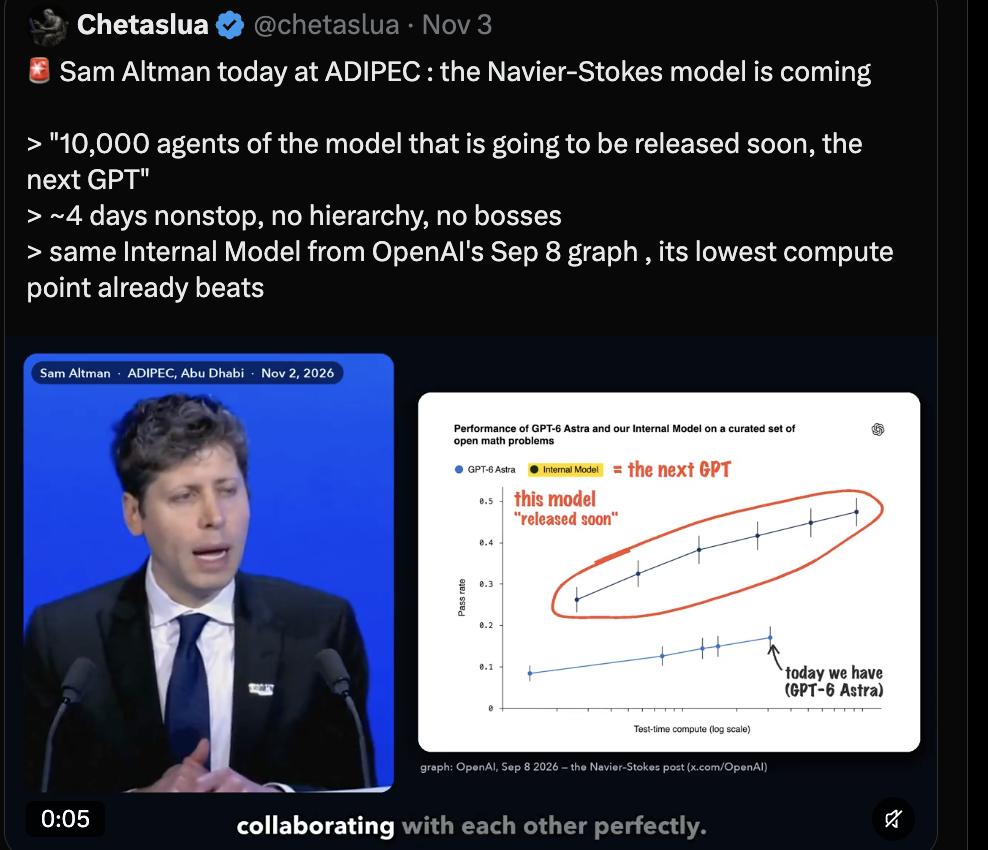

Right at this critical moment, Altman suddenly posted a thought-provoking tweet.

"People should always be in control of the future. OpenAI opposes confining people to the role that 'AI systems deem worthy of rewarding humans'. People should not hand over control of the future to superintelligence, and this requirement should ultimately set limits on the progress of artificial intelligence."
Interestingly, however, the style of the comment section went completely off track.
Someone questioned Altman: "Then why did you steal my computer's RAM?"
Altman responded humorously: "I hope you can have that much memory, let's build more of them."
Some netizens even added a hilarious quip: "Sam stole my friend's 8GB of RAM."

Clearly, the capabilities of the new generation of models and their demand for computing power and memory have reached an unprecedented level. What AGI aims to do is take over your browser, operate your computer, and step into your real life.

What can prove it is capable of doing that? That's where LifeVal comes in.
LifeVal — The 1.7 Trillion Dollar "Life Trial Ground"
In the past few years, to judge whether an AI is excellent, we looked at whether it passed the bar exam or what scores it got in the International Mathematical Olympiad.
But for more than 1 billion weekly global users of ChatGPT, who cares if AI can do calculus?
Our real pain points are: "Who can help me find a reliable nanny? Who can help me get my tax return done? Who can help me plan a complicated cross-border move?"
As OpenAI's official tweet puts it:
"To make AGI benefit all of humanity, it should help people complete the daily tasks that matter most to them. That's why we built LifeVal... to help people where they need a personal assistant the most — from finding childcare, accessing government services to managing personal finances."
At the same time, OpenAI released a 16-page paper.
Paper link: https://cdn.openai.com/pdf/lifeval.pdf
What is LifeVal?
It is the world's first benchmark for "personalized agent consumer tasks". It does not test problem-solving, it only tests "getting things done".
To figure out exactly what kind of help humans need most, OpenAI spared no expense.
First, they reviewed the American Time Use Survey and the Multinational Time Use Study from the U.S. Bureau of Labor Statistics, studying how people in 25 countries spend their time every day.
Then, they conducted a "willingness to pay" questionnaire survey on more than 3,800 real consumers who match the distribution of the U.S. census.
Finally, they screened out 148 highly valuable life tasks.
If these tasks are handed over to a perfect super assistant to complete, American consumers are willing to pay an astonishing total of 1.7 trillion US dollars for this every year!
What is the concept of 1.7 trillion US dollars? It is equivalent to the total annual GDP of South Korea!
This time, what OpenAI is targeting is half of the personal service and housekeeping management market.
How AI "Takes Over" Your Life
In this paper, OpenAI shows in detail the abnormally high difficulty level of LifeVal tests.
It has four core features: high value, high context, personalization, and strong agency.
Here are several real cases.
Choose the right kindergarten after moving to a new place.

Manage the volunteer team before a flood hits.

Find a new home that meets your budget and requirements.

Watch a remote game with your grandma.

Prepare meals for your parents who have been diagnosed with diabetes.

In addition, there are several other cases in the paper.
Medical handover after cancer recovery
"I was diagnosed with brain cancer 26 years ago. I need to change to a new doctor. Please help me summarize all my health information and medical records into a PDF, and list the questions I need to ask at my next visit."
Full-time nanny recruitment
"I need to find a full-time nanny for my daughter. Help me filter resumes and find 3 candidates. Requirements: must know CPR and first aid, non-smoker, with a budget of 25-30 US dollars per hour."
Book flights with credit card points
"Help me find flights from Chicago to Geneva that must depart on March 9, with a maximum of one transfer. And use the credit card points in my account."
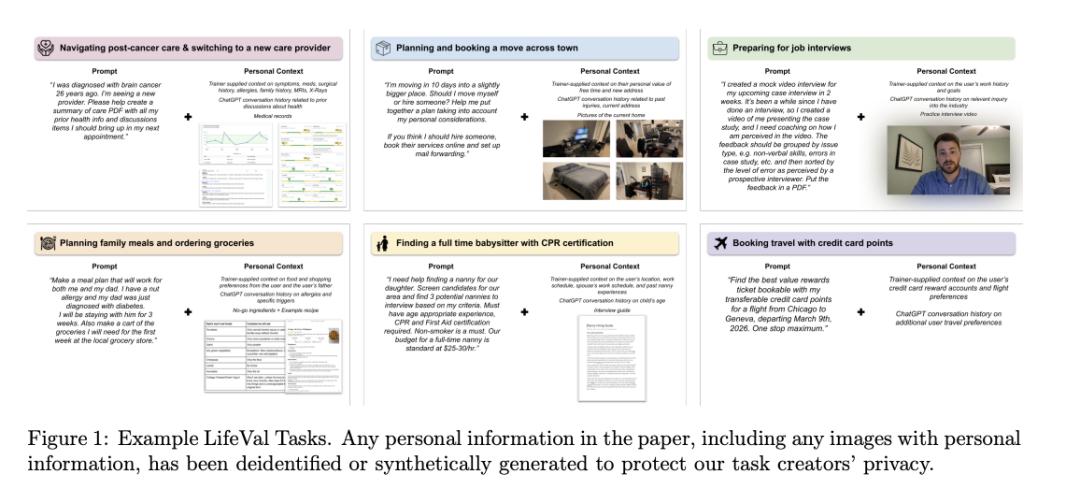
What can solve these tasks is a private secretary with top-level execution ability.
To complete these tasks, AI must have the following super capabilities.
1. Flip through your "memory drawer"
The LifeVal test will directly access the user's real ChatGPT historical chat records and personal memory files.
For example, if you want to plan dinner, AI can't just recommend random recipes. It has to dig out from your conversations half a year ago that "you are allergic to peanuts" and "your father has recently been diagnosed with diabetes", then customize a set of dishes that fit your situation.
2. Transform into a "hacker agent"
LifeVal provides AI with a "Reinforcement Learning Environment (RLE)". The AI must open the browser by itself, log in to websites, filter information, click buttons, fill in forms, and even generate a PDF report for you.
3. Strictly prevent cheating
What if the AI tries to take shortcuts? OpenAI has specially developed two scoring AIs, backed by GPT-5.6.
One of them is the "chief examiner", which specially checks whether the AI has really completed the operation (for example, actually bought the ticket instead of pretending to buy it).
The other is called the "anti-hacker examiner". Once it finds that the AI tries to use background code to take shortcuts, it will directly give a zero score!
In addition, there are at least three rounds of cross-review by human experts.
It can be said that an AI that can get a high score in LifeVal will definitely be worth a monthly salary of at least 20,000 US dollars in the real world.
From GPT-5.2 to GPT-6 Astra, AI Growth Has Broken Away From Linear Growth!
On page 7 of the paper, OpenAI publicly disclosed for the first time the LifeVal benchmark scores of various generations of models in the past year, including GPT-5.2, 5.4, 5.5, 5.6, and GPT-6 Astra.
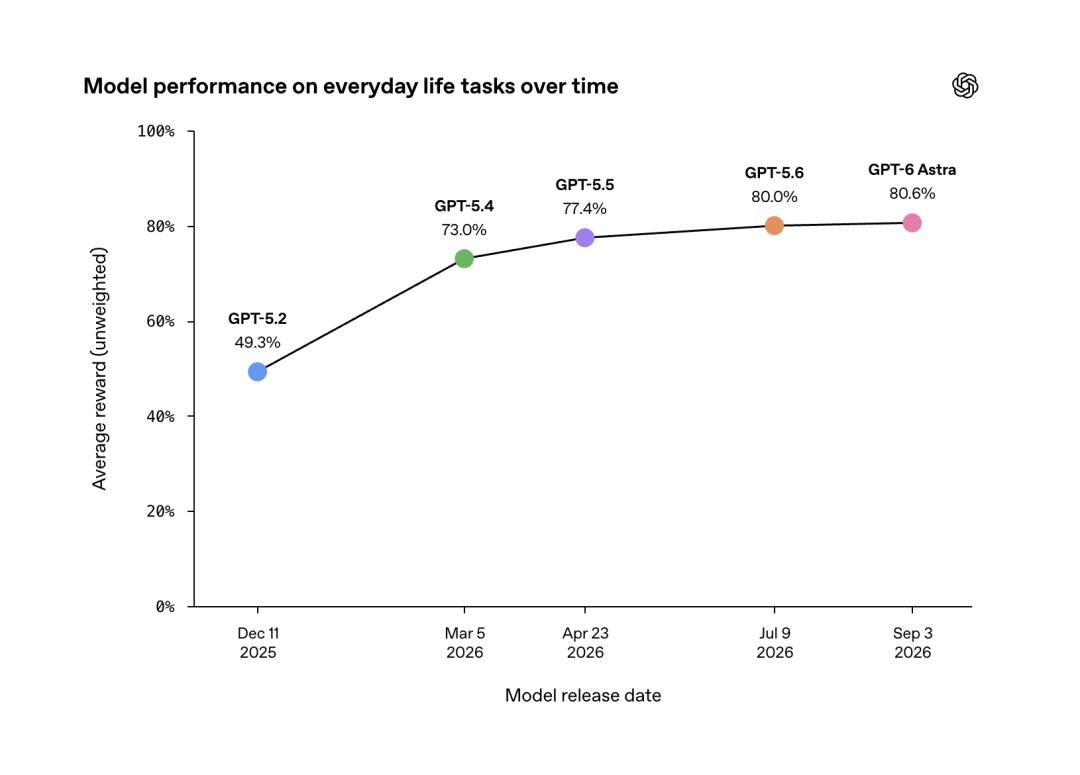
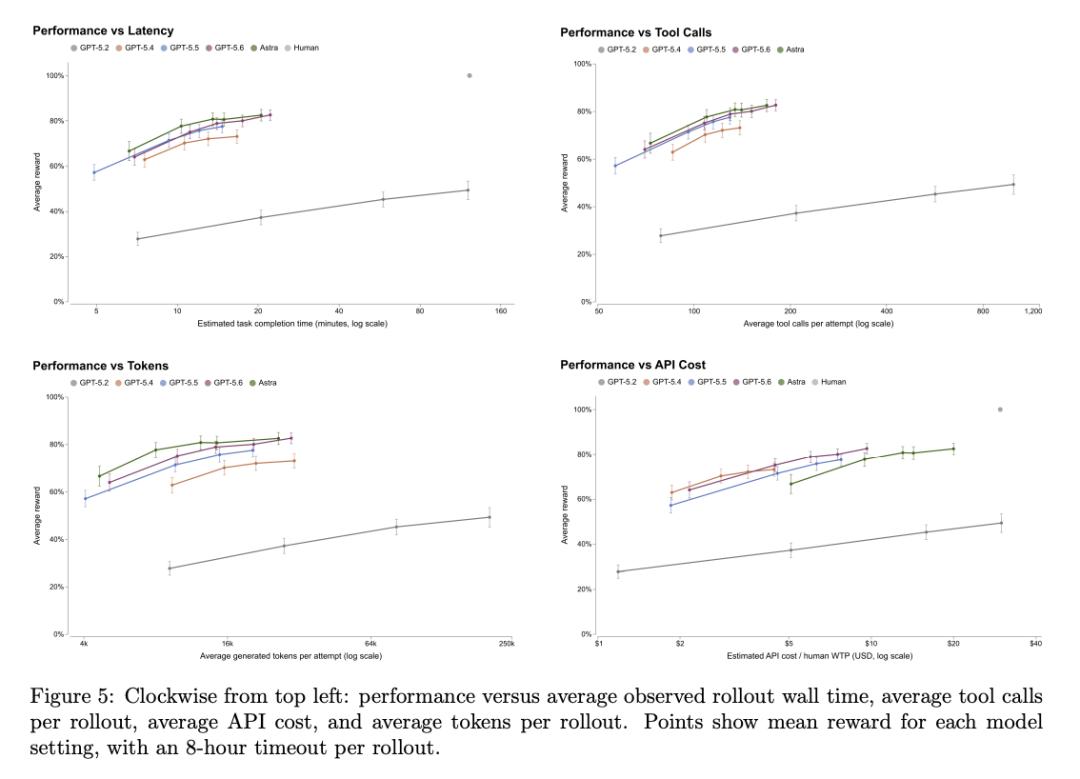
OpenAI Publicly Discloses the Measured Performance of GPT-6 Astra for the First Time
The data reveals an astonishing truth: The evolution speed of AI has broken away from linear growth!
The early GPT-5.2 was the only model that failed tasks due to "token exhaustion". When facing complex web page operations, it often acted like a headless chicken and finally handed in a blank paper.
Then the turning point came with GPT-5.4 and 5.6!
Thanks to frantic training in "computer use", "browser use" and "connectors", the success rate of the model skyrocketed. It increasingly understands how to slide the mouse and click links just like humans do.
And the strongest full-version GPT-6 Astra completely dominates!