36Kr Exclusive | Hefei Industrial Investment leads an over 100 million-yuan financing round for a quantum computing enterprise, dedicated to tackling the core technology of multi-machine interconnection for neutral atom quantum systems.
Text by Zhang Zhuoqian
Edited by Yuan Silai
36Kr has learned that neutral atom quantum computing enterprise Qianyuan Quantum recently completed an angel round financing of over 100 million RMB. The funds raised in this round will be mainly used for independent R&D and iteration of core optical devices, the whole-machine R&D of Qianzhen series neutral atom QPU (Quantum Processing Unit), as well as the pre-research and engineering debugging of QAVEXUS (quantum interconnection technology) multi-machine interconnection interface. At the same time, the funds will be invested in industrial supporting inputs such as expansion of the scientific research team and laboratory construction.
This round is led by Hefei Industrial Investment Group, with the joint participation of 12 institutions including Chuanggu Capital, Hefei High-tech Investment, Guoyuan Fund, Shanzheng Investment, Dingxing Quantum and other institutions. It is a project with joint investment from provincial, municipal and district-level state-owned capitals and market-oriented institutions. Zhongguancun Industrial Research Institute served as the financial advisor for this round of financing.
The core team of Qianyuan Quantum comes from the State Key Laboratory of Quantum Optics and Quantum Optics Devices of Shanxi University, and is one of the earliest teams in China to carry out research on Cavity Quantum Electrodynamics (hereinafter referred to as QED) and neutral atom arrays. Chief Scientist Zhang Tiancai is a recipient of the National Outstanding Youth Science Fund and a distinguished "Changjiang Scholar" professor of the Ministry of Education, who has long been deeply engaged in the research of quantum optics and cavity QED. Li Gang, Chairman and CEO, is a national high-level young talent, focusing on the fields of neutral atom arrays and optical tweezer quantum manipulation. The team has deployed experiments related to cavity QED since 2002, and has accumulated more than 20 years of technology so far.
At present, R&D personnel account for more than 60% of the company's total employees, including 2 chief scientists of the National Key R&D Program, 4 selectees of national talent programs, and more than 20 doctors (postdoctors), covering quantum optics, precision optics, vacuum engineering, electronic control, software measurement and control and other directions, with both in-depth basic scientific research capabilities and engineering implementation capabilities.
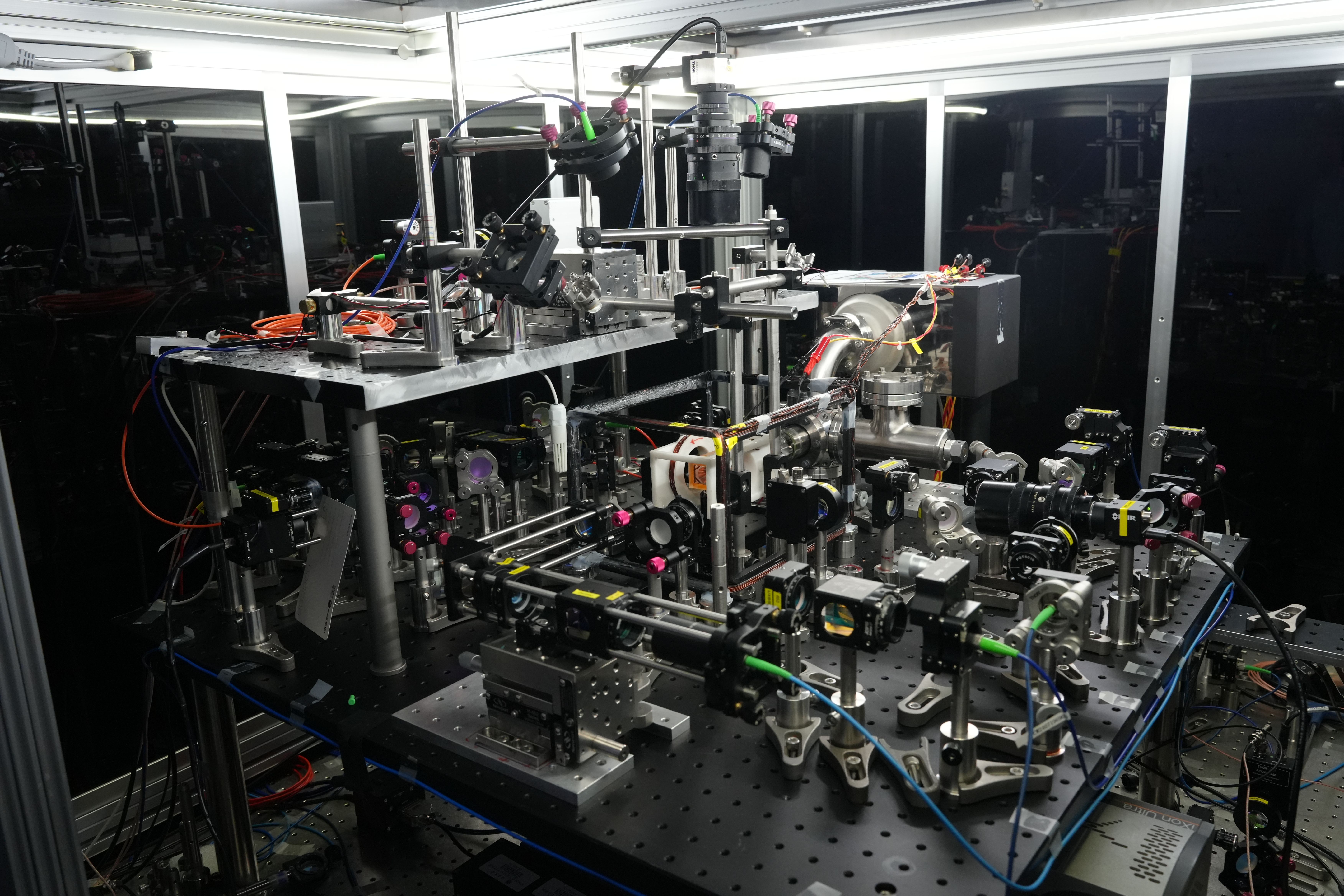
Schematic diagram of the overall neutral atom quantum computing platform
Bit number competition hits bottleneck, multi-machine interconnection becomes the next stop of the industry
Since the development of the quantum computing industry, it has gradually stepped out of the stage of simply competing for the number of single-machine bits. No matter the technical route is superconducting, ion trap or neutral atom, the expansion of bit scale of a single device is facing clear engineering bottlenecks: with the increase of the number of bits, crosstalk, control complexity, hardware and operation and maintenance costs all rise non-linearly. However, quantum computing tasks that can really produce practical value often require more than millions of physical bits for support. The path relying only on single machine stacking has low efficiency and high cost, which is difficult to support long-term large-scale development.
Aiming at this common pain point of the industry, Qianyuan Quantum has chosen a differentiated path of "high-performance single machine + modular multi-machine interconnection", trying to realize the continuous expansion of computing power at a relatively controllable cost in the way of distributed quantum clusters, and becoming one of the few neutral atom quantum computing enterprises in China that simultaneously deploy single-machine computing power and multi-machine interconnection.
In the judgment of Qianyuan Quantum, single machine and distributed are not alternative relationships, but complementary relationships: the performance of a single machine determines the computing power base of the module, and the interconnection capability determines the upper limit of the scale of the system. The current industry is in the transition stage from "meeting single-machine performance standards" to "multi-machine interconnection cluster". Only by deploying the interconnection architecture in advance can we take a leading position in the next stage of competition.
Taking cavity QED as the core barrier to open up the whole chain of "devices - complete machines - clusters"
The core technical barrier of Qianyuan Quantum is built on the strong coupling technology of atomic array and optical cavity (cavity QED), which is also the underlying confidence for it to choose the multi-machine interconnection route.
At present, there are four mainstream quantum interconnection schemes in the industry: atomic transport, free-space photon interconnection, nanofiber coupling and cavity QED interconnection. Among them, atomic transport is only applicable to the close-distance scenario inside the machine, the free-space scheme has extremely low photon collection efficiency and limited parallel expansion, and nanofiber coupling has engineering challenges in near-surface stability and consistency. In contrast, cavity QED enhances the interaction between atoms and specific optical modes through the optical cavity, greatly improves the efficiency of photon emission and collection, and supports multi-channel parallelism at the same time, which is considered by the industry as the most potential technical route leading to multi-QPU clusters.
Qianyuan Quantum named its standardized multi-machine interconnection interface QAVEXUS, which is positioned as "NVLink" in the quantum computing field, responsible for realizing quantum information transmission and entanglement interconnection between multiple QPUs. Relying on more than 20 years of accumulation in cavity QED, the team has a first-mover advantage in atom-photon coupling efficiency: at present, it has realized strong coupling between 26 single-atom defect-free arrays and optical cavities, and recently further achieved the interaction between 100 atoms and optical cavities.
On the single-machine computing power base, Qianyuan Quantum has deployed Qianzhen series neutral atom QPUs. Among them, Qianzhen-I is positioned as a thousand-level quantum dedicated simulator, which is expected to be delivered in 2027, and is preferentially oriented to scientific research simulation scenarios such as new materials and biopharmaceuticals; Qianzhen-II is planned to have ten thousand-level physical bits, which is expected to be launched in 2028. In terms of performance indicators, the team has achieved a coherence time of 20 seconds for alkali metal atoms, which is at the forefront of the neutral atom track; the optical tweezer array can generate 100,000 trap positions, providing a hardware basis for large-scale atom loading and manipulation.
In addition, Qianyuan Quantum has also independently developed core optical components such as cavity QED optical cavities, optical tweezer modules, and single-photon reading modules, forming a complete R&D closed loop of "devices - complete machines - clusters". Independent R&D of core devices can not only support the rapid iteration of internal products and control costs, but also supply scientific research-level optical devices externally, so as to polish the engineering capability in reverse.
Compared with most neutral atom teams that prioritize the breakthrough of single-machine bit scale, Qianyuan Quantum has a very clear differentiation: first, it has deployed modular interconnection synchronously from the early stage, taking multi-machine interconnection as the core main line rather than a supplement to a single machine; second, relying on long-term accumulation of cavity QED, it has a natural advantage in atom-photon coupling efficiency, laying a core technical foundation for quantum interconnection.
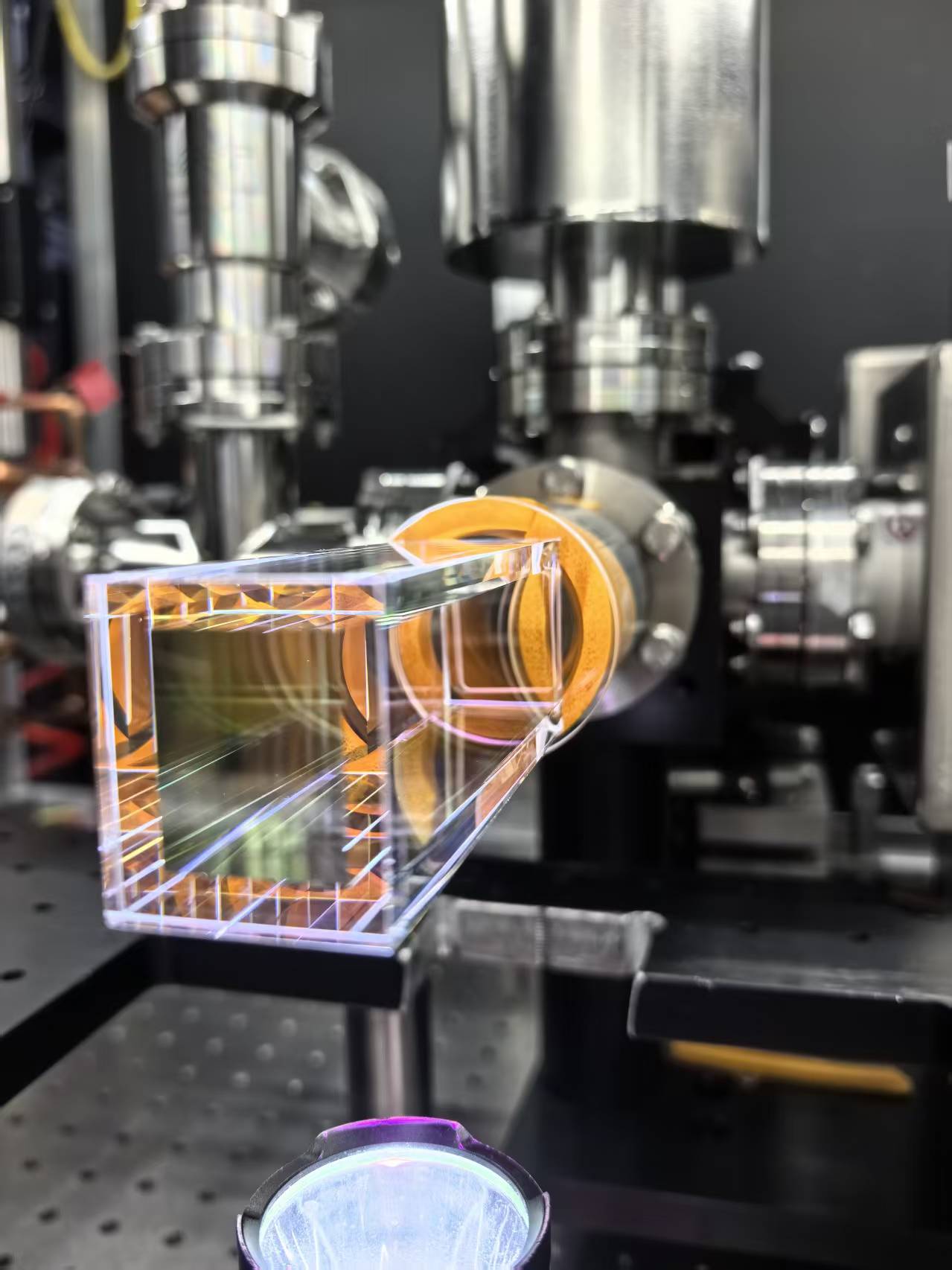
Schematic diagram of the ultra-high vacuum cavity module
From laboratory to industrialization: run through the technical closed loop first, and then gradually implement commercialization
At this stage, Qianyuan Quantum is still in the prototype R&D stage. The core goal is to promote the R&D of the prototype machine and interconnection verification platform according to the nodes, and prioritize running through the technical closed loop. After that, commercial paths such as joint prototype testing and technical services will be gradually opened.
Its target customers cover three groups: universities and scientific research institutes, national-level scientific research platforms; computing power service providers; leading industrial enterprises with demands for quantum simulation and combinatorial optimization. Long-term application scenarios will cover material molecular simulation, drug R&D, cryptanalysis, financial risk control optimization, basic scientific research simulation and other directions.
At present, its self-developed core optical components have entered many scientific research institutions such as University of Science and Technology of China, National Time Service Center, Shenzhen Institute of Quantum Science and Engineering, and are expanding to industrial customers. According to the plan, the team will focus on promoting three things in the next three years: continuously optimize the single-machine indicators, improve the defect-free preparation capability of atomic arrays, coherence time and reading fidelity, and promote the iteration of Qianzhen series prototypes; complete the principle verification of QAVEXUS two-machine interconnection, and open up cross-node quantum information transmission and long-distance entanglement; continuously promote the engineering and standardization of core optical devices, and reduce the iteration cost of complete machines and clusters. The longer-term goal is to implement the prototype of Qianqiao cluster to realize a modular and scalable quantum computing power cluster.
Investor Views:
Hefei Industrial Investment Group stated that "Quantum computing is moving from the single-machine bit competition to the era of scalable clusters. The differentiated route of Qianyuan Quantum of 'high-performance single machine + modular multi-machine interconnection' complements the neutral atom quantum computing industry sector in Hefei, and improves the local quantum industry ecosystem with multi-technical route coordination. As a patient state-owned capital, we value the enterprise's independent R&D system of the whole chain of devices, complete machines and clusters, and look forward to promoting the engineering implementation of cutting-edge scientific research achievements, driving the coordination of upstream and downstream industrial chains of optics, vacuum, measurement and control, and helping the construction of domestic quantum computing power infrastructure."
Guoyuan Equity said that "This investment is another move to implement the 'Scientist Companion Plan', which is a forward-looking layout for the neutral atom route. Neutral atoms have the advantages of naturally identical bits, reconfigurable arrays and low expansion cost, and are an important route leading to large-scale fault-tolerant quantum computing. The Qianyuan Quantum team has complete full-link R&D capabilities, and Guoyuan Equity will support the enterprise to accelerate the development of prototypes and industrialization implementation."
Shanzheng Investment introduced that "This is the institution's first layout in the neutral atom technical route. Qianyuan Quantum pioneered the technical route of 'neutral atom QPU + QAVEXUS interconnection', adhering to the two-way parallel of single-machine performance breakthrough and multi-machine cluster collaboration. The team is derived from the State Key Laboratory of Quantum Optics and Quantum Optics Devices of Shanxi University, and has more than 20 years of scientific research accumulation in cavity QED. Shanzheng Investment looks forward to helping the team complete the engineering implementation of cutting-edge scientific research achievements and promoting the development of domestic distributed quantum cluster technology."