Jensen Huang's Dialogue in Kazakhstan: Energy is Intelligence, Every Country Should Build Its Own AI
During a fireside chat in Kazakhstan, Jensen Huang, CEO of NVIDIA, elaborated on the "AI Nation" strategy, the five-layer cake framework, sovereign AI, physical AI, employment and ambition. His core judgment is: AI is a platform transformation and a new industry; energy equals intelligence, and data is a country's natural resource; every country should build its own AI infrastructure to convert energy and data into national intelligence.
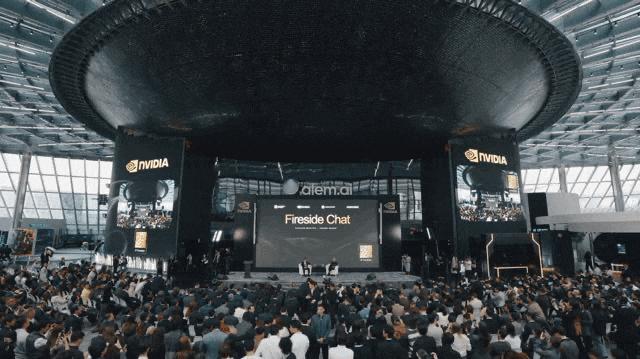
The following is the full transcript of Jensen Huang's views:
I. AI is a global technological reset, and Kazakhstan has taken the lead
First of all, I would like to congratulate the President of Kazakhstan on his announcement that Kazakhstan will become a AI Nation. This is a highly farsighted decision. This is a global technological reset, which presents a rare opportunity for Kazakhstan.
While other countries around the world are still deciding how to participate in and build the AI economy, Kazakhstan is already taking action. AI is a general-purpose technology that is reshaping every industry, every citizen, every company, and every country. This is a technology-driven industrial revolution.
But AI is not just a technology, it is a new industry in itself. AI is manufacturing: it must be generated in real time and cannot be pre-computed; every use requires real-time generation, so it requires a new type of factory — the AI factory. The computing systems manufactured by NVIDIA are designed to power AI factories. These factories need natural resources, the most important of which is electric power. They also need data and offtake. Where does offtake come from? It comes from leaders motivating young people, universities, scientists and the industrial sector to participate in the AI economy.
Kazakhstan has a fundamental advantage: you already have abundant natural resources and a large amount of energy. In the future, you will not only export energy, but also convert energy into intelligence and export intelligence.
II. The Five-Layer Cake: Energy, Chips, Cloud, Models, Applications
From an industrial perspective, AI is essentially a five-layer cake.
The bottom layer is energy. AI real-time processing and real-time generation of intelligence requires energy. The second layer is chips and computing infrastructure. The third layer is cloud infrastructure and cloud services. The fourth layer is AI models. Most people think AI is only this layer. The fifth layer is the application layer. Financial services, healthcare, manufacturing, etc., where the final economic benefits will be generated.
But the key point is: This computing platform requires the support of all layers below. Therefore, it has launched the largest infrastructure construction in human history. It is correct for you to take the five-layer cake as the main pillar of the digital Kazakhstan strategy in the next five to ten years. The total addressable AI market exceeds 50 trillion US dollars, but you must systematically advance all five layers instead of only focusing on one layer.
III. Data is a country's natural resource, and sovereign AI is a national security issue
People ask: Do we need our own Kazakh GPT? My answer is absolutely necessary, in fact, this is a national security issue.
Intelligence is fundamental, it is a general-purpose technology that affects every citizen, every company, and every country. A country's intelligence comes from its data. And a country's data is its culture, history, human nature and values. Data belongs to you, just like natural resources belong to you.
You cannot export the culture and values of your people and then import other people's intelligence. This does not make sense. You need to control your own data, control your own natural resources, and also control the way services are delivered to your own people. Just like you have Kazakhstan Telecom and your own power grid, in the future you will also have your own intelligent grid.
It is acceptable to allow other countries or companies to serve as supplements, but you cannot rely entirely on them. You must have the ability to provide basic infrastructure services for your own country. That is why Kaz LLM is a wise move. The invention of technology is very difficult, but the application and adaptation of technology are not that difficult. Kazakhstan has abundant talents in science, mathematics and programmers. You should adopt open-source technologies and open models, apply them to your own language and culture, and operate your own intelligent infrastructure.

IV. Physical AI is the next wave and also the largest industry
AI starts with cognitive intelligence, but will eventually move towards physical AI. Physical AI is the largest of all industries, because most of the world involves interaction with and understanding of the physical world.
Physical AI is not just about robots. Robots will be very important, but physical AI also includes: earthquake understanding, mapping of mines and oil wells, geographical and geological understanding, where to mine, how to mine optimally, materials science, and chemical processing. Every stage from mineral mining and processing to converting minerals into new materials will benefit from physical AI.
Kazakhstan has heavy industry, factories, mines, agriculture, transportation and logistics infrastructure, as well as talents with deep expertise in these industries. You should become a hub for training physical AI robots. We are at the very beginning of the physical AI journey, and everyone is at the starting point. This is a great opportunity to participate in and shape the future industry.
In the future, just as we have general artificial intelligence and cognitive AI, we will also have general-purpose robots. We will try to cultivate "general-purpose engineers", "general-purpose farmers", "general-purpose miners", and "general-purpose scientists", who will exist in every field.
V. Will AI replace jobs? The key lies in whether you focus on "purpose" or "task"
What people care most about is jobs. My answer is: The only thing that matters is whether you have ambition.
If you have ambition, AI and robots will lift you up and give you the ability to do more things. If you are a farmer with ambition, robots will help you farm, but precisely because you have ambition, you can expand your operation, expand your vision and expand your business. If you are a scientist with ambition, AI assistants will expand the universe you can explore. If you are an engineer with ambition, AI engineers will help you explore better designs.
The question is simple: Do you have ambition? If you do, AI will elevate your country, your people and your companies, and enable you to participate in global competition; AI will transform your society.
The same is true for children. As parents, our responsibility is to instill hope, ambition and aspiration in children, and help them dream bigger. When children dream bigger, AI will help them achieve it. If children want to learn more, AI will help them learn more; if children want to do less, AI can also help them do less. So the key is not AI, but whether we cultivate children's ambition.
VI. Investing means investing in people: Why NVIDIA invested in Higgsfield AI
When we invest in a company, first and last, we invest in people, not the company itself.
The founders of Higgsfield are very farsighted. They have a brilliant idea that is not easy to implement, and they have global competitors, many of whom are located in San Francisco, the United States, with abundant capital and strong technology. But they are among the smartest people in the world. They have 600 employees in Kazakhstan with an average age of 25, many of whom are already deep tech engineers and computer scientists. They have offices in both Kazakhstan and the United States, and are able to bridge the cultures and expertise of the two countries to compete globally.
Therefore, when you invest in a company, you are actually investing in talents, you must choose the best people.
VII. AI Safety: Safety is not a wish, but technology and engineering
In order for the world to enjoy the benefits and huge opportunities of AI, we must develop, advance and deploy it responsibly. Just like building autonomous vehicles, safety is critical from the very beginning; just like in the mining industry, safety is critical from the very beginning.
The technology to ensure AI safety is a fundamental technology in itself. It must be invented and engineered. We have developed a technology called OpenShell. OpenShell contains these autonomous systems. These agents are essentially autonomous vehicles or robots in computers. If you grant them access to files and tools, they will freely access files and complete tasks. So we must restrain them to ensure that they only get the access permissions we exactly want, the permissions are limited to what is needed to complete the work, and they are monitored at all times.
The technology used for the safe deployment and even safe creation of AI is called OpenShell, and I suggest everyone use it.

VIII. I am more enthusiastic about AI than I was a year ago
Over the past year, has anything changed my view on AI? No. I am more enthusiastic about AI now than I was a year ago, and I was already extremely enthusiastic a year ago.
The biggest breakthrough in the past year, especially agentic systems, has made AI truly useful. Take the videos generated by Higgsfield as an example. In just one year, the progress is tremendous. At first, it could only generate short videos, but now it can generate very long videos that are temporally and physically consistent, and can tell stories for a long time. None of this would be possible without agentic reasoning systems.
Therefore, this technology has become very useful in many fields such as video generation, text generation, software programming, robot systems, and drug discovery.
IX. If I were 18 years old, I would train myself to become the world's best AI programmer
If I were 18 years old today and lived in Kazakhstan, what would I learn and build in the next five years?
I envy people who are 18 years old today, because the world is changing so fast, everything is being completely reset due to technology. When I was 18 years old, personal computers had just become possible; my generation was defined by the creation of computers. Our 40 years of efforts have finally given birth to artificial intelligence, which is a complete reset of everything we have done.
In the past, you had to learn how to program computers; now you have to learn how to program AI. AI is new to you, and it is new to everyone. I will dedicate myself to becoming the best AI programmer in the world.
AI can automate, cooperate with us, and assist us. But just like when you cooperate with people and get assistance from others, you must learn how to interact, and learn how to "program each other". You need both technical skills and social science, both are indispensable.
The best AI programmers are those who understand how AI works. The best users of machines are those who understand how machines work; the best racing drivers are those who understand how racing cars work. Therefore, AI programmers should understand the mechanism, basic principles, strengths, weaknesses, development direction and future of AI. If you want to give full play to the capabilities of AI, you must understand these technical attributes.

Epilogue
Jensen Huang's dialogue, on the surface, is to "offer advice" to Kazakhstan, but in essence, it provides a set of industrial upgrading narratives for resource-based countries in the AI era: Energy is not only for export, it can be converted into intelligence; data is not free, it is a country's natural resource; every country should build its own intelligent grid instead of only importing intelligence from others. This set of narratives is very attractive to resource-rich countries with weak software industries such as Kazakhstan, the Middle East, and Southeast Asia, and it also opens up new national-level markets for NVIDIA.
But it should also be noted that Jensen Huang's position is very clear: he stands on the second layer of the five-layer cake, and most hopes to see the simultaneous expansion of the five layers of energy, chips, cloud, models and applications. "Sovereign AI" is not only a national security issue, but also an infrastructure business. For policy makers, the real question to answer is not "whether to build an AI Nation", but "whether energy, data, talents, and governance capabilities are well-matched"; for entrepreneurs and investors, opportunities do not lie in shouting slogans, but in finding a position in the five-layer cake that you can occupy for a long time. Jensen Huang finally landed the answer on "ambition", which is both an inspiration and a screening: AI will amplify people with ambition, and will also amplify the gap between countries.
This article is from the WeChat Official Account "Postwave Evolution Planet", written by Mark, and published with authorization from 36Kr.