AMD's financial report set a new record, with quarterly revenue reaching 13.4 billion US dollars, and its data center business nearly doubled.
On November 3 local time in the United States, AMD released its financial report for the third fiscal quarter ending September 26, 2026. Benefiting from the continuously growing demand for artificial intelligence infrastructure construction, AMD's performance in the third quarter hit a new record high, with both revenue and net profit exceeding Wall Street expectations.
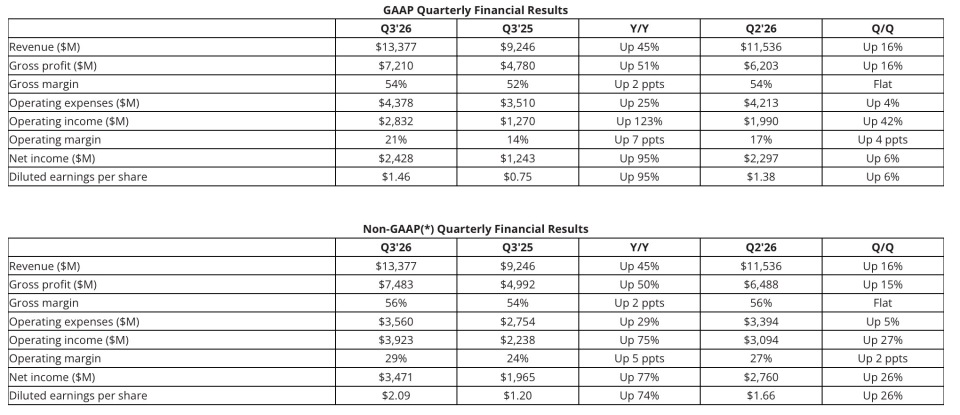
The company's operating revenue for the quarter reached 13.377 billion US dollars, a year-on-year increase of 45% and a quarter-on-quarter increase of 16%, exceeding Wall Street's expectation of 10.9 billion US dollars. The data center business became the main driving force for growth this quarter, with revenue reaching 8.546 billion US dollars, a year-on-year increase of 97%, and its proportion in the company's total revenue rose to 64%.
Calculated in accordance with GAAP (Generally Accepted Accounting Principles), the company's net profit was 2.428 billion US dollars, a year-on-year increase of 95%; non-GAAP net profit reached 3.471 billion US dollars, a year-on-year increase of 77%. Non-GAAP diluted earnings per share was 2.09 US dollars, higher than 1.20 US dollars in the same period last year and exceeding Wall Street's expectation of 1.95 US dollars.
Driven by the performance exceeding Wall Street's expectations, AMD's after-hours share price once surged by 8%.
AMD expects that its revenue in the fourth quarter will reach about 17 billion US dollars. Calculated at the midpoint of the guidance, the year-on-year increase will be about 66%, and the quarter-on-quarter increase will be about 27%.
Lisa Su, AMD Chair and Chief Executive Officer, said in the earnings statement that the revenue of the data center business nearly doubled year on year, which pushed the company's third-quarter performance to a new record. Market demand for AMD Instinct series GPUs and AMD EPYC server processors remains strong. With the gradual expansion of production of the Helios full-rack system and "Venice" architecture products, the company expects its business growth to further accelerate in the fourth quarter.
01 Gross Margin and Operating Profit Rise Simultaneously
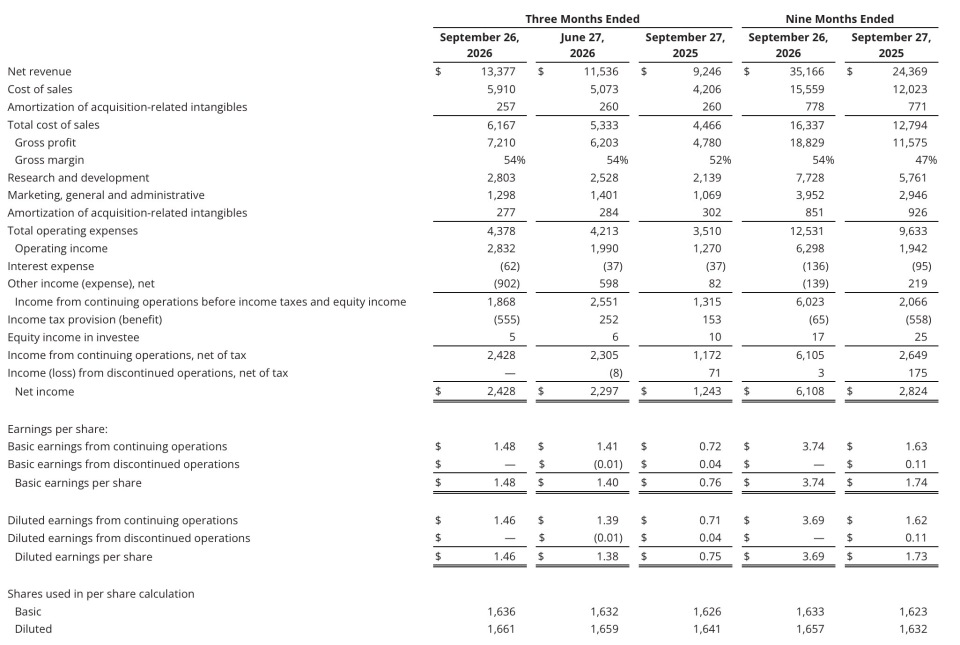
AMD's GAAP gross profit this quarter was 7.210 billion US dollars, with a gross margin of 54%, up 2 percentage points from the same period last year and flat with the previous quarter. Calculated on a non-GAAP basis, the gross profit was 7.483 billion US dollars, with a gross margin of 56%, also up 2 percentage points from the same period last year.
The gross margins under both calibers have improved compared with the same period last year, indicating that while the revenue scale expands, the profitability of the company's overall product portfolio has also improved. The continuously increasing proportion of data center business revenue is an important background for observing this change.
In terms of operating expenses, GAAP operating expenses this quarter were 4.378 billion US dollars, a year-on-year increase of 25%; non-GAAP operating expenses were 3.560 billion US dollars, a year-on-year increase of 29%. Among them, GAAP R&D expenses were 2.803 billion US dollars, higher than 2.139 billion US dollars in the same period last year.
The growth of R&D expenses reflects that AMD is still increasing investment in core technologies and products. With the continuous iteration of AI acceleration cards, high-performance server processors and supporting software products, the company needs to continuously invest R&D resources to maintain product competitiveness and meet the growing demand of the data center market.
In terms of operating profit, GAAP operating profit this quarter was 2.832 billion US dollars, a year-on-year increase of 123%, and the operating profit margin rose from 14% in the same period last year to 21%. Non-GAAP operating profit was 3.923 billion US dollars, a year-on-year increase of 75%, and the operating profit margin reached 29%, higher than 24% in the same period last year.
The growth rate of GAAP operating profit is higher than the revenue growth rate, and the operating profit margin has also increased by 7 percentage points. This shows that the revenue growth this quarter not only drives the expansion of profit scale, but also enables the company to obtain higher operating returns. Combined with the gross margin performance, the growth of data center business and the improvement of overall profit structure support AMD's profit growth this quarter.
02 Data Center Becomes the Core of Growth
The boom in artificial intelligence data center construction is affecting the traditional PC market. The growing demand for memory chips from AI servers has squeezed the supply of chips required for laptops and desktops, and pushed up prices, which has also affected PC chip manufacturers such as AMD.
At the same time, AMD is expanding its business in the AI infrastructure market by launching new-generation CPU and AI accelerator products, as well as the Helios full-rack server solution.
AMD's business is mainly divided into three sectors: Data Center, Client & Gaming, and Embedded. In the third quarter, the data center business continued to expand its leading edge, the Client & Gaming business was affected by the decline of the gaming business, and the embedded business continued its recovery trend.
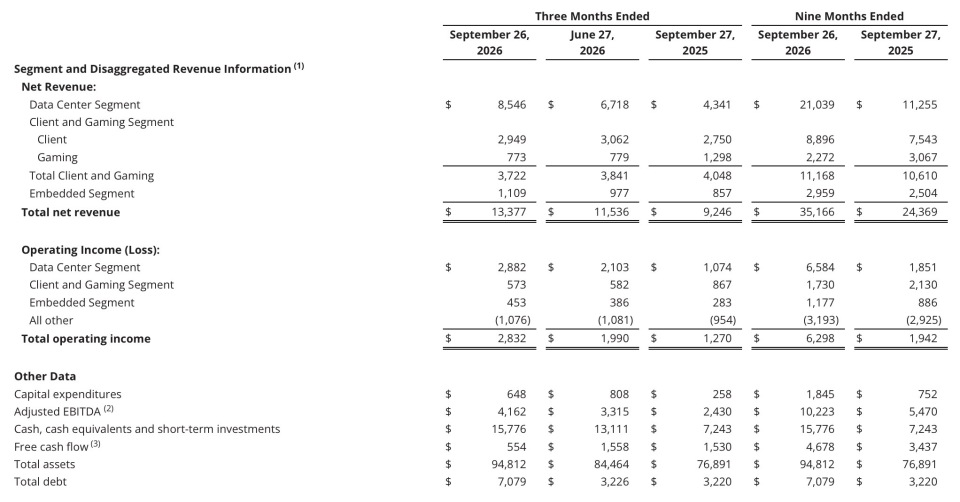
The revenue of the data center business this quarter was 8.546 billion US dollars, up 97% year on year and 27% quarter on quarter; the operating profit was 2.882 billion US dollars, up 168% year on year. This sector accounts for about 64% of the company's total revenue, a significant increase from 47% in the same period last year, and has become AMD's largest source of revenue and profit.
Business growth mainly comes from the Instinct series AI accelerators and EPYC server processors. AMD disclosed in its official materials that the Helios full-rack solution, powered by AMD Instinct MI450 series GPUs and the 6th generation AMD EPYC processors, has been put into operation in the AI infrastructure of customers including Anthropic, Meta, Microsoft, OpenAI, and Oracle Cloud Infrastructure.
As generative AI applications evolve towards Agentic AI, model inference, task scheduling and complex computing put higher requirements on the computing power of data centers. GPUs undertake AI training and inference tasks, while server CPUs are responsible for system scheduling and general-purpose computing. The demand for these two types of products jointly drives the growth of AMD's data center business.
The combined revenue of the Client & Gaming business this quarter was 3.722 billion US dollars, down 8% year on year. Among them, the revenue of the client business was 2.949 billion US dollars, up 7% year on year; the revenue of the gaming business was 773 million US dollars, down 40% year on year.
The client business maintained growth, mainly benefiting from the demand for laptops equipped with AMD Ryzen mobile processors and the company's product layout in the commercial and high-end workstation markets. AMD also launched the Ryzen AI Max PRO 400 series processors for local AI computing, and promoted the layout related to the Ryzen AI Halo platform.
The gaming business was affected by changes in demand for semi-custom chips for game consoles and other factors, and its revenue decreased by 40% year on year. The growth of the client business failed to offset the decline of the gaming business, resulting in the overall revenue of the Client & Gaming sector being lower than that of the same period last year.
The revenue of the embedded business this quarter was 1.109 billion US dollars, up 29% year on year and 14% quarter on quarter; the operating profit reached 453 million US dollars, up 60% year on year.
With the gradual improvement of demand in aerospace, national defense, automotive, communications and industrial fields, the embedded business continues to recover after the previous inventory adjustment. AMD also disclosed AMD Ross, an AI agent tool for embedded system development this quarter, and began to provide customers with Versal AI Core samples for long-cycle aerospace missions, continuing to expand its product layout in the fields of embedded and edge computing.
03 Increase Investment to Ensure Production Capacity
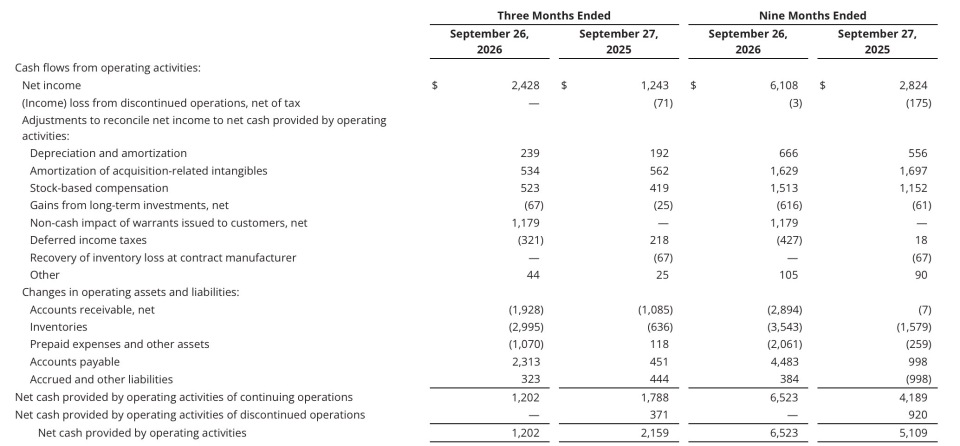
As of September 26, 2026, AMD held a total of 15.776 billion US dollars in cash, cash equivalents and short-term investments, with total assets reaching 94.812 billion US dollars and shareholders' equity of 68.389 billion US dollars. This quarter, the cash flow generated by the company's operating activities was 1.202 billion US dollars, and the free cash flow was 554 million US dollars; the cumulative free cash flow in the first three quarters of 2026 reached 4.678 billion US dollars.
AMD's capital expenditure (CapEx) this quarter was 648 million US dollars, higher than 258 million US dollars in the same period last year; the cumulative capital expenditure in the first three quarters of 2026 reached 1.845 billion US dollars, compared with 752 million US dollars in the same period last year. With the growing demand for AI chips and server processors, the company continues to increase capital investment to support business expansion and product delivery.
Advanced process wafer foundry, high-bandwidth memory (HBM) and advanced packaging are important links in the supply chain of AI accelerators and server processors.
AMD stated in its earnings materials that the company is continuously deepening cooperation with key customers and supply chain partners to support the product supply of Instinct series GPUs and EPYC processors. As the scale of the data center business expands, production capacity guarantee and supply chain collaboration will affect the delivery rhythm of new products.
In addition to expanding the existing business layout, AMD also supplements its technical capabilities through mergers and acquisitions. The company disclosed this quarter that it has reached an agreement to acquire World Labs to further expand its layout in model research and AI infrastructure; at the same time, it reached an acquisition agreement with Taalas to introduce customized inference chip technology and expand its technical capabilities in the AI inference field. Both transactions are currently in the stage of agreement disclosure and have not been completed.
04 Q4 Revenue Expected to Rise 66% Year on Year

AMD expects its operating revenue for the fourth quarter of fiscal 2026 to be about 17 billion US dollars, with a floating range of plus or minus 3%. Calculated at the midpoint of the guidance, the fourth-quarter revenue will increase by about 66% year on year and about 27% quarter on quarter.
This figure is significantly higher than the previous market average expectation of about 16.2 billion to 16.3 billion US dollars, reflecting that the company expects the data center business to maintain a strong growth momentum.
In terms of gross margin, AMD expects the non-GAAP gross margin in the fourth quarter to be about 55%, a slight decrease of 1 percentage point from 56% in the third quarter. The actual gross margin performance will still be affected by factors such as product shipment structure, business mix and supply chain costs.
In response, the Wall Street Journal commented that the short-term slight narrowing of gross margin is mainly due to the high supply chain cost of the new-generation full-rack products in the initial stage of mass production, but this conforms to the normal profit curve of hardware products in the large-scale delivery stage, and does not shake the market's confidence in its profitability.
CNBC pointed out that the strong fourth-quarter guidance given by AMD has injected a shot in the arm into the capital market that has fluctuated recently due to concerns about the "AI infrastructure investment bubble". The report analyzes that although AMD still lags behind NVIDIA in the AI accelerator field, it is continuously expanding its market share through the Helios full-rack design and the technical barriers of server CPUs (EPYC series), and has successfully positioned itself as an indispensable "second source" in the AI computing power supply chain of large technology companies.
Looking ahead to the fourth quarter, the market's focus will be on the delivery progress and production capacity collaboration of the Helios full-rack system, Instinct MI450 series GPUs and new-generation EPYC processors.
Whether AMD can steadily convert the growing demand for AI computing power into stable product shipments and revenue while facing the production capacity constraints of upstream advanced processes and memory chips will be the key to determining its performance trend in the next few quarters.
Special translator Wu Ji also contributed to this article
This article is from "Tencent Tech", written by Su Yang, edited by Xu Qingyang, and published by 36Kr with authorization.