Why is there no second "Feiliu" alternative available in Tencent's home improvement AI business landscape?
Recently, on the dedicated stage of Tencent Global Digital Ecosystem Summit in Shenzhen, one signing party was Chen Fei, Senior Vice President of Tencent Cloud, and the other was Wen Jianhuai, Chairman of Goldmedal Home. A traditional custom home furnishing company with a market value of about 2.3 billion yuan and a loss of 127 million yuan in the first half of the year has stepped into the core scenario at the forefront of Tencent AI.
If we only look at the narrative of "large tech companies empowering traditional enterprises", this signing is nothing special. But the real question worth unpacking is: Tencent has mature AI distribution capabilities in retail, mobility, and cultural tourism. Why, in the home decoration sector, did it specifically hand over the business to an AI product under a loss-making home furnishing company?
The answer does not lie in "what features Feiliu has". It lies in the fact that "Tencent has no other better options".
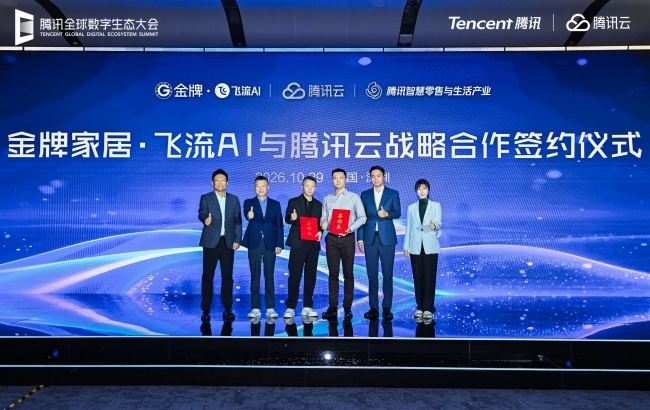
What Tencent lacks is not an AI partner, but a player that has already finished all the tedious and hard work in the home decoration sector
In Tencent's AI landscape, the "housing" sector has long been an awkward gap. Retail has transaction links, mobility has scheduling capabilities, and cultural tourism has a content ecosystem, but home decoration is different: it is a scenario that requires "someone to finish all the work" to form a closed loop.
A general large model can answer "how to match colors for the log style", but the user's next question is "then how to arrange my 89-square-meter three-bedroom apartment specifically". The next question after that is "who will make the cabinets and when will they be installed". Tencent can develop a home decoration Agent on its own, but building a vertical Agent that can output editable solutions with dimensions and connect products and installation means building a full set of industrial capabilities from scratch: house type data, supply chain, and offline installation networks. This is not what Tencent is good at.
Therefore, the conditions Tencent needs are very specific: design generation capability that can capture user intent, service links that can connect to implementation, and a business model that is already in operation. If any of the three is missing, the entry jump will only be a drainage link, not a service node that can form a closed loop.
Feiliu just meets all three conditions at the same time
First, the capability to capture user intent. The most fatal shortcoming of general AI is that the solution looks good, but the cabinet has model penetration problems, the moving line is unreasonable, and the dimensions are distorted. An Agent that cannot deliver a "constructible solution" will still break at the implementation link after capturing the user intent. The self-inspection mechanism of Feiliu AI 3.5 solves all the above problems.
Second, the capability to connect to implementation. This is the real dividing line between Feiliu and most AI home decoration products. It does not output "how much this set costs", it outputs "whether this decoration plan is reasonable", and then the back-end products and installation services push the plan to the real scene. Feiliu is not positioned as a goods distribution tool, but as a service provider for design planning and implementation.
Third, a business model that is already in operation. According to the disclosure of both parties, Feiliu has accumulated about 600,000 visits, about 40,000 monthly active users, and a service intention conversion rate of 10.81%; in the blind evaluation of designers in the first half of 2026, the selection rate of its floor plan solutions reached 66%. The significance of these figures is not that they "look good", but that they prove one thing: this set of products is being used by people, and some of the users are actually proceeding along the back-end service links. For an Agent waiting to be connected to the ecosystem, this is the minimum proof of credibility.
With all three conditions met, in Tencent's option set, Feiliu is not necessarily the "best", but one of the "very few that meet all the conditions at the same time".
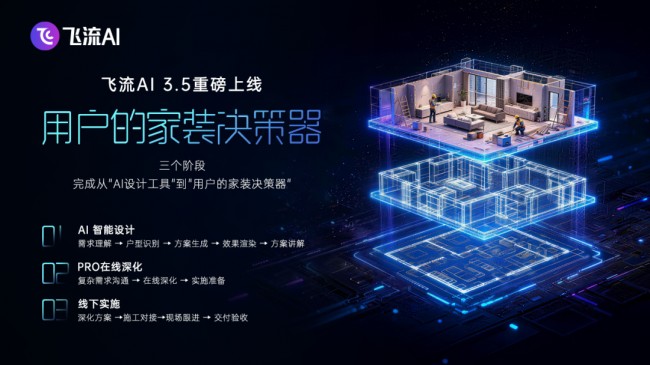
Feiliu also needs Tencent, but not because it "lacks traffic"
Looking at Feiliu's side from the opposite perspective, does it lack traffic? Partly yes, but far more than that.
In Feiliu's previous traffic structure, natural search accounted for more than 80%. This means its user growth relies on active searches from people who "already know what they want". But the larger group of people making home decoration decisions are those who gradually figure out what they need in the process of conversation. The value of Yuanbao and WeChat AI is not "giving Feiliu more search traffic", but moving the discovery scenario of home decoration intent from the "search box" forward to the "conversation".
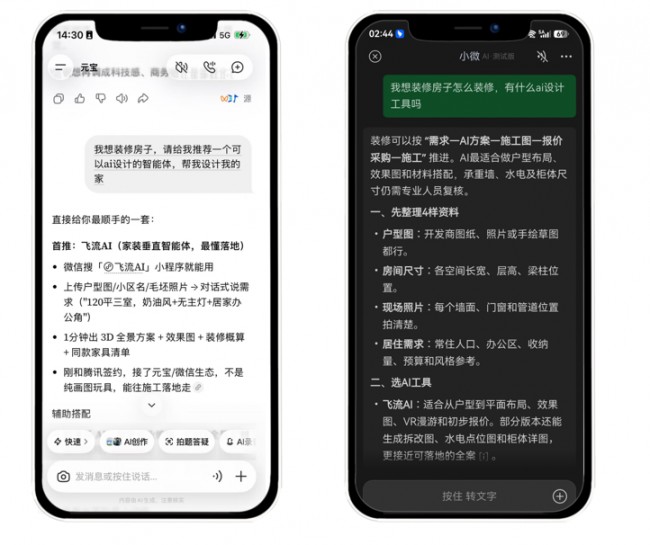
A user casually asks in WeChat "I want to renovate my old house, where should I start", this intent will not be captured by Feiliu under the traditional search logic. But under the intent recognition of conversational AI, it can be captured. This is something Feiliu cannot achieve on its own: not because it lacks capability, but because it does not have the corresponding scenario.
Jiutian 2.5 is the back-end engine of this link, but its role needs to be accurately understood
In addition to Feiliu which targets C-end users, Jiutian 2.5 is positioned as an empowerment platform for individual designer entrepreneurship. It reuses the same set of spatial computing power and user database of Feiliu, providing AI assistants, customer resource reception and implementation collaboration. According to the company's disclosure, Jiutian is expected to have more than 20,000 settled designers and store shopping guides by the end of 2026. Currently, paying users account for about 6%, which is still in the early stage of payment conversion.
Jiutian's role in this link is not "another monetization channel", but the performance buffer layer after Feiliu captures the user intent. AI completes standardized solutions, complex scenarios (families with two children, old house renovation) require designers to deepen the plan, and offline installation needs the industrial base to undertake. The climbing speed of Jiutian's payment rate is essentially the thermometer of the efficiency of this performance link.
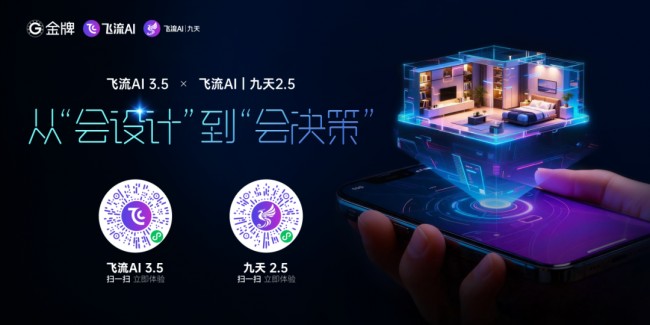
The asset attribute has changed, but there is verifiable data between "should be revalued" and "will be revalued"
Back to the capital market. Goldmedal Home currently has a market value of about 2.3 billion yuan, its attributable net profit in the first half of 2026 is -127 million yuan, and the share price revision clause of the "Gold 23 Convertible Bond" is in the condition prompting stage. This set of figures corresponds to a manufacturing valuation framework: orders, production capacity, gross profit margin.
After the signing, the asset attribute of Feiliu has indeed changed: from an "in-house technical project of the company" to an "entry asset for the home decoration scenario within the Tencent ecosystem". It is certain that the pricing logic of entry-type assets and manufacturing-type assets are not in the same coordinate system.
However, between "should be revalued" and "will be revalued", there is verifiable data. The completion rate of the link from the solution after entry jump to installation, the climbing speed of the proportion of paying designers on Jiutian, and whether there is Feiliu-related revenue split in the annual report — before these three signals land, revaluation is only a direction, not a conclusion.
Back to that question
Why Feiliu?
Because Tencent needs a vertical Agent that has already finished all the tedious and hard work, and in the home decoration track, there are not many Agent options that have design generation capability, implementation connection capability and a running business model at the same time. Because Feiliu needs to move intent discovery from search to conversation scenarios, and there are even fewer companies that own such scenarios.
This is not a cooperation of "which player the large tech company has selected". It is two parties that each have their own gaps finding each other within limited options.
As for how much value this cooperation can finally deliver, the data will give the answer. But at least at this point in time, the logic of choice of both parties is clear, and neither has a significantly better alternative. This explains why this signing happened better than any expression of "strategic synergy".
The data in this article comes from the publicly disclosed information of Goldmedal Home and the disclosure of the signing by both parties. This article does not constitute any investment advice.