Core members from the former GoerTek and Huawei teams have developed a full-color 3D assembly DIY creation platform, and successfully secured angel-series financing from investment institutions including Yuanhe Ventures and Plum Ventures | Exclusive Premiere by HardKrypton
Author | HUANG Nan
Editor | YUAN Silai
36Kr has learned that Ruilink Intelligence, a full-color 3D assembly DIY software and hardware creation platform, has recently completed two consecutive rounds of financing totaling tens of millions of yuan. The angel round was led by Yuanhe Origin, and the angel+ round was led by Plum Ventures. Professor GAO Bingqiang and his Brizan Venture fund, Linge Venture Capital, and the founder of a leading global IP enterprise participated in the follow-up investment. The funds will be mainly used for the mass production and process iteration of the first product, accelerating the construction of the content ecosystem, expanding the layout of offline channels, and achieving commercial scale growth.
Founded in 2024, Ruilink Intelligence is positioned as an assembly DIY creation platform. Through the integration of "3D laser cutting + full-color printing" technology, it connects the full chain from AI-aided design, hardware production to assembly guidance. Its first consumer-grade product Focalab X1 has completed PMF demand verification, which is expected to be launched for pre-sale in December this year and delivered in mass production in Q1 2027.
The core team members come from leading technology companies such as Goertek and Huawei, with nearly 20 years of profound experience in consumer electronics product planning, software and hardware R&D and other fields.
The consumer-grade laser engraving equipment is in a stage where rapid growth coexists with structural bottlenecks. Data from China Commerce Industry Research Institute shows that the global consumer-grade laser engraving machine market size reached about 1.2 billion U.S. dollars in 2025, and is expected to reach 1.5 billion U.S. dollars in 2026.
However, the core contradiction always points to the problem of user retention. In the past few years, the growth of consumer-grade laser engraving equipment has centered on tool attributes, with all manufacturers competing for precision, speed and stability, mainly serving the distributed customized manufacturing needs of small and medium merchants and small studios.
This hardware parameter competition is reaching the ceiling of growth, which is also a common proposition that enterprises must face: as a pure processing tool, the use scenarios of 2D plane engraving are limited, and the equipment is very likely to be idle after users complete several works; once the boot rate drops, subsequent values such as consumable repurchase, software subscription, and community activity will no longer exist. In addition, as the popularity of the track rises and a large number of players pour in, the homogeneous competition of hardware parameters intensifies, continuously compressing the profit margin.
The industry needs a new growth engine. Ruilink Intelligence judges that the next stage of laser engraving is not about tool upgrading, but about the release of creation attributes, so that the equipment can break away from the positioning of a pure processing tool and find long-term value beyond hardware.
The underlying logic of this judgment comes from the re-understanding of user needs. The Ruilink team found in market research that the proportion of assembly model enthusiasts is not lower than that of users of integrally formed models. The latter's DIY market is relatively mature, while the former is almost in a blank state.
Traditional assembly model brands sell in the form of standardized products. Users buy the schemes completed by designers and are only responsible for the assembly process. The advantage of this model is mature experience and low entry threshold, but the limitation is also obvious: users cannot participate in creation and can only choose from limited designs; personalized needs are difficult to meet, and the finished products are all the same.
Although integrally formed equipment such as 3D printing supports personalized creation, there are two pain points: first, the customized production time is long, and users cannot wait for the completion on site; second, the forming size is limited by the equipment space, making it difficult to build large-scale scenes.
"The fun of hands-on assembly originated from Lego, and the continuous growth of wooden assembly and metal assembly proves that this is a market with strong demand but insufficient supply." JIANG Xiaoliang, founder of Ruilink Intelligence, told 36Kr. This is also the differentiated path that the team finally chose: using laser cutting to achieve rapid production, using full-color printing to solve the coloring problem, using assembly methods to break through the size limit, and providing a complete creation system from creativity to physical object.
The core of this system is to allow users without modeling experience to complete the whole process from idea to finished product. Ruilink has built a DIY software and hardware creation platform from AI-aided design to assembly guidance. Users post ideas in the product community, AI assists in generating concept maps and converts them into 3D models, which are processed into cuttable part files with the help of model algorithms; then the equipment completes cutting and coloring, and users get a package of parts arranged by number, and then complete the assembly step by step with the help of video guidance.
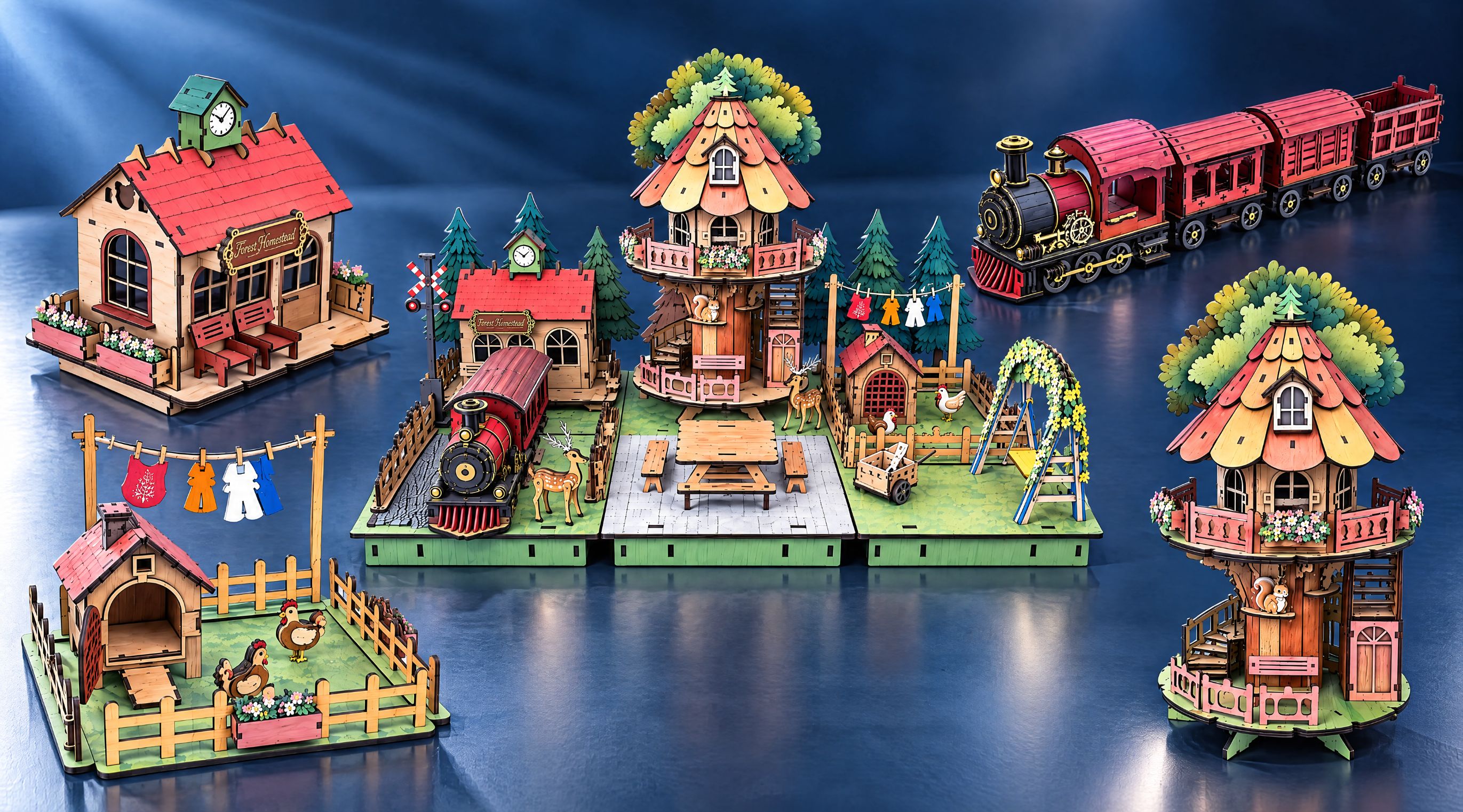
Solving the coloring problem with full-color printing (Source/Enterprise)
At the hardware level, Ruilink integrates laser cutting and full-color printing into the same device, and several pieces of wood boards can be processed in only ten minutes, supporting users to wait and pick up parts at the store; at the same time, full-color printing also provides complete color performance for the finished product, which can solve the semi-finished product feeling of single material of traditional laser parts.
"We are not trying to make a machine with higher parameters and more complex structure, but to provide a creation system that allows everyone to turn the ideas in their minds into physical objects." said JIANG Xiaoliang.
In terms of business model, different from the classic practice of hardware manufacturers selling equipment directly, Ruilink Intelligence does not take equipment sales as the core source of revenue, but builds user stickiness through the "hardware + content + community" ecosystem model.
Users can either purchase equipment to complete creation independently at home, or choose a lower-threshold store solution: no need to purchase hardware, they can go directly to offline cooperative stores to submit creative schemes, and the stores complete cutting and full-color printing processing, so users can pick up the assembly kit on site. This model is more like a shared DIY processing station in the field of physical creation: users do not need to buy processing equipment by themselves, they only need to output creativity to get a physical material package that can be assembled.
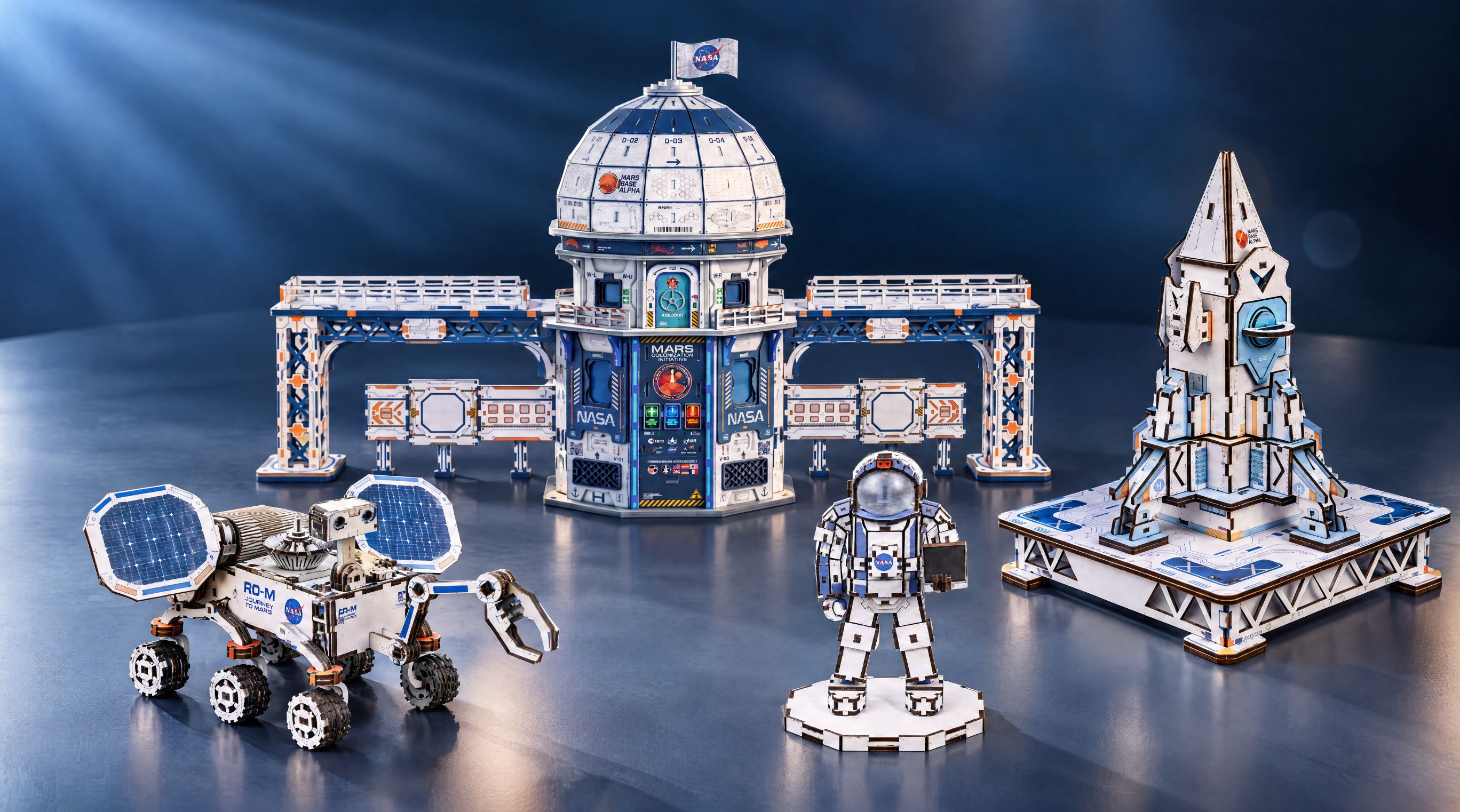
Cutting and full-color printing processing can be completed in offline stores (Source/Enterprise)
In terms of user acquisition, Ruilink Intelligence will directly target all people who have the willingness to create. The team judges that the geek group is the natural core user, who has high acceptance of new tools and is willing to actively explore the capability boundary of the equipment, but the broader market is concentrated in people who do not have creation ability but have the desire to express, such as parents who want to make exclusive toys for their children, young people who want to turn pet photos into ornaments, and fans who want to customize peripherals for idols.
"These groups have ideas and emotional demands, but lack the tools and skills to turn ideas into physical objects. The user portrait is very simple: as long as there is something in your mind that you want to realize, you are our user." said JIANG Xiaoliang, "When users can see the finished product in the store and experience the customization process, the ecological construction and conversion path of the creation platform is often much shorter than that of pure online."
The core users of traditional laser engraving equipment are SMBs and geek groups, and the usage scenarios are concentrated in distributed manufacturing and small studios. With the maturity of AI-aided design capabilities, the reduction of hardware operation thresholds, and the enrichment of content ecology, the creation attribute is opening up larger market space. Scenarios such as family entertainment, personalized gifts, IP peripherals, and parent-child interaction are expected to become new growth points.
"The future competition of DIY creation platforms does not lie in who has higher parameters, but in who can build a more complete content closed loop. Hardware is only the entry point, AI tools lower the creation threshold, content communities provide materials and inspiration, offline channels complete experience and conversion, and finally form a positive cycle of 'creation - production - sharing'." said JIANG Xiaoliang.
According to the plan, Ruilink Intelligence's first product will be launched in December this year, and sold simultaneously at home and abroad. At the same time, the company will accelerate in-depth cooperation with a number of offline channels, and gradually expand to more offline scenarios in the future.
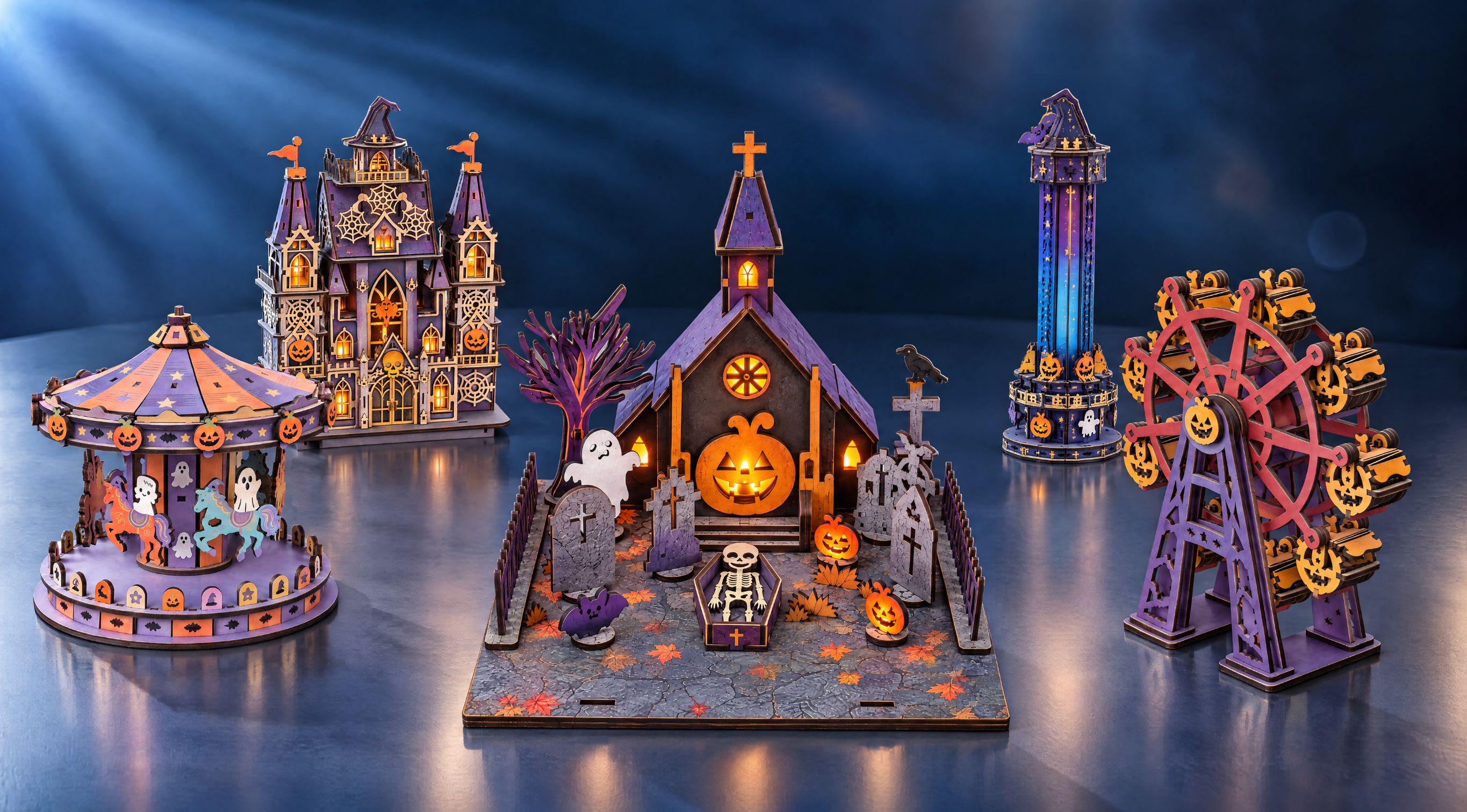
Form a positive cycle of "creation - production - sharing" (Source/Enterprise)
The following is an excerpt of the interview between 36Kr and JIANG Xiaoliang, founder of Ruilink Intelligence (slightly edited):
36Kr: Consumer-grade laser engraving equipment has grown rapidly in recent years, but user retention has always been a hidden worry in the industry. What is the judgment behind Ruilink's choice to cut into the assembly track?
JIANG Xiaoliang: The core contradiction of laser engraving equipment is not the hardware shipment volume, but the user's equipment boot rate.
This judgment comes from our observation of the industry. In the past two years, the shipment volume of consumer-grade laser engraving equipment has grown rapidly, but a widely ignored problem is that a large number of users will leave the equipment idle after completing several projects after buying it back. It is not that the equipment is not easy to use. On the contrary, the current equipment is quite mature in precision, speed and stability. The problem lies on the user side: it is very fresh at the beginning, but after trying to do several projects, users do not know what to do next.
This brings about a structural dilemma. Hardware companies obtain one-time revenue through equipment sales, but continuous value creation depends on long-term user use, including consumable repurchase, software subscription, content consumption, community activity and so on, all of which require users to maintain a certain boot frequency. Once the equipment is idle, the subsequent value chain is broken. Therefore, industry manufacturers are trying to solve this problem, with different paths: some are making AI-aided design tools to make it easier for users to generate drawings; some are optimizing automatic calibration and operation processes to lower the usage threshold. The direction is the same, to enable non-professional users to continuously generate creative motivation.
But we judge that these paths solve the problem of "operation threshold", not the problem of "creation motivation". Users are not unable to use the tool, but do not know what to do with it. Therefore, Ruilink has chosen a more underlying path, not making a "faster cutting machine", but making a "complete creation system from idea to physical object".
What users lack is not tools, but the complete chain from creativity to finished product. This chain includes three links: how to turn vague ideas into executable designs, how to make the production process fast enough, and how to make the finished product have sufficient presentation power. Combined together, they constitute a complete creation experience.
36Kr: In the consumer-grade DIY hardware industry, most people will prioritize the geek group as seed users, and then gradually penetrate into the mass market. Why did Ruilink choose to skip this path and directly target all ordinary users who have the willingness to create physical objects?
JIANG Xiaoliang: The geek group is the natural core user, but what Ruilink wants to do is not only to serve a small group of professional players, but to bring creation capabilities to more people who originally have no opportunity to express themselves.
This judgment comes from our re-stratification of user needs. The user structure of traditional laser engraving equipment is relatively single, concentrated in SMBs and geek groups, and the demand is dominated by tool efficiency. But a wider group of people have another type of demand: they do not want to "process a part", but want to "realize an idea".
These two types of demands are essentially different. The former pays attention to equipment performance parameters, while the latter pays attention to whether the creation chain is complete, whether the operation threshold is low enough, and whether the finished product has sufficient presentation power. The former is the stock market, and the latter is the incremental market.
The types of users we have come into contact with far exceed expectations. There are people in their eighties who want to make a model of the life scenes with their daughters when they were young as a souvenir; there are fan groups who want to make mini models of idols' musical instruments and peripherals for communication in the circle; there are content creators who want to turn astrophysical phenomena into three-dimensional models that ordinary people can understand. The common point of these demands is that users have clear emotional demands and creation willingness, but lack the tools and skills to turn ideas into physical objects.
Traditional laser engraving machines have too high a threshold for them, requiring them to master modeling software, understand material properties, and debug equipment parameters. Although 3D printing lowers part of the threshold, its production time is long and the forming size is limited, which cannot meet the needs of instant pickup and large-scale scene construction.
The product definition of Ruilink is developed around this group of people. Users do not need to learn professional tools, they only need to express their ideas, which can be text descriptions, reference pictures, or even a story. The system passes through AI-aided design and equipment manufacturing, and finally delivers the finished product that can be assembled. Offline stores further lower the experience threshold, users do not need to buy equipment first, and can go directly to the store for customization.
Therefore, the user portrait is not divided according to "professional level", but according to "creation willingness". As long as there is something in your mind that you want to realize, you are our user.