Tencent, which does not manufacture vehicles, has built the complete AI underlying infrastructure for automakers.
Cabin AI is stepping into an awkward transitional period.
Nearly all automakers can demonstrate the function of "ordering coffee with one sentence", but what users frequently use in daily life are still a few fixed services such as navigation and music. Large models and Agents have already been installed in vehicles, but they are far from reaching the level of "truly easy to use and continuously used".
Enterprise AI is also facing similar dilemmas. Office AI has boosted individual efficiency, but to achieve organizational efficiency improvement, it still needs to cross three barriers: scenario selection, engineering governance and ROI. Automakers have deployed a large number of agents, but few of them are truly integrated into the business processes of R&D, production, supply, marketing and service.
These two industry pain points are exactly the entry point to understand Tencent Smart Mobility's latest moves.
At the Smart Mobility Session of 2026 Tencent Global Digital Ecosystem Summit, Tencent released a series of products including the new-generation intelligent cockpit TAI agents and AI organizational efficiency solutions, trying to promote AI from product functions to practical applications.
In Tencent's view, the competition of cabin AI should shift from model capability to task completion capability. Enterprise AI should not only focus on how many agents have been deployed, but also on whether they can truly enter the business process.
Therefore, technical capability is undoubtedly important, but the key is to connect AI with real businesses, make it operate stably and generate value. This requires not only large models, but also underlying capabilities that seem unflashy but determine the landing quality, such as cloud, maps, data closed loop and service ecosystem.
01
Users need AI cockpits that can "get things done"
Over the past year, cabin AI players have focused on three major themes: large models installed in vehicles, voice assistant upgrade, and ecological applications deployed in vehicles.
The industry narrative defaults that whoever occupies the in-vehicle entrance can occupy more of users' time and form user stickiness.
However, do users need to spend a lot of time interacting with the infotainment system? Is it necessary for the infotainment system to replace mobile phones?
If we truly start from user value, the answer should be: not necessarily.
Zhong Xuedan, Vice President of Tencent Cloud and Head of Tencent Smart Mobility, believes that in the AI era, experience cannot be simply measured by the duration of use in the sense of the Internet. What really matters is what problems AI solves.
In other words, if users spend one less minute in the car, it does not mean the experience is bad. If one sentence can get one thing done, the saved time and operations are exactly the convenience brought by AI.
This is in the same line with WeChat Mini Program's product concept of "leave as soon as you finish using". Users open the mini program with demands, and can close it after the matter is settled. In the cockpit scenario, the key lies in whether AI can get things done properly.
The TAI agent launched by Tencent this time is developed around this idea, with capabilities divided into two layers.
The first layer: Yuanbao is deployed in vehicles to open up the service chain.
With capabilities such as full-duplex end-to-end speech, Yuanbao Search and Hunyuan model, the infotainment system has more room for imagination in understanding user needs, handling complex problems and conducting natural interactions. At the same time, TAI cockpit assistant, TAI travel service agent and TAI content entertainment agent further extend these capabilities to specific in-vehicle scenarios.
For example, when users state their travel preferences, AI can recommend food, entertainment and sightseeing spots along the route, and adjust the itinerary according to the demands. After the arrangement is confirmed, the TAI travel service agent can also connect to hotel booking, ticket purchase, and even call restaurants via AI to reserve seats, helping users complete a series of operations from planning to booking.
You can see that the model provides understanding capability, the agent is responsible for task execution, and the service ecosystem undertakes specific demands. The smoother the connection between links, the fewer operations users need to do manually.
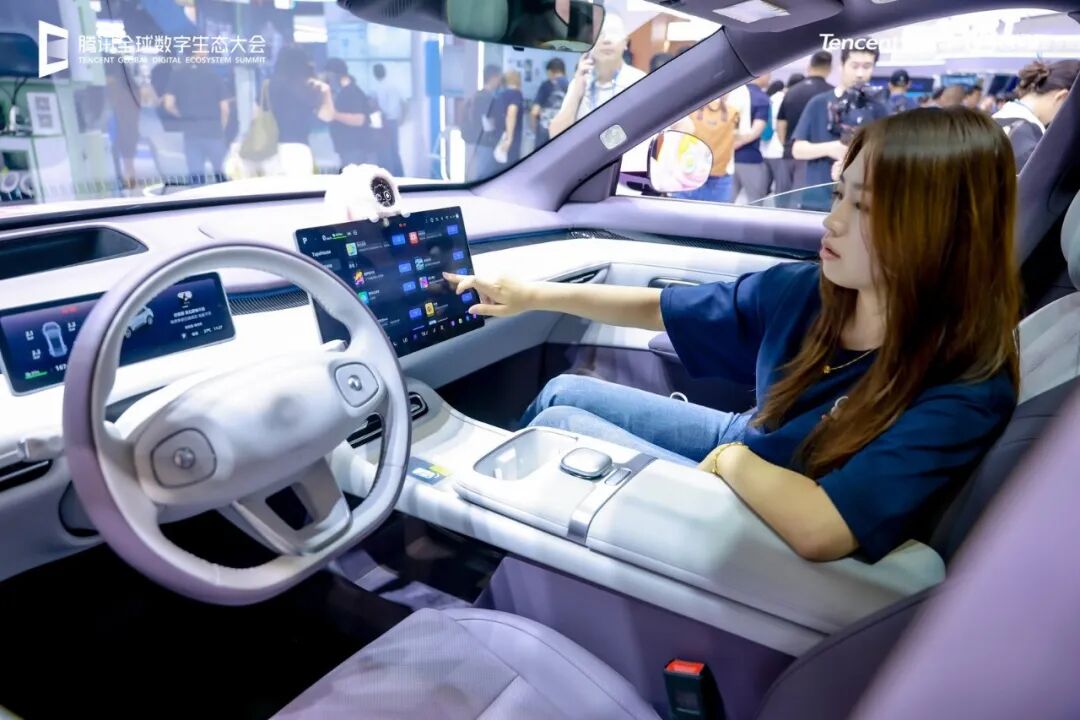
The second layer: linkage with WeChat Xiaowei to ensure uninterrupted services inside and outside the vehicle.
Another easily overlooked problem of travel services is that user demands run through the entire trip, not limited to the inside of the vehicle.
For example, before departure, users need to check routes and make travel strategies; during driving, they need navigation and services along the way; after arriving at the destination, they may need to find restaurants and visit scenic spots. If users have to re-open the application and describe their demands repeatedly at each link, the whole experience is still fragmented.
Therefore, the infotainment system and mobile phone should not be a zero-sum game. Tencent believes that the two will still coexist for a quite long period.
The infotainment system and mobile phone have their own applicable scenarios, and the key is to make the services on both sides connect smoothly. This is exactly the significance of the linkage between mobile-side Xiaowei, WeChat Mini Programs and vehicle-side Yuanbao.
Users plan their trips on the mobile phone before departure. After getting in the car, the routes and arrangements can be synchronized to the vehicle end; after arriving at the destination, services such as restaurant ordering and scenic spot tour guide can be connected back to the mobile phone. From pre-trip planning to in-vehicle navigation, and then to destination services, all links of travel are connected seamlessly.
Behind this, there are not only Tencent's large model and data service support, but also Tencent Maps' route planning and location services, as well as ecological resources such as catering and hotels connected by WeChat Mini Programs, and WeChat Pay that connects the transaction links. The seemingly simple cross-terminal connection actually relies on the collaboration of cloud, map, data and service ecosystem, which is also the advantage of Tencent accumulated over a long period of time.
Tencent has indeed spotted a key value of AI cockpit, that is, it is not necessary to let users spend more time on the infotainment system, but to let AI integrate into the travel process naturally and respond to demands when needed.
After all, no one will specifically look for the large model in the car to chat, but if you can order coffee conveniently when you are in a hurry, do not need to search for the payment page when parking, and can continue to check the itinerary after getting off the car, AI will naturally become a part of daily travel more easily.
02
The landing of AI in organizations is more difficult than imagined
Automakers hope that AI in the car is anthropomorphic and smart enough, but their own internal R&D, production and management processes may not be ready to work collaboratively with AI.
The AI in the car needs to understand users, and the AI inside the automaker also needs to understand the business.
The former needs to cross the threshold from "understanding the instruction" to "getting things done", while the latter needs to cross the gap from "making a Demo" to "stable implementation". This threshold is also very difficult to cross.
Although individual efficiency improvement has made many employees taste the benefits of AI, the fact that individuals use it smoothly does not mean that enterprises can rely on AI to improve the overall business.
The most direct problem is that there is always a gap between DEMO and the real production process. In the demonstration environment, agents can often complete tasks quickly, but once entering the real business, they will encounter problems such as incomplete knowledge, unstable data quality, complex system interfaces, and difficulty in covering abnormal situations.
What's more tricky is that many problems do not lie in the model itself.
First of all, the business demands may not be clarified, and the AI project chooses the wrong scenario from the very beginning. If the goal is not clear, no matter how strong the model capability is, it may only run the original process faster without improving the final result.
Secondly, data, knowledge and business processes are isolated from each other. Enterprises have accumulated a large amount of business experience, but it is scattered in different departments and systems.
A new Chinese automaker mentioned in the roundtable forum that although each department has established its own knowledge system, it is still very difficult to connect the knowledge at the group level, do a good job in authority management, and let knowledge circulate at the bottom of technology and products. There is also a lack of mature solutions in the market that can be directly applied.
Organizational mechanism is also a threshold. For example, the organization and management methods remain in the traditional digital era, which is easy to take detours in the construction of digital platforms. In addition, the model iterates too fast, and engineering investment and risk governance cannot keep up.
The superposition of these problems means that after AI goes deep into the business, what automakers need is not just more tools, but also a set of system mechanisms that can continuously discover demands, organize collaboration, precipitate experience and control risks.
Tencent tries to promote this matter from three levels: tools, platforms and business co-creation.
WorkBuddy and CodeBuddy are oriented to individual employee efficiency improvement, helping employees complete tasks quickly and explore use cases; the enterprise agent platform is oriented to business processes that require long-term operation and multi-person collaboration.
The former makes it easier for employees to use AI, while the latter undertakes verified Skills and Agents, so that effective experience can be reused by other teams, and manages task scheduling, resources and security through platform mechanisms.
These two layers of capabilities cannot be confused. Only providing tools for employees may improve the efficiency of a group of people respectively, but still leave old problems such as repeated development and system fragmentation. Only by precipitating the verified capabilities can individual exploration become an asset that the organization can use continuously.
But the platform is not a panacea. Unclear business demands and unqualified data quality will still make agents run into walls in the real environment.
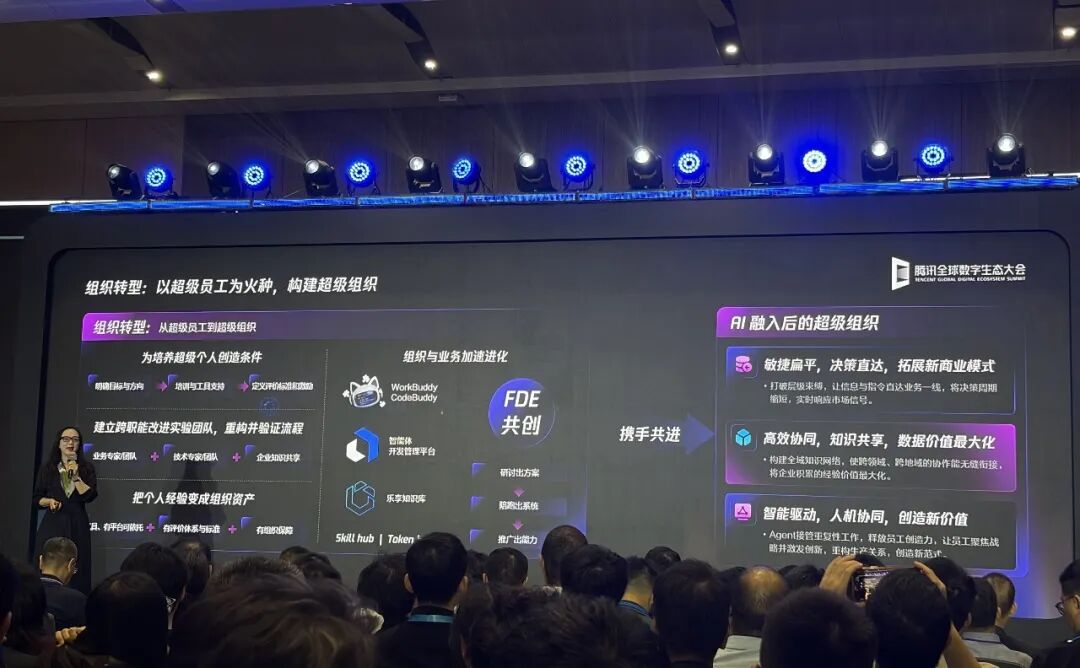
Therefore, Tencent also goes deep into the business site through the FDE mechanism, working with technical personnel, business consultants and automaker teams to identify high-value scenarios, clarify data conditions, human-machine collaboration boundaries, risk control and evaluation indicators, and then promote the application from Demo to real business. The "Rocket Class" co-creation carried out by Tencent and Changan Automobile is the practice of this idea.
Tencent is also exploring the application of agents in scenarios such as vehicle model planning, R&D data analysis, production and marketing collaboration, and dynamic marketing. It is reported that the vehicle model planning assistant of a certain automaker group has shortened the data analysis cycle from weekly to hourly, and the efficiency of generating research reports has increased by 95%.
Such data still needs to be viewed in combination with specific tasks and statistical calibers, but it at least shows that AI has begun to enter business links with clear goals and evaluation methods, instead of only staying in the technical demonstration links.
03
Tencent does not make cars,
Why does it take over all AI-related work for automakers?
C-end users perceive changes on AI cockpit and intelligent driving products, while B-end automakers see AI efficiency improvement at the organizational level. But Tencent's presence is far more than these two explicit fields. Under the iceberg, Tencent's entire AI capability has been feeding back the productivity evolution of the automotive industry.
It is worth mentioning that AI is an extension of Tencent's existing capabilities, not a ticket for it to re-enter the market.
In 2017, Tencent began to enter the automotive industry. In the early stage, focusing on cloud computing, maps and other capabilities, it served automakers' data processing and intelligent driving R&D;
In 2018, Tencent put forward the concept of "intelligent co-pilot" for the cockpit, and TAI has been continuously iterated afterwards, gradually evolving from the initial cockpit solution to a service system centered on agents.
According to Tencent, it has served more than 100 automakers and mobility technology companies so far, and its cockpit solutions have been mass-produced and deployed in Changan, NIO, Leapmotor and other automakers, with a total installed volume of more than 20 million units.
These accumulations have begun to release new value in the AI era. As Tencent's capabilities of models, agents and engineering are continuously upgraded, its automotive business is also expanding synchronously. Tencent no longer focuses on a single product, but digs in depth vertically and extends horizontally along the automotive industry chain.
From the vertical perspective, it continues to go deep along the technical chain of automotive intelligence.
In addition to intelligent cockpit solutions, in the field of intelligent driving, Tencent Cloud continues to provide capabilities such as computing power, data processing, model training and simulation back injection to help automakers improve R&D efficiency. As Chinese automakers accelerate their overseas expansion, Tencent extends its cloud infrastructure, intelligent driving maps and cross-border data compliance capabilities to overseas markets.
From the horizontal perspective, it extends from in-vehicle products to automaker organizations, and then to more intelligent scenarios.
Tools such as WorkBuddy and CodeBuddy help automaker employees improve their personal efficiency, and the enterprise agent platform tries to precipitate effective experience into reusable organizational capabilities.
At the same time, Tencent also extends its capabilities to embodied intelligence and Robotaxi: the former reuses the experience of computing power, model and data closed loop in the field of intelligent driving to explore scenarios such as automobile factories, warehousing and logistics; the latter combines cloud, maps and travel ecosystem to help Robotaxi enterprises promote commercial operation.
From inside the vehicle to outside the vehicle, from R&D to marketing, and then to new intelligent scenarios, Tencent is expanding the scope of businesses it can participate in.
But the vertical and horizontal lines are not parallel, their intersection still returns to the cloud and AI base, data closed loop, as well as the content and service ecosystem accumulated by Tencent for a long time. Tencent combines these capabilities to solve the problems of the entire business chain.
But this is also the boundary of Tencent's cooperation with automakers.
Zhong Xiangping, Vice President of Tencent Group and President of Tencent Smart Mobility, emphasized at the summit that automakers are responsible for making good cars, and Tencent is responsible for enabling AI to be used and achieve better results.
In other words, Tencent adheres to the principle of not making cars, and does not need to make R&D decisions or define vehicle products for automakers. What it wants to do is to lower the threshold for automakers to apply digital and AI technologies, so that AI can truly play a role.
Just like in the past, when automakers chose cloud service providers, they needed to weigh the investment in self-built infrastructure, the speed of global deployment, system maintenance and compliance costs.
Entering the AI era, such trade-offs have not disappeared, and have even become more complex. Automakers need to consider the computing power requirements of model training and reasoning, the engineering deployment and security management of enterprise agents, and the infrastructure and data compliance requirements of overseas businesses in different markets.
Self-construction is no longer an absolute path leading to Rome. It represents higher costs, unnecessary pitfalls and detours.
Under the background of fully embracing AI, automakers should think more calmly about which links can be completed through external cooperation to produce effects quickly and continuously.
Perhaps, concentrating resources on vehicle products, core technologies and user experience, and handing over some general but complex digital capabilities to mature partners is a more ideal choice.
AI will not automatically turn into productivity after entering the automotive industry. The tough battle in the next stage for automakers is not about who uses AI earlier, but about who can truly embed it into products and businesses, and establish capabilities for sustainable iteration.