A brain-computer interface company from Hangzhou has raised 1 billion yuan in financing.
Brain-computer interface remains a red-hot track.
According to Investment Circle AI, Hangzhou Nuoxinjia Electronic Technology Co., Ltd. (hereinafter referred to as Nuoxinjia) announced the completion of a RMB 500 million Series C+ financing, with a star-studded investor lineup —
Led by Gaorong Ventures, the financing round was joined by PICC Equity, Monolith Lisi Capital, Xianfa Emerging Investment, Oriental Richful Capital, Danhe Capital, Hangzhou Industrial Investment Group, while existing shareholders including Legend Capital and well-known industrial investment institutions made over-subscribed follow-on investments. Qifeng Capital acted as the exclusive financial advisor for this financing round.
This marks the second round of financing for Nuoxinjia within the year, bringing the company's total accumulated financing size to RMB 1 billion.
"I have been in this industry for 20 years, and it is not until today that I have truly ushered in the explosive period of the brain-computer interface industry." Dr. Yang Jiawei, founder and CEO of Nuoxinjia, once remarked at the 2026 Investment Circle SuperLink Conference. While brain-computer interfaces can cure neurological diseases, they have also inadvertently opened a new era of human evolution.
Decoding Nuoxinjia
Let's start with three clinical cases.
Lingling (pseudonym), who has been blind for nearly 20 years, received a retinal visual brain-computer interface embedded with 320 electrical stimulation channels implanted in her fundus in May this year. The day after the device was turned on, without being informed of the shape of the letters in advance, she independently identified complex letters such as H and R.
According to conventional experience, for patients who have been blind for such a long time, the visual cortex area of the brain may have been partially taken over by other sensory functions, and usually 3 to 6 months of strict visual rehabilitation training is required to establish the ability to recognize basic letters; in previous experiments by overseas teams, patients often need to be informed of the target letters in advance, and go through long-term feedback training to gradually get the hang of it.
Over the following two months, Lingling completed highly difficult actions such as writing "China", grabbing a water cup, walking along the white line on the ground and making turns.
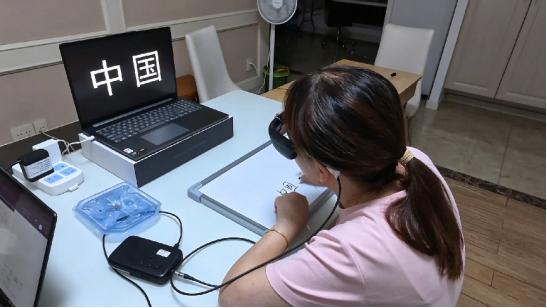
Lingling wrote the characters for "China"
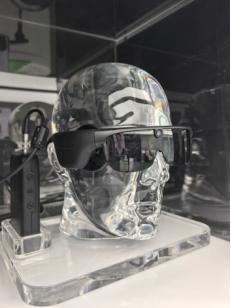
The external device of Nuoxinjia visual brain-computer interface
Three months later in Wuhan, 60-year-old Qiu Hua (pseudonym) received the world's first high-resolution semi-invasive retinal brain-computer interface implantation, which does not penetrate the eyeball and is minimally invasive and reversible. After 4 years of darkness, Qiu Hua recognized the numbers in front of him one by one, wrote Chinese characters and letters, grabbed objects and completed independent walking after the device was turned on.
In October this year, 66-year-old Aunt Li (pseudonym), who has been blind for 8 years, underwent the country's first subchoroidal implantation of retinal pathway visual brain-computer interface surgery in the macular area. She went from only retaining faint light perception to drawing numbers and Chinese characters, and finally completed the walking test independently without the support of her family members.
All three brain-computer interface clinical trials on patients come from Nuoxinjia.
Judging from the completed clinical cases, the first subject could identify complex letters the day after the device was turned on, and achieved writing, grabbing and directional walking within two months. This rehabilitation speed far exceeds the international conventional level, and also allows Nuoxinjia to deliver "China speed" in terms of the speed and quality of visual reconstruction.
Investors have also flocked to the company.
Gaorong Ventures starts from market demand: About 2.2 billion people worldwide suffer from varying degrees of visual impairment, of whom at least 43 million are completely blind. Visual reconstruction brain-computer interfaces break through the limitations of traditional medicine and bring unprecedented hope to these patients. "In this ultimate cross-field of neuroscience, chip manufacturing and biomedical engineering, Nuoxinjia has not only broken through the technical barriers of high-density artificial retina, but also built a solid infrastructure of underlying core components."
Xianfa Emerging Investment believes that the brain-computer interface industry is currently at a critical node from early R&D verification to demonstrating clinical value, and visual reconstruction is one of the directions with high clinical rigid demand and extremely urgent patient needs.
Oriental Richful Capital holds a more straightforward judgment: Brain-computer interface is the most certain future industry track during the 15th Five-Year Plan period, and visual reconstruction is the direction with the most rigid clinical demand and the clearest commercialization path. Nuoxinjia is one of the very few enterprises in China that fully masters chip design, high-density electrodes, airtight packaging and visual codec algorithms in-house. "This full-stack self-developed capability is exactly the watershed for invasive brain-computer interfaces to move towards mass production."
GF Xinde, as an existing shareholder, stated that Nuoxinjia has taken a globally rare path by adopting a two-line parallel strategy for retina and visual cortex, and full-stack self-development from core chips to intelligent algorithms, turning the "China Clinical Moment" from a vision into reality.
Globally Rare, Tackling Visual Brain-Computer Interface
Well-known VCs Gather
Nuoxinjia started with a very long-term goal that even seemed almost "science fiction" at the time: to help blind patients regain visual perception with domestically produced visual brain-computer interfaces.
Dr. Yang Jiawei, the founder, has long been engaged in neuroengineering research at the Centre for Neuroengineering at the University of Melbourne, the birthplace of cochlear implant technology. He was exposed to cutting-edge research related to visual reconstruction very early, and clearly saw the reality of the industry: global high-resolution visual brain-computer solutions are mostly controlled by overseas teams, similar products are expensive, and there are almost no local players in China laying out this track.
In 2014, Yang Jiawei returned to China and founded Nuoxinjia. Different from many brain-computer companies that prioritize non-invasive, consumer-grade solutions, Nuoxinjia has been anchored in implantable medical-grade visual reconstruction from the first day, making it the earliest science and innovation enterprise in China to deeply cultivate the field of visual function reconstruction brain-computer interfaces.
Looking around the world, most visual brain-computer interface companies only bet on one route: Science Corporation's PRIMA is the retinal pathway, and Neuralink's Blindsight is the visual cortex pathway. It is already not easy to get one of the two routes through.
Nuoxinjia chose to advance on both tracks at the same time — it innovatively laid out a complete solution with parallel retinal pathway E-BCI and visual cortex pathway V-BCI, providing the possibility of visual reconstruction for different types of blind patients.
Yang Jiawei once explained the difference between the two pipelines at the 2026 Investment Circle SuperLink Conference: The retinal pathway E-BCI is to place the implant on the retina, and transmit nerve signals to the cerebral cortex through the optic nerve pathway, which requires the patient's optic nerve pathway to be intact; the visual cortex pathway V-BCI directly places the electrode array on the primary visual cortex. The advantage of this technology is that it can bypass the optic nerve, and it is mainly for patients with optic nerve defect or atrophy, but the risk is relatively higher.
What supports the simultaneous advancement of the two tracks is a shared full-stack self-developed technical system. Since 2014, Nuoxinjia has built a full-stack self-developed system covering core chips, precision electrodes, MEMS processes, packaging technologies, intelligent algorithms and system integration, overcome a number of core "stuck neck" technologies, and built a leading domestic and even global visual brain-computer technology R&D and industrialization platform, laying a solid technical foundation for product clinical transformation and long-term iteration.
At present, Nuoxinjia's 320-channel retinal visual brain-computer interface E-BCI has officially entered the GCP standardized clinical trial stage, and it is one of the few enterprises in China that has achieved substantial breakthroughs in human clinical practice of invasive visual brain-computer interfaces. At the same time, the 1280-channel visual cortex brain-computer interface product is in the R&D stage, and clinical verification is planned. From "seeing" to "seeing clearly", the next leap in resolution has already begun.
A Global Competition
The Endpoint Is Not Just "Seeing"
Visual reconstruction is regarded as the "jewel in the crown" in the field of brain-computer interfaces, and a global competition has long kicked off.
On the other side of the ocean, Neuralink's visual reconstruction product Blindsight has obtained the FDA's "Breakthrough Medical Device" designation, and is planned to be implanted in human bodies in 2026; Science Corporation's retinal product PRIMA has been approved for commercial use in Europe with clinical data published in the New England Journal of Medicine. Behind this is the huge unmet demand of about 2.2 billion people with visual impairment worldwide, of whom 43 million are completely blind.
In China, brain-computer interfaces have been incorporated into the national strategy. The speed at which Nuoxinjia is advancing has added a Chinese coordinate to this global competition.
But Nuoxinjia's goal is not limited to allowing patients to "see" light spots or letters.
The further destination is that vision can be "software-defined". When visual signals no longer come from the eyeball, but from cameras and algorithms, the boundary of "seeing" will be rewritten: the number of electrical stimulation channels can continue to double from 60 to 320 and 1280, and the resolution will increase accordingly; neural coding can evolve from 256 levels of grayscale to richer colors; cameras can zoom in, achieve night vision, superimpose navigation and text information, and vision will become a sense that humans can "upgrade".
This is destined to be a long journey. According to Yang Jiawei's division, the evolution of brain-computer interfaces will roughly go through three stages: the current stage is in the core medical breakthrough period, and the closed-loop implementation will be completed first among patients with severe paralysis, blindness and aphasia; the next stage will move to pan-medical and consumer applications; in the longer term, it will realize deep carbon-silicon integration to achieve cognitive enhancement and sensory sharing. Visual reconstruction is exactly the first verified anchor point on this long path.
With the development of technology, visual reconstruction will continue to expand the boundary of human perception. Every time the number of channels doubles and every generation of coding algorithm iterates, Nuoxinjia takes one more step on the road of visual reconstruction. A cyber world that benefits all of humanity is right in front of us.
This article is from the WeChat official account "Investment Circle AI", written by Zhou Jiali, published with authorization from 36Kr.