The iPhone Duo is still taking flak, while the foldable phone market has already reshuffled its rankings.
Controversies have emerged one after another right after the iPhone Duo went on sale.
On October 16, the iPhone Duo opened for pre-order. This foldable phone, priced starting at 15,999 yuan and weighing 254 grams, has become one of Apple's most high-profile new products. The first batch of supplies was very tight, and on the same night, the estimated delivery time for some orders on Apple's official website was scheduled for January 2027.
After the official release on October 23, users at home and abroad have successively reported abnormalities such as cracks and bright lines on the inner screen near the hinge. Apple later responded that a small number of devices have inner screen problems and provided replacement channels, but has not yet announced the specific cause of the failure and the number of affected units.
The functional differences between the Chinese mainland version and the US version have also raised doubts about "cutting corners". Some teardown videos pointed out that the Chinese mainland version lacks the satellite communication module, 6GHz Wi-Fi antenna and 25W wireless charging circuit, and netizens estimate the price difference is between 800 and 1000 yuan. However, the Apple official website indicates that the Chinese mainland version is still equipped with the second-generation Ultra Wideband technology chip, and UWB has not been removed; the differences in satellite communication, 6GHz Wi-Fi and wireless charging power mainly come from the regulatory restrictions on domestic communication, radio and frequency management. On November 2, Apple technicians responded that there is no situation where the materials and quality of the Chinese mainland version are worse, but the specific details of component differences will not be disclosed for the time being.
The software experience is also uneven. Digital enthusiast Frok told "Dingjiao One" that only a few apps such as Taobao and Xiaohongshu have completed adaptation; most mainstream applications have not been fully adapted, and problems such as black borders and stretching will still occur after unfolding the inner screen.
After the first batch of users received their phones one after another, the channel price also dropped rapidly. At the end of October, the premium of some versions on resale platforms had dropped to several hundred yuan, and the price in some channels was even lower than the official pricing.
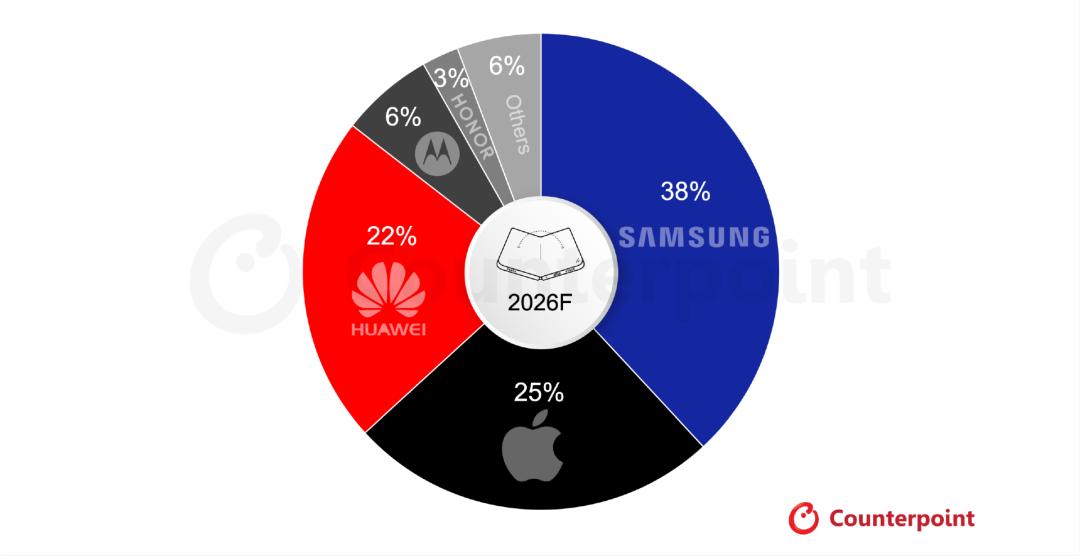
However, institutions still give high expectations for the shipment prospects of this new product. On October 28, TrendForce predicted that the Duo will ship about 5 million units in 2026, accounting for about a quarter of the global foldable phone shipments. Earlier, Counterpoint also gave a forecast of a maximum of about 6 million units, with a market share of about 25%.
Foldable phones have entered their eighth year, with continuous improvements in hinges, screens and overall weight, but their proportion in global smartphones is still only about 2%. How many users can Apple bring into this market? Why is a new product with a higher price and many compromises still favored?
01. 15999 yuan, is the Duo easy to use?
"When unfolding the Duo, the large screen and nano-texture make you feel that Apple has put a lot of thought into the screen. But after closing it, the heavy weight, relatively wide body, and the volume keys moved to the top will directly affect daily holding and use." Frok said.
In his opinion, the most notable improvement of the Duo is first of all the screen aspect ratio.
Some early foldable phones are like stuffing two devices into one body, with one usage pattern for the outer screen and another after unfolding. Apps work normally on the outer screen, but may only be magnified on the inner screen, or even leave black borders.
Duo's approach is to make the outer screen, inner screen, and the left and right areas after split-screen maintain a similar display ratio (close to the √2:1 ratio of A4 paper), and then move some status and interactive buttons to the side. "It seems that only the layout has been changed, but in reality it eliminates the need for re-adaptation when switching between the inner and outer screens." Developer Kyle said that developers can reuse more layout rules to reduce extra processing when switching between inner and outer screens, but they still need to adjust the interface for different sizes and usage states.
Apple is not the first manufacturer to adopt a wide-aspect-ratio foldable screen. The Huawei Pura X Max and Xiaomi 18 Fold have already made the inner screen close to √2:1, while the Samsung Galaxy Z Fold8 has chosen a 4:3 inner screen and a 10:16 outer screen. All manufacturers are exploring solutions that are easy to operate when closed, and suitable for reading and split-screen use when unfolded. What is worth observing about the Duo is whether Apple can better coordinate screen design, system interaction and application layout.
The effect is already visible in some applications. Apps such as Xiaohongshu and Feishu can use the two-column display, with the feed stream and comment area, list and details each occupying one side. Reading and video can also make fuller use of the inner screen area. "After the layout is sorted out, page jumps are reduced, and multi-tasking is more convenient." Frok said.
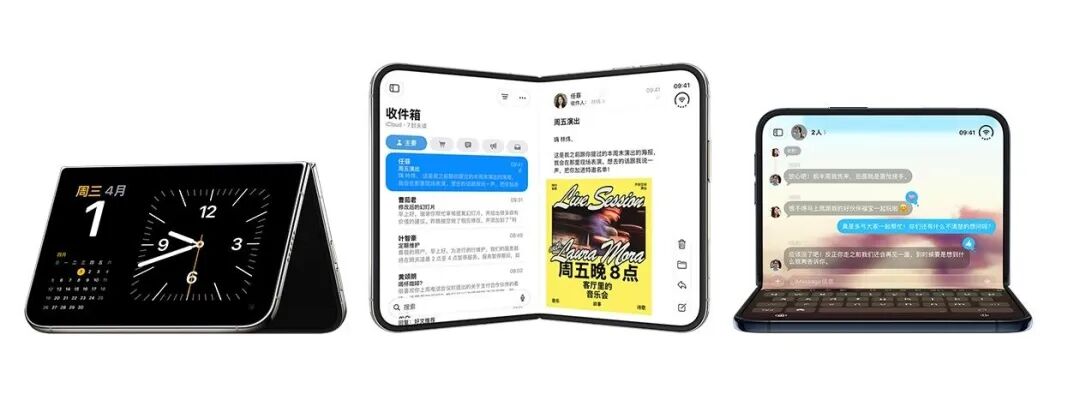
Image source / Apple official website
However, there are not enough apps that have completed adaptation for the Duo at present. Some applications can only be displayed, and some still have problems such as black borders, interface overlap and direction recognition errors.
Apart from software, the Duo has also adjusted the inner screen and the overall structure of the device. Apple added a nano-texture surface layer to the inner screen to reduce the visual presence of reflections and creases; a layer of UTG ultra-thin glass is covered on the top and bottom of the panel, and a titanium metal support plate is placed at the bottom to withstand repeated bending and keep the screen flat after unfolding. The whole device supports IP68 dustproof and waterproof.
These designs also have drawbacks. The nano-texture will make dark pictures appear gray under side light, losing part of the color and clarity, and fingerprints, sweat and cosmetic residues are also relatively difficult to clean.
As a mobile phone for daily use, the Duo still has many compromises.
It weighs 254 grams, which is heavier than some similar products (the Samsung Galaxy Z Fold8 is 201 grams). It is wide and thick after closing, making it difficult to hold with one hand; to save thickness and internal space, it removed FaceID and uses side TouchID instead, there is no independent telephoto lens, and the under-screen camera on the inner screen is only sufficient for video calls, with average selfie quality.
In terms of performance and battery life, the Duo uses the same generation of chip as the Pro models of the same period, with similar CPU performance, but it cannot perform well in scenarios that consume more GPU such as games and graphics processing; heat on both sides of the body is not easy to conduct, and obvious local overheating can be felt after holding for a long time. The battery life is sufficient when the outer screen is used a lot, but power consumption rises significantly once the inner screen utilization rate is high.
At the end of the day, many of the Duo's hardware designs are still solving the problems brought by the folding structure, while making compromises in weight, performance, imaging and battery life. For users who are used to the Pro series, adding an inner screen also means accepting these changes.
Durability and maintenance costs will also affect whether users are comfortable using the device. Apple has confirmed that a small number of Duo units have inner screen problems and provided replacement channels, but the specific cause of the failure and the number of affected units have not been announced. Without purchasing AppleCare+, the estimated out-of-warranty service fee for inner screen damage is 7998 yuan, which is close to half of the starting price.
The Duo has demonstrated the value of some large-screen scenarios, but these experiences have not yet covered enough commonly used applications. For those who plan to use it as their only primary phone, weight, adaptation progress, durability and maintenance costs are still thresholds.
02. Why can Apple rank second as soon as it enters the market?
The Duo has exposed these problems, but why do institutions still favor Apple? The most direct reason is Apple's existing user base.
According to TrendForce's forecast, the global foldable phone shipments in 2026 will be about 20.2 million units. If the forecast of 5 million units shipped by Apple is realized, it is enough to change the manufacturer ranking of this market.
The first-year shipments rely more on the user base and supply, while subsequent retention and repurchase depend on whether the inner screen is truly easy to use. Kyle said that for developers, foldable screens require additional processing of screen aspect ratio, inner and outer screen switching and split-screen interaction, and the size differences of different models increase the testing and maintenance costs. When the user scale is limited, it is difficult for small and medium-sized teams to give deep adaptation high priority. The core reason why the market is optimistic about Apple is its appeal to the developer ecosystem.
An engineer working on front-end development at a large manufacturer summarized to "Dingjiao One": when there are few foldable screen users, developers' willingness to carry out deep adaptation is low; if the application experience cannot keep up, consumers' motivation to change phones will not be strong, making it more difficult to expand the user scale. In the software segment, developers' investment and user growth restrict each other.
The Android ecosystem has been promoting large-screen adaptation.
Google continues to improve the system's split-screen, multi-tasking and compatibility mechanisms. Domestic manufacturers such as Xiaomi, OPPO, vivo and Honor incentivize developers through industry specifications, store tags and recommendation resources.
Samsung and Huawei have made faster progress. 94% of the top 200 commonly used apps in Samsung's app store have been adapted for the Galaxy Z Fold8, and more than 100 key apps have exclusive wide-screen UIs. On Huawei's side, more than a dozen PC-level apps on the tri-fold Mate XT 2 have completed deep adaptation, and the official also reduces adaptation costs through development guides, simulators and cloud debugging.

Image source / Huawei official website
But Kyle, taking some of Samsung's applications as an example, said that being usable after adaptation does not mean the layout is reasonable enough, and problems such as stretching still exist.
"Apple may be able to accelerate the change of this situation." Kyle believes.
On the one hand, the first-generation Duo has a single screen aspect ratio; for applications that use standard system components and already support size changes, Apple also provides the ability to automatically adjust the layout. These conditions help reduce adaptation work.
On the other hand, Apple's existing high-end user base and shipment expectations help developers judge the possible returns brought by adaptation.
On October 5, Apple released a developer announcement, stating that starting from April 2027, apps and games submitted must provide Duo screenshots. If developers want to continue updating their apps, they must first complete the adaptation.
Kyle said, Apple is more likely to speed up basic compatibility first, and whether it can form a truly easy-to-use large-screen experience still depends on the deep adaptation of key applications.
03. After Apple enters the market, Honor, Xiaomi and other brands are in the most dangerous position
Before Apple entered the market, the global foldable phone market was mainly dominated by Samsung and Huawei. Counterpoint data shows that in 2025, the two accounted for about 40% and 30% of the market share respectively, totaling 70%.
After the Duo was launched, Apple directly squeezed into the top tier. According to Counterpoint's full-year forecast released in September, the market shares of Samsung, Apple and Huawei in 2026 will be 38%, 25% and 22% respectively.
Compared with 2025: Samsung still maintains its leading position, with its share dropping by only about 2 percentage points; Apple directly ranks second; Huawei's predicted share has declined, decreasing by about 8 percentage points. The space left for other manufacturers has dropped from about 30% to about 15%.
The Duo targets existing Apple users who originally planned to buy the ProMax, and a part of high-end Android users who are still hesitating.
The competition between Samsung and Duo is the most direct. Both target the global high-end market and are book-style large foldables, so consumers are likely to compare them together under similar budgets. A person from a manufacturer focusing on foldable phones said, Samsung has accumulated generations of products and a more complete foldable product line, and is still the object Apple needs to catch up with in the short term.
The pre-order performance of Samsung's new generation products is also very strong. According to Samsung's disclosure, the combined first-round pre-orders of Galaxy Z Fold8, Fold8 Ultra and Flip8 in South Korea reached 1.44 million units, setting a new pre-order record for Galaxy phones, of which Fold8 accounts for about 70%. In Europe, the sales of the Z8 series increased by 20% compared with the previous generation (Flip7 and Fold7).
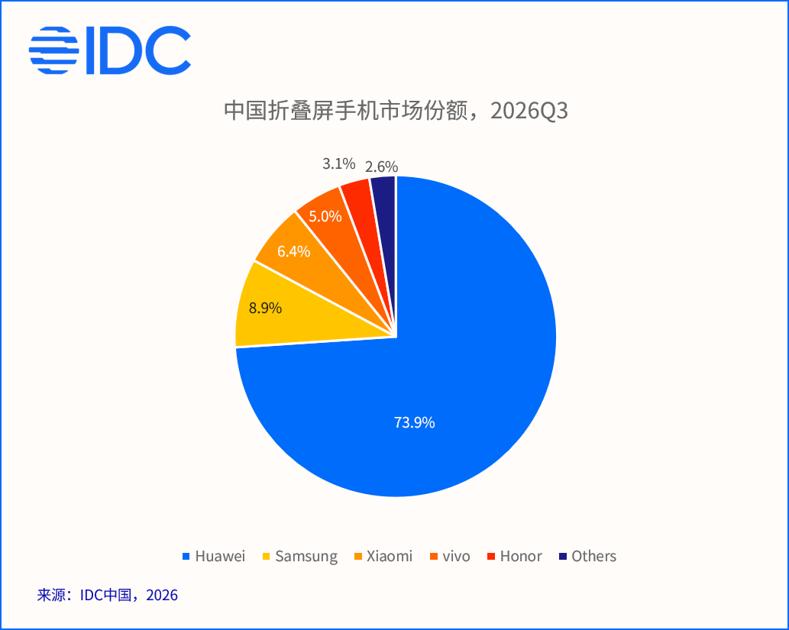
What Huawei needs to pay attention to is the changes in the Chinese market, especially the flow of Apple's high-end users. IDC data shows that in the third quarter of 2026, Huawei accounted for 73.9% of China's foldable phone shipments, with a clear leading advantage.
In the past, if some iPhone users wanted to experience foldable phones, they could only switch to other brands, and Huawei was the most competitive choice among them. The above-mentioned person from the manufacturer said that after the Duo was launched, these users can stay in the iOS ecosystem, and Huawei thus lost an opportunity to attract Apple users to switch ecosystems. This mainly affects Huawei's ability to win cross-brand high-end users.
More than one interviewee mentioned that after Apple enters the market, the second-tier players outside Samsung, Huawei and Apple, including Motorola, Honor, OPPO, vivo and Xiaomi, are under the greatest pressure.
In the July forecast, Motorola's share dropped by 4 percentage points.
This squeeze is more obvious in the Chinese market. In the third quarter of 2026, the second place in China's foldable phone market was Samsung (8.9% share), which together with Huawei accounted for about 83% of the market; Xiaomi, vivo and Honor accounted for 6%, 5% and 3% respectively. IDC predicts that the size of China's foldable phone market in 2026 will only be 7.33 million units, down 26.7% year-on-year. The market is shrinking, and the share that the second-tier players can get in the future may be even smaller.
The pressure on these manufacturers is not only on market share, but also on product rhythm, resource input and pricing.
"The most critical point is how much return can be obtained by continuing to invest in foldable phones." The above-mentioned person from the manufacturer said that foldable phones are inherently demanding in R&D, testing and after-sales services. The smaller the shipment scale, the harder it is to dilute these costs. After Apple enters the market, market attention will further concentrate on leading brands. Other manufacturers need to present clearer differentiation in terms of weight, imaging, price or specific application experience.
This competition takes place at a stage when mobile phone costs are rising. IDC data shows that China's smartphone shipments in the third quarter of 2026