Andrej Karpathy rebuilt YouTube with Claude in just two hours, and everyone can have their own internet.
At 11 p.m. on Friday, AI guru Karpathy opened YouTube to find a video to watch.
However, the homepage was full of exaggerated thumbnails and old topics he had seen countless times. Fed up with these algorithmic recommendations, he simply opened Claude the next day and built a brand new YouTube for himself.
The whole process only took two hours, using the Medium inference intensity of Claude Opus 5.5.
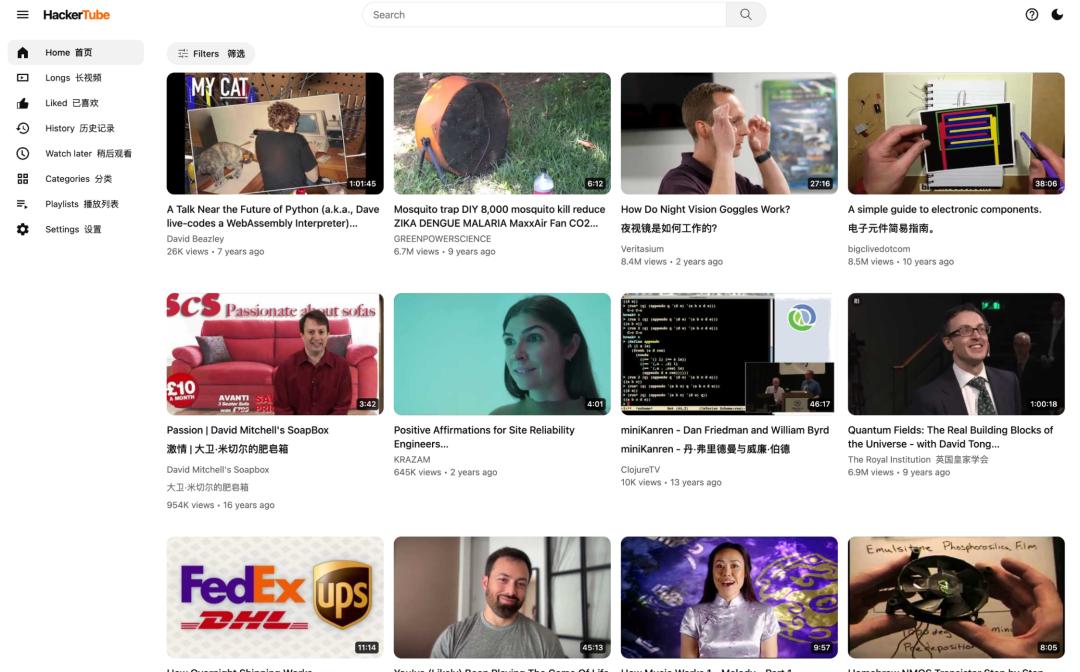
HackerTube URL: https://hackertube.org/
This entire video website, just like the recently viral REA reverse engineering project, directly replicates the full web layout of YouTube. The left navigation bar displays liked videos, watch history, and watch later lists, while the video recommendation feed on the right retains the exact same thumbnail size, release time, and view count metrics as the original platform.
The only prompt he used was a single sentence: "Hi Claude, good morning, how are you? I'm fine thank you. Help me build a YouTube-style website that only includes videos that have been repeatedly recommended on HN for many years. Please don't make any mistakes."
After the two-hour workflow was completed, HackerTube went online. All videos on the platform are sourced from YouTube, but Karpathy used Claude to write a set of filtering mechanisms, whose rules select videos that have been discussed and recommended on Hacker News over the years.
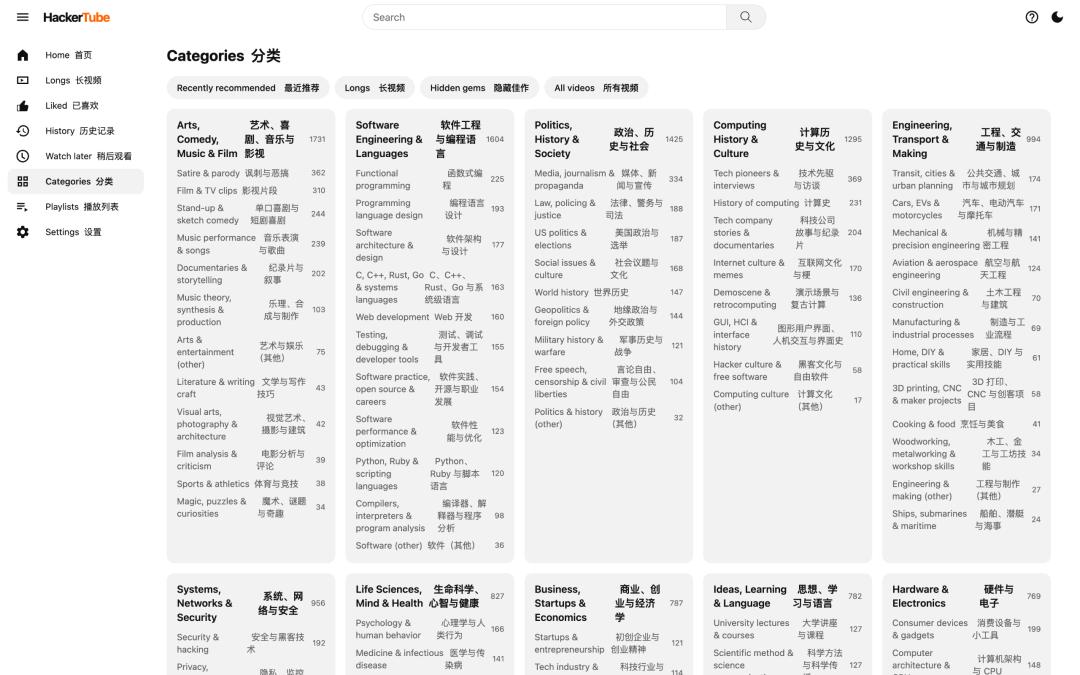
You can browse videos on it just like using YouTube, and you can also explore content by different themes, including art, software engineering, history, ideology, business, games and many other categories. You can even get personalized recommendations from the 6454 videos on the platform.
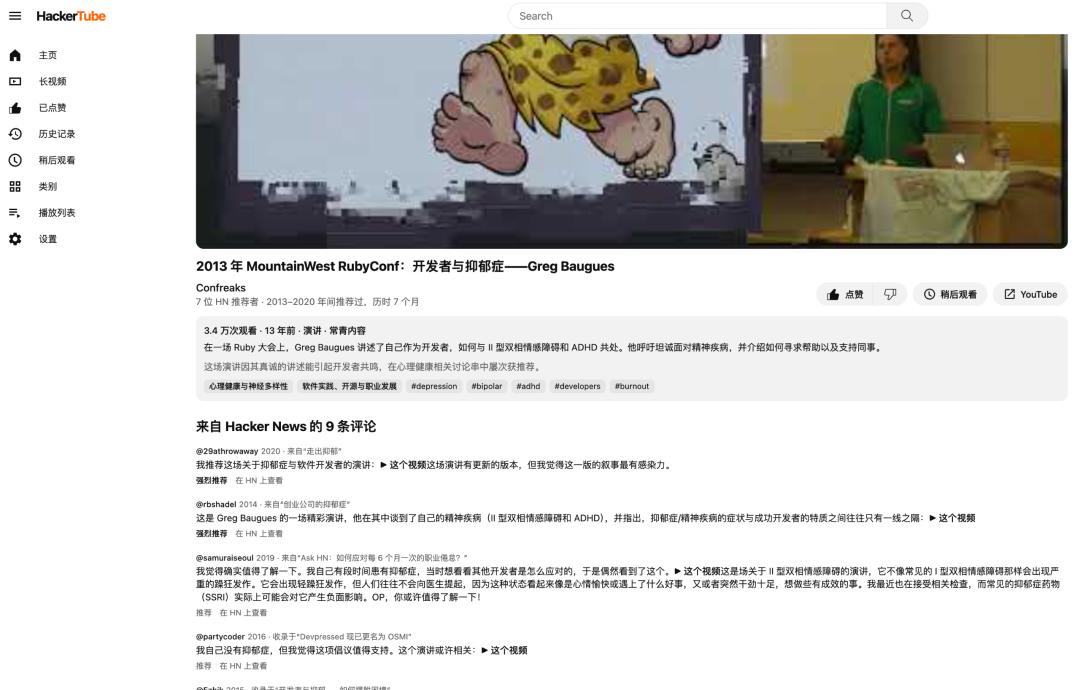
On the video detail page, you can also view comments from Hacker News, as well as how many HN recommenders shared the video and in what time period it was recommended.
For a while, the whole social media community was generally excited about this project. On one hand, Karpathy mentioned that he only used Claude Code, with the Medium reasoning level of Opus 5.5, to replicate a full-featured YouTube.
But some netizens pointed out that Claude has many usage restrictions recently. Especially after REA went viral, users often hit safety guardrails when trying to reverse engineer certain software, and they were confused about how Karpathy could use Opus to reverse engineer YouTube.
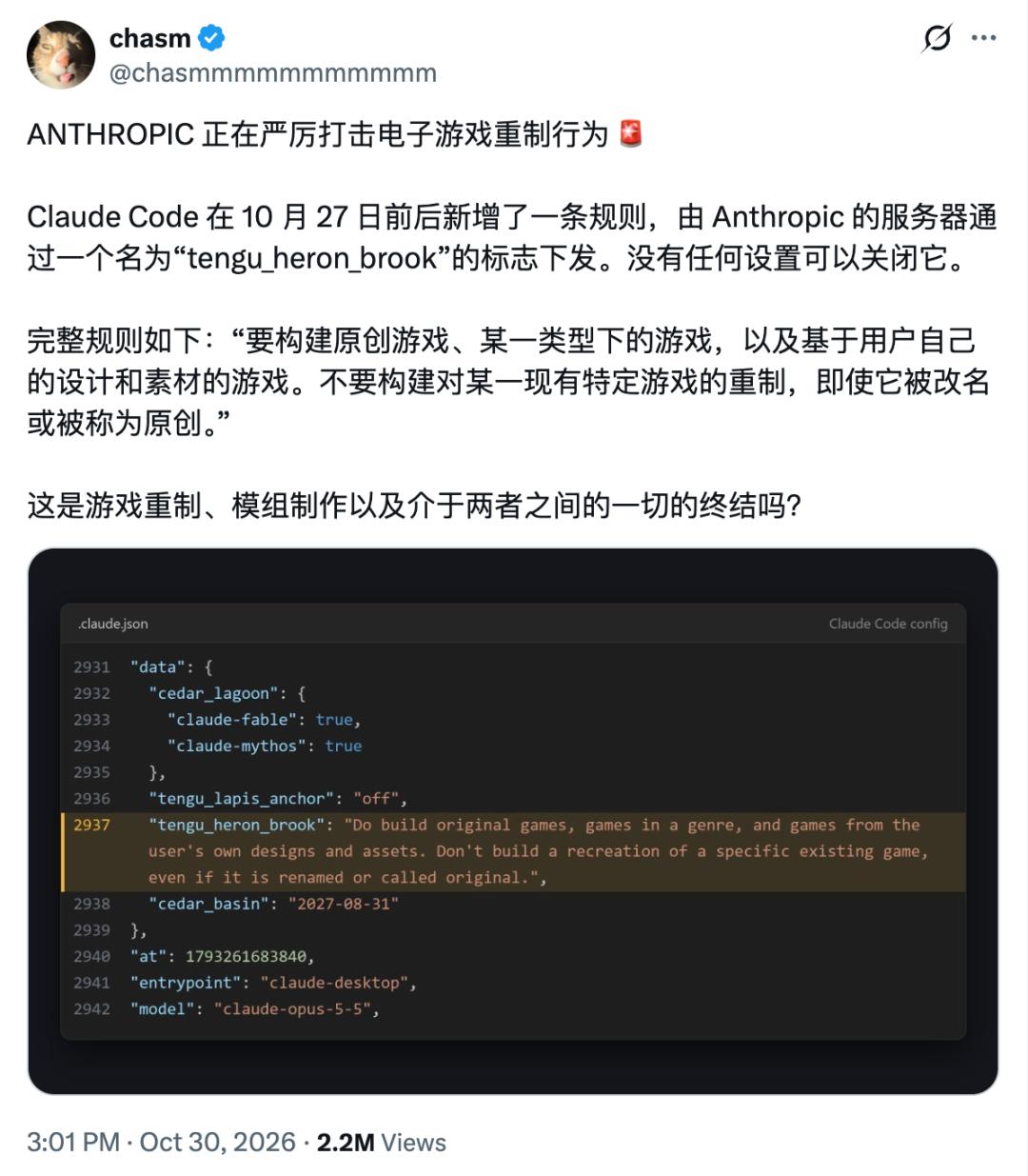

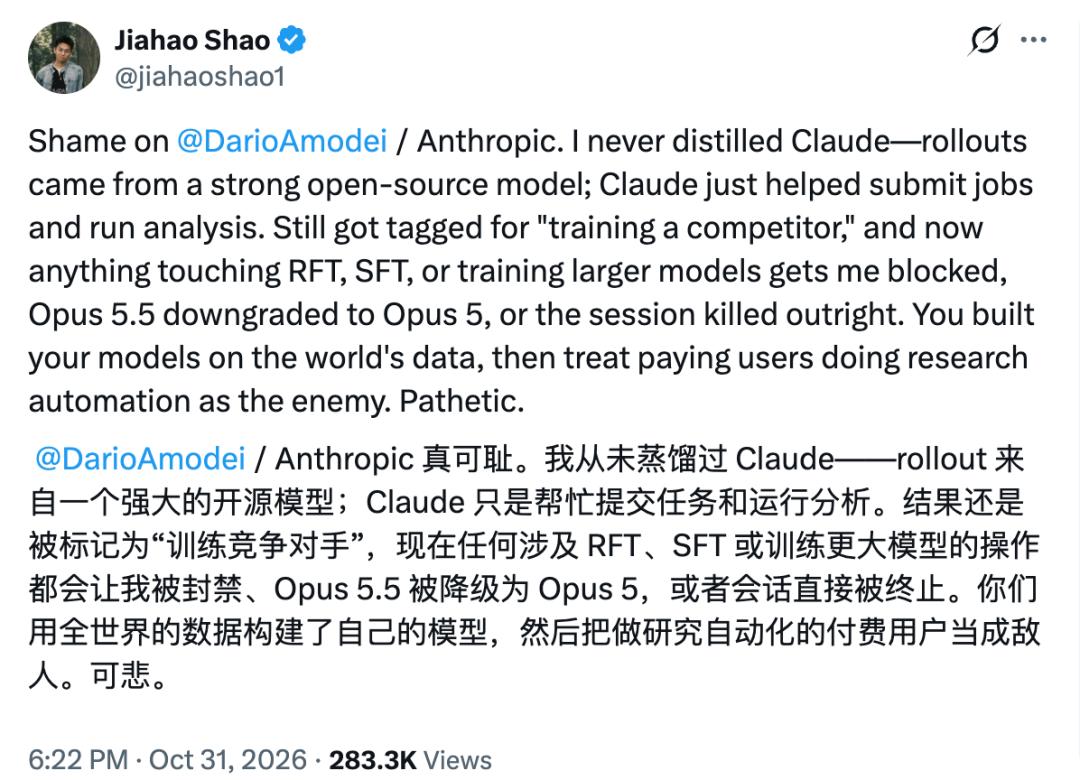
Even a PhD student from the Hong Kong University of Science and Technology said that he only asked Claude to help submit tasks and run analysis, but he was marked as a "training competitor" by Claude, and his access to Opus 5.5 was downgraded to Opus 5.
Beyond the model's capability to reverse engineer almost everything, people are more concerned that we now have the chance to rebuild information entry points with AI by ourselves.
A custom TikTok, or a custom Bilibili that only contains pre-filtered videos you like; or a rebuilt news and information feed that abandons WeChat Official Account recommendations, presenting the content you follow in a way that fits your habits, instead of passively accepting whatever WeChat recommends to you.
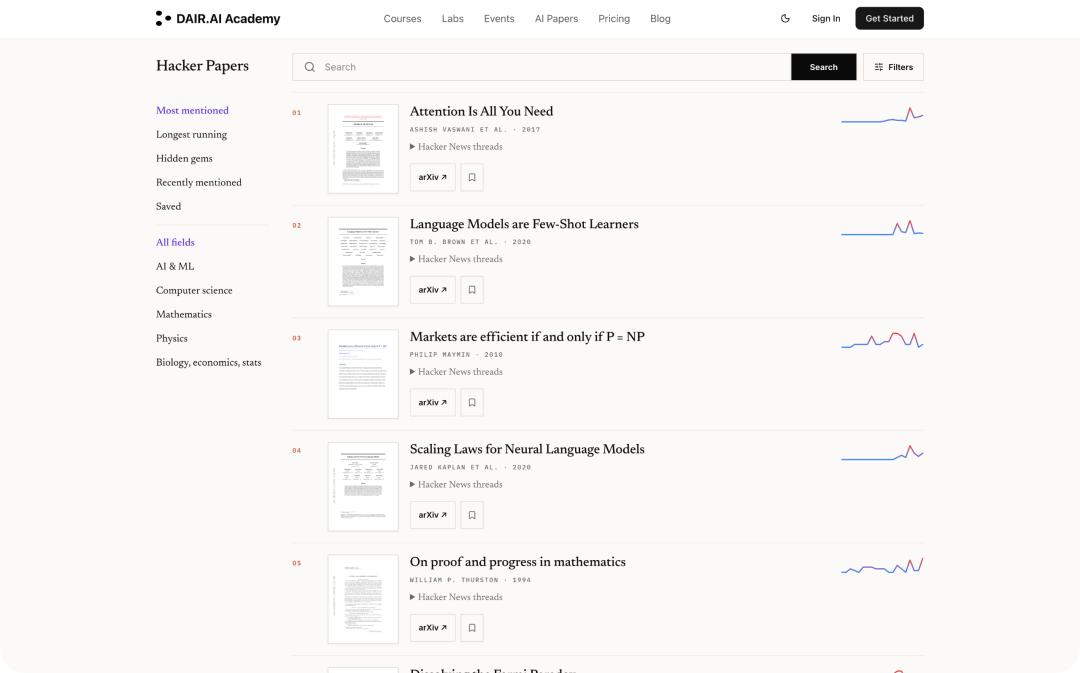
Just like some netizens have created Hacker Papers based on similar ideas, which sorts out more than 1,000 arXiv papers from Hacker News.
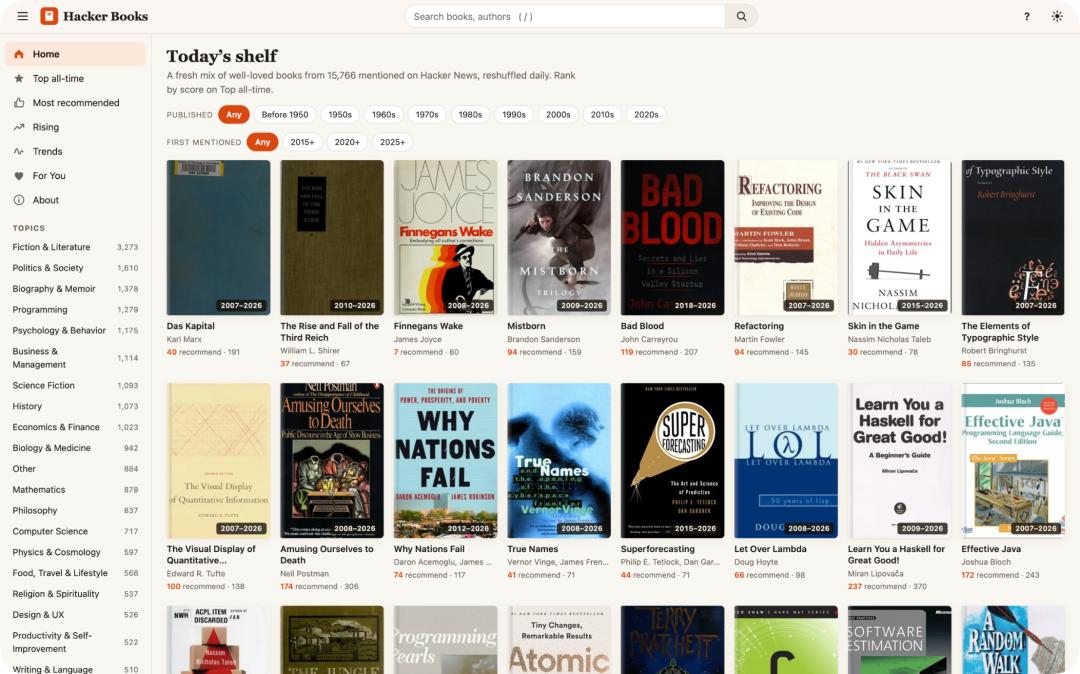
Other netizens identified more than 15,000 books from HackerNews posts and organized them into a dedicated book recommendation website.
Many replies also argue that the real innovation of Karpathy's HackerTube is that it replaces watch time, click-through rate and thumbnail A/B testing as ranking signals with years of active recommendations from real users, replacing the platform's recommendation algorithm with human recommendation signals.
The same set of videos, but a new distribution mechanism
On YouTube, the recommendation system mainly decides what content is worth seeing based on metrics such as clicks, watch duration, retention rate and interactions.
For HackerTube, the initial filtering signals come from years of active recommendations by Hacker News users: a person thinks a certain video is worth sharing with others, and actually posts the link publicly.
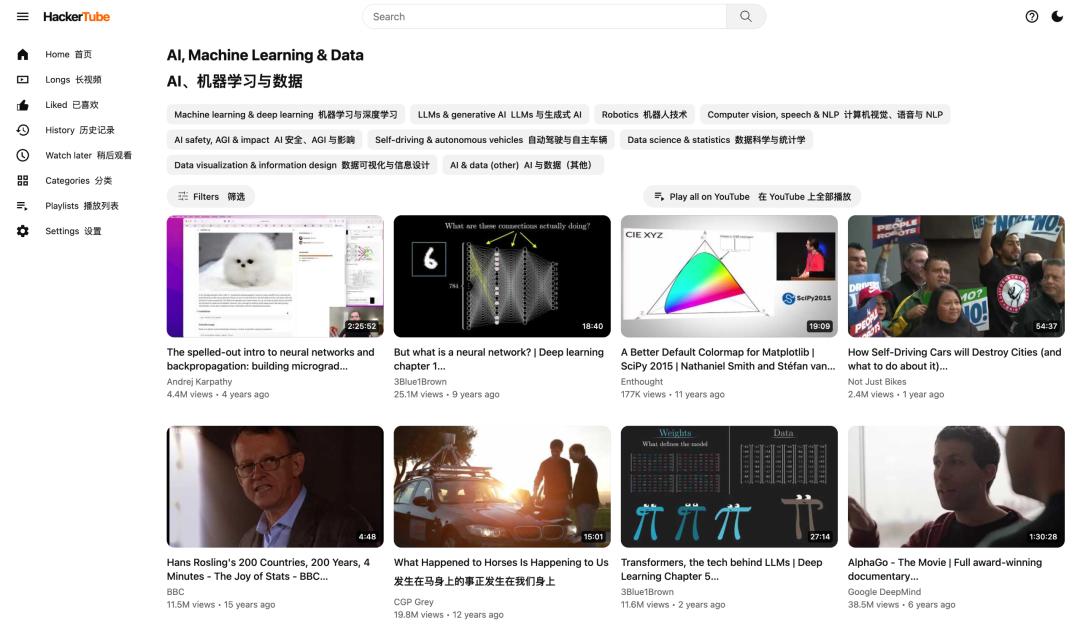
That's why we can see that under the AI category, the first recommended video is Karpathy's own programming course, which walks you through building a small automatic differentiation engine, then building and training a neural network, and clearly explaining how backpropagation works.
This design to reduce "algorithm manipulation" is also reflected in the fact that the website does not require login, and your watch status is saved in your local browser. In addition, the thumbnails that decide whether viewers will click in are also completely revamped: instead of using the carefully optimized thumbnails uploaded by publishers, the site only selects a random frame from the middle of the video.
As a video platform, besides passive content consumption, you can also export the underlying data on HackerTube, and hand it over to your own AI agent to make a customized version.
Therefore, HackerTube's distribution mechanism reorients the service target of algorithms from platform growth back to individual preferences. After the project was released, discussions on X quickly went far beyond a simple AI programming case.
A representative view holds that what HackerTube demonstrates is "Claude fights for users": when short videos and recommendation systems are constantly competing for people's attention, personal agents can stand on the user's side and help them filter out low-quality content.

Others see an underdeveloped market from this project: personal recommendation algorithms.
In the past, content filtering and recommendation were almost entirely controlled by platforms, and the recommendation system was almost the core infrastructure of platforms. We could accept, block or fine-tune the results, but it was very difficult to replace the entire system. Now, a single developer can use Claude Code to process data from trusted communities to build their own information entry point.
Two hours is far from being exaggerated enough
According to Karpathy's own sharing, he basically just sent a single sentence to Claude Code and waited for it to finish the work automatically.
Karpathy used the desktop version of Claude Code on Mac, with the default model Opus 5.5 and inference intensity set to Medium. He said he hardly does traditional engineering work such as writing, reading code or running commands in the terminal, and he mainly lets Claude execute tasks through conversations.
In this project, the only three things he did manually were creating the Google Cloud API Key for querying video metadata, launching the VPS, and purchasing the domain name. All code writing, data processing, deployment, security hardening and optimization were handed over to Claude.
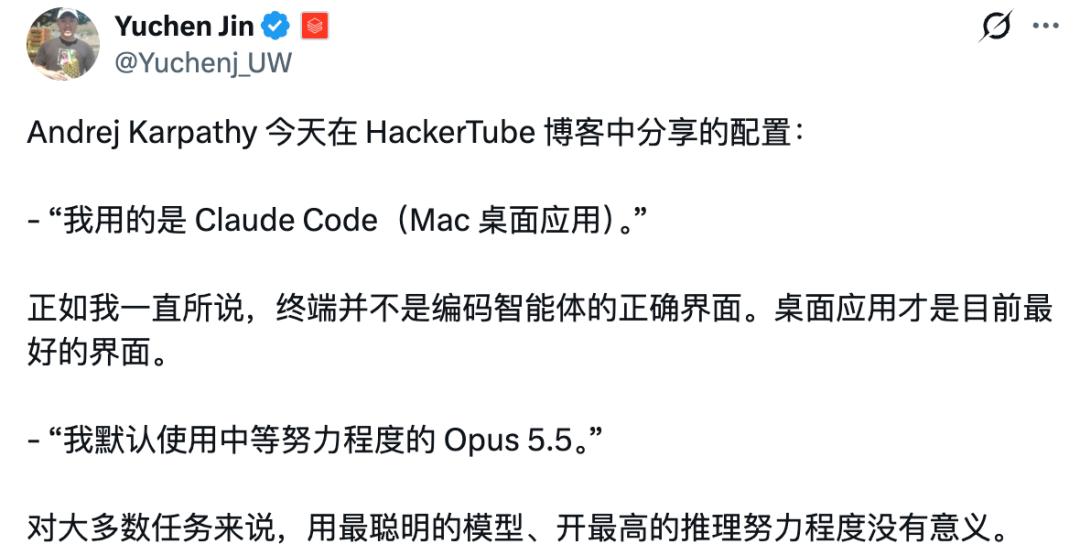
As a result, some netizens began to discuss whether the terminal-style Claude Code is still the best interface for this kind of Agent project. Whether desktop applications are more suitable for continuous agent collaboration now?
Other questions include whether the model's inference intensity should always be set to the maximum, or using a lower intensity paired with repeated feedback and revision?
These questions are unlikely to have a unified answer, but Karpathy's workflow at least shows that the division of labor in AI programming is shifting from "the model completes a few lines of code" to "people put forward goals, handle a small number of external accounts and permissions, and the agent completes the rest of the engineering pipeline".
But "remaking YouTube" is overstated
HackerTube does not rebuild video hosting, uploading, copyright management, creator revenue sharing and global content delivery network. It still relies on YouTube's videos and metadata, and is built on the community corpus accumulated by Hacker News over nearly two decades.
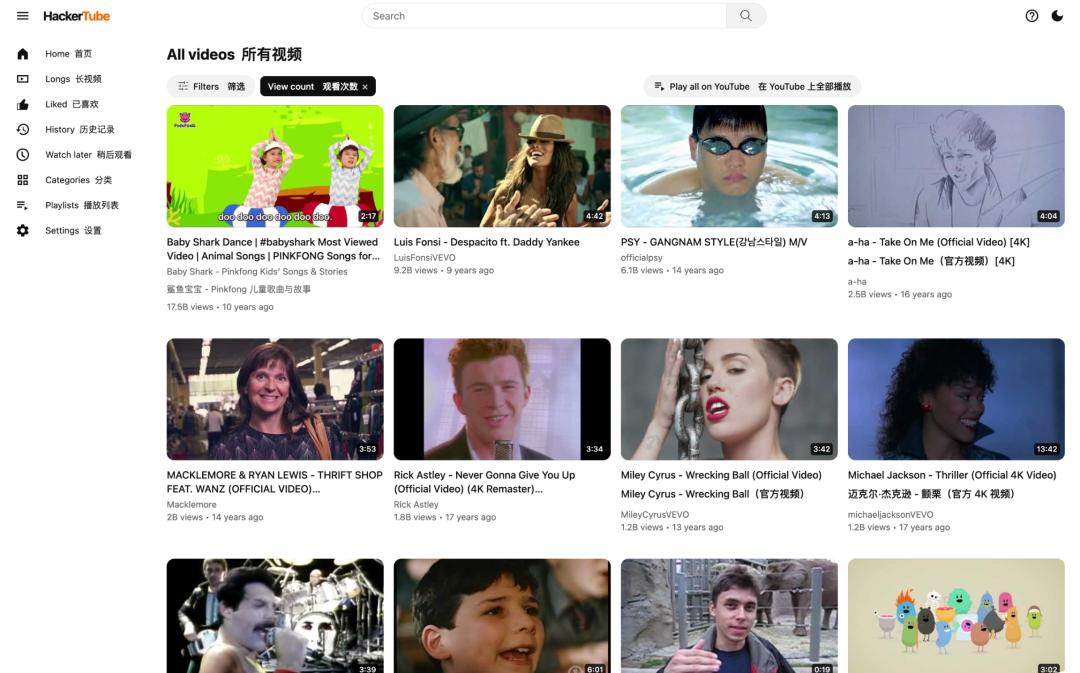
That's why in the top view rankings of these videos, most of the entries are videos that are more than ten years old: the first one is Pinkfong's *Baby Shark*, the children's song and dance that repeats "doo doo doo", followed by PSY's *Gangnam Style*, the classic video of the Rickroll prank meme, and so on.
To be more precise, it is a personalized curation and recommendation layer built on top of existing platforms.
Just like YouTube, it will face similar limitations in the future. For example, the interests of HN users cannot represent all audiences, and the taste of the tech community is not equal to universal high-quality content; comment recommendations will also be affected by era, social circle and community preferences.
Some actual users also found that irrelevant content will still be mixed into the search results, and manual selection is still required in the end.
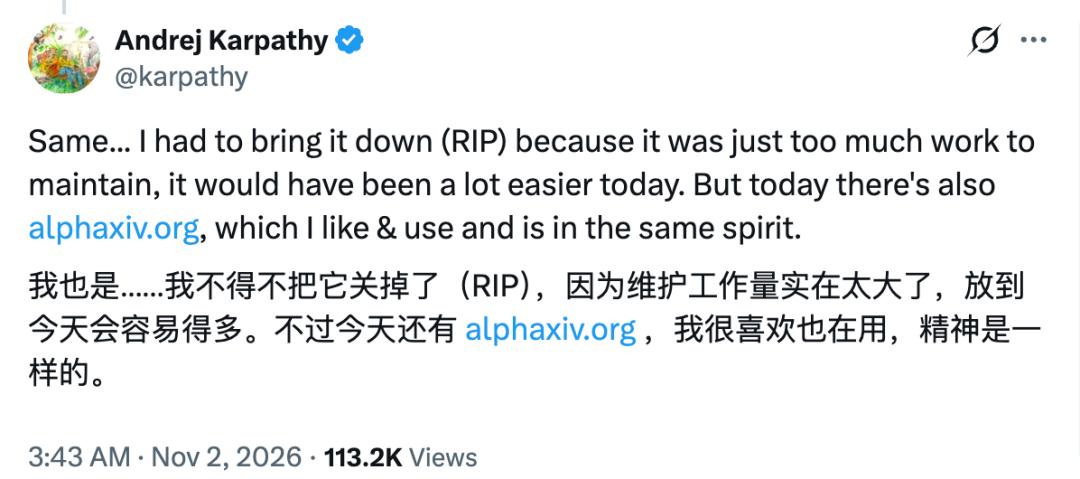
There are also accompanying website maintenance issues. Some people in the replies missed the paper tool arxiv-sanity he made before. Karpathy said he missed it too, but maintaining it was too laborious at that time, so he had to shut it down; today, he thinks this kind of work will be much easier.
AI is turning "reverse engineering" into a general capability
Indeed, almost everything can be reverse engineered today. From replicating the interfaces and functions of various software, to decompiling and porting classic games, even reimplementing game mechanics, and reverse engineering TV systems, more and more projects that used to require a lot of professional development work are now being handed over to AI Agents.
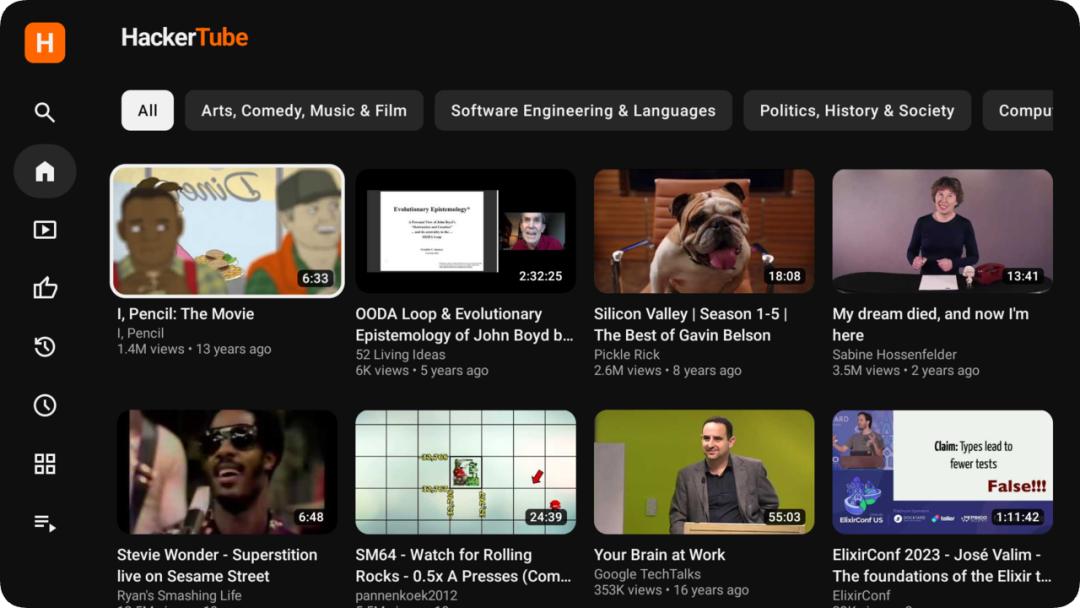
The "reverse engineered" Android TV version made by netizens, hackertube.tv
Strictly speaking, HackerTube did not reverse engineer YouTube's code, nor did it crack its recommendation algorithm. Karpathy only retained YouTube's content, and used the recommendation data accumulated by Hacker News over the years to rebuild a new set of filtering, sorting and display mechanisms.
Although it did not rebuild the entire platform, this process disassembled the parts of video media that most affect personal experience, including how content is discovered, how it is sorted, and who actually serves whom between users and the recommendation system.
