Junrou Technology has completed a nearly 100 million-yuan Angel+ round of financing, driving brain-computer interface technology to move from the laboratory to the real world.
Recently, invasive brain-computer interface enterprise 「Junrou Technology」 announced the completion of nearly RMB 100 million in Angel+ round financing. This round of financing is led by Shunwei Capital, with follow-on investments from GL Ventures, Zhiyuan Robotics (representative of the embodied intelligence industry), Nansha Qisheng and other institutions. The proceeds from this round of financing will be mainly used for the process finalization of the original "NeuroWorm" dynamic electrode, GMP production line construction, advancement of animal experiments, and continuous iteration of the neural signal algorithm system, etc.
Junrou Technology was founded in 2025, focusing on full-chain independent R&D of brain-computer interface materials, electrodes, algorithms and motion control. Academician Zheng Hairong of the Chinese Academy of Sciences serves as the chief academic consultant, and the team led by founder Professor Liu Zhiyuan has been deeply engaged in the brain-computer interface field for 14 years, with profound accumulation in the field of electrode materials. Professor Liu Zhiyuan originally proposed the "NeuroWorm" dynamic electrode technology, and the relevant results were published in Nature, which is the first Nature main journal paper in the domestic brain-computer interface electrode field.
For neurological diseases involving multiple brain regions, multi-target and long-cycle monitoring and intervention are often required in clinical practice. However, traditional electrodes are restricted by the "fixed once implanted" design, making it difficult to flexibly meet the needs of different targets with the progression of the disease. Based on the "NeuroWorm" technology, Junrou Technology develops a new paradigm of movable flexible electrode materials. Through self-developed thin-film curling processing and integrated packaging technology, the company produces fiber electrodes with a diameter of only hundreds of microns, which can be implanted through a millimeter-level minimally invasive opening in the skull. At the same time, the company pioneered the magnetically controlled peristaltic driving technology, which enables the electrode to move in a 3D controllable manner in the cranial cavity after implantation. This means that in the future, patients may only need a single implantation to achieve multi-brain-region coverage, and realize position calibration in a non-invasive manner after implantation.
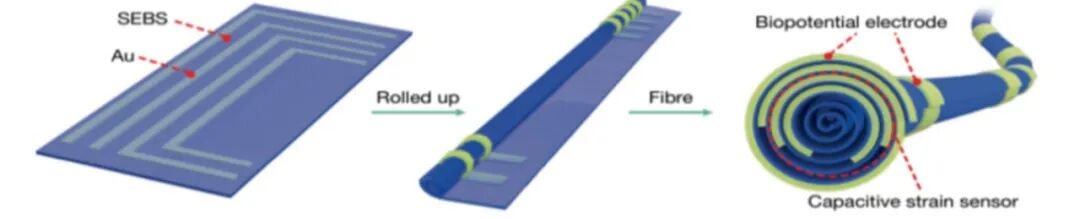
Schematic diagram of NeuroWorm processing technology
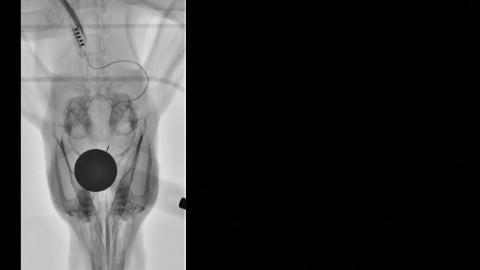
Magnetically controlled movement of NeuroWorm across brain regions
Based on the homologous flexible sensing platform, which can not only synchronously collect high-density electrophysiological signals on the human body surface such as electromyography, Junrou Technology has further extended its technology to the embodied intelligence field. Using stretchable conductive materials and fully automatic printing technology, the company has developed flexible multi-dimensional force electronic skin that can be attached to dexterous hands and the surface of robots, which can sense pressure, texture and force distribution in real time. This enables humanoid robots to obtain "touchable" tactile feedback in addition to "seeing", creating a tactile entry point for perceiving the physical world.
Brain-computer interface is moving from the laboratory to clinical practice and industrial application. What is truly scarce in the industry is the underlying capability that can span materials, processes, clinical verification and large-scale manufacturing at the same time. Junrou Technology's technical capabilities are forming a synergy between the two lines of medical treatment and embodied intelligence: on the medical side, it targets the diagnosis and treatment needs of multi-brain-region neurological diseases; on the embodied intelligence side, it complements the robot's tactile perception capability, and the two paths share the same set of flexible sensing and material platforms. This technical structure that starts from the underlying materials and reuses across multiple scenarios gives the company the opportunity to occupy a long-term ecological niche at the node where the industrialization process of brain-computer interface is accelerating, and also enables an original Chinese-origin technology to have the possibility of participating in the construction of the next-generation global human-computer interaction infrastructure.