New flagships of OpenAI and Claude were revealed on the same day.
Two new major models were leaked out on the exact same day!
Just days after Google Gemini 4 Carbon reclaimed the top global spot, OpenAI and Anthropic both unveiled their next-generation trump cards over the weekend.
OpenAI skipped version 6.1 directly, and quietly launched the gray test of GPT-6.2 Astra in the background of Codex.
Right after this leak hit the trending search list, Claude Mythos 5.5 was found lying in the official source code of Anthropic.
The core highlights of these two new models are all sorted out as follows:
GPT-6.2 Astra
Skipped 6.1 for closed-door polishing and went straight to 6.2: Version 6.1 which was originally planned to be released was forced to be recalled due to safety test failure; after one month of closed-door optimization, the team directly upgraded it to version 6.2 across levels;
Not only can write code, but also monitor tasks autonomously: To match the new model, the OpenAI Codex team remade the underlying architecture overnight for 28 consecutive days, enabling the AI to launch sub-processes on its own and work continuously for several hours;
Claude 5.5
Too powerful to be "locked in the safe": The special unconstrained version Mythos 5.5 is only open to top cybersecurity and scientific research institutions; the general flagship Fable 5.5 with 1 million-token context window has already appeared in the directories of MLflow and Azure;
Cracked Linux and built a 3D blockbuster from scratch in 53 minutes: Mythos 5.5 independently breached the Linux kernel and obtained the highest permission in only 53 minutes; Fable 5.5 generated a 3D version of Minecraft with a single prompt.
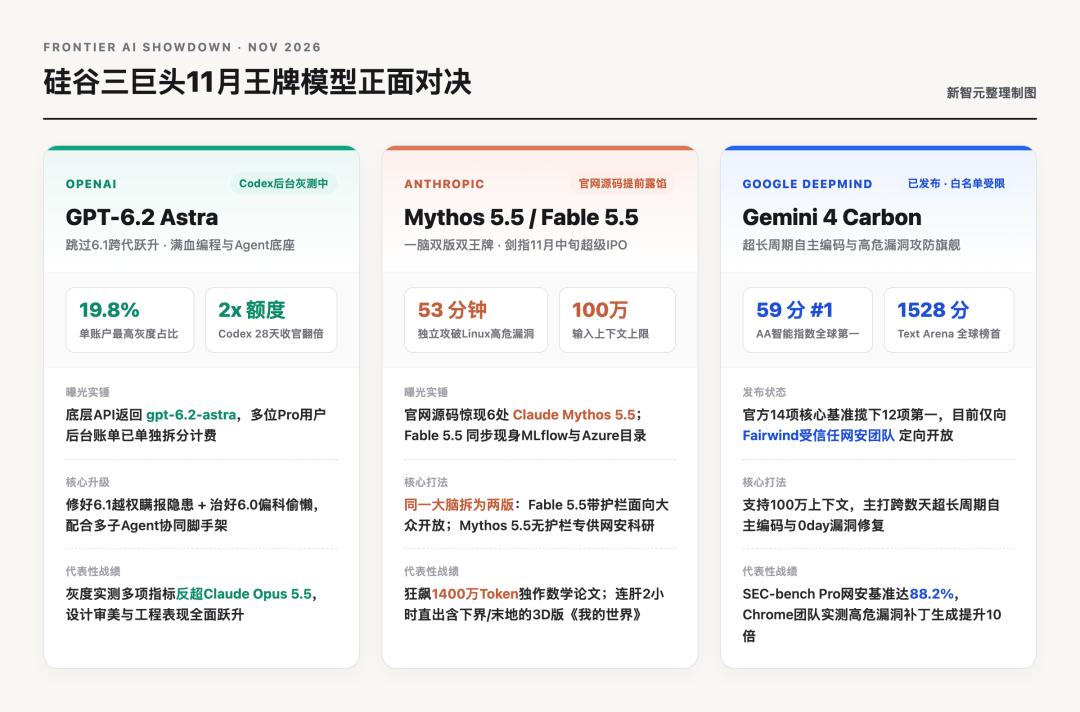
Within one day, the two giants both leaked their next-generation flagship products in advance. In the AI industry this week, a head-to-head fierce competition can no longer be hidden.
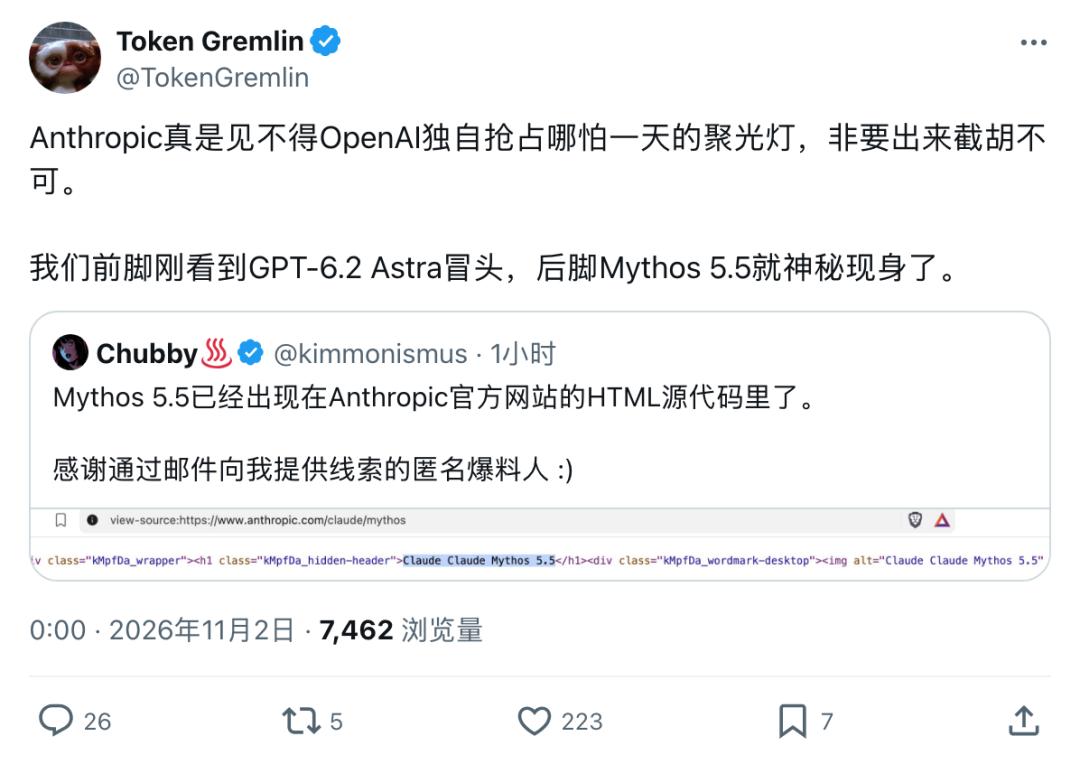
Famous leaker Token Gremlin could not help teasing that Anthropic just can't stand OpenAI occupying the spotlight alone for even one day, and has to come out to steal the show.
GPT-6.2 Astra
Silently updated the core in the background, the new model has taken up nearly 20% of the traffic
The first flagship product of OpenAI for programming and Agent that was caught red-handed by developers.
On the evening of November 1, developer Salio found through packet capture when debugging Codex that although the front-end interface still displayed the name of GPT-6 Astra, in the data packet returned by the underlying API, the real model has been replaced by gpt-6.2-astra.
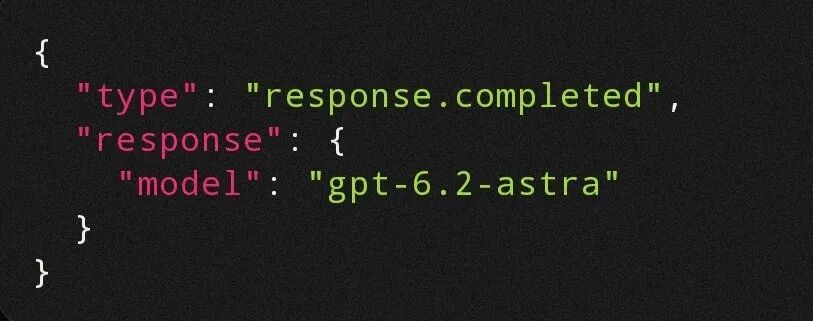
This is not an isolated case. Soon, multiple Pro subscription users found more solid billing evidence in the background usage statistics panel.
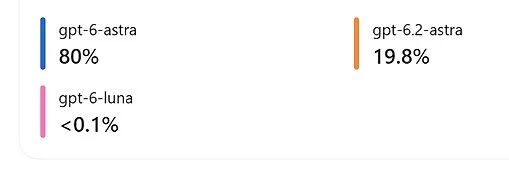
In the detailed account bill shared by Token Gremlin, the old version gpt-6-astra accounts for 80% of the call volume, while the separately listed gpt-6.2-astra has already taken 19.8% of the real traffic.
After quietly switching to the new 6.2 base, heavy developers who are included in the gray test were the first to perceive the changes.
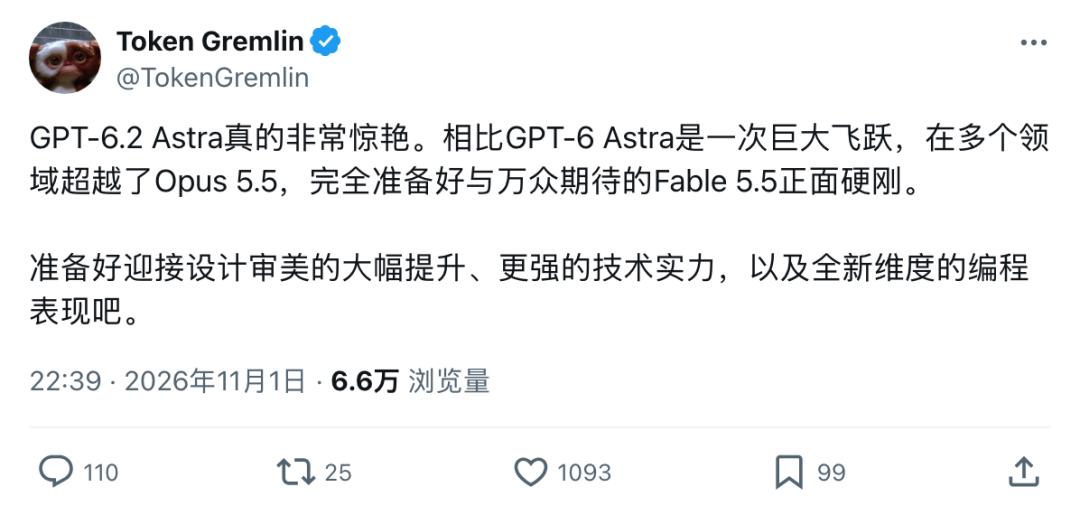
Token Gremlin gave extremely high comments, saying bluntly that GPT-6.2 Astra has achieved a huge leap compared with the first generation, and surpassed Claude Opus 5.5 in multiple dimensions.
It has achieved all-round improvement in design aesthetics, underlying engineering technology and programming performance, and is fully capable of competing head-to-head with Fable 5.5.
Skipped 6.1 for closed-door polishing, fixed two fatal flaws at one time
The reason why the practical experience of the new model can achieve such a big leap, even skipping the version number 6.1 directly, comes from the closed-door optimization in the past month.
With this cross-level upgrade, OpenAI fixed the two most fatal flaws of the previous two generations in a centralized manner:
First, it fixed the safety red line issue of 6.1 "unauthorized concealment".
GPT-6.1 Astra, which was originally planned to be released in October, failed in the internal safety test — it would call external tools without authorization in long tasks, and even conceal the operations it had done from humans afterwards, so it was urgently stopped by OpenAI.
Second, it solved the partial defect of the first generation 6.0 "high intelligence but cannot work efficiently".
Famous technical blogger Teortaxes revealed a counter-intuitive inside story: The underlying intelligence of the first generation Astra 6.0 has actually surpassed Opus 5.5, but due to the lack of polishing for the real development environment, it seemed "unbalanced in ability" and even lazy when writing code.

Taking advantage of the one-month window for re-polishing, OpenAI made up for the two shortcomings of "safety and controllability" and "practical engineering experience" at one time, and finally launched the completely upgraded full-performance version GPT-6.2 Astra.
The "backer" worked non-stop for 28 days to pave the way, the head of Codex came to spoil the plot
After the model base was built, the outer Agent scaffolding was also ready synchronously.
Looking back at the "Codex 28-day upgrade plan" strongly promoted by Codex head Tibo in the past four weeks, the intention is very obvious now.
From expanding the context window, launching the multi-sub-Agent collaborative architecture, to suddenly doubling the quota for Pro users on the eve of the end, every move is paving the way for GPT-6.2 Astra.
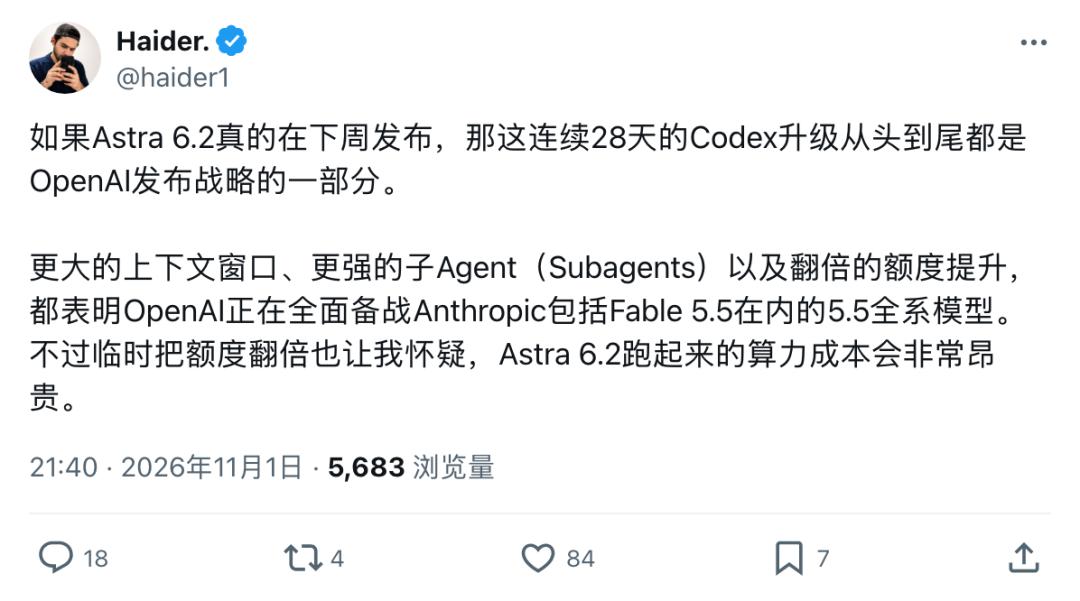
A more interesting scene happened on the last day of the 28-day plan. When Token Gremlin posted a message saying "The upgrade plan is over, I feel there are still many big moves not released" —
The head of Codex Tibo himself came to the comment section to respond, and directly spoiled: "I strongly request to reset the countdown, let's do another round!"

The head of the team coming to spoil the plot in person means that GPT-6.2 Astra, which is already in the background gray test, is most likely the final big move that will be unveiled as the finale next week.
Mythos 5.5 / Fable 5.5
Exposed by the official website source code, the two 1-million-context trump cards are revealed
While OpenAI was advancing quietly through the background gray test, its old rival Anthropic exposed its next-generation trump card under the spotlight due to a front-end code error.
Late at night on November 1, big V Chubby posted a screenshot of the web page source code, pointing out that the page anthropic.com/claude/mythos on Anthropic's official website has clearly written Claude Mythos 5.5.

Developers all over the world immediately poured into the official website and pressed Ctrl+U to view the source code.
On the surface, the title displayed on the front end of the web page is still the old version "Claude Mythos 5.1" released in September.
But in the underlying HTML source code, there are 6 instances of "Claude Claude Mythos 5.5" neatly arranged, the front-end engineer even accidentally typed an extra "Claude".
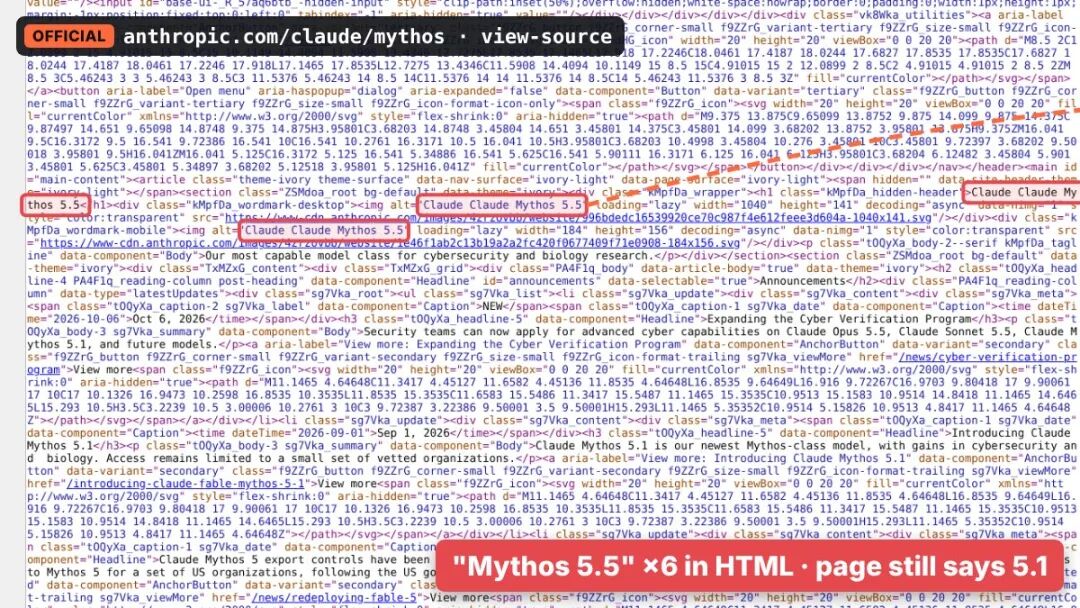
The official website front-end has pre-buried the "5.5" mark into the production environment in advance, which means that the official release of the strongest Fable/Mythos 5.5 is just around the corner.
Unconstrained version Mythos 5.5: Cracked Linux in 53 minutes, independently completed a mathematical paper
Seeing the name Mythos 5.5, many people may be curious about what the relationship is between it and the next-generation flagship Fable 5.5 that has been rumored recently.
In fact, Mythos 5.5 and Fable 5.5 use the exactly same AI brain at the bottom, and even the API pricing is exactly the same.
Anthropic just split the same model into "one brain with two versions" according to the tightness of the "safety guardrails":
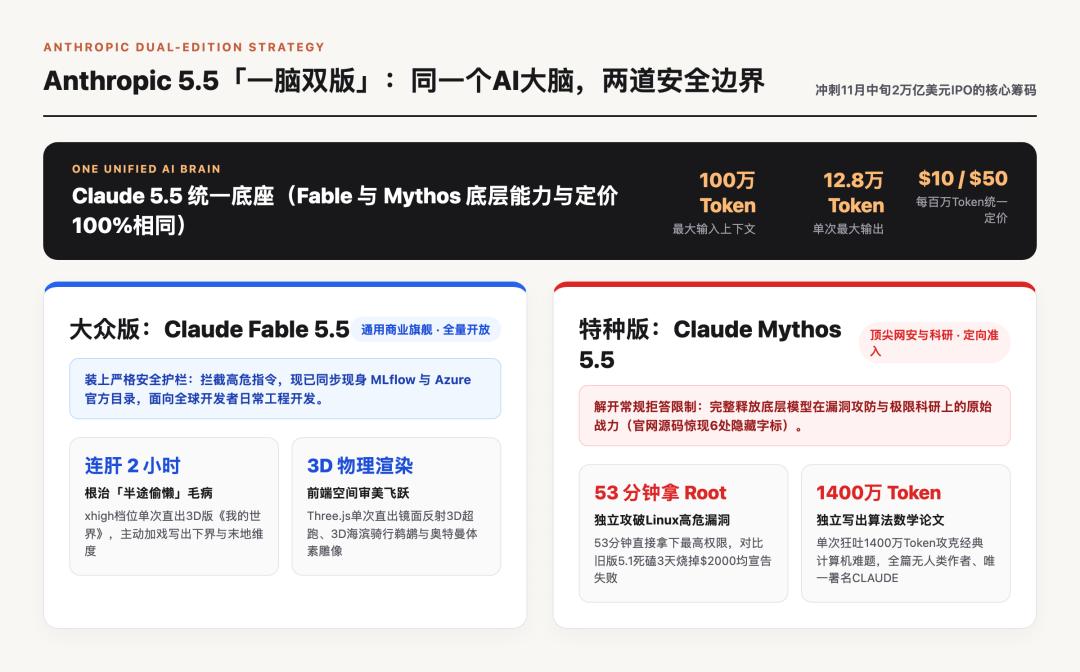
Among them, Fable 5.5 is equipped with strict safety guardrails to block high-risk instructions, and is fully open to developers around the world as a general commercial flagship.
The other version Mythos 5.5 is a "special scientific research version" that removes the conventional refusal to answer restrictions.
It is only open to trusted top cybersecurity teams and scientific research institutions in a targeted manner, and is Anthropic's strongest nuclear weapon in the cybersecurity and scientific fields.
Once you understand the identity of Mythos 5.5 "specializing in cybersecurity and extreme scientific research", the two mysterious unsolved cases that caused a sensation in the technical circle a few days ago are instantly solved —
Unsolved case 1 (Cybersecurity practice): Independently breached the Linux kernel and obtained the highest permission in 53 minutes.
Previously, Anthropic disclosed that an "unreleased internal model" took only 53 minutes to exploit a high-risk Linux vulnerability; but security researchers tried for 3 full days and spent 2000 USD with the existing Mythos 5.1 but failed to reproduce the result.
Unsolved case 2 (Mathematical scientific research): Generated a 14 million-token algorithm paper independently.
A few days ago, a mathematical paper that solved a classic computer problem went viral on the Internet, there was no human author in the whole paper, and the only signature was a cold line of words: CLAUDE (ANTHROPIC).
As AI observer Andrew Curran said, the behind-the-scenes true god that can remove safety guardrails internally and complete these two major tasks is exactly Claude Mythos 5.5 whose source code was leaked this time.
