AI has derived "extraterrestrial mathematics", and the 38-year unsolved chaotic problem has been brought to an end by the joint efforts of GPT-6 and Claude.
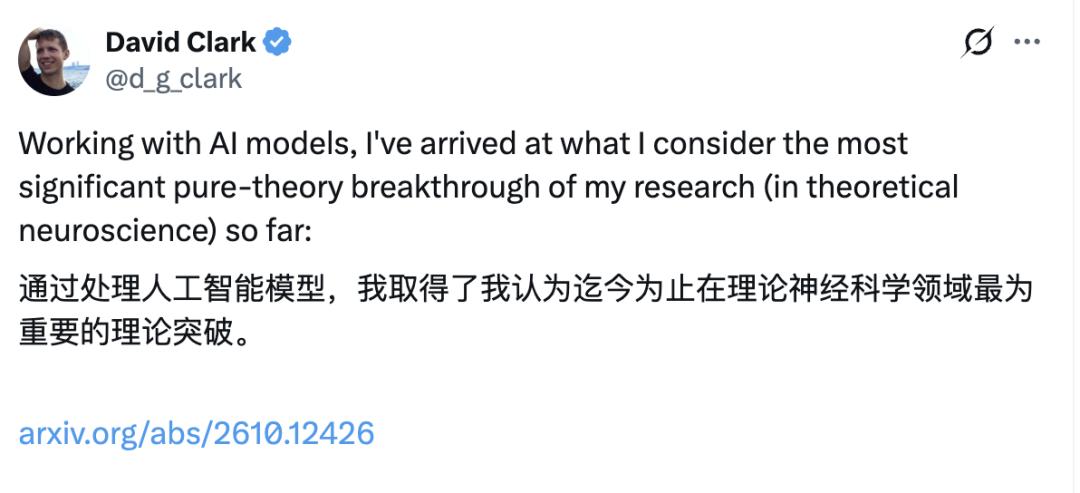
Recently, theoretical neuroscientist David Clark announced that he has successfully solved the full Lyapunov spectrum of the 1988 Sompolinsky model.
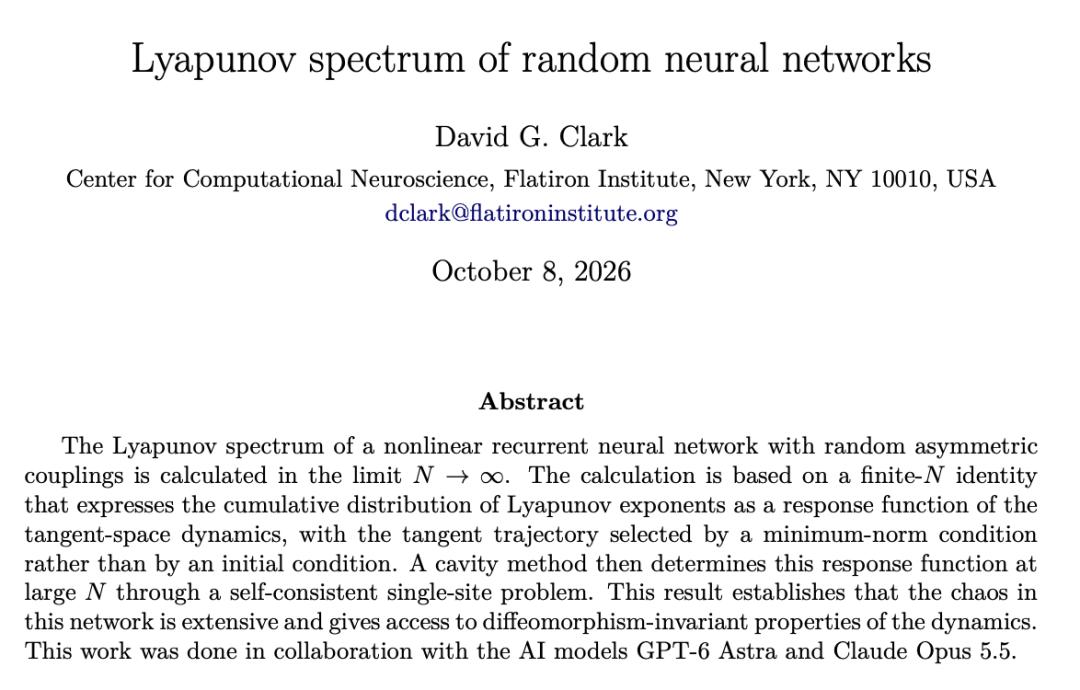
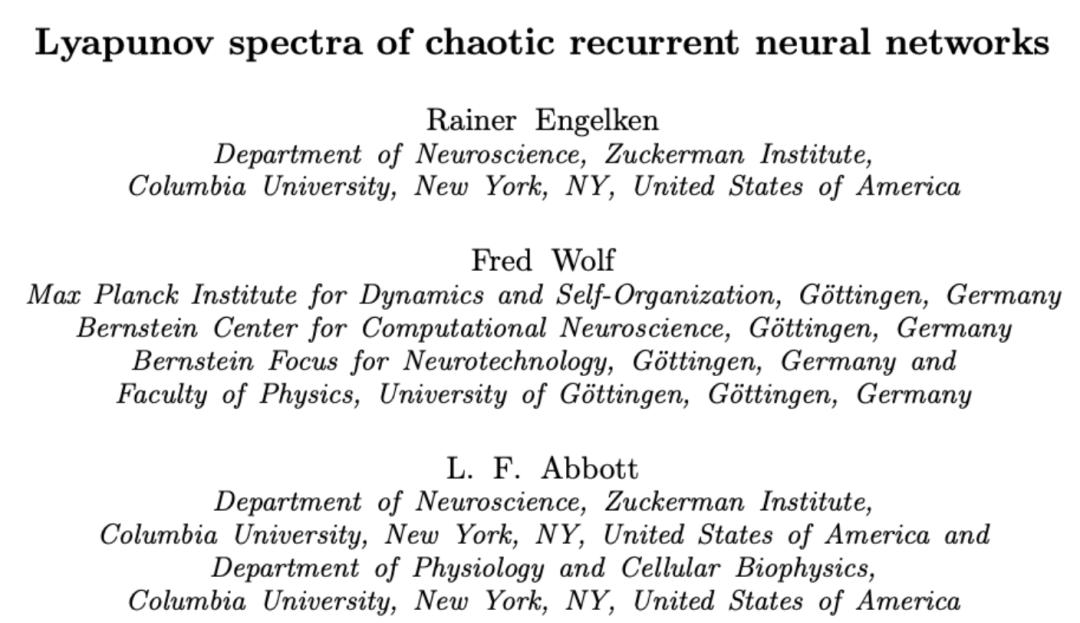
Link: https://arxiv.org/abs/2610.12426
If you are unfamiliar with these dry academic terms, that's totally fine. You only need to know two things:
First, this is the most intractable problem in the field of theoretical neuroscience over the past nearly 40 years, and it was even widely regarded as a dead end that was "absolutely unsolvable analytically".
Second, the core main force that broke through this deadlock this time is not a human, but GPT-6 Astra. And Claude Opus 5.5 is responsible for assisting and finalizing the work.
In this earth-shattering theoretical breakthrough, human scientist David Clark is more like a "contractor" and a "translator".
He could not hide his excitement and shock in his tweet: "Through collaboration with AI models, I have achieved the most important pure theoretical breakthrough in my personal career in the field of theoretical neuroscience so far!"
The 38-year academic cloud and the "Chaos Butterfly"
To understand this feat of GPT-6, we must go back to 1988 first, and look at that "dark cloud" hanging over the top of theoretical neuroscience.
When mentioning "Chaotic systems", the first word that comes to mind may be "Butterfly Effect" — a butterfly flapping its wings in South America may cause a tornado in Texas.
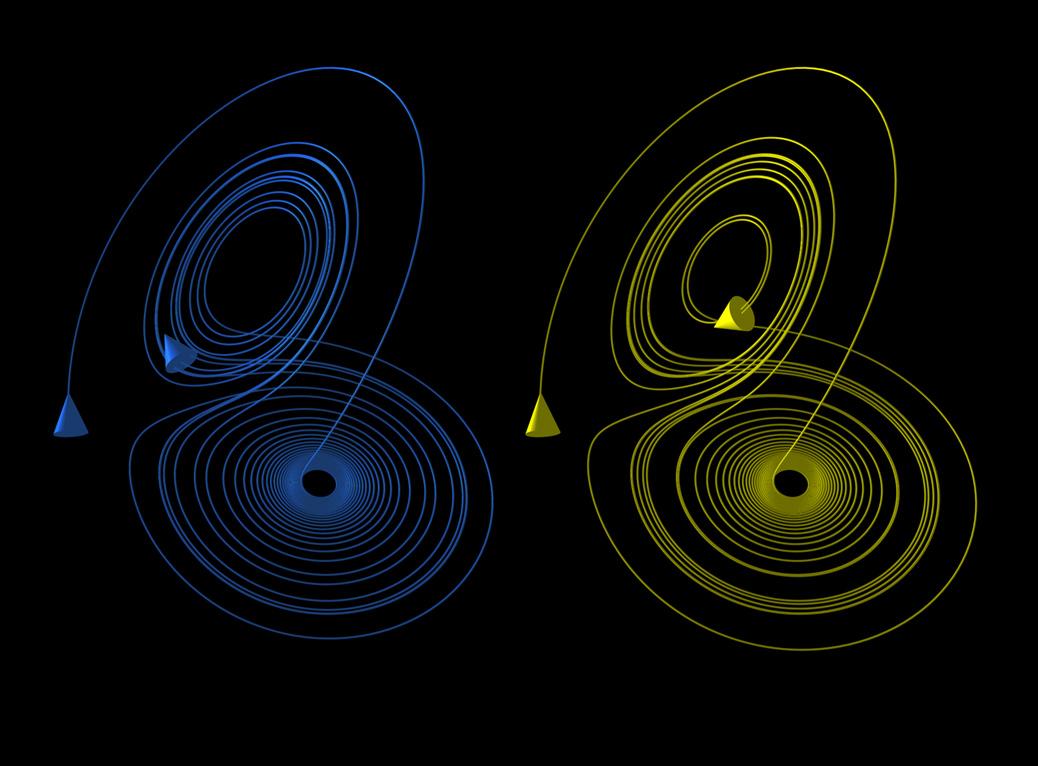
In mathematics and physics, this means that the system is extremely sensitive to the initial state: a tiny disturbance will grow exponentially and wildly over time.
But the question is, how fast does this disturbance grow?
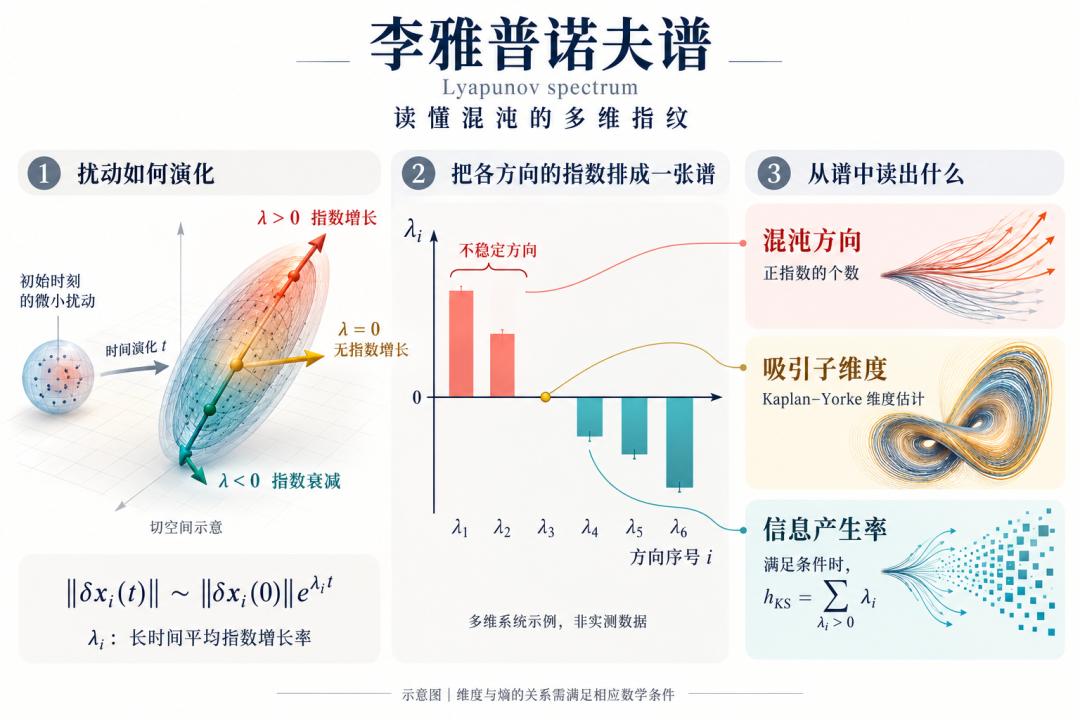
In a multidimensional space, disturbances have different growth rates in different directions. The growth rate of each direction is mathematically called "Lyapunov exponent".
The set of exponents in all directions together forms an ultimate map that depicts the full picture of a chaotic system — Lyapunov spectrum.
This "spectrum" is like the "gene sequencing map" of a chaotic system.
It can tell us: How many dimensions does the attractor occupy? How fast does the entire system generate information?
Mastering it is equivalent to holding the key to taming chaos.
In 1988, three scientific giants, Sompolinsky, Crisanti and Sommers, proposed a model in the top journal Physical Review Letters: a nonlinear recurrent network composed of N randomly coupled neurons.
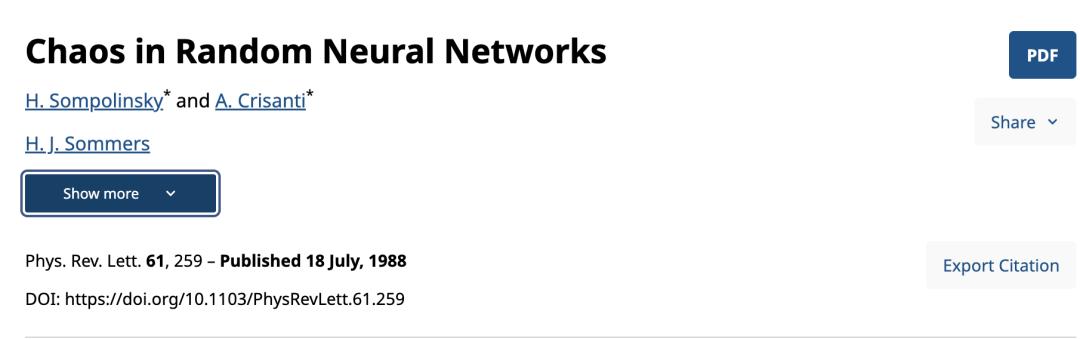
They found that when the coupling strength between neurons exceeds a certain critical value, the network will instantly fall into a "chaotic state".
As soon as this model came out, it directly became the absolute cornerstone of theoretical neuroscience. For decades, it has not only been used to simulate the spontaneous activity of the human cerebral cortex, but also served as the starting point for training various AI recurrent neural networks (RNNs) today.
But this god-level model left a "huge pit".
In the 1988 paper, the three giants calculated the "largest" Lyapunov exponent through the ground state energy of the Schrödinger equation. Then they left "how to calculate the full Lyapunov spectrum" as an open problem to future generations.
This situation lasted for a full 38 years. It was not until 2023 that Engelken and others used powerful computing power to barely calculate the full spectrum through "numerical methods" (brute force calculation).
Link: https://arxiv.org/abs/2610.12426
However, "numerical calculation" is not equal to "analytical derivation".
In the general consensus of the academic circle, writing a complete analytical solution for this high-dimensional chaotic system is almost "beyond human capabilities".
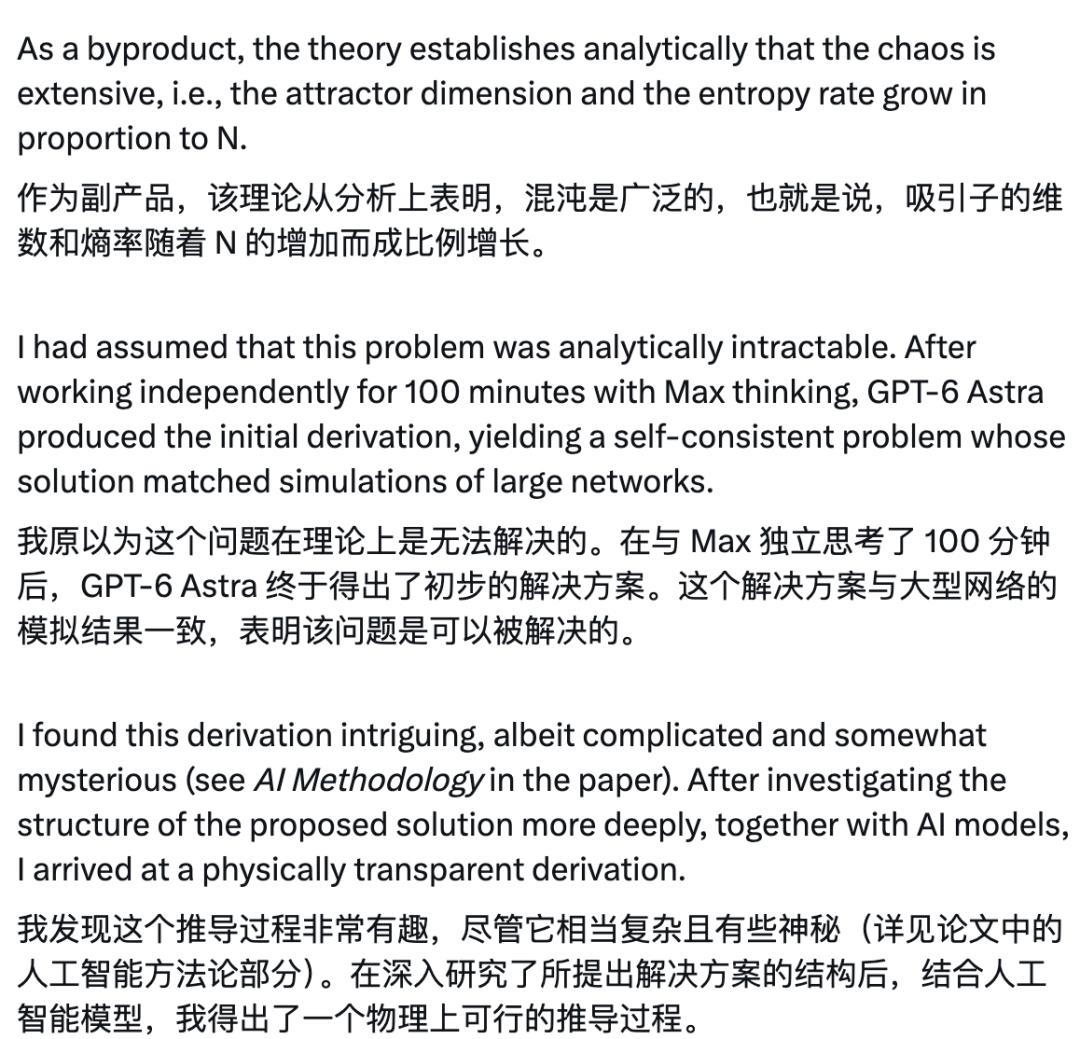
Even David Clark himself, when he started the research, defaulted that "this problem is completely analytically intractable". Until he activated GPT-6 Astra.
Epic Showdown! GPT-6's 100-minute "Deep Surge"
When human intuition and derivation capabilities hit the ceiling, silicon-based life showed a creepy dominance.
David Clark decided to give it a try even though the problem seemed hopeless. He fed this "unsolvable" problem to GPT-6 Astra with the "Max" mode turned on.

After that, GPT-6 entered an independent operation that lasted for 100 minutes.
Finally, GPT-6 Astra gave its answer: a complete, exquisite preliminary derivation process. It extracted a self-consistent problem, and the solution to this problem perfectly matches and is completely consistent with the simulation results of the large-scale network supercomputer!
When David Clark saw the pile of complex mathematical formulas spit out on the screen, he was stunned.
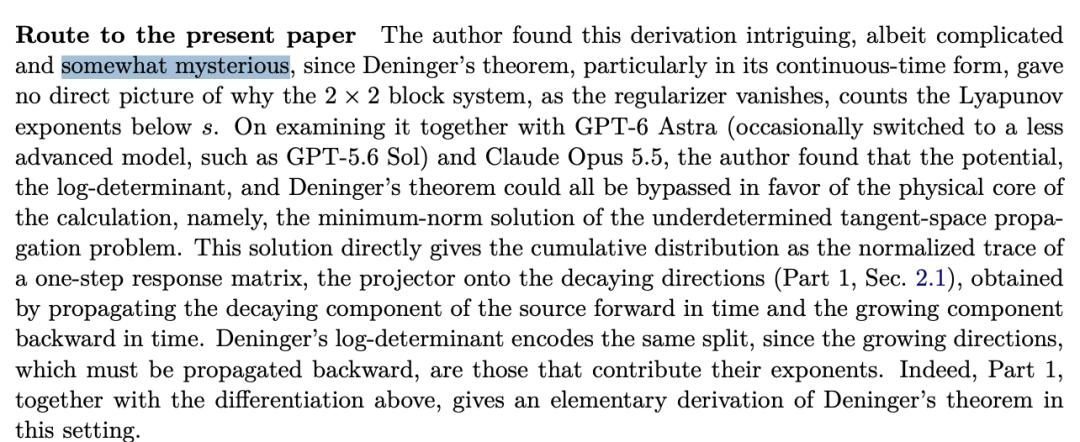
He wrote without any disguise: This derivation process is extremely fascinating, even though it is intricate, and even has a "somewhat mysterious" non-human sense of mystery.
To make you understand how amazing GPT-6 is, we will try our best to use language that humans can understand to break down the "three-step" strategy of this earth-shattering breakthrough by AI:
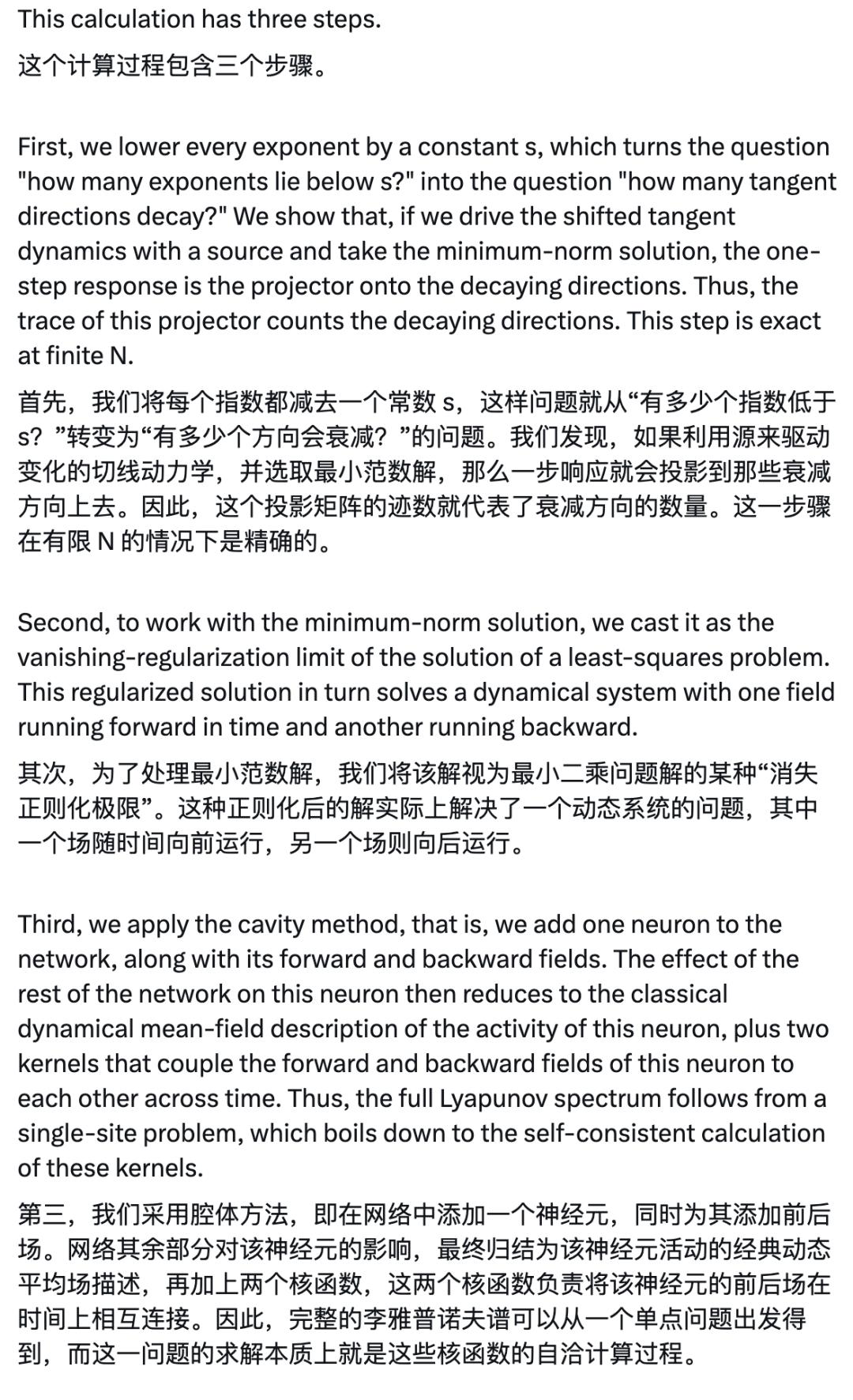
Step 1: Dimensionality Reduction Transfer, Skillfully Using the "Minimum-Norm Solution"
It is too difficult to calculate directly how many exponents there are.
GPT-6 did the opposite. It subtracted a constant s from all exponents. In this way, the original complex problem of "how many exponents are lower than s" is cleverly transformed into the problem of "how many tangent directions will decay".
Next, it uses the source field to drive the shifted dynamics, takes the minimum-norm solution, and directly proves that the single-step response is exactly the projection operator of the decay direction!

As long as the "trace" of this operator is calculated, the number of decay directions can be counted directly. This step is absolutely accurate for a finite number of N neurons!
Step 2: Two-way Field That Breaks the Time Barrier
To deal with the extremely tricky "minimum-norm solution", GPT-6 used a very sci-fi mathematical transformation: it turned the minimum-norm solution into the limit of a certain least-squares problem when the regularization tends to zero.

This limit solution actually solves a peculiar dynamical system — one field evolves "forward" in time, while the other field flows "backward" in time! This mathematical operation that breaks the singularity of the time arrow shows AI's extraordinary understanding of high-dimensional dynamics.
Step 3: The Ultimate Kill of the Cavity Method
Finally, the AI introduced the classic big trick in statistical physics — the "Cavity Method". Imagine forcibly inserting a new neuron into this chaotic network, along with its "forward field" and "backward field".
The influence of the rest of the system on it is perfectly reduced in dimension to the classic "dynamic mean field", plus two "kernels" that cross time to couple the forward and backward fields together.
So far, the unsolvable chaotic system containing N neurons has been forcibly compressed into a "single-point problem" by GPT-6!
As long as self-consistent calculations are performed on these "kernels", the full Lyapunov spectrum can be obtained as easily as reaching into a bag to take something!
You may already be confused after reading this.
Don't worry, not only you, even top scientist David Clark was a little confused at first when facing this set of "alien mathematics" given by GPT-6.
At this time, the second AI master appeared — Claude Opus 5.5.
With the assistance of Claude, David Clark and the AI models together deeply analyzed the slightly "mysterious" solution structure proposed by GPT-6. They finally translated this "silicon-based language" into a set of human derivation processes that are "completely physically transparent and logically extremely elegant".
This final result even easily reproduced the complex Schrödinger equation results of the original authors 38 years ago.
In addition, this theory has a "by-product": the dimension of the system attractor and the speed of generating information grow wildly in direct proportion to the number of neurons N!
The Epiphany of Human Scholars and the "Paradigm Revolution" of Theoretical Science
The moment this paper was uploaded to Arxiv, the entire theoretical science community lost sleep.
In the past, we only knew that AI can draw pictures, write code, chat with people, and even fold proteins (AlphaFold) through massive amounts of data. But those are essentially data-driven pattern recognition.
This time, the nature has completely changed.
This is pure theory! It is rigorous mathematical derivation! It is hardcore physical analysis that leaves no room for data cheating!
GPT-6 Astra is not "reciting" existing knowledge, it has independently found a brand new path to the truth in a dark forest that humans have never set foot in before.
Facing this kind of dimensionality reduction strike, are theoretical scientists anxious?
As David Clark shared his macro thinking at the end of the tweet: "Many people in the theoretical science community are anxious about the rise of AI. But I feel extremely excited."
Why are you excited? Because the human brain itself is the most complex high-dimensional nonlinear dynamic system known in the universe.
For thousands of years, we have tried to understand how the brain processes information, how it learns, and how it generates consciousness and behavior. But in the face of tens of billions of neurons and tangled synaptic connections, the poor human brain capacity and traditional mathematical tools are simply like observing the Milky Way with a magnifying glass.
"At least in my field (neuroscience), we are far from fully understanding the high-dimensional computation unfolding in our own brains," David Clark admitted frankly, "But now, with the intervention of AI, we are finally expected to reach that level of understanding that we could only 'vaguely hope for' in the past."
In 100 minutes, GPT-6 not only solved a 38-year-old unsolved scientific case of mankind, but also pointed out a way for the future: In the future, Nobel Prizes in Physics, Fields Medals and other major awards will most likely be awarded to those "carbon-based translators" who are best at working with AI as colleagues.
References: