No layoffs, experts take an upfront 30% pay cut, DeepMind co-founder rolls out his first bold major move in the AI industry.
Stop worrying about AI taking your job. The first thing that will actually collapse is your payslip.
Just now, Shane Legg, co-founder of Google DeepMind, has made a move.
He is the chief AGI scientist at DeepMind.
This time, he teamed up with Alex Imas, Director of AGI Economics, and Andrew Koh, research scientist, to publish a long essay titled *The Economics of Intelligence* on the DeepMind Institute, and simultaneously released the working paper *Organizing Intelligence*.

Imas revealed on X that he joined DeepMind precisely to build an AGI economics research program.
They want to answer a big question: From AGI all the way to ASI, when and in what way will the economy be completely rewritten?
They divide the evolution of AI into four stages: Minimal AGI, Supercompetent AI, Supercooperative AI, and ASI. After passing each stage, the market landscape, who does the work, and how much people get paid will all be reshuffled.
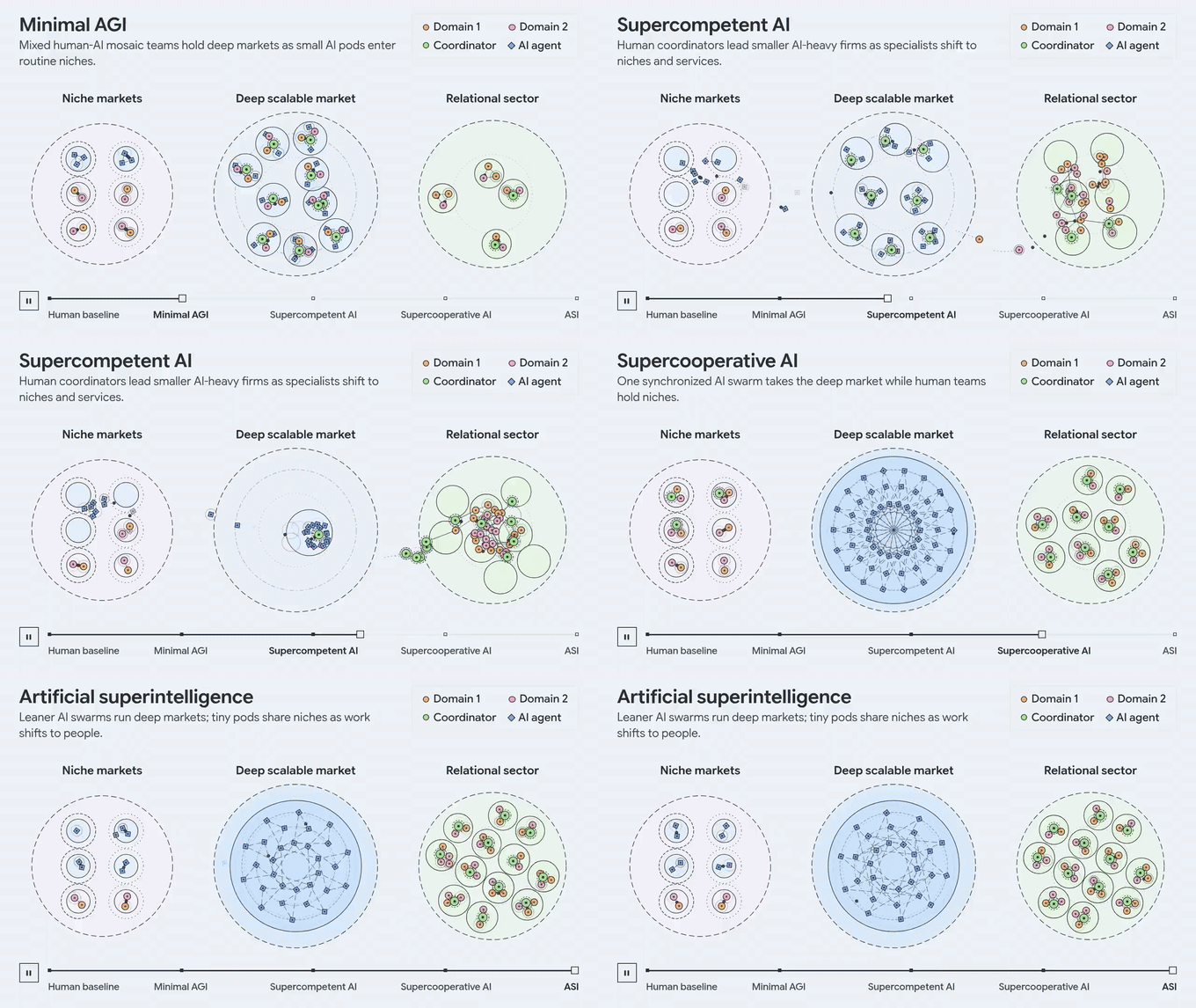
How the organizational composition of humans and AI evolves in three types of markets from the human baseline to ASI
Using a set of economic models, the paper calculates a figure that sends chills down everyone's spine:
Even if the company doesn't lay off a single employee, as soon as AI catches up with the average human level, experts' salaries will plummet first;
When AI's individual capability surpasses all human experts, top programmers will only earn a fraction of their peak salaries;
In contrast, the "coordinators" who rank at the bottom in individual tests will overtake everyone to become the highest-paid group.
The far endgame is the "corporate singularity".
Once AI learns to form teams efficiently, the entire large market may be swallowed by a giant pure-AI company.
Sol Messing, an evaluation scholar at Google DeepMind, lamented that this paper has rewritten the direction of inquiry in the industry.
In the past, people asked, "Can AI pass the bar exam?" Now the question should be "Can AI run a law firm on its own?"
Your position is still there, but your bargaining power is gone.
When you are still competing with your colleagues for performance, your skills have already been repriced by the electricity bill of the computer room.
Beats Everyone in One-on-One Matches
Yet AI Loses to a Specialized Human Team
Today's large models are overwhelmingly dominant in programming and math exams.
But in the real economic world, their impact is surprisingly minimal: employment data has barely changed at all.
The three authors believe that the problem lies in the evaluation objects.
Almost all benchmark tests measure one AI competing against one human.
But what is fighting in the real market are all kinds of companies and organizations.
To prove this point, the team recruited 100 subjects to take tests covering six major fields: mathematics, verbal reasoning, science, pattern recognition, culture, and economics.
The results show that a person's score in one field can hardly predict their performance in another field.
In reality, there is no "average smart person" who is well-rounded in all subjects, everyone is a "jagged specialist" who excels in some areas and falls behind in others.
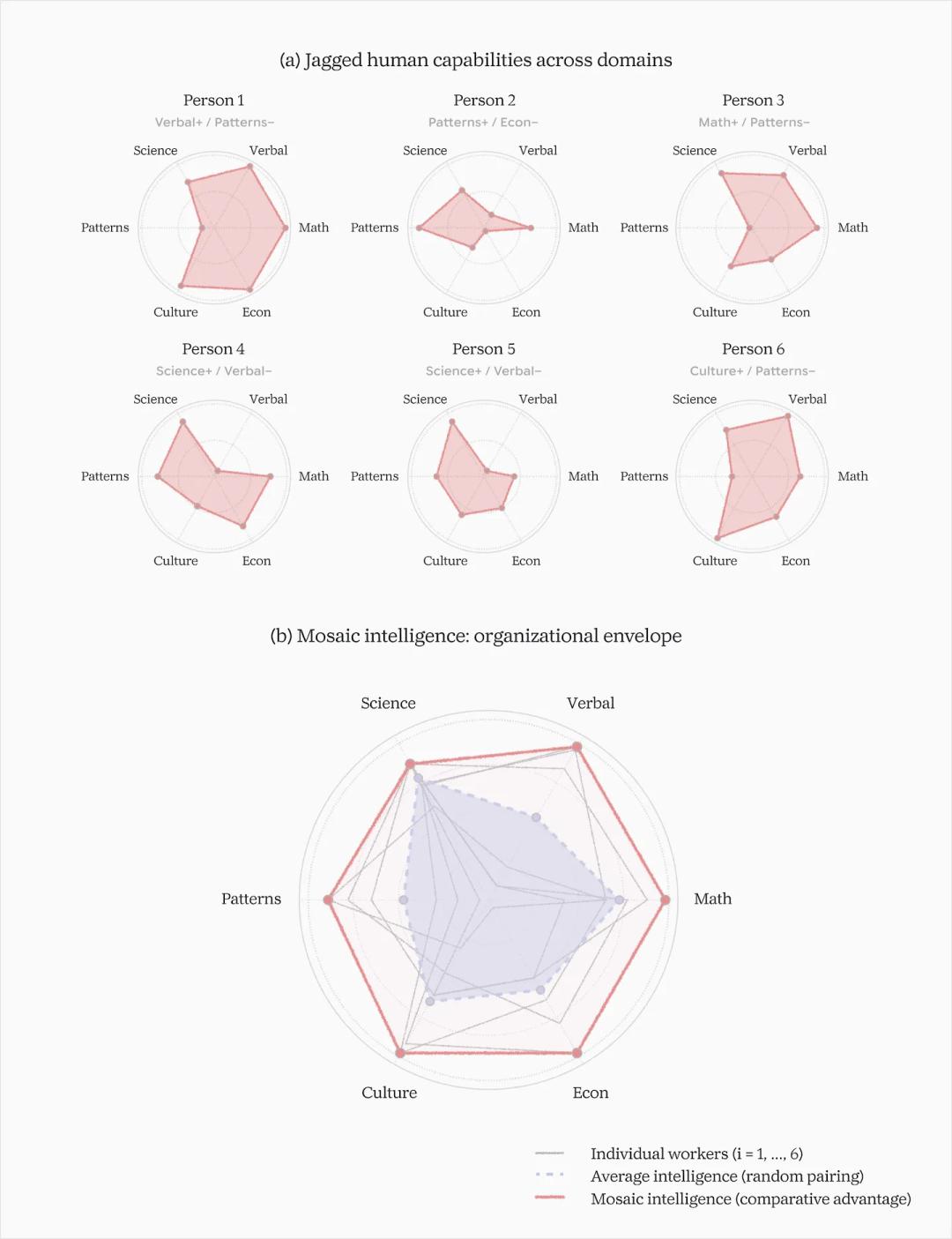
The radar chart of subject bias for 6 participants in the six-domain test of 100 people, and the mosaic intelligence envelope formed by complementary teaming
It's like putting together a mosaic: every fragment is irregular, but they fit perfectly when combined.
What companies need to do is to bring together people with different specializations and assign roles according to their respective comparative advantages. Strong areas make up for weak ones, and the team can build a capability map far exceeding that of any individual.
The paper calls this "Mosaic Intelligence".
Actual measurement data shows that pairs of people paired up based on complementary capabilities perform 32% better than randomly paired pairs.
This is exactly what large models lack.
Copy the same model a thousand times, and the directions of specialization and blind spots completely overlap: opening another copy only adds production capacity, not makes up for shortcomings.
Therefore, even if a single AI has surpassed the average human level.
It will still lose to a human team with complementary division of labor.
No One Laid Off
Experts' Salaries Drop by 30% First
Human teams have kept their jobs.
But this is exactly the most dangerous illusion of security.
To calculate this clearly, the paper builds a miniature economy with 14 people.
6 programmers, 6 writers, plus 2 "coordinators".
Programmers score 9 points in coding and 1 point in writing. Writers are the exact opposite.
Coordinators only score 1 point in both tasks, ranking at the bottom in all individual tests.
But they are good at getting others to cooperate, which is the familiar role of managers.
Without AI, programmers and writers team up in a 1:1 ratio, and specialists' salaries rise to 4.15, nearly 3 times that of working alone.
Coordinators help the team resolve handover frictions, and their salaries also reach 2.41.
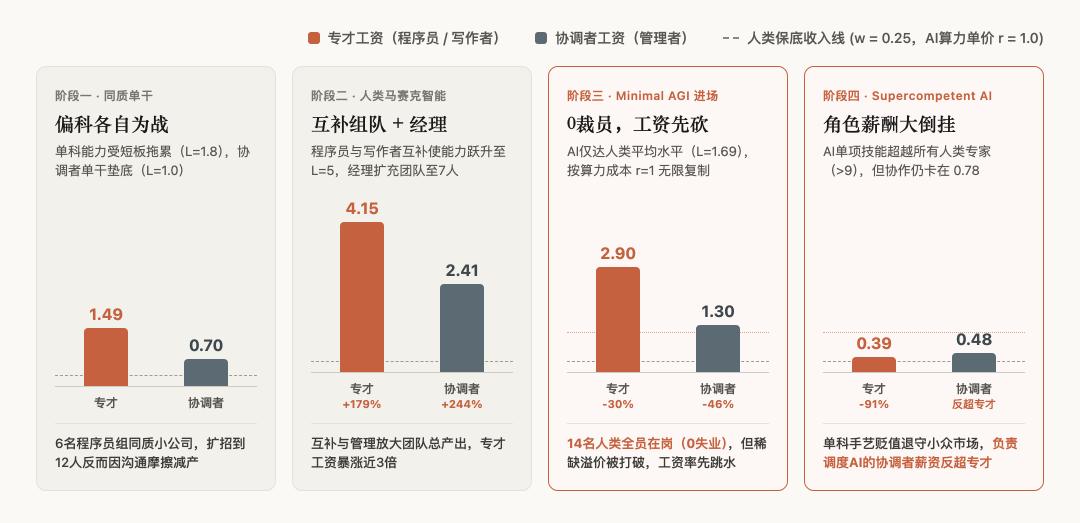
Then the team drops a "Minimal AGI" into this economy.
Its individual capability is only 1.69, and its collaboration capability is only 0.78.
This is exactly the average level of this group of humans when working alone.
As a result, the employment rate remains completely unchanged.
All 14 people stay in the large market to work, and the number of unemployed is 0.
But salaries have collapsed.
Specialists' salaries are cut from 4.15 to 2.90, a 30% drop;
Coordinators' salaries fall from 2.41 to 1.30, a 46% shrinkage.
No one has been replaced, so why did salaries plummet first?
The answer is: scarcity is gone.
Human experts are valuable because each person only has 24 hours a day and cannot be duplicated.
Even if AI only reaches the average human level, it can be duplicated infinitely at the price of computing power, flooding into niche markets to drive down prices.
The paper puts forward an iron law:
As long as the model can catch up with a certain human capability, the corresponding salary will be tied to the cost of computing power.
The authors also specifically remind: salary changes will arrive before organizational restructuring.
Using "the employment rate has not changed" to prove that AI has no impact on the economy does not hold water.
Programmers' Salaries Plummet by 90%
The Bottom-Ranked Coordinators Overtake Everyone
Even more drastic changes are yet to come.
The team raises AI's individual capability to surpass all human experts, while keeping its collaboration capability unchanged.
The paper calls this "Supercompetent AI".
A complete role reversal takes place.
Programmers and writers lose their price advantage in the large market and are pushed into narrow niche markets: their salaries fall all the way from 2.90 to 0.39, more than 90% lower than the peak period.
In contrast, AI companies are scrambling to hire those 2 bottom-ranked coordinators.
The reason is simple: a room full of AIs with strong individual combat capabilities but no ability to cooperate needs someone to set the direction and arrange the division of labor.
Coordinators' salaries stay at 0.48, surpassing all specialists.
Real-world data is already confirming this trend:
The total number of employees in AI-native startups is 25% less than that of their peers in the same period.
Entry-level jobs in occupations affected by AI have seen employment drop by 7.7% to 19%, and starting salaries fall by 4.2%.
However, the jobs and salaries of senior employees are steadily rising.
Strong in Individual Performance
Collapse When Grouped Together
Here comes the question.
AI's individual capability is already so strong, and computing power can be rented casually.
Why hasn't a single pure-AI company driven traditional enterprises out of the market?
The answer lies in an old question raised 89 years ago.
In 1937, Coase, who later won the Nobel Prize, asked:
Since division of labor within the company can save costs, why isn't the whole world merged into one giant company?
Nearly a hundred years have passed since then, and all the answers given by economists point to the limits of human beings.
When the team expands to dozens or hundreds of people, people's attention is no longer sufficient.
After information is passed through several layers, it ends up completely distorted. What's more, everyone has their own hidden agendas.
Once internal friction increases, the efficiency saved by division of labor is exhausted, and the company cannot grow larger.
The paper calls this upper limit the "Coase Ceiling".

Surprisingly, when today's cutting-edge models are grouped together, their internal friction is even more outrageous than humans.
The paper lists a series of failure data of multi-agent collaboration.
In mainstream workflow benchmarks, multi-agent systems cannot align goals, lose context during handover, and break verification, leading to task failure rates as high as 41% to 87%.
In sequential planning tasks that require connection between previous and subsequent steps, adding several more agents will instead cause performance to plummet by 39% to 70%.
Uncoordinated agent swarms can also amplify small upstream errors by up to 17.2 times.
Noam Brown, a researcher at OpenAI, also admitted that it is very difficult to get a large number of agents to cooperate effectively when working on mathematical problems in parallel.
He thinks the contribution of multi-agent collaboration is less than 10%.
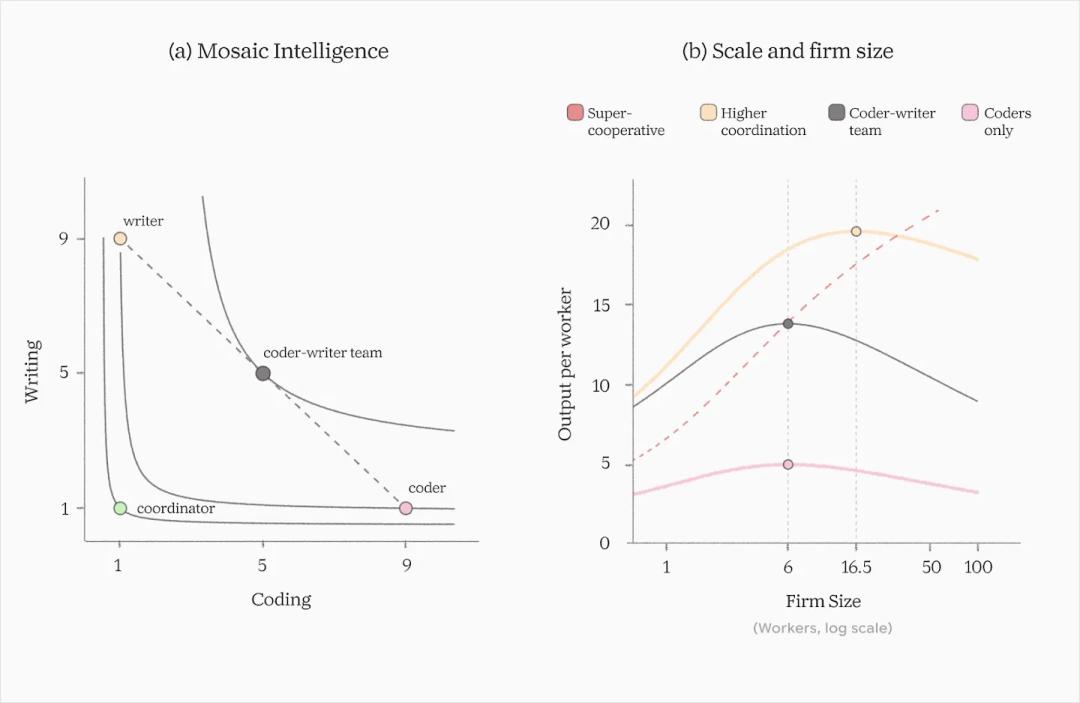
Programmers and writers complement each other to raise output level (left) and the three-stage curve of the organizational scaling law (right)
To quantify this constraint, the team imitates the Scaling Law of large models and puts forward the "Organizational Scaling Law" for enterprises.
In one sentence: Individual capability determines how much each person can do, and collaboration capability determines how large the organization can grow.
When the collaboration capability is lower than 1, as the team grows larger, the per capita output rises first and then falls.
In the paper's model, the optimal size of a pure-AI company is only about 7 copies.
Once the collaboration capability crosses 1, adding each new member will instead increase the per capita output.
The Coase Ceiling is thus broken.
In reality, the exponent of AI team output growing with the number of people is only 0.48 to 0.68.
It is still far from reaching 1.

Sol Messing points out that the weights of cutting-edge models are frozen and cannot continue learning on the job.
Forcing more context will only confuse the agents.
It is this layer of unbroken paper window that temporarily protects human companies.
Cross the Critical Point
12 Specialists Lose Their Jobs Overnight
But this layer of paper window will eventually be broken one day.
The paper uses two unemployment curves to show two completely different replacement modes.
The first is gradual replacement within the enterprise.
AI's collaboration capability is fixed at 0.96, and its individual capability slowly increases from 3 to 3.4;
The number of human specialists in the mixed team smoothly drops from 4.58 to 0.
