The Muse humanoid robot is here, led by Mark Zuckerberg, made in China.
Zhidx reported on November 1 that, according to a report by foreign media The Information citing sources familiar with the matter, Meta has partnered with Chinese robotics company Fourier Intelligence to build a humanoid robot prototype named "Max", and has started developing the second-generation product at present.
One of the sources said that Meta and Fourier Intelligence only spent 3 months building this humanoid robot weighing about 106 pounds (about 48 kilograms). The goal of this work is to help Meta's robotics division further polish future products. The product may be officially launched later, and the time to market has not yet been determined.
Two people familiar with the matter said that Li-Chen Miller, Vice President of Product for Meta's Robotics Business, once worked for nearly two months at Fourier Intelligence's factory in Shanghai to jointly promote the development of this prototype.
After Meta launched the phenomenal personal Agent assistant product "Muse" for consumers, developing consumer-grade robots that can assist users with housework and daily affairs has become a more urgent goal for the company. People familiar with the matter said that Andrew Bosworth, Meta's Chief Technology Officer, once described the humanoid robot as the physical form of Muse internally at Meta.
Although the project is still in its early stage, this prototype represents the most specific progress Meta has made in the robotics field since the establishment of Meta Robotics Studio at the beginning of last year.
Fourier Intelligence, the Chinese robotics enterprise cooperating with Meta, was founded in 2015, with its headquarters located in Zhangjiang, Shanghai. It is a technology enterprise focusing on general-purpose robots and intelligent rehabilitation. In recent years, in the field of humanoid robots, Fourier Intelligence has launched products including GR-1, GR-2, GR-3, and laid out core components such as dexterous hands.
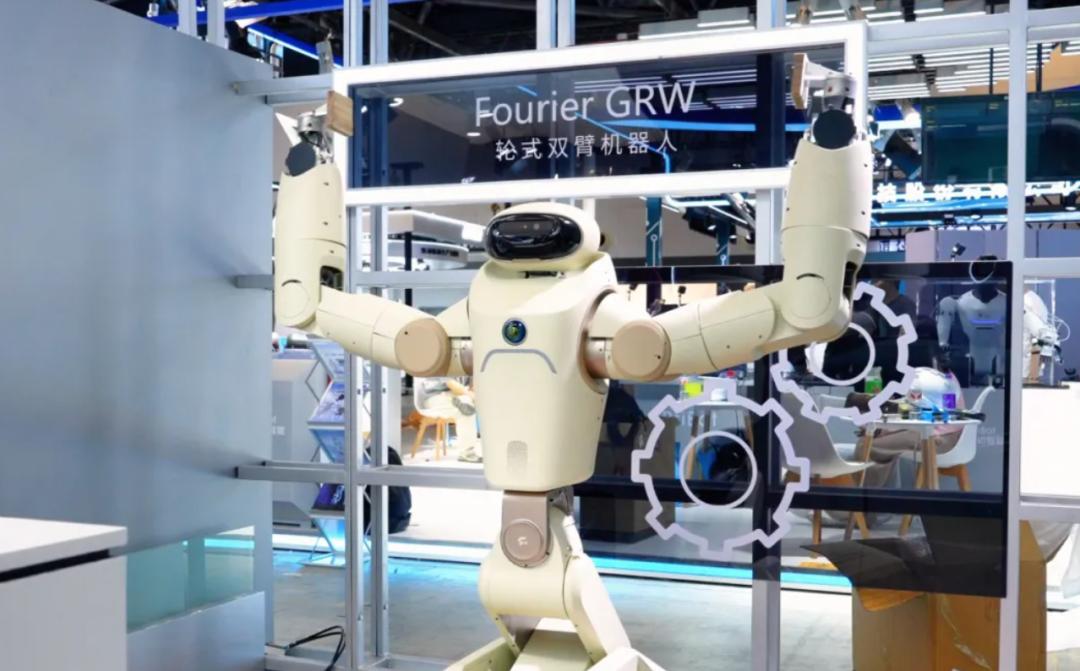
▲ Fourier Intelligence wheeled dual-arm robot GRW
01.
Exposed: Meta and Fourier Intelligence Developed Max in 3 Months
To Meet Home Interaction Demands
According to The Information's report, Max is about 1.5 meters tall, currently equipped with NVIDIA Jetson Thor chip and a set of software platform to help the robot move. It is fitted with two speakers on its chest, the eyes and mouth on its face can simulate human expressions, and its five-finger manipulator can pick up small bottles and toys.
Meta built this customized robot based on the hardware and experience of Fourier Intelligence's first-generation, second-generation and third-generation robot products. The two parties readjusted the height, body proportion, head design, display screen and camera of the prototype, and added manipulators and shoe structures.
Meta also put forward specific requirements for the robot to perceive and respond to humans in the home environment. The two parties designed Max according to a number of requirements proposed by Meta, including recognizing sounds from 5 meters away, understanding gestures or waving movements from 3 meters away, maintaining eye contact, and conveying states such as listening, thinking, speaking and uncertainty through different signals.
The development of Max required the Meta team to travel to China to cooperate closely with Fourier Intelligence. Two people familiar with the matter said that Li-Chen Miller, Vice President of Product for Meta's Robotics Business, once worked at Fourier Intelligence's factory in Shanghai for nearly two months to jointly promote the development of this prototype.
At the end of August, Meta showed this prototype to some employees at an internal robotics summit.
02.
Max 2 May Upgrade Manipulators, Projectors and Stair Sensors
Sources familiar with the matter said that Meta and Fourier Intelligence have started developing Max 2 in September. The new version will adopt a redesigned torso and improved manipulators to enhance manipulation capabilities; it will also be equipped with a projector to display visual content. Max 2 will also add more sensors to help the robot go up and down stairs.
At present, Meta is also building its internal robot manufacturing team. Recruitment information shows that Meta is recruiting supplier development engineers in Shanghai, who will work with product design and manufacturing teams to help the robotics business "move from the prototype stage to mass production".
Meta is also recruiting product design engineers and technical project managers in Shenzhen, responsible for prototype development, project planning and mass production of Meta Robotics Studio.
Meta is also advancing work on robot software. In May this year, Meta acquired the startup Assured Robot Intelligence. The company has developed AI models for training robots, helping robots understand human behaviors and adapt to different environments.
03.
Competition in Humanoid Robot Sector Heats Up
Management Changes in Meta's Robotics Team
If Meta tries to sell humanoid robots to consumers in the future, it will face fierce competition. Chinese enterprises have already achieved mass production of humanoid robots, and Elon Musk has also placed Tesla's important bet on the humanoid robot Optimus, which has now been iterated to the third generation.
In addition, startups such as Figure and 1X Technologies have also been developing humanoid robots for many years. Figure has begun testing robots in home environments, and 1X has started accepting reservations for the NEO robot.
Meta's robotics division has also seen recent management changes. Marc Whitten, former CEO of Cruise, left Meta at the end of August after working for about 18 months. Ning Li currently serves as the interim head of Meta Robotics Studio and reports to Andrew Bosworth, Meta's Chief Technology Officer.
According to people familiar with the matter, Bosworth has taken over part of Whitten's previous responsibilities, regularly holding meetings with the team and participating in handling technical and operational issues of the division.
04.
Conclusion: Meta May Bring Agents into Physical Robots
Judging from the currently disclosed information, Meta seems to be trying to extend Muse's capabilities from the software interface to the real home environment. The relevant details of the Max prototype and Max 2 show that Meta is focusing on the capabilities of robots in home interaction and other aspects.
Whether this business can move from internal prototypes to consumer-grade products for households in the future depends on the robot's manipulation capabilities, environmental adaptability and mass production costs.
Source: The Information
This article is from the WeChat official account "Zhidx", written by Yang Jingli, edited by Li Shuiqing, and published by 36Kr with authorization.