Has the inflection point for smart homes arrived? These are the chips that truly deserve attention.
Smart speakers can understand voice commands, air conditioners can be controlled remotely, cameras can identify people and pets, and robot vacuums already have the capability to independently plan routes. But for ordinary households, full-home smart solutions in the real sense are still not fully popularized. Devices from different brands have their own independent control systems, requiring users to switch between different apps. The so-called smart linkage is often limited to simple operations under preset conditions.
The crux of the issue is that connecting devices to the internet does not equate to making them truly smart. Over the past decade, the smart home industry has mainly focused on solving the problems of how devices access the network and accept remote control. The next stage needs to address how devices understand the environment, identify user needs, and achieve collaboration across different devices.
Recently, Apple has put forward its new solution. On October 13, Apple officially released three home products: HomeView, a smart home hub with a 7-inch display, the second-generation HomePod mini, and the fourth-generation Apple TV 4K. Unlike previous purely hardware updates, this time Apple positions Siri AI and Apple Intelligence as key selling points, hoping to integrate entertainment, communication, personal information and smart device control through the home hub, transforming the voice assistant from a simple command execution tool into an intelligent interaction entry for home scenarios.
While Apple is ramping up its efforts in the smart home sector, enterprises including Huawei, Xiaomi and Amazon are also continuously advancing their respective home ecosystems. Behind this competition, what deserves the attention of the semiconductor industry is no longer just the sales volume of end products such as smart speakers and smart screens, but the ongoing changes in the chip architecture that supports the operation of the entire home smart system.
01
The next stage of smart home: enabling true interconnection of all devices
The smart home is by no means a new concept. From early smart lighting and smart locks, to smart speakers and robot vacuums, to today's full-home smart solutions, the industry has gone through multiple rounds of product iteration. However, a long-standing problem has never been completely solved: why is it so difficult for devices of different brands and different categories to truly work in a coordinated manner? This is closely related to the early development path of the smart home industry.
At the initial stage of the market, manufacturers paid more attention to the differentiation of single-product functions. Air conditioner enterprises developed their own smart control systems, lighting enterprises built independent device management platforms, and smart speaker manufacturers built ecosystems around voice assistants. For enterprises, controlling device entry points, user data and software platforms can form certain competitive barriers. But from the perspective of consumers, compatibility issues between different systems have emerged. Users may purchase air conditioners, lamps, locks and cameras from different brands at the same time, only to find that these products require the installation of multiple apps, and some devices cannot access the same control platform. Even if linkage can be achieved, it often requires pre-set fixed conditions, lacking the ability to understand complex home scenarios. Therefore, the first problem to be solved in the next stage of smart home is not to add many new functions, but to establish a more unified device connection and management system.
Matter is exactly the important technical foundation in this direction. As a smart home interconnection protocol promoted by the Connectivity Standards Alliance (CSA), the CSA officially released the Matter 1.6 version in June, further improving capabilities such as device network configuration, cross-ecosystem management and contextual control. Among them, NFC network configuration can simplify the installation process of some devices, and the Joint Fabric mechanism supports multiple authorized controllers to manage devices together. This means that the evolution of Matter is no longer just about enabling devices to recognize each other, but also trying to improve the actual experience when multiple smart home platforms jointly manage devices.
The domestic market is also advancing along a similar direction. Huawei HarmonyOS Smart Home continues to strengthen cross-device and cross-space scenario linkage, integrating lighting, air conditioning, security and other devices into the home environment through central control screens, voice interaction, sensors and smart control systems. Relying on mobile phones, smart speakers, routers and a large number of IoT terminals, Xiaomi continues to expand its smart home product matrix.
From Apple's home hub, to Huawei's HarmonyOS Smart Home, to Xiaomi's smart ecosystem, although each party adopts different technical paths and business models, their core competition directions are converging: the party that can stably connect more devices will have more opportunities to become the core entry point for home smart services.
This also means that the value of the smart home industry is shifting from single hardware to system-level solutions. For semiconductor enterprises, the increase in the number of devices will certainly bring chip demand, but what is more noteworthy is that with the improvement of device collaboration, the performance, power consumption, communication capabilities and software and hardware adaptation requirements of chips are also rising simultaneously.
02
From internet connectivity to AI services, three categories of chips are worth attention
If the smart home in the previous stage mainly focused on solving device internet connectivity and remote control, then after AI enters the home, the industry's demand for chips is no longer limited to communication and basic control. A complete smart home system needs to complete at least three basic tasks: connecting different devices, sensing the home environment, and conducting analysis and decision-making based on the collected information. Corresponding to the semiconductor industry chain, MCUs and wireless connection chips, AI processors and sensors constitute three categories of basic hardware worthy of attention.
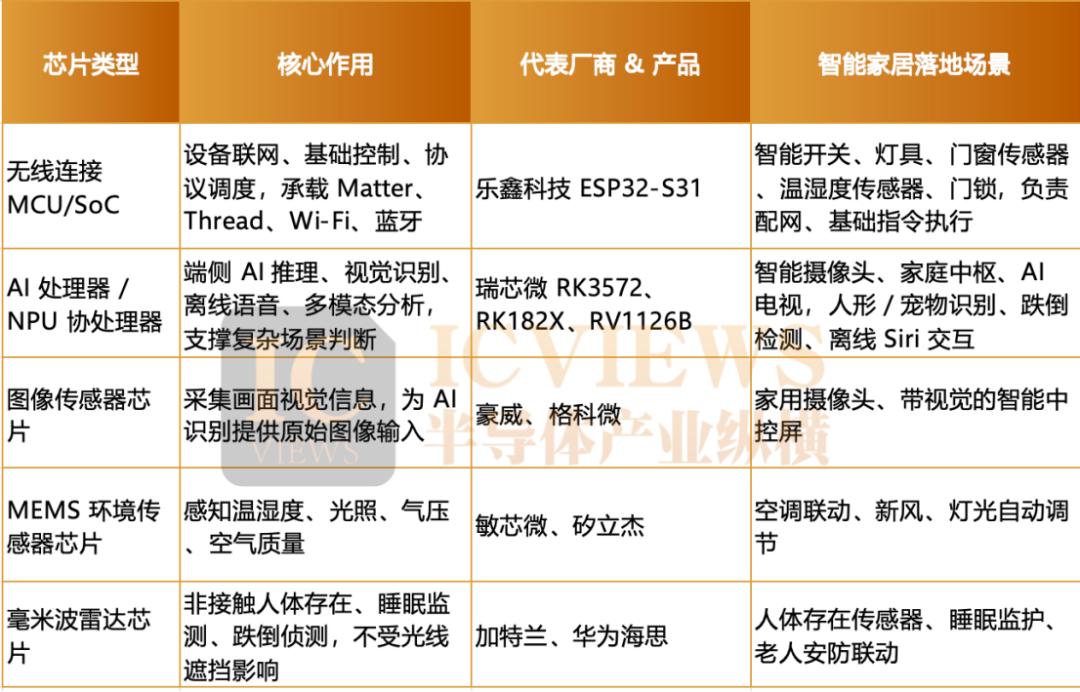
The first category is chips responsible for connection and control. Products such as smart lamps, door and window sensors, smart switches, temperature and humidity monitoring devices usually do not require particularly powerful computing capabilities, but need to run stably for a long time and reduce power consumption and manufacturing costs as much as possible. Therefore, MCUs are still indispensable core components for a large number of smart home terminals. MCUs are mainly responsible for executing preset control logic, reading sensor data, managing peripheral devices, and completing basic task scheduling. With the increasing demand for device internet connectivity, some products also integrate wireless communication capabilities such as Wi-Fi, Bluetooth, Thread, forming wireless SoCs with higher integration.
A typical example here is Espressif Systems, a wireless connection chip manufacturer. The company's products cover technologies such as Wi-Fi, Bluetooth, Thread and Zigbee, and provide Matter-related chip solutions. In the first three quarters of 2026, the company achieved an operating revenue of 2.37 billion yuan, a year-on-year increase of 23.94%. It also pointed out in its three-quarter report that the overall demand in the smart home industry showed stable performance, and the expansion of IoT application scenarios is an important background for its performance growth. On the product side, ESP32-S31 launched by the company this year entered mass production in July. This chip adopts a dual-core RISC-V architecture, integrates connection capabilities including Wi-Fi 6, Bluetooth 5.4, Thread and Zigbee, and adds hardware support related to image processing and human-computer interaction, reflecting that wireless connection chips are extending to more complex terminal applications.
The control logic of traditional smart homes is relatively simple. For example, when the temperature exceeds the set value, the air conditioner starts; when human activity is detected, the light turns on. Such tasks can be completed through MCUs and preset rules. But when devices need to understand natural language, analyze camera images, identify abnormal behaviors, or judge home scenarios based on data from multiple sensors, the computing complexity will increase significantly. At this time, AI SoCs, NPUs and dedicated coprocessors begin to play their roles. Taking home cameras as an example, traditional products mainly complete video collection, encoding and transmission. After adding AI computing capabilities, devices can locally complete tasks such as partial human shape detection, pet identification and abnormal activity analysis, reducing invalid video uploads and cloud computing pressure. Smart hubs can combine user instructions, device status and environmental information to complete more complex task scheduling.
Rockchip is a noteworthy domestic chip enterprise in this field. Its product layout covers AIoT application processors, vision processors, coprocessors and other product lines. In May, it launched the new generation mid-range AIoT processor RK3572, which integrates an NPU with 4TOPS computing power, targeting applications such as smart cameras, video analysis and multimedia terminals. The RK182X series coprocessors have also entered mass production, and are combined with RK3588 for AI TVs, supporting end-side multimodal models, image recognition and analysis, and offline voice interaction. In addition, vision processors such as RV1126B and RV1106 are mainly targeted at smart camera and machine vision scenarios. It can be seen that Rockchip is expanding the local AI computing capabilities of terminal devices through the combination of main control chips and coprocessors.
The third category is sensors responsible for sensing the environment. If communication chips solve the problem of how devices transmit information to each other, and AI processors solve the problem of how to analyze information, then sensors are the entry point for the entire system to obtain external information. Traditional smart homes mainly rely on users to actively input commands, or trigger preset actions through single parameters such as temperature and humidity. But real scenario intelligence requires the system to understand multiple changes in the home environment.
For example, judging whether there is a person in a room only relying on an ordinary infrared human sensor may have limitations; judging whether an elderly person has fallen, whether the user is in a sleep state, or whether there is abnormal activity in the room, may require comprehensive judgment combining millimeter-wave radar, infrared sensors, cameras and other environmental data. This also brings new application space for MEMS sensors, environmental sensors, image sensors and millimeter-wave radar related chips. Among them, temperature and humidity, light and air quality sensors can be used for environmental monitoring and automatic adjustment of home appliances; image sensors are responsible for collecting visual information; millimeter-wave radar can obtain information such as target distance, speed and motion state through electromagnetic wave reflection, and has application value in scenarios such as non-contact human presence detection and fall detection.
Taking some scenario solutions of Huawei HarmonyOS Smart Home as an example, it has applied sensing technologies such as millimeter-wave radar to functions such as sleep state auxiliary detection and fall event detection, and linked them with lighting, air conditioners and other devices. This change means that sensors are no longer just auxiliary parts of a certain home appliance, but gradually become an important foundation for the full-home smart system to obtain environmental information.
It needs to be emphasized that the sensors themselves do not directly complete complex scenario judgment. They are responsible for collecting information, and subsequent algorithms, processors and control systems need to participate together. Therefore, the future competition in the smart home sector is not the separate upgrade of a certain type of sensor, but the collaboration of multiple sensing technologies and computing platforms.
03
Where are the opportunities for domestic chips when AI enters the home?
The introduction of AI into smart homes does not mean that all calculations must be performed in the cloud. In fact, home scenarios have special requirements for response speed, privacy protection and network stability, which makes end-side AI an important development direction.
Taking home cameras as an example, if every image analysis needs to be uploaded to the cloud, it will not only increase the cost of network bandwidth and server computing, but also bring privacy concerns. For devices such as locks, security and environmental monitoring, some tasks also need to be completed as timely as possible. End-side computing can process part of the data locally on the device or on the home gateway, reducing dependence on continuous network connection and reducing the scope of sensitive information transmission. At the same time, the cloud can still undertake tasks such as complex model inference, knowledge update and cross-device data management.
Apple's HomeView design also reflects this idea. It is equipped with the A18 chip, which performs isolated processing of camera and microphone data through Secure Enclaves, and allows Siri requests to adopt on-device processing or Private Cloud Compute according to the task type. This shows that even Apple, which emphasizes personal privacy, does not limit all AI capabilities to the local side, but is exploring the combination of end-side hardware and cloud computing. For domestic semiconductor enterprises, this change also brings new development opportunities.
China has a relatively complete smart home terminal manufacturing system, with a large number of local brands and supply chain enterprises participating in sectors ranging from smart lighting, home appliance controllers to cameras, smart locks and home gateways. The continuous upgrading of terminal products provides a wide range of application entry points for MCU, wireless connection chip, AI processor and sensor enterprises. Secondly, the development of end-side AI provides product upgrade space for chip enterprises. In the past, some smart home products did not have high requirements for computing power, and competition between manufacturers was more focused on cost, power consumption and basic functions. With the gradual implementation of local speech recognition, visual analysis and complex scenario control, chip enterprises can improve product added value by increasing integration, optimizing energy efficiency and developing dedicated AI acceleration modules.
The layout of enterprises such as Rockchip and Espressif Systems is exactly the embodiment of this industrial change. At the same time, China's domestic smart home appliance MCU and smart controller industries are also continuing to develop, and related enterprises have the opportunity to benefit from the intelligentization of home appliances and the upgrade of control systems.
However, it should also be noted that the market opportunities of smart homes will not automatically translate into the performance growth of chip enterprises. Consumers' willingness to pay for full-home smart solutions is still restricted by cost and actual experience. For ordinary households, if a set of smart systems requires replacing a large number of home appliances, installing complex central control equipment, and the subsequent maintenance cost is high, it will be difficult for market popularization to advance rapidly. Only when intelligence can effectively improve the life experience, will consumers be willing to pay continuously for it.
Secondly, the smart home industry has obvious ecological attributes. Even if chip enterprises have products with good performance, it is difficult for them to quickly enter the mainstream terminal supply chain without a mature software development environment, protocol adaptation capabilities and customer support systems. Standards such as Matter can lower the interconnection threshold, but cannot eliminate the differences in product design, system adaptation and service experience among different manufacturers. Another easily overlooked issue is that the life cycle of home devices is usually long. When consumers buy an air conditioner or refrigerator, they often expect it to be used for many years. If the smart home platform cannot provide continuous software updates, stable device compatibility and long-term security maintenance, even if the hardware itself has AI capabilities, it will be difficult to form a truly reliable home smart system.
04
Conclusion
For the semiconductor industry, the next round of opportunities for smart homes may not lie in a certain hit home appliance, but in the hardware architecture upgrade of the entire home system. The inflection point of smart homes may be coming, but it will not be driven solely by an AI speaker or a home hub. What truly determines the development speed of the industry is whether the underlying chips, communication standards, software ecosystems and terminal demands can form a joint force. For domestic semiconductor enterprises, this is not only a new market opportunity, but also a test for upgrading from a single component supplier to a system-level solution provider.
This article is from the WeChat Official Account "Semiconductor Industry Insight" (ID: ICViews), written by Fang Yuan, and published with authorization from 36Kr.