The moment the prediction fails, the storage industry encounters the boundary of physical AI.
After two years of heated competition in the AI PC track, the Windows camp has finally rolled out its flagship offering that truly matches the Mac ecosystem.
Microsoft, in collaboration with NVIDIA, has launched the Surface Laptop Ultra equipped with the RTX Spark superchip. This is no longer a regular iteration of Microsoft's independent hardware efforts, but the first time the Windows ecosystem has gained access to this all-in-one top-tier SoC from NVIDIA, leveraging massive end-side computing power to fill long-standing gaps.
Pavan Davuluri, Executive Vice President of Windows and Devices at Microsoft, stated at a company event held in San Francisco on Wednesday that the Surface Laptop Ultra is now open for pre-orders and will start shipping on October 16. The computer is equipped with a magnetic USB-C port, similar to Apple's MagSafe charging interface.
Counterpoint Research previously predicted that the storage demand for humanoid robots will increase 20 times in 5 years, but Elon Musk directly refuted the claim as "absurd", stating that the memory capacity required by robots will exceed the sum of all other devices on Earth.
Because only by relying on a physical substrate can robots complete atomic-level shaping. The computing power demand for superintelligence will far exceed this magnitude, but almost all superintelligence computing power will be deployed in deep space computing nodes.
However, the disagreement between the two sides has never been a numerical game about DRAM demand: one side is a mature research system that makes linear extrapolations along the growth path of commercialized terminals; the other defines the end point of embodied intelligence as material reconstruction, and then deduces the upper limit of infrastructure demand from that end point.
It is clear that the two systems are essentially discussing different time scales and different types of task forms.
Two Sets of Estimation Frameworks, Misaligned Premises and Assumptions
The analyst's measurement framework is rooted in a set of widely accepted estimation paradigms that have been used in the semiconductor industry for many years.
Its logical chain is not complicated: it takes the per-unit storage specification and terminal shipment volume as the core, superimposes penetration rate assumptions, to estimate the overall demand of the track.
Autonomous driving is the most valuable reference sample for this framework. The task scope of mass-produced assisted driving is relatively controllable, typical scenarios have a high degree of structurization, and the matching scheme of computing power and storage has accumulated sufficient implementation data for horizontal reference.
This has also led many institutions to refer to the implementation experience of in-vehicle computing power for extrapolation when measuring the hardware increment of humanoid robots over the past period of time.
However, this set of deductions is based on several implicit premises that are rarely written in research reports.
First, it is the constraint of the task scope. In the short term, the implementation scenarios of commercialized humanoid robots are concentrated in standardized operations such as handling, inspection, simple assembly, and human-robot collaboration. The supporting world model tends to be lightweight and localized, triggering updates on demand, without the need to continuously maintain a global and high-precision physical state representation.
Second, it is the layered design of computing power scheduling: perception and basic planning are completed on the end side, and complex model inference and long-cycle task scheduling are transmitted back to the cloud. The storage load mainly carries images, point clouds, short-term state caches and policy weights, and the load composition is relatively close to that of in-vehicle systems.
Third, the growth path is progressive release: demand rises steadily with yield optimization, cost reduction, and scenario penetration. It is a new increment on top of the overall semiconductor market, rather than a paradigm shift that subverts the existing industrial framework.
This set of deductions is not unfounded. It is highly consistent with the mass production ideas of Optimus and the vast majority of humanoid robot manufacturers. To control BOM costs and promote commercial implementation, engineers often choose to compress on-board memory, prioritize bandwidth, and reduce hardware computing power pressure through model distillation.
This also exposes the most common confusion in this discussion: many views compare short-term hardware solutions for mass production with the long-term end state depicted by Musk on the same dimension.
Mass production engineering needs to answer how to deliver products stably and at low cost, while the "absurd" evaluation points to a vision of intelligence with a completely different time scale and set of premises.
In the final analysis, the figure given by Counterpoint is an incremental measurement for the mid-term commercialization cycle.
It presupposes that humanoid robots, as a new type of terminal, are embedded in the existing production system, with controllable task complexity and rigid cost red lines, and the iteration rhythm refers to the verified iteration paths of consumer electronics and automotive electronics.
The report does not predict whether silicon-based intelligence can transform the material world, but only answers one question: if humanoid robots are implemented along the current path, how much increment will the storage market usher in.
Musk's question directly jumps out of this set of presuppositions. He no longer uses the existing terminal form as the measurement standard, but redefines the ultimate goal of embodied intelligence: atomic-level shaping.
Following this assumption, intelligent agents need to continuously maintain a high-fidelity, strongly coupled physical world model, tracking physical processes such as deformation, mechanical feedback, friction, and phase change. Every grab, contact, and intervention with matter will drive the synchronous update of the model state.
Under this premise, it is no longer the number of large model parameters that determines the size of storage demand, but this continuously evolving and mutually coupled physical state space.
Behind the Concept, Unavoidable Hard Engineering Constraints
Atomic-level shaping is not an enlarged version of 3D printing.
It points to a closed-loop and sustainable material manipulation capability: the intelligent agent needs to maintain a high-fidelity, strongly coupled physical world model, and track dynamic processes such as solid deformation, contact mechanics, friction effects, heat conduction, and material phase change in real time.
Every grab, assembly, and rewrite of the material structure requires synchronous updating of a huge state space.
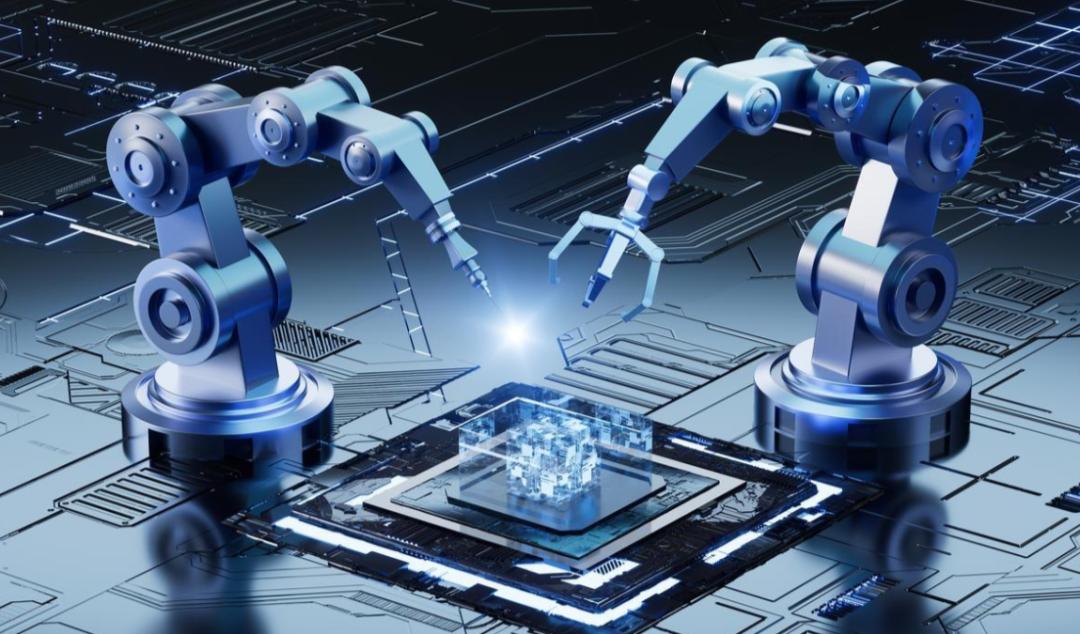
Traditional large models process symbolic information such as text and images, and the data supports sharding, sampling, and compression, and a certain degree of distortion is acceptable; for embodied intelligence oriented to atomic-scale manipulation, there are strong causal correlations between various states, and tiny local disturbances will continue to propagate and spread along the physical link.
The statement that "memory capacity exceeds the sum of all other devices on Earth" is often simplified and misinterpreted as that a single robot needs to carry massive storage.
An interpretation that is more in line with the logic of the original expression points to the cluster collaboration scenario: a large number of robots no longer execute scattered instructions independently, but collaborate to complete material reshaping, share and synchronize a global physical world model, and any physical interaction will drive the synchronous refresh of the global state.
Of course, the preconditions for supporting this conjecture are extremely harsh: does the global state space support sharding and layered caching? If high-frequency local states are kept on the end side and low-frequency global deduction is handed over to remote computing power, can the storage pressure be effectively shared? Around these issues, the industry does not yet have a mature engineering implementation path, and it is still a hypothesis to be verified.
The concept of deep space computing nodes should not be simply labeled as science fiction.
It is essentially a breakthrough idea that attempts to break through the ceiling of ground computing power. Ground supercomputing clusters have long been limited by multiple rigid constraints: heat dissipation limit, energy density, gravity disturbance, as well as land and power costs.
Once the goal of embodied intelligence shifts from information generation to large-scale material transformation, the demand for computing power may expand to a level that the surface infrastructure cannot support, so looking for new computing power carriers outward is logically a direction worth exploring.
The migration context of computing power site selection has traces to follow: from scattered computer rooms to large data centers, and then to seabed and polar computing clusters, the common logic behind it is to find a deployment environment with better temperature, energy and electromagnetic interference conditions.
Deep space computing nodes can be regarded as a conjecture when this evolution line is pushed to the limit. However, the speed-of-light time delay is a constraint that this concept is difficult to avoid, and it is also the core engineering contradiction.
The force control, tactile interaction and precision assembly of surface humanoid robots highly rely on millisecond-level closed-loop feedback. There is a fixed optical path delay between the surface and deep space nodes, and remote computing power is difficult to undertake such physical manipulation tasks with strict real-time requirements.
Deducing along this constraint, a compromise division of labor framework may gradually take shape: the end-side robot retains the local physical model, real-time perception and closed-loop control to meet low-latency rigid needs; deep space super nodes are responsible for long-cycle task planning, global material system optimization, super-large-scale world model deduction and long-term path search.
This division of labor model is expected to lower the threshold for the implementation of deep space computing power, but it may also weaken its irreplaceability at the same time.
If most of the high-value real-time closed-loop control remains on the surface end side, deep space nodes are more like a long-term supplementary computing power pool, rather than an indispensable core in this embodied intelligence system.
In addition, on-orbit chips also have to face a series of high-threshold challenges such as radiation hardening, high launch costs, difficult on-orbit maintenance, stability of inter-satellite laser communication, and service life degradation of storage media in the space environment.
It is not an alternative route that can be activated at any time. Only when the ground scheme really hits a substantive bottleneck, can it enter the serious route evaluation link.
Combining these two layers of constraints, it is not difficult to see that the picture depicted by Musk is a logically consistent thought experiment, but its establishment depends on a series of harsh assumptions being fulfilled at the same time.
As long as any link of the engineering bottleneck cannot be broken through, the deduction logic about storage and computing power demand may be greatly reduced.
It can become the direction of long-term technical exploration, but it is difficult to use it to revise the industrial demand curve in the next five years.
Two Parallel Narratives, A Game of Chip Allocation
At present, the storage industry chain has two completely different narrative scripts coexisting, and manufacturers and capital are also allocating chips between the two expectations.
The first is a script of moderate volume growth, which is consistent with Counterpoint's measurement logic.
LPDRAM, highly reliable storage and high-bandwidth interfaces will bring steadily growing demand along with the commercial penetration of humanoid robots. The increment of this route is quantifiable, the production capacity is easy to plan in an orderly manner, and the secondary market can also price it using a mature valuation framework.
Its risks are concentrated in the fact that commercial implementation falls short of expectations, scenario expansion is slow, and terminal demand cannot pick up for a long time. This is also the main line of current industrial resource input: the capacity expansion plans of storage manufacturers, the iteration of storage interface standards, and the development of supporting test schemes are mostly based on this narrative.
This route is conservative enough with clear risk boundaries, and is more suitable for leading large factories and public market capital to place bets.
The second is a script of paradigm shift, corresponding to the long-term hypothesis put forward by Musk.
Demand no longer expands linearly along the existing curve, but with the shift of the underlying logic of intelligent tasks, it may force the reconstruction of the entire storage architecture. Near-memory computing, high-bandwidth stacking, persistent memory, and distributed shared state pools are expected to usher in new implementation scenarios. The probability of this route being fulfilled is low, but once it succeeds, it will reshape the value distribution pattern within the storage track.
At present, most of the participants are cutting-edge laboratories, small R&D teams and primary market venture capital. Although they cannot dominate the current production capacity planning, they are subtly raising the R&D priority of some cutting-edge technical routes.
The layout strategy of industrial capital has also differentiated accordingly: most of the chips are bet on the more deterministic mid-term increment, and at the same time, a small part of the resources are used to pre-research new storage architectures adapted to the super-large physical state space.
This two-line layout is not contradictory in itself.
The Optimus team continues to compress the per-unit memory configuration and prioritize clearing mass production obstacles, and its long-term research group is also deducing the next-generation hardware form oriented to the physical world model. Short-term engineering implementation optimization and long-term technical conjecture can completely coexist within the same entity.
Essentially, analysts' predictions are linear extrapolations of existing mature paradigms. This method is good at estimating the hardware increment brought by mobile phones, servers, and automotive electronics: with sufficient samples, converged variables, and the correlation of historical data can provide support for predictions.
Once the underlying shift of technical goals occurs, and AI is no longer limited to perceiving and interpreting the information world, but moves towards active transformation of material structures, the growth curve drawn based on historical samples is likely to lose its reference basis.
Musk's judgment is not a standard industrial demand forecast. It is more like a target statement: first anchor the end point that embodied intelligence wants to reach, and then reversely deduce what kind of capability upper limit the underlying infrastructure needs to have.
One narrative looks backward, deducing increments based on historical laws; the other anchors the end point forward, and reversely deduces the limit boundary of the hardware system.
For a long time to come, the storage industry will hover between the two narratives, and no one can be certain which path will inevitably take shape. The industry can only steadily promote commercialization by stepping on visible steps, while quietly laying technical groundwork for those distant and even ultimately unimplementable ideas.
The core of the disagreement has never been a demand magnitude of 20 times in 5 years or higher, but what kind of capability boundary we are willing to delineate for silicon-based intelligence.
This article is from the WeChat official account "Silicon Carbon Variable", author: Hu Yidao, published with authorization from 36Kr.