The net worth of Google's founder shrank by over 210 billion yuan overnight.
Alphabet, Google's parent company, suffered a "Black Thursday".
On October 29 local time, Alphabet's share price plummeted by nearly 13%, marking its worst single-day performance since its listing in 2004, with its market value evaporating by approximately 500 billion U.S. dollars (equivalent to about 3.36 trillion yuan).
Larry Page, Google's founder, suffered heavy losses in this round of slump, with his net worth shrinking by 31.5 billion U.S. dollars (about 211.485 billion yuan) overnight.
The sharp drop in Alphabet's share price not only dragged down major U.S. stock indexes and exacerbated the decline of the Nasdaq Composite Index, but also made the market increasingly worried that global AI capital expenditure may exceed the returns it can bring.
Founder's net worth shrinks
Larry Page, 53 years old, co-founded Google in 1998 with Sergey Brin, his doctoral classmate at Stanford University.
Larry Page served as Google's CEO until 2001, when he was succeeded by Eric Schmidt; he served as Google's CEO again from 2011 to 2015, and has served as Alphabet's CEO since 2015.
In 2019, Larry Page stepped down as CEO of Alphabet, but he remains a director and a controlling shareholder of the company.
Affected by the sharp drop in Alphabet's share price, Larry Page's personal wealth has shrunk significantly. Data from the Forbes Billionaires List on October 29 shows that he ranks 4th on the Billionaires List, with a real-time net worth of 2359 billion U.S. dollars (about 15.8 trillion yuan), and his assets have shrunk by 31.5 billion U.S. dollars compared with the previous day.
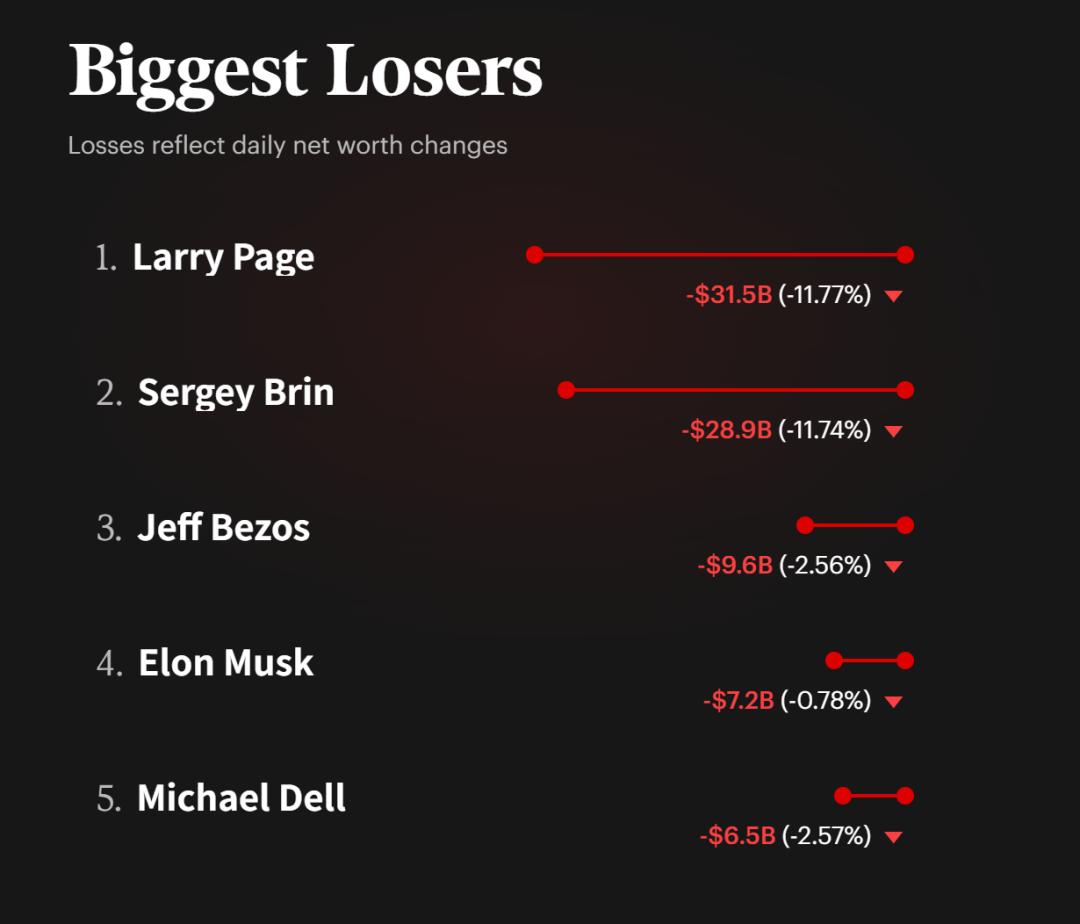
Screenshot source: Official website of Forbes
Sergey Brin, another co-founder of Google, also failed to avoid the wealth shrinkage brought by this round of decline. According to the Forbes Billionaires List, Sergey ranks 5th in the world in personal wealth, with a real-time net worth of 2172 billion U.S. dollars (about 14.6 trillion yuan) on October 29. Compared with the previous trading day, his personal wealth decreased by 28.9 billion U.S. dollars (about 194.029 billion yuan).
Free cash flow negative for two consecutive quarters
According to the UK's Financial Times, the scale of Alphabet's one-day market value evaporation this time ranks second in the history of Wall Street in the United States, second only to Nvidia's one-day decline record of 593 billion U.S. dollars (about 3.98 trillion yuan) set in January 2025.
The trigger for the sharp drop in share price was the third-quarter 2026 results disclosed by Alphabet after the market closed the previous day. Financial report data shows that Alphabet's revenue in the third quarter increased by 25% year-on-year to 1275.8 billion U.S. dollars (about 8.565 trillion yuan), but it still fell short of market expectations. In the third quarter of 2026, the company's net free cash flow outflow was 9.1 billion U.S. dollars (about 611 billion yuan), and its AI-related expenditure in the quarter exceeded 500 billion U.S. dollars (about 3.357 trillion yuan).
This is the second consecutive quarter that Alphabet has recorded negative cash flow, and it is also the second time that its quarterly cash flow has been negative since its listing in 2004. At the same time, investors are increasingly worried that this unprecedented AI investment boom can bring returns.
The reason why Alphabet turned to the "cash burning" model stems from its record-breaking capital expenditure in the field of artificial intelligence. The company is fully betting on the transformative potential of artificial intelligence technology.
In the third quarter of 2026, Alphabet's capital expenditure rose to 513 billion U.S. dollars (about 3.444 trillion yuan), higher than the 449 billion U.S. dollars (about 3.0145 trillion yuan) in the second quarter. Anat Ashkenazi, Google's Chief Financial Officer, reiterated that the maximum capital expenditure this year will reach 2050 billion U.S. dollars (about 13.7 trillion yuan), which means that the expenditure in the fourth quarter may be as high as 731 billion U.S. dollars (about 4.908 trillion yuan).
Google disclosed that the company has made forward commitments of more than 1 trillion U.S. dollars in data center acquisition, leasing, equipment procurement, energy and other obligations.
To support this large-scale expenditure, Alphabet borrowed hundreds of billions of dollars, and announced in June that it plans to raise about 850 billion U.S. dollars (about 5.707 trillion yuan) through stock issuance, which is also its first stock placement in more than 20 years. This is in sharp contrast to the company's practice of continuously repurchasing stocks over the past years.
Search advertising business impacted by AI
This financial report also disclosed that "AI Mode" is impacting Google's core search advertising business.
The financial report shows that in the third quarter of 2026, the revenue related to advertising from search and other channels increased by 12% year-on-year to 634 billion U.S. dollars (about 4.25655 trillion yuan), lower than the market expectation of 649 billion U.S. dollars (about 4.35726 trillion yuan), a significant slowdown from the year-on-year growth rate of nearly 20% earlier this year.
Philipp Schindler, Google's Chief Business Officer, admitted that "AI Mode" is affecting the traditional search business, leading to a decline in advertising monetization capacity. Different from the traditional search that displays a list of links, AI Mode directly outputs conversational text answers.
"What the market is really worried about is the search business," said David Wagner, head of equity business at U.S. investment advisory firm Aptus Capital Advisors. "The market is worried that AI chatbots will erode Google's core main business, and investors want to see the growth rate of this business accelerate instead of continuing to weaken."
Against the backdrop of sluggish search business, Alphabet's cloud business revenue doubled to 307 billion U.S. dollars (about 2.061 trillion yuan). On the one hand, customer demand for its AI services has surged, and on the other hand, the company sells computing power resources to startups such as Anthropic, which jointly drives the growth of the cloud business.
Google regards its full-stack AI strategy as a core competitive advantage, reaching billions of users through self-developed chips, building data centers, developing cutting-edge large models, and relying on its mature applications and services.
Outside critics say that Sundar Pichai, Google's current CEO, has a slow pace of AI implementation. In the higher-margin enterprise service track, large companies of Google's size have fallen behind startups such as Anthropic and OpenAI.
Pichai said that Google's two brand new top-tier Gemini models — Argon and Carbon — have narrowed the gap with competitors in the fields of coding, finance, and cybersecurity, and are expected to help Alphabet regain market share.
This article is from the WeChat Official Account "China News Finance" (ID: jwview), written by Wei Wei, and authorized for release by 36Kr.