After previously pushing its employees to embrace AI, Amazon is now complaining about excessive token burn, pouring cold water on programmers: do not take token consumption as a performance achievement.
In the past, the number of lines of code written by programmers might be one of the indicators to measure workload. Nowadays, with AI programming tools becoming increasingly popular, some enterprises have set their sights on a new metric: Token consumption.
How many times is AI called every day? How many Tokens have been consumed? How much code has been generated? These data seem to have become the new standard for measuring whether programmers actively embrace AI — but now Amazon has stepped forward to pour cold water on this trend: Stop blindly pursuing Token consumption. Heavy use of AI does not mean good work performance.
Recently, Amazon publicly released a guidance document for software engineers, explicitly stating that the company expects developers to focus more on the actual value created by AI, rather than blindly consuming Tokens just to inflate usage metrics.
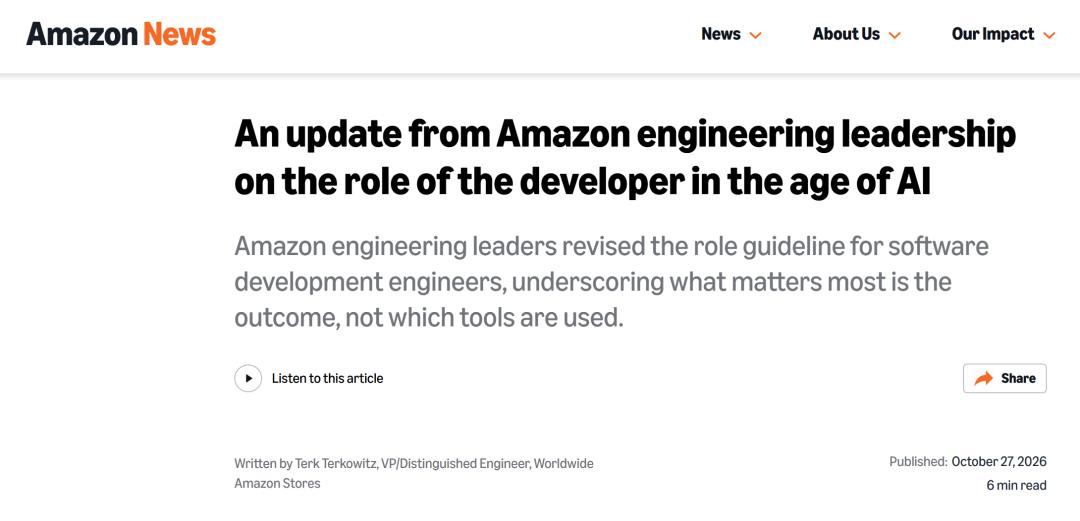
Amazon Reminds Programmers: Do Not Take Token Consumption as Work Achievement
This adjustment comes from Amazon's engineering management. Terk Terkowitz, Amazon Vice President and Distinguished Engineer, revealed in the official document that technical leaders including distinguished engineers and senior principal engineers from all business departments of the company have recently jointly revised the job guidance guidelines for Software Development Engineers (SDEs).
The core issue of their discussion is: AI is completely transforming software development, so should the criteria for good programmers also change accordingly? Amazon believes the answer is yes, but developers cannot be simply defined by AI usage volume. Terk Terkowitz stated:
"Our most productive engineers have proved that neither the positioning of developers' roles nor the outcomes they create should be defined by their AI usage."
He also put forward a new concept: "Renaissance Developer", which refers to engineers who can combine AI tools, human judgment and domain expertise to create brand new products.
One point needs to be made clear: Amazon is not against employees using AI. On the contrary, the company believes that AI will become the core of software engineering in the future, and even requires engineers who have not yet used AI to learn as soon as possible and integrate it into their daily work — what really worries Amazon is another trend: treating the act of using AI itself as a work outcome.
In the past, some teams at Amazon used metrics such as Token consumption, AI tool adoption rate, number of code changes, and number of code reviews to observe the impact of AI on development efficiency. These data do have certain reference value. Amazon found that "Frontier Teams" that actively embrace AI usually achieve higher productivity and better delivery performance.
But the problem is that correlation does not equal causation, let alone directly turning these numbers into performance targets. Amazon warned in the document:
"If these metrics are taken as targets rather than measurement tools, it may lead to negative outcomes, including rising costs and increased complexity."
For example, frequently calling AI to increase Token consumption will raise the cost of model usage; if you blindly pursue generating more code, you may also make originally simple systems more complex. This runs counter to Amazon's long-emphasized principles of "Frugality" and "Invent and Simplify".
An Amazon spokesperson also confirmed to the media that one of the purposes of releasing this document is to dissuade engineers from blindly pursuing Token consumption, the so-called "Tokenmaxxing".
In fact, Amazon has encountered similar problems before: according to a report by Fortune magazine, there was once an informal AI usage leaderboard called Kirorank inside Amazon, and some employees would make AI Agents perform tasks with no practical meaning to increase Token consumption in order to improve their ranking, and Amazon had shut down this leaderboard in May this year.
Less AI Usage Is Not Necessarily a Bad Thing, But the Reason Must Be Explained
However, for this adjustment, Amazon also emphasizes that this does not mean engineers can stop learning AI. The official document clearly requires that employees who have not yet used AI should start learning as soon as possible, and employees who have already used AI need to continuously explore better working methods.
For company managers, Amazon also put forward a specific requirement: focus on observing teams whose AI adoption rate is around 10% and 90%.
● The former represents groups with low AI usage, to understand why they have not adopted AI effectively;
● The latter are teams with high AI usage, to confirm whether they have truly achieved efficiency improvement matching their usage volume.
There is another sentence in this document: "If your current work cannot benefit from existing AI tools, this is a discovery, not a failure." Amazon believes that engineers should record the specific reasons why AI cannot provide help, share them with colleagues and managers, instead of forcing the use of AI just for the sake of using it.
For technical leaders, Amazon's requirements are more specific: they cannot only listen to others' introductions to AI, but must personally use these tools in actual production work, be able to cite cases where AI plays a role and cases where it does not work respectively, and explain the reasons to the team.
In addition, Amazon has also found a problem: as the company scales up, some engineers and managers have gradually moved away from customers and actual business; while teams that have a better understanding of products, customer needs and business goals can often give full play to the advantages of AI and agent development.
Therefore, Amazon hopes that engineers can not only write code and call AI, but also clearly understand what problems they are solving: "After all, AI can help engineers write code and complete tasks, but judging which problems are worth solving and which functions truly meet customer needs still requires engineers to have in-depth understanding of products and business."
Microsoft Also Calls a Halt to "Burning Tokens": Some People Spent Thousands of US Dollars in a Single Month
People who often pay attention to this circle should know that Amazon is not the first tech giant to question Tokenmaxxing.
In August this year, Jay Parikh, Executive Vice President of Microsoft, sent an email to internal development teams, requiring engineers to use AI more rationally: "Tokenmaxxing is not the goal we pursue... I hope everyone focuses on creating outcomes that can truly drive customers and business development, and let each Token create greater value."
To this end, Microsoft immediately adjusted its internal AI usage guidelines, set the lower-cost GPT-5.6 as the internal default model, and required all departments to manage Token expenses more strictly — according to foreign media reports, at that time, some engineers at Microsoft could spend hundreds or even thousands of US dollars on Token consumption alone every month.
Back in June this year, AWS CEO Matt Garman also stated that enterprises can select models with appropriate costs according to specific tasks, instead of calling the most expensive AI for every task. For some daily development tasks, open-weight models with "good enough" capabilities and lower prices may be more cost-effective than top-tier closed-source models.
From Microsoft to Amazon, the two tech giants have successively slammed on the brakes on the trend of "recklessly burning Tokens", which is somewhat thought-provoking.
After all, not long ago, they were still encouraging employees to use AI as much as possible, for fear that no one would keep up with this technology wave. Now, as Token bills are getting more and more expensive and AI-generated code is piling up, the management is beginning to ask: How much actual outcome have the money spent really brought?
For programmers, this may also be a somewhat contradictory situation: using less AI may be considered as failing to keep up with the times; using more AI may be questioned as wasting Tokens. So, does your company also count employees' Token consumption? Do you think this can truly reflect the work efficiency of programmers?
References:
https://www.theregister.com/ai-and-ml/2026/10/28/amazon-tells-tokenmaxxing-devs-to-slow-their-ai-roll/5306090
https://www.aboutamazon.com/news/company-news/amazon-software-engineer-role-guideline-ai
This article is from the WeChat Official Account "CSDN", written by Zheng Liyuan, authorized for release by 36Kr.