China's longest metro loop line opens, greatly boosting Wuhan's traffic efficiency.
October 29 marks a milestone in the history of Wuhan's metro development. At 9:29 a.m., as the first Yangtze Blue train slowly pulled out of the platform, Phase II of Wuhan Rail Transit Line 12 was officially put into operation, which means the full-loop operation of Wuhan's metro loop line has been realized.
The total length of this line is 59.9 kilometers, and its Phase I was opened back in May this year. The blue part in the figure below is the Phase I opened in May, and the gray part is the Phase II which is now also open to traffic.
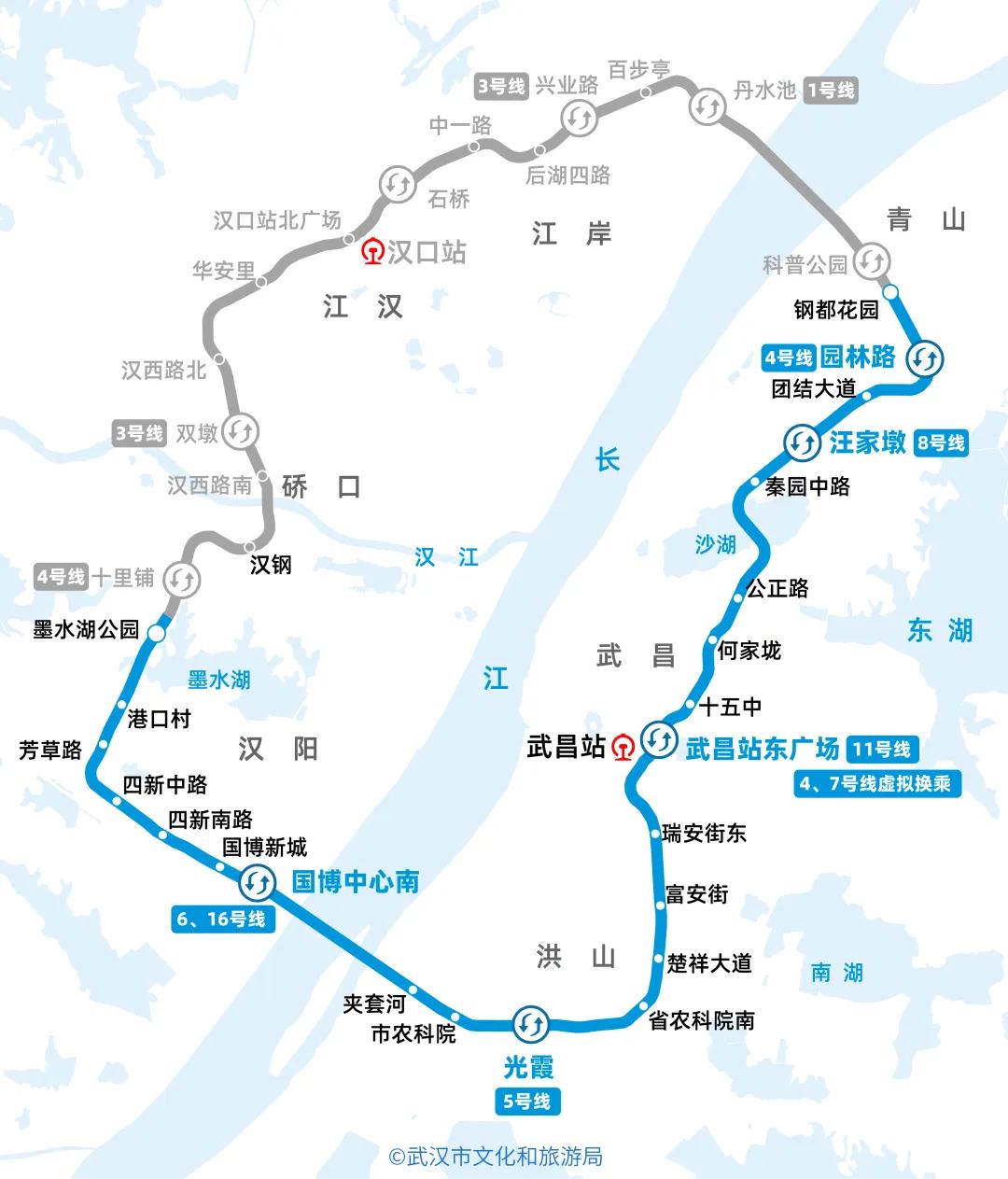
There are three reasons why the opening of this line is of milestone significance to Wuhan Metro:
First, the opening of this line has allowed Wuhan to catch up from behind and become the city with the longest metro loop line, ranking first not only in China but also in Asia.
Before Wuhan, Beijing was the first city to open a metro loop line, and also the city with the largest number of metro loop lines, with two metro loop lines. The first loop line, Metro Line 2, was fully put into operation in 1987. The second metro loop line, Metro Line 10, opened its Phase I in 2008, Phase II in 2012, and was fully connected in 2013.
After Beijing, Chongqing, Xi'an, Guangzhou, Zhengzhou, Chengdu and Harbin have successively opened their metro loop lines.
Second, this is the metro line with the highest construction difficulty among all Wuhan metro lines. The difficulty lies in that this metro line crosses the Yangtze River twice, the Han River once, and also crosses Shahu Lake and Moshui Lake, which can be called an underwater metro. Many sections along the line are located on the first terrace of the Yangtze River, with high underground water level and thick aquifer. Especially at Hankou Railway Station (the deepest foundation pit of the whole line, with an excavation depth of 34.9 meters), it faces the risks of highly permeable and high-pressure underground water.
Third, Wuhan Metro Line 12 has won the titles of "Social Media Favorite" and "Transfer King" at the same time. The whole line allows transfers to Wuhan Metro Line 1, Line 2, Line 3, Line 4, Line 5, Line 6, Line 7, Line 8, Line 11, Line 16 and Line 21, and transfers will also be available after Line 10 is opened.
From another perspective, this loop line almost covers the most core business districts and core sectors of Wuhan. The line is located between the Second Ring Road and the Third Ring Road of Wuhan, and the area inside the loop is roughly the area within the Second Ring Road where purchase restrictions were the strictest before Wuhan lifted the purchase restriction policy on the real estate market. At the moment when houses have become pure consumer goods, the best choice for buying a house in Wuhan is within this loop line.
The explosive industrial growth of Wuhan
In addition to the achievements made in the metro sector, Wuhan has also fully completed industrial transformation this year, which is specifically reflected in three aspects: economic growth rate, industrial growth rate and export volume.
In the first half of this year, Wuhan's GDP growth rate ranked 5th among 29 trillion-yuan GDP cities, and 3rd among 27 provincial capitals. Compared with other provincial capitals in central China, its actual growth rate ranks 2nd, and its GDP increment ranks 1st.
In the first three quarters of this year, Wuhan Bureau of Statistics disclosed that: According to the unified accounting results of the gross domestic product of prefecture-level cities and prefectures in Hubei Province, preliminary accounting shows that the city's gross domestic product (GDP) reached 1,671.443 billion yuan in the first three quarters, growing by 5.6% year on year at constant prices.
The 5.6% growth rate is 1 percentage point higher than the national average growth rate. In terms of growth rate, it ranks 3rd among the top 10 GDP cities, on a par with Suzhou, only after Shenzhen and Guangzhou. Its nominal growth rate is 7.57%, ranking 2nd among the top 10 GDP cities, only after Shenzhen.
Behind the remarkable economic growth of Wuhan, industry has made outstanding contributions. In the first three quarters, the growth rate of the added value of Wuhan's secondary industry (industry in a broad sense) reached as high as 10.3%, realizing a double-digit growth. This growth rate is at the leading level among key cities. In addition, the growth rate of the added value of industries above designated size is as high as 17.5%, which ranks 2nd among trillion-yuan GDP cities, only after Hefei.
Behind the double-digit growth of industrial growth rate is Wuhan's completion of the transformation from traditional industries to emerging industries. This transformation does not mean abandoning traditional industries, but that emerging industries have grown into the pillar industries, while traditional industries have also realized transformation and upgrading.
In the past, when we talked about Wuhan and Hubei, the first thing that came to mind was automobiles, and Dongfeng. After all, the automobile industry is not only the pillar industry of Wuhan, but also the core pillar industry of Hubei.
In 2023, Wuhan had four 100-billion-yuan industries, among which the automobile industry achieved an operating revenue of 328.85 billion yuan, ranking first, and the electronic information industry ranked second. However, since 2024, the pillar industry of Wuhan has quietly switched to the electronic information industry. In 2024, the operating revenue of the electronic information industry surged to 313.763 billion yuan, while the operating revenue of the automobile industry declined accordingly, making the electronic information industry replace the automobile industry as Wuhan's pillar industry.
The 2025 operating revenue data of various industries has not been released yet, but judging from the growth rate of the electronic information industry, it is very likely to approach 400 billion yuan.
Let's look at a set of data to understand how fast Wuhan's electronic information industry has developed in recent years: In 2025, the added value of industries above designated size increased by 4.6%, among which the manufacturing of computers, communications and other electronic equipment increased by 34.8%. In the first three quarters of 2026, the added value of industries above designated size increased by 17.5% year on year, 2.1 percentage points faster than that in the first half of the year. From the perspective of major industries, the manufacturing of computers, communications and other electronic equipment increased by 98.2%.
It can be seen that the added value of the electronic information industry in the first three quarters of this year nearly doubled compared with the same period of last year. Based on this estimate, by the end of this year, the operating revenue of Wuhan's computer, communication and electronic equipment manufacturing industry is expected to approach 500 billion yuan. This is the harvest period of the results of Wuhan's years of layout in the chip industry.
Therefore, you can see that cities with local chip industry enterprises have performed very well this year. Hefei, Suzhou, Guangzhou and Wuhan are all showing the dividends of this round of development.
Over the past years, Wuhan has continued to invest in the fields of optical communication, laser equipment, optical chips, optical fibers and optical cables, but due to the insufficient industry prosperity, the capital market has long underestimated the value of these enterprises.
With the advent of the AI era, the demand for computing power has exploded, the construction of data centers has been accelerated, and optical communication has become one of the most important links of AI infrastructure. After years of planning and construction, Wuhan's optoelectronic industry now accounts for half of the national optoelectronic industry.
In addition, you should notice that the growth rate of Wuhan's industrial added value reached 17.5% in the first three quarters. Behind such an amazing growth rate, it is obvious that not only the electronic information industry is driving growth, but also the emerging industries are experiencing full-scale explosive growth.
Wuhan Bureau of Statistics disclosed that: The added value of high-tech manufacturing industries above designated size increased by 72.1%, accounting for 40.8% of the added value of industries above designated size, and contributing 107.8% to the growth of industries above designated size. By product, the output of integrated circuit wafers, tablet computers and smart TVs increased by 36.8%, 33.0% and 16.8% year on year respectively.
In addition to optoelectronics, Wuhan also has three other industries: commercial aerospace, network communication and biomedicine. These three industries, together with the automobile and optoelectronics industries, form Wuhan's "five prosperous industries", namely, the "Auto Valley", "Optics Valley", "Network Valley", "Bio Valley" and "Star Valley".
These growing industries will form the safety cushion for Wuhan's future industries. When some industries enter the cycle of adjustment, other industries will take over the growth momentum, so as not to lose the driving force for growth.
Wuhan's import and export volume ranks top 20 for the first time
In addition to driving the double-digit growth of Wuhan's industry, the industrial explosive growth has also made Wuhan's import and export ranking enter the top 20 for the first time.
Wuhan Customs disclosed that: In the first three quarters, the total import and export volume of the city reached 412.42 billion yuan, up 22.3% year on year. Among them, the total export volume reached 263.70 billion yuan, up 17.6%; the total import volume reached 148.72 billion yuan, up 31.9%. With the import and export volume of 412.42 billion yuan, Wuhan, an inland hinterland city, has entered the top 20 foreign trade cities for the first time.
The substantial growth of import and export is the result of the joint efforts of the two pillar industries of electronic information and automobile. The data shows that in the first three quarters, the import and export volume of Wuhan's optoelectronic information industry reached 240 billion yuan, up 68% year on year; the import and export volume of automobile manufacturing reached 46 billion yuan, up 71% year on year. The total import and export volume of the two industries accounts for nearly 70% of the city's total foreign trade volume.
This means that Wuhan has not only completed the transformation of the main forces from traditional industries to emerging industries, but also the traditional automobile industry is seizing the opportunity of going global to achieve a rebound from the bottom.
The "Action Plan for the Construction of the Auto Valley Industrial Innovation Corridor (2026-2030)" released by Wuhan this year has set the goals for the 15th Five-Year Plan period: By 2030, 6 vehicle enterprises with an operating revenue of 100 billion yuan will be cultivated, the total output of complete vehicles will exceed 2 million, the output of new energy vehicles will exceed 1.5 million, and the operating revenue of the "vehicle-energy-software-chip-material" automobile industry ecosystem will exceed 1.3 trillion yuan.
The automobile industry is bottoming out, the leading electronic information industry is developing at a high speed, and the commercial aerospace, network communication and biomedicine industries are growing rapidly. Wuhan, which is experiencing multi-point explosive growth, is ushering in its glorious moment.
Looking into the future, Wuhan's real competitors are no longer limited to cities in central China. What it is competing for is the industrial position among the top-tier cities in China.
The metro loop line shortens the internal distance of the city, the optoelectronic and chip industries determine how far Wuhan can go in the new round of scientific and technological competition, and the going global of automobiles is related to whether the traditional pillar industry can rise again. These three clues are closely linked, jointly promoting Wuhan to move towards a higher-level city.
This article is from the WeChat official account "Urban Finance & Economics", written by Yu Fei, authorized for release by 36Kr.