Lao Gan Ma Uses AI: Has It Cut Costs While Retaining Its Distinctive Flavor?
What changes will happen when a food enterprise that has captured the market with traditional flavors starts to use AI for raw material quality control? Recently, the news that Laoganma's revenue hit 5.4 billion yuan in 2025, together with reports of its introduction of an AI visual quality inspection system, has drawn widespread attention. Even news headlines like "Laoganma earns 5.4 billion yuan a year with AI" have emerged to grab public attention.
Yang Wei, Associate Professor of Strategy and Entrepreneurship at China Europe International Business School, put forward a quick comment: As more and more traditional enterprises begin to adopt AI, what is worth discussing is not only how much cost can be cut and how much labor can be replaced. More importantly, we need to clarify which tasks are suitable for AI to handle, and which experiences and values still need to be upheld by human beings. She also reminded that when enterprises use AI to improve efficiency, it does not necessarily mean that consumers can perceive better product value.
To view Laoganma's AI application rationally, we need to first separate the facts disclosed by the enterprise from the additional explanations added in the communication process.
Laoganma's operating revenue reached 5.26 billion yuan in 2022, 5.391 billion yuan in 2024, and about 5.4 billion yuan in 2025, showing little change. The AI visual quality inspection system was fully launched in 2025, but no public data can prove how much revenue it has contributed or how much performance growth it has driven.
The more direct role of AI may lie in quality management. According to Li Xin, Executive Deputy General Manager and Chief Quality Officer of Laoganma, after the full launch of the AI visual quality inspection system in 2025, the non-conformity rate of products in key processes dropped to 0.02%, and 100% of core raw materials are traceable. However, public reports have not provided comparable data before the transformation.
How much of these changes comes from AI, and how much comes from equipment upgrading and management adjustment? Is it cost-effective after taking input costs into account? The information available now is not sufficient to answer these questions. Still, Laoganma's case provides an entry point for observing the AI application in traditional enterprises.
Why Is AI Adopted for Pepper Sorting?
For food enterprises like Laoganma, whether they can retain the familiar taste for consumers largely depends on raw materials. The quality of peppers is the first checkpoint of its product quality. This type of raw material that requires massive procurement and processing is directly linked to the product flavor.
Pepper sorting seems trivial, but it determines the stability of subsequent processing. What AI can do here is not only to reduce manual sorting work, but also lower the risk of bad fruits and foreign impurities being mixed into the raw materials.
Laoganma once triggered taste disputes after adjusting its pepper procurement sources. Media reports show that the company once increased the use of peppers from regions such as Henan, leading to consumers' subsequent discussions that the taste "has changed". It is still debatable whether the taste change is solely caused by the origin adjustment, but raw material management will affect the product flavor that consumers are familiar with, and may also influence the long-accumulated customer trust of the brand.
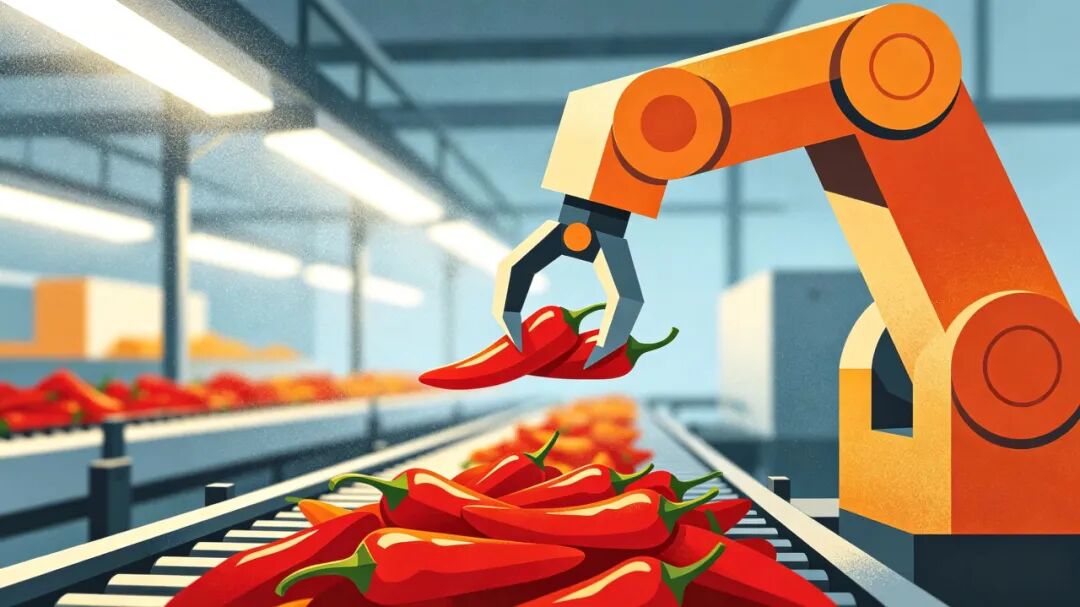
Therefore, the value of introducing AI in the pepper sorting link is not only to save manpower, but also to make raw material quality control more stable.
There is another reason why this link is suitable for AI application first: part of the judgment has clear standards and needs to be executed repeatedly. For example, to identify foreign impurities, spots and abnormal colors, the system can be trained with qualified and unqualified samples, and then the results can be spot-checked manually.
Of course, peppers of different varieties, origins and batches vary greatly, and flavor cannot be judged only by appearance. AI can undertake part of the appearance inspection work, rather than replace all quality judgments.
Industrial vision and optical sorting have already been applied in food processing, which can identify defects and remove foreign impurities according to features such as color and shape. Enterprises still need to conduct on-site tests to judge whether the equipment can adapt to raw materials of different batches and the actual production speed.
Even a small improvement in sorting accuracy, when scaled up to the production scale, can bring considerable benefits after long-term accumulation.
Laoganma's case reminds us that enterprises do not have to pursue full AI transformation from the very beginning. It may be more pragmatic to first find links that are closely related to product quality, have relatively clear standards and verifiable effects.
The Meaning of "Handmade" Under the AI Narrative
But another question arises: if AI improves efficiency, can it definitely enhance the brand's competitive advantage?
If one chili sauce brand highlights AI sorting, and another highlights manual sorting and retains traditional practices, what choice will consumers make?
Although we cannot simply conclude that consumers prefer the latter, the association brought by production methods will indeed affect consumers' impression of products.
A study published in the *Journal of Marketing* in 2015 found that in its research scenario, labeling products as "handmade" will improve product attractiveness, partly because consumers feel that the producers have put their heart into the products. Although this study cannot directly prove that chili sauce consumers have the same preference, it still has certain reference significance.
Some people will associate handmade products with careful material selection and home-style taste, while others may think machine sorting is cleaner and more stable. More extremely, AI may even trigger the association of "technology and tricky additives". Therefore, whether AI is a plus or a minus depends on how consumers understand it, and whether the actual product has changed.
For brands that have experienced raw material disputes, consumers may be particularly sensitive to cost reduction. If an enterprise only emphasizes how much labor it has saved without explaining how quality is guaranteed, it will easily make people worry that the familiar taste will change.
Manual participation may have brand value in some products and scenarios, but we cannot conclude that manual work is necessarily better than machines.
The cost problem in the eyes of enterprises is sometimes also the quality problem that consumers care most about.

Laoganma previously adjusted its pepper procurement sources to find space for cost reduction, and now introduces AI in the raw material sorting link. Its focus has always been on peppers, which is not strange from the perspective of business logic: peppers are the core resource of Laoganma, and the capability of pepper selection and processing is an important foundation of its core competitiveness.
The pain points of business costs and the sensitive points of consumers converge in the same link in this way. Enterprises see the space for efficiency improvement, while consumers care more about whether the taste will change. Both concerns are reasonable.
But the trouble is that it is not easy to measure both with the same report. Changes in procurement prices and labor costs can be calculated quickly, but consumers' disappointment with taste may accumulate gradually, and it is difficult to attribute it to a certain production adjustment. If enterprises only focus on the immediate cost, they may underestimate the long-term brand loss.
If an enterprise does not clearly explain which quality indicators AI has improved, consumers may only remember that "fewer people are employed". Even if the machine does improve the stability of sorting, it may be interpreted in the context of past taste disputes.
This is also why the previous raw material disputes will increase the difficulty for enterprises to explain new changes.
What is really worth retaining is not a fixed production method, but the familiar flavor for consumers and their trust in the brand. Technology can be updated, but enterprises need to make clear what has changed and what quality requirements have remained unchanged.
Rather than taking AI as a marketing selling point, it is better to let consumers taste stable and delicious products first. For an enterprise that builds its reputation by taste, this may be more convincing.
New Imagination Space for Laoganma's AI Application
A widely spread number around Laoganma's AI application is that the number of pepper sorting workers has been reduced from more than 600 to 48. But this set of data has not been confirmed. On October 26, 2026, multiple media reported that Laoganma's staff clearly denied the relevant layoff rumors, saying that the company had never released this set of data.
Therefore, we cannot calculate the changes in Laoganma's labor cost and profit based on this, let alone take it as conclusive evidence that AI replaces workers.
Although the layoff rumor is unreliable, the question is still worth discussing: when machines undertake more appearance sorting work, how should the experience accumulated by workers who have been dealing with raw materials for years continue to play a role?
Skilled workers may notice that a batch of peppers is different from usual based on humidity, smell, appearance and years of experience. Some of these judgments can be converted into detection indicators, while others need further recording and verification. Whether the machine can cover these judgments depends on the actual capability of the system, and we cannot draw a conclusion only by the word "AI".
Instead of just regarding AI as a tool to replace labor, Laoganma can also explore its role in the R&D link. Food enterprises looking for talents who understand R&D and are familiar with consumer needs are sometimes restricted by region and talent supply, and AI can just fill this gap.

Some food enterprises have tried to use AI to assist R&D. In 2019, condiment company McCormick cooperated with IBM, using data such as consumer preference and sensory research to assist in finding new flavor combinations, and launched the ONE series. According to reports, its R&D speed has been significantly improved.
For Laoganma, the more imaginative question may be: can AI help develop new formulas, so that while maintaining the familiar flavor, some consumers will feel "no internal heat, no heartburn" after eating spicy food?
AI can first screen candidate formulas, but whether the food tastes good and whether it is easy to cause discomfort still requires sensory tests and necessary scientific verification, which cannot be judged only by algorithms or a small number of taste tests.
What Laoganma ultimately needs to prove is not how many people AI has replaced, but that after saving labor, it still retains the capability of understanding peppers and making good chili sauce. How to retain and make good use of human experience should also become part of this transformation.
Profile of the Professor
Professor Yang Wei is Associate Professor of Strategy and Entrepreneurship at China Europe International Business School. Before joining CEIBS, she served as Assistant Professor of Management at George Mason University in the United States. Professor Yang graduated from the University of Texas at Austin in the United States, where she obtained her doctorate and master's degree in management. She also obtained her master's degree in finance from the University of Hong Kong and master's degree in management from Peking University.
Professor Yang's research focuses on how artificial intelligence reshapes the competitive landscape and innovation models of enterprises. She pays special attention to how enterprises achieve strategic breakthroughs in the AI wave through interactions with competitors, partners, users and investors.
This article is from the WeChat official account "China Europe International Business School" (ID: CEIBS6688), author: Yang Wei, and is authorized for release by 36Kr.