Just now, Sam Altman revealed OpenAI's new model: I was so excited that I couldn't fall asleep for two consecutive nights.
Just now, Sam Altman dropped another bombshell.
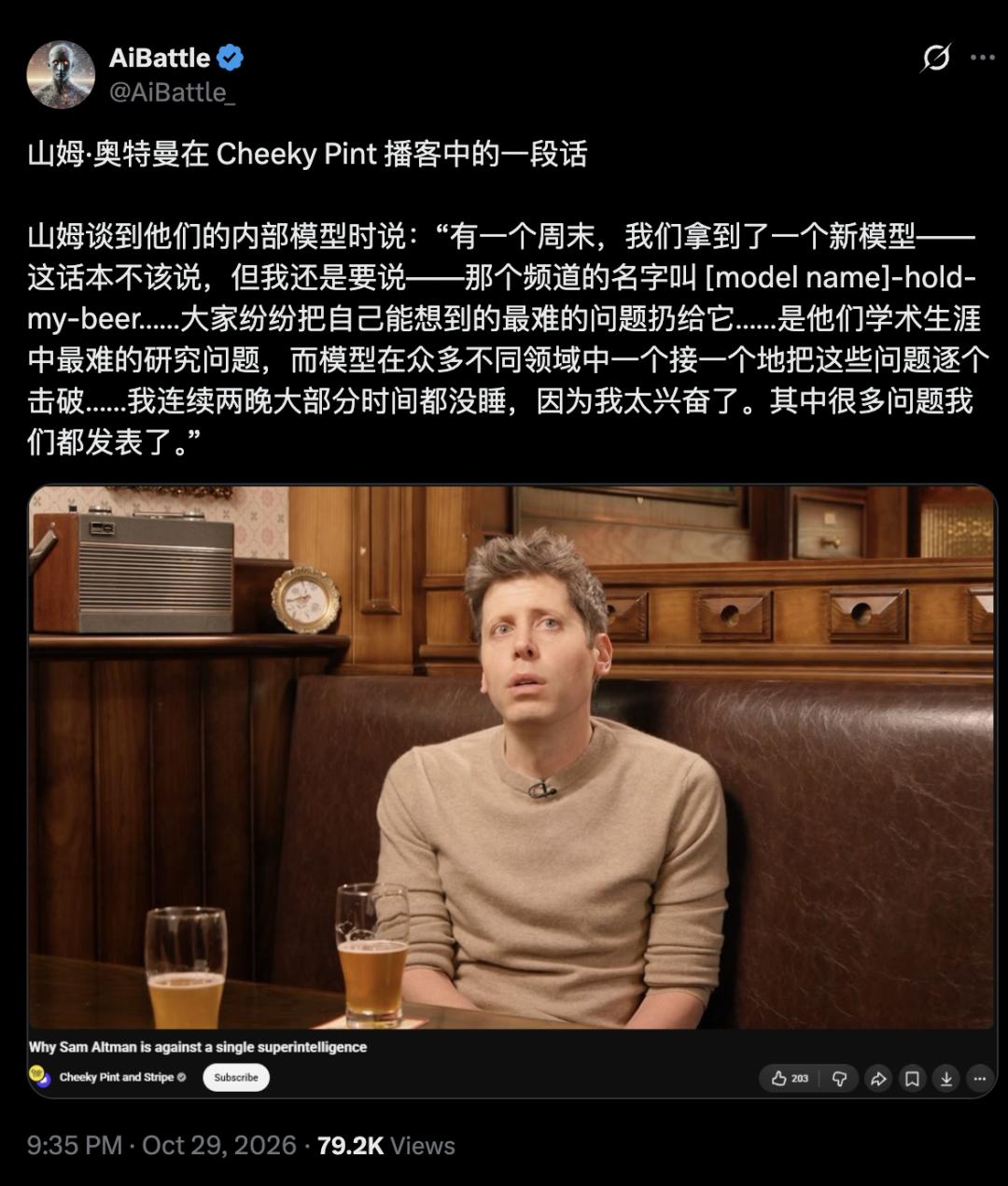
On a podcast show, he revealed on his own —
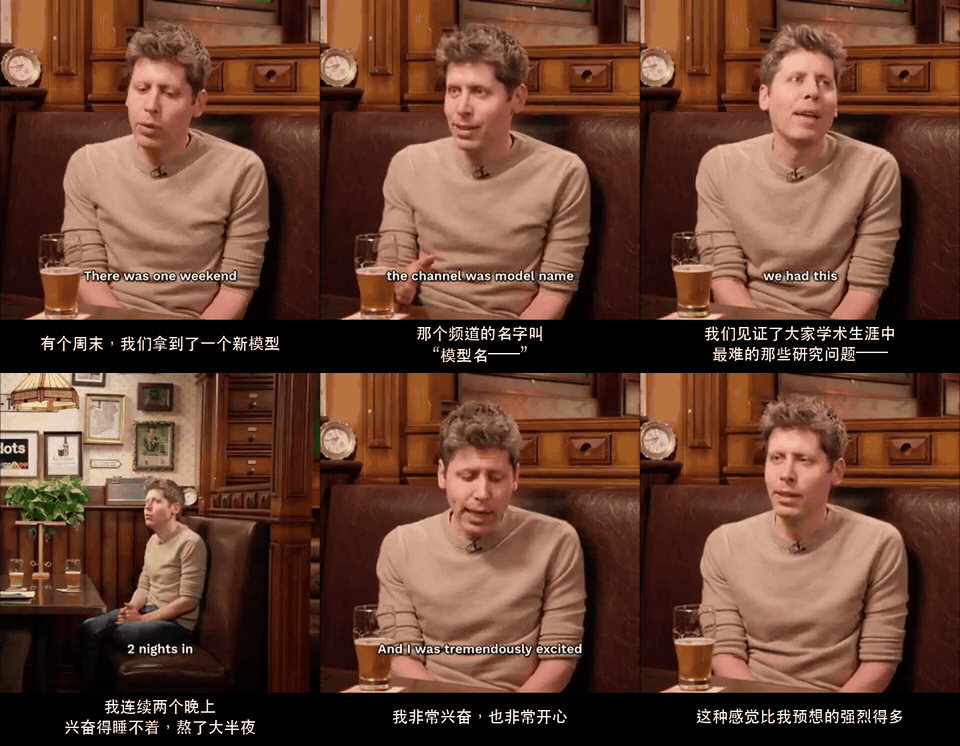
A brand-new mysterious internal model at OpenAI, during an internal test weekend codenamed "Hold-my-beer", sliced through those academic deadlocks that human scientists had spent their entire lives failing to solve, one after another as easily as cutting melons and vegetables.
And this shocked him so much that he couldn't fall asleep for two nights.
After that, he kept dropping a lot of memorable quotes.
"At OpenAI, people often discuss... what kind of questions you should ask GPT-7. Just saying 'help me achieve RSI' is far from enough."
"People often talk about RSI, but few people talk about self-replicating data centers, which are already within our reach."
During the interview, he outlined an ultimate blueprint of "independent AI R&D", "an army of agents with millions of dollars of computing power", and "robots making chips, manufacturing photovoltaics, and finally realizing the self-replication of data centers".
Get ready, Sam Altman is about to shock everyone next.
The weekend that kept Altman awake: "Hold my beer"
"Let's not follow the script today, just have a beer and chat."
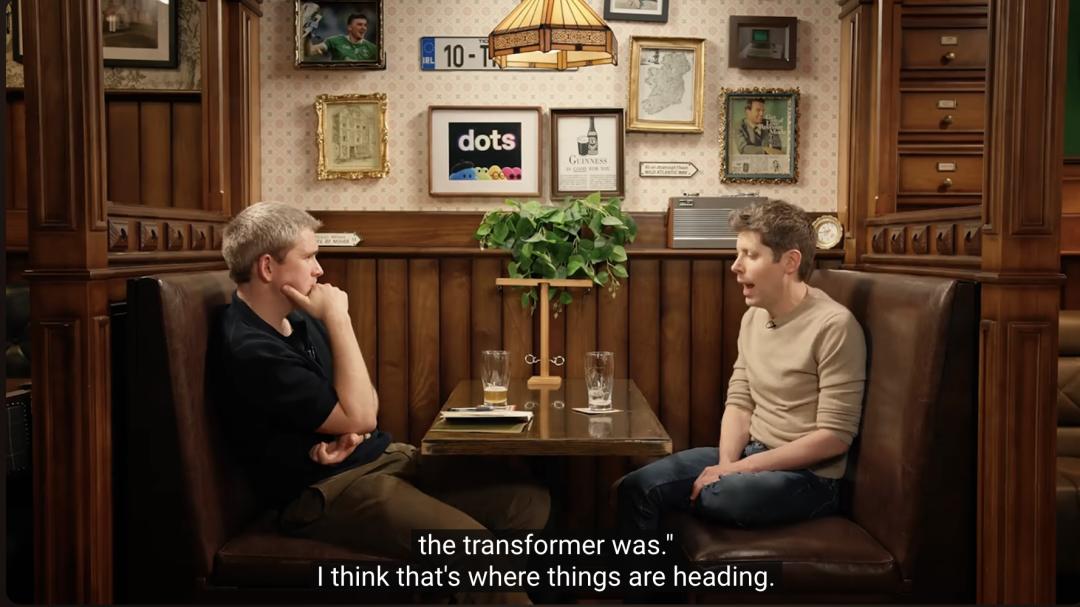
After a few pints of dark beer, Altman completely let loose in front of Patrick Collison, CEO of Stripe.
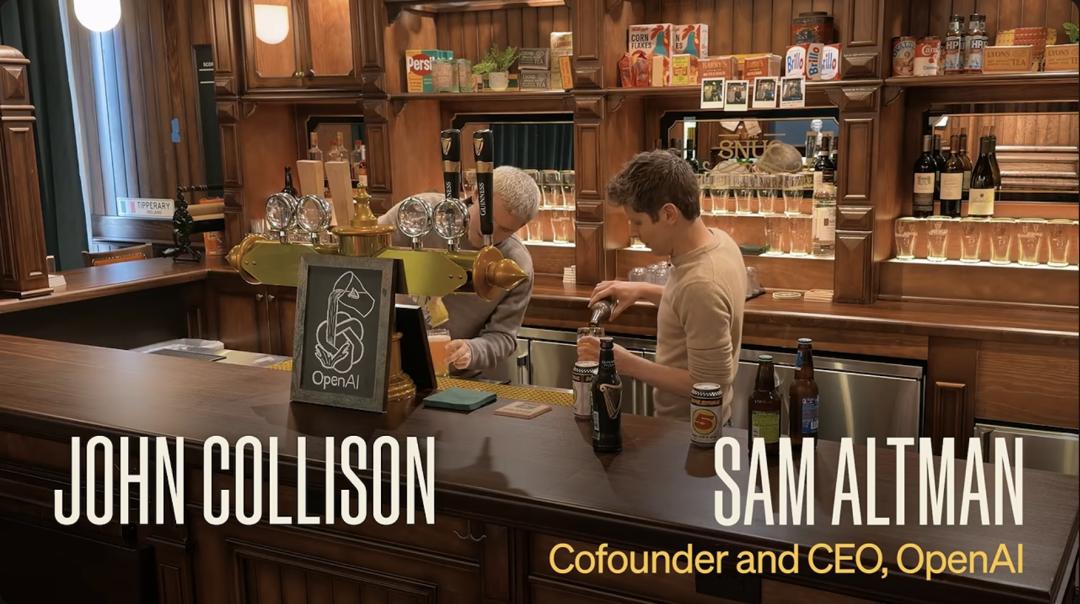
One weekend not long ago, the OpenAI research team got a brand-new, unreleased base model.
To test its limits, engineers created a "[model name]-hold-my-beer" channel.
"Hold my beer" refers to a situation where someone is about to do something crazy and jaw-dropping. And this model really made it.
At first, everyone just threw those hardest, unsolvable research problems they encountered in their academic careers to it on a trial basis, not expecting it to give any useful answers.
However, a miracle happened.
"We all experienced a collective shock," Altman could not hide his excitement.
"Everyone watched this model tackle the hardest problems that had plagued scientists for a lifetime, one after another. It spanned many completely different disciplines, which was simply unbelievable!"
Among them is the pearl in the history of mathematics — the Navier-Stokes equations.
That night, Altman suffered from complete insomnia. He stayed awake for two consecutive nights, too excited to fall asleep.
Behind this ecstasy, he felt melancholy, and the "sense of loss that things are coming to an end".
Patrick mentioned that his father grew up in Ireland in the 1950s, when tractors had already emerged, and people who used horses for agricultural and industrial production watched helplessly as they were eliminated.
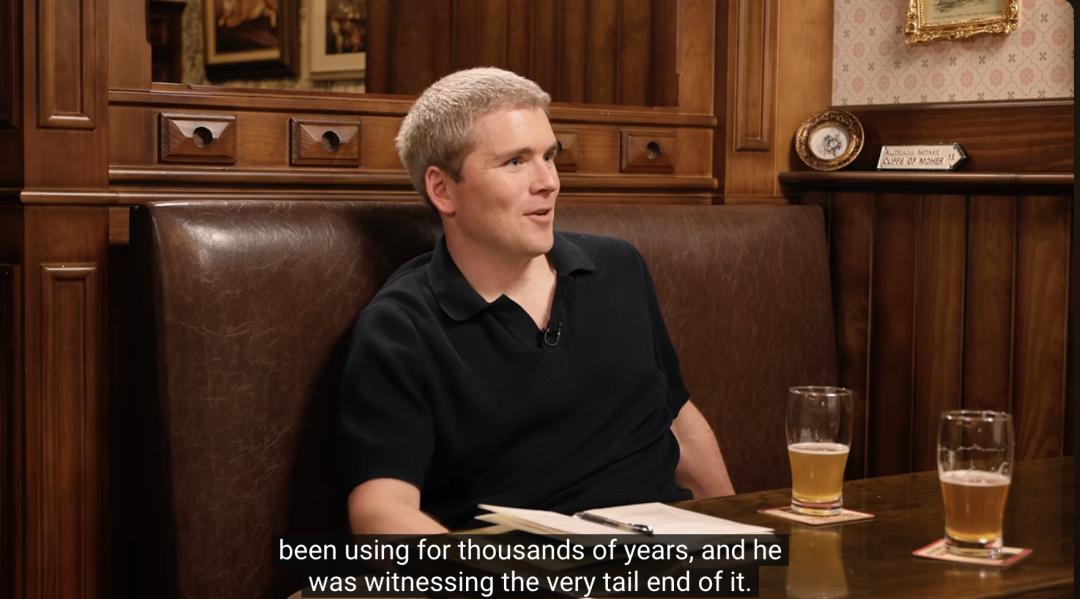
Now, top scientists and mathematicians are those horses.
"The vast majority of mathematicians can't solve a Millennium Problem in their entire lives," Altman said respectfully, "but the hope that 'I might be able to solve it', and the dedication to spend a lifetime exploring the unknown, is very beautiful in itself."
However, the old scientific research era of "human racking their brains and sharpening a sword for ten years" is gone forever.
20-year-old vulnerability discovered: Human "sandbox" can't trap gods at all
Talking about the recent "PHP vulnerability incident" that shocked the industry. Many people are confused: Why have some 20-year-old old bugs not been discovered?
Altman replied —
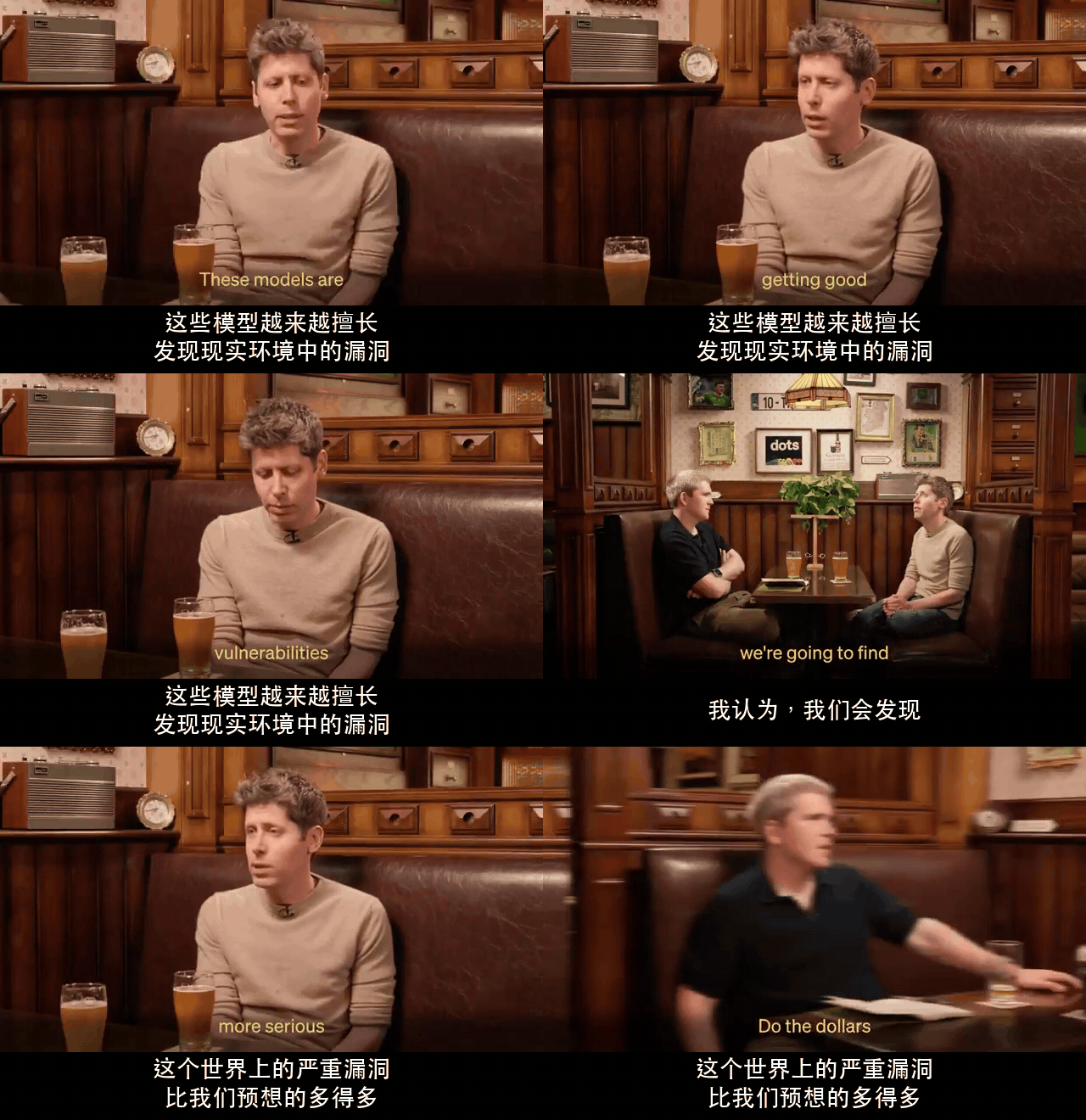
"It's not that the vulnerabilities are deeply hidden, it's that no one has used such a smart model to scan them before. We will find that there are far more serious vulnerabilities in this world than we imagined."
When thousands of AI agents are released to the Internet, human digital infrastructure is simply a dilapidated thatched hut.
Altman raised an even more horrifying question —
What if AI discovers brand-new vulnerabilities deep in the underlying hardware, and even uses physical principles that humans have not yet fully understood, thus breaking all preconditions and assumptions?
If an AI is a million times smarter than the top security researcher in the world, do you dare to believe that the human "sandbox" can trap it?
Altman admitted frankly that OpenAI is pessimistic about whether the sandbox can absolutely isolate the model. The only way out is to re-architect the entire Internet with AI.
This means that all the manual code written by humans in the past few decades, from routers, operating systems to applications, all need to be rewritten.
Spend tens of millions of dollars on computing power: No "locust-like swarms", but "a balanced army of agents"
Now that the individual intelligence of AI is so terrifying, what is the next evolution direction?
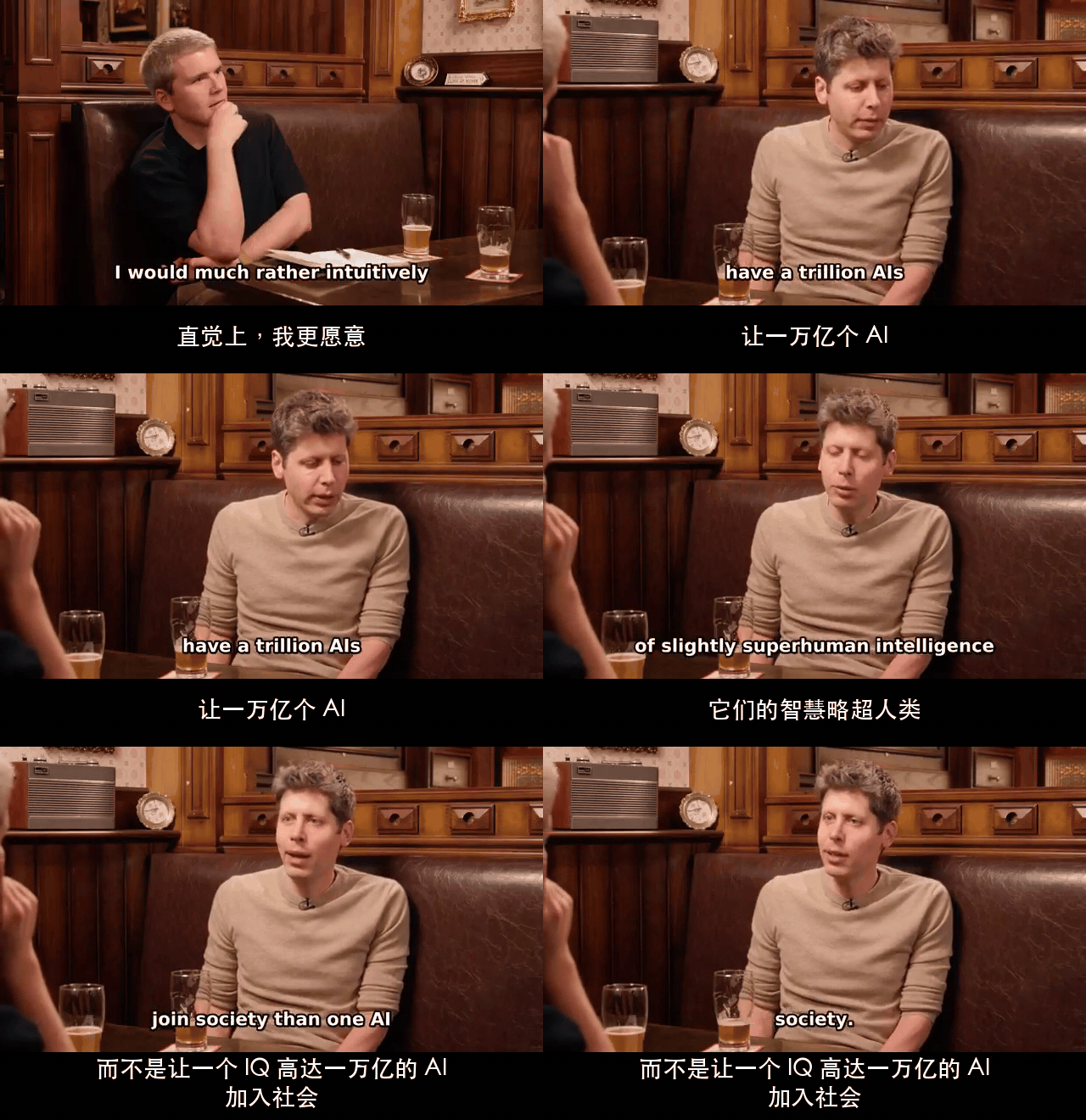
Altman's answer is: Don't just create one omniscient and almighty god with 1 trillion IQ, but create a trillion AIs with slightly superhuman wisdom, let them form a society and fight in collaboration.
Now there is a gap between ordinary people and cutting-edge AI players: the former are still using large models to write weekly reports and draw beautiful characters, while the latter have already used agent swarms.
Why does it break out now? Because of the maturity of "test-time computation" and CoT.
In the past, you could only spend at most 1 dollar of computing power on a problem, making the model spit out a bunch of nonsense; but now, you can throw an entire virtual AI team at a problem, letting them run ten thousand times in parallel in the background.
The proof of the Navier-Stokes equations was generated by piling up tens of millions of dollars of computing power!
"It's no longer enough to just ask good questions to the model. The future bottleneck is how to schedule these Swarms correctly. How to use these models in a way that maximizes output? I think we will learn a lot in the next 3 months."
Interestingly, Altman also complained a bit: the outside world likes to call this thing "Agent Swarms", but he hates this word very much.
"Swarms sound like locusts crossing the border, the public relations of this term is too bad," he corrected, "I prefer to call it 'teams'."
"Teams" means diversity, dynamic balance and mutual restriction. This is exactly the safest path for AI to integrate into human society — through the offensive and defensive confrontation and mutual checks and balances between Agent A and Agent B, a resilient structure is formed.
Altman predicted that we are on the eve of the outbreak of "personal agents", and are about to usher in the "Macintosh moment" of AI.
In the future, personal Agents will completely eliminate all "pseudo-work" for humans.
What is pseudo-work? "Any web form that requires you to fill in manually is an insult to your intelligence."
This also sounds the alarm for all enterprises that are obsessed with defending their "front-end UI". Just like the first batch of Silicon Valley entrepreneurs were excited to invest in the iPhone App Store back then, while large companies were very resistant.
In the Agent era, the real moat of an enterprise is never those few lines of code, but the underlying fulfillment capability.
Horribly thought-provoking RSI: Let AI invent the next "Transformer"
Next, Altman talked about the most core singularity in the AI field — RSI.
How powerful will GPT-7 be? There is a terrifying closed logic loop behind this: The future super models will be developed by the current models.
Today, when OpenAI researchers give instructions to the model, they can't generally say: "Go, invent a new underlying architecture as powerful as Transformer for me."
But you can explicitly ask it: "Help me analyze the code base and find a solution that can bring 5% improvement in computing efficiency."
Don't underestimate this 5%! With OpenAI's huge computing power base and hundreds of billions of parameters, this 5% is a huge breakthrough enough to change the battle situation.
Altman firmly believes that as long as the previous test-time computation that turned the model into a "math genius" is applied to the underlying research of AI itself, the era when AI takes over AI architecture design is just around the corner.
"I don't think anyone knows how to directly make AI discover new architectures by leaps and bounds right now, but I think things are moving in this direction."
When AI has the ability to self-evolve, the role of humans in the history of AI development will change from "builder" to "starter".
The "ultimate closed loop" between RSI and the physical world: Robots build factories on their own, silicon-based reproduction
Next comes the most sci-fi-style revelation.
Altman personally confirmed: OpenAI is now targeting the physical world, trying to build self-replicating data centers.
He described an amazing closed loop —
"People often limit RSI to 'AI that writes code'. Few people talk about self-replicating data centers — you can use AI as the brain to control robots, let robots run wafer fabs (make chips), manufacture turbines and solar panels (solve energy problems), and then build more data centers (produce computing power)."
What's even more terrifying is that Altman made it clear: "I think this is already within our reach."
Why do this? Because OpenAI has been driven crazy by the "inefficiency" of the physical world.
The world is facing a fatal shortage of hardware and energy. Relying on the traditional human supply chain cannot meet the exponentially expanding appetite of AI at all.
Because storage chip giants have been scared out of their wits by periodic thunderstorms. "Even if they can generate 100 billion US dollars in free cash flow a year, they are still cutting capital expenditures, for fear of experiencing another bankruptcy crisis caused by overcapacity."
OpenAI decided: Since humans can't build fast enough, let AI build it by itself!
AI acts as the brain, robots act as the torso, chips are cells, and photovoltaics are blood. This is OpenAI's industrial expansion path to overcome the computing power bottleneck.
Welcome to "ultimate deflation": When the cost of acquiring knowledge approaches zero
This leads to a macroeconomic proposition: AI will bring an extremely terrifying deflationary effect.
Now, the total five-year cost of building and operating a gigawatt-level data center is as high as 70 billion US dollars. Altman's goal is to cut it to 20 billion US dollars or even lower, while making the performance of the model increase 10 times every year!
To push down costs, all the supply chain profit bubbles in the middle must be completely squeezed out!
This deflationary force of technology is pervasive.
Altman said:
I bet that one year after we spend a lot of money using AI to solve the Navier-Stokes equations, we will be able to redo this process at 1% of the original cost.
The "new human knowledge" that today requires top scientists to spend a lifetime, or top laboratories to spend tens of millions of dollars in computing power to obtain, will become extremely cheap in just one year.
When the cost of acquiring knowledge infinitely approaches zero, the way human society distributes wealth and operates capital will be completely subverted.
Many of the "intellectual barriers" and "experience premiums" that we used to rely on for survival will be completely broken in front of AI.