Once you start scrolling, you easily lose track of time and spend at least two hours on it. The viral Hongguo that no one across the web can tear themselves away from fears being "killed by excessive praise".
Hongguo Short Drama has become the fourth largest App in China, allowing users to binge-watch for 125 minutes a day. Why is it so wary of being hailed as the "King of Time-Killing" and refusing to recognize that China's internet has entered the "ByteDance Era"?
Media professional Qin Shuo probably never expected that his remarks "the terrifying Hongguo" and the claim that China's internet is entering the "ByteDance Era" would prompt Li Liang, Vice President of ByteDance Group, to issue successive posts in response.
On October 26, Qin Shuo cited data from Nomura Securities and wrote: In July 2026, among the Top 50 Apps by mobile internet usage duration in China, ByteDance's ecosystem accounted for 40.9%, Tencent's ecosystem accounted for 29.1%; Douyin surpassed WeChat for the first time; Hongguo Short Drama had 168 million daily active users, exceeding the sum of the four platforms iQiyi, Tencent Video, Youku and Mango TV, with a per capita daily viewing duration of 125 minutes. Calculated by total user usage duration, Hongguo has become the fourth largest App on China's mobile internet, second only to Douyin, WeChat and Douyin Lite. Based on this, Qin Shuo put forward the concept of the "ByteDance Era" for China's internet.
In his first round of response, Li Liang argued that this statement was "extremely unrigorous" and pointed out that there were "common-sense errors": Nomura only counted the Top 50 Apps, excluding long-tail apps and PC-side usage, and ByteDance's ecosystem share "did not even reach half of the total". Later, he posted successive articles, with the core point that such generalization would bring misleading effects and the risk of "excessive praise leading to downfall". Qin Shuo also responded continuously, launching a debate around data calibers and wording.

(Photo/Unsplash)
One of the scarcest resources on the internet is attention. Whoever occupies users' time will gain advertising revenue, data resources and ecological entry points accordingly. A Chinese mobile user's day has long been divided into many fragments: Douyin, WeChat, Hongguo, Xiaohongshu, Taotian, JD, Meituan, Bilibili, Doubao, Youku, iQiyi, Tencent Video, Mango TV, Alipay... Douyin and Hongguo are obviously the top performers in the ByteDance ecosystem, while Hongguo is the fastest-growing "King of Time-Killing" in recent years. Relying on its free model, it has become a national-level App comparable to Douyin and WeChat in only three years, and has to some extent become a byword for short dramas.
But labels are external generalizations, and platforms themselves are often reluctant to be simply labeled. Why is Hongguo so popular, and why does it keep a distance from the title "King of Time-Killing"? This issue is worth careful consideration.
What exactly are the two sides arguing about in the "ByteDance Era" discussion?
Qin Shuo believes that what he made is a trend judgment: "Just as many scholars at home and abroad say that the 21st century is the Chinese century, this is a judgment of a trend... When the statement 'the 20th century is the American century' was put forward in 1941, the US GDP accounted for just over 30% of the global total."
In his view, the "ByteDance Era" is not a rigorous legal ruling, but a generalization of the trend of the times, focusing on share and momentum rather than absolute monopoly. Faced with doubts about data calibers, he cited the Nomura report to respond: The Top 50 Apps account for 93% of the total mobile internet duration, which is sufficient to represent the overall market. At the same time, he actively defined the boundary: duration share does not equal value contribution, and Alipay and Meituan are high-value counterexamples where users "leave immediately after use".
He said that instead of worrying about the statement "ByteDance Era", it is better to strive to make this period of time more socially valuable and meaningful.
Li Liang countered with data and also expressed his concern about the risk of "excessive praise leading to downfall". His response even started with "recommendation". On October 27, he first recommended several Hongguo short dramas such as *Entering the Song Dynasty with Weapons* and *Emergency Department Slacker King* on Weibo to prove that "content quality is improving", and then directly pointed out that the definition of the "ByteDance Era" is extremely unrigorous.

(Photo/Baidu Baike)
His reasoning is: Among internet products, only instant messaging has a relatively stable pattern due to the moat of social relationship chains; short dramas and short videos are fully competitive industries, and "no company can firmly occupy the first place in the market". He believes that "instant messaging, games, e-commerce, and music all occupy a lot of user time", not to mention that "the growth rate of Tencent's short dramas and short videos far exceeds that of Douyin and Hongguo".
Regardless of whether the generalization of the "ByteDance Era" is valid, users' real experience that Douyin and Hongguo are "time-killing artifacts" is undeniable. Some people regard Hongguo as "electronic pickles", binge-watching for an hour and a half during lunch break and commuting time, and feel that "you can stop at any time, it's very relaxing". Some people posted screenshots showing 10 hours and 23 minutes of viewing time under hot searches, shouting "Hongguo, please launch an anti-addiction function, I want to sleep", while complaining that their brains are numb, their fingers are still swiping down.
The mouth and the hands act separately. This sense of division has become a daily routine on the internet: the "Hongguo Service Area" in Guizhou has been checked in and teased by netizens that "you have to watch ads to get out"; the line "it's a bit expensive, but it doesn't make your stomach burn" has evolved from a short drama line to a social code for judging everything; "Jia Zhangke watches Hongguo short dramas, Wang Shuo binge-watches short videos for 10 hours a day, so there's nothing wrong with me doing these things". Since many celebrities kill time in the same way as I do, it doesn't seem difficult to achieve self-reconciliation.
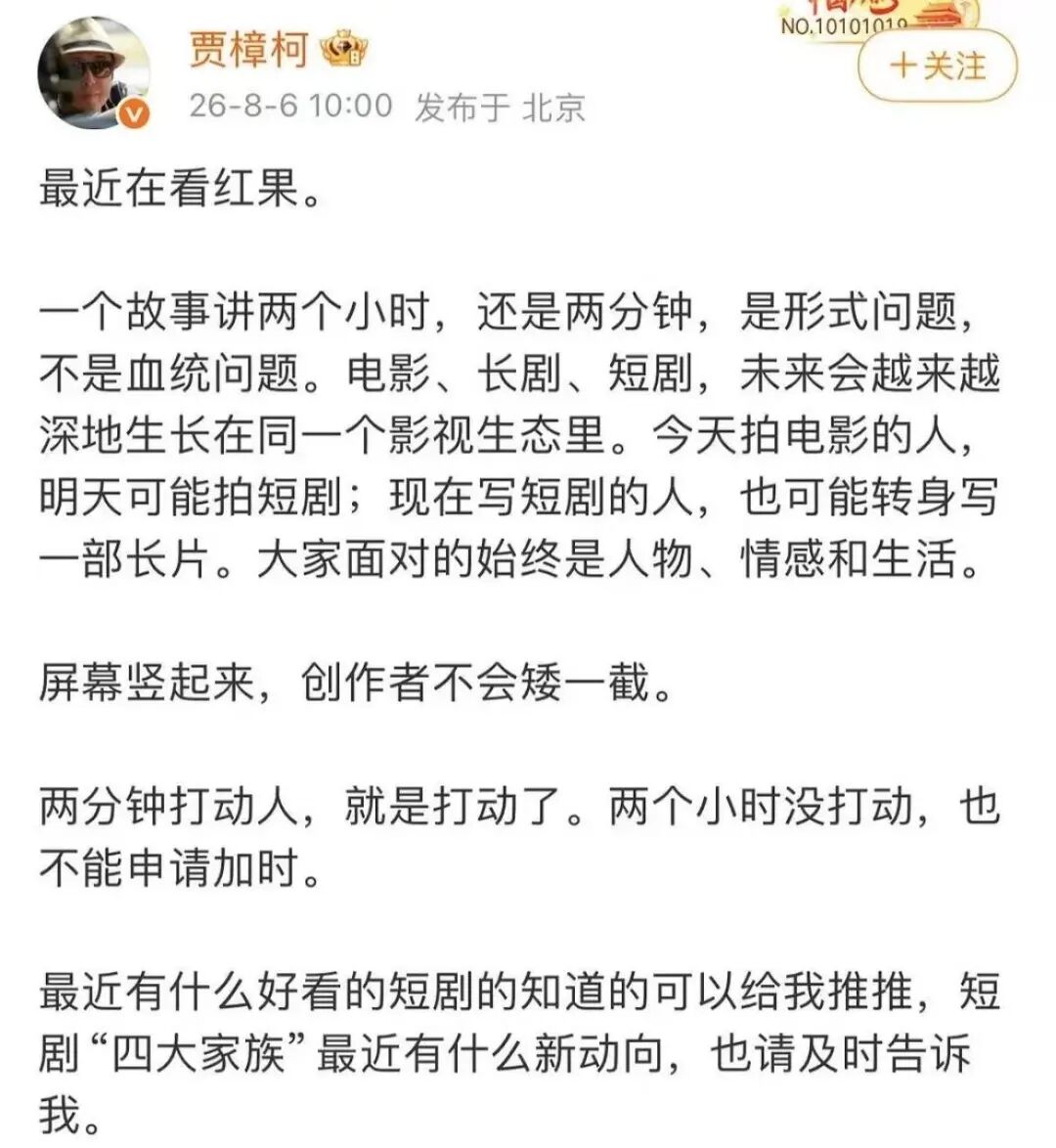
(Photo/Screenshot from Weibo)
Regulation on short dramas has been extremely strict. Since the beginning of this year, regulatory authorities have removed 68,000 illegal micro-short dramas across the entire network, supervised platforms to dispose of more than 1,200 illegal accounts, and over 90% of the disposed content comes from AI-generated dramas. Hongguo itself was suspended for rectification for five days at the end of 2024 for failing to implement management regulations, and as of October 27 this year, it has disposed of 20,426 low-quality and homogenized micro-short dramas. The *Administrative Measures for the Development of Micro-Short Dramas* implemented on September 1 this year requires classified filing, mandatory labeling of AI-generated content, and prohibition of algorithm models that induce addiction and excessive consumption.
At the same time, the National Radio and Television Administration launched the "Micro-Short Drama +" initiative in 2025, planning to support about 300 key works. The regulation's intention of cleaning up while supporting is obvious: short dramas cannot have only one way to survive, nor only one way to provide pleasure. For the industry, this is not only a constraint, but also an opportunity to make content more diverse.
Why can Hongguo keep people binge-watching for 125 minutes?
Hongguo accounts for nearly 90% of the market share of independent short drama Apps. Who exactly are the people who spend 125 minutes on Hongguo?
In 2026, the proportion of male users in Hongguo Short Drama and Hongguo Manhua has both approached 60% (58.6% and 60.5% respectively), which is consistent with the overall trend of the industry, while the actual proportion of users over 45 years old has dropped to about 43%, and young and middle-aged people have become the main user group. In addition, users from third-tier and lower cities account for 55.2% of the platform, and as high as 49.2% of new users are diverted from the internal manhua section. It can be seen that Hongguo has evolved from the early female-dominated ecosystem to a sinking ecosystem with a slight advantage of male users and relying on internal matrix diversion.

(Photo/Hongguo Short Drama Xiaohongshu account)
What is certain is that Hongguo's user base is skewed towards middle-aged and elderly groups and sinking markets — they are middle-aged people who collapse on the sofa after work, urban elderly who have plenty of time but are reluctant to pay dozens of yuan for long video memberships, and elders who forward posts with shocking headlines in the "Family of Relatives" group and are silently set to "message do not disturb" by young people.
Hongguo lowers the entry threshold with the model of "watch for free, just watch ads", letting users enter easily. What really makes people unable to stop is that it implants Douyin's information flow gene into drama content. On long video platforms, you have to search for dramas first, read posters and check comments to select; on Hongguo, you don't need to search, it automatically plays continuously after you open it, and the suspense at the end of each episode directly pushes you to the next one. The platform does the drama selection for users. This reduces the selection cost, and also gives the platform more control over the decision of "what to watch next".
TMTPOST once analyzed this commercial closed loop: Hongguo's more critical innovation lies in the commercial mechanism, which changes the short drama model from "charging users" to "selling user time to advertisers". In the past, to make short dramas, producers had to spend money on traffic investment on Douyin, and ByteDance earned the "toll"; now Hongguo itself makes free short dramas, directly turning producers into "suppliers settled by revenue sharing", and ByteDance has changed from a toll station to a terminal. When AI pushes down production costs, the value will not stay at the production end, but precipitate to the platform's right to allocate attention.

(Photo/Douban)
When the platform has strong control over the allocation of attention, content forms will tend to be more standardized. Each episode is only 1 to 3 minutes long, and the first 10 to 15 episodes must be "highlights in every episode". If you can't see the main storyline after watching three episodes, you will most likely swipe away. Therefore, the platform's hit list is highly solidified: more than 80% of the works are concentrated in the genres of fantasy cultivation, urban counterattack, and ancient-style female-oriented themes; 90% of them follow the three-part structure of "suppression — gaining special abilities — slapping back". The protagonist is destined to be a loser or cleaner betrayed by relatives and friends at the beginning, and must reveal his true identity as a "war god" or "miracle doctor" within 30 seconds. The character setting must be established in 3 seconds, the conflict must break out within 5 seconds, and if there is too much foreshadowing, the audience will swipe away. This rhythm is very effective, but it also brings homogenization pressure. Users can easily fall into a state of being led by the emotional rhythm.
Users' viewing habits in turn reshape the production mode of the short drama industry. When AI reduces the cost of each episode to a fraction of that of real-person shooting, Hongguo tightens the minimum guarantee policy for AI-simulated real-person scripts, and the revenue sharing rules are tilted towards pure sharing. This adjustment practically prompts contractors to pay more attention to the probability of hit works. According to reports, a company that has filmed nearly 200 real-person short dramas directly emptied its real shooting studio, and all its employees switched to AI drama production.
The platform is no longer just a distribution channel. How to share revenue, what the algorithm recommends, and what themes are popular are all in its hands. It knows far more about retention data than creators themselves about what to recommend, what to reward, and what to mass-produce. With Hongguo's nearly 90% share among independent short drama Apps, this set of internal rules will inevitably spill over to the entire production ecosystem, but whether it has solidified into a cross-platform "industry standard" still depends on the extent to which other channels follow the same logic.
Short dramas have become a trend, what should we pay attention to?
Recently, "AI short dramas reduce intelligence" became a hot search. People can't stop when watching, but after turning it off, their brains feel like they have been formatted. Some people describe that after binge-watching dramas, "it's even difficult to finish reading one page of a book"; some people say they can't remember what the drama is about the next day, as if they have been fed a bellyful of "electronic spicy strips" by the algorithm.
Zou Ying, deputy chief physician of the Clinical Psychology Department of the Second Affiliated Hospital of Zhejiang Chinese Medical University, gave an explanation in an interview with the media: Short dramas use dense reversal hooks to continuously stimulate dopamine, making the brain passively excited and overloaded. She believes that long-term high-frequency consumption may be accompanied by fatigue of the dopamine system, which temporarily affects concentration and comprehension. This mechanism still has room for scientific discussion, but the physical feeling that "the brain feels formatted after turning it off" is real. What really deserves attention is whether people still have the patience to return to deep reading or viewing that requires going through boring parts after getting used to rewards every 3 seconds.

(Photo/Unsplash)
When it comes to watching short dramas, the elderly are less able to quit than young people. The payment traps targeting the elderly in the short drama ecosystem are not limited to Hongguo. According to reports, a 70-year-old