Lobster carcasses, shattered SaaS dreams, the anxiety of big tech giants: What exactly is AI office?
In 2026, AI office productivity has become a must-do business for every major tech giant.
Three months after Tencent launched its WorkBuddy, the product recorded 20.97 million monthly PC-side visits; Alibaba integrated three Agent products, namely QoderWork, Wukong and MuleRun, into "Qianwen Office"; ByteDance's "Doubao Work" attracted more than 100,000 enterprises to apply for internal beta testing within one week of its launch.
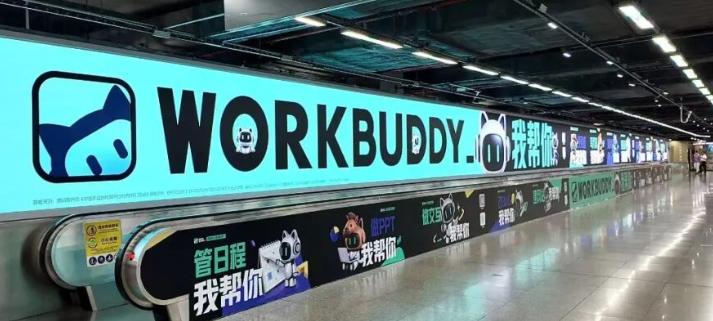
For a time, AI office productivity advertisements could be seen everywhere in airports, subways and elevators. When opening Xiaohongshu and Bilibili, users are flooded with overflowing AI office tutorials and product recommendations. If you do not pay attention to AI in daily life, you may be completely confused about what is happening when seeing the ubiquitous advertisements. But at least everyone will have this first impression: AI office productivity is definitely a lucrative business, otherwise major tech giants would not have entered the market so intensively and invested so many resources.
But is this really the case? I would like to pour some cold water: Sorting out the origin of the AI office boom, you will find that this is a business that lacks commercialization prospects. The collective entry of major tech giants into this field is less of an active choice than a forced move to the poker table. Driven by the combination of external trends and internal pressure, AI office productivity is likely to turn into a do-or-die battle with a frustrating outcome.
Everything starts with "picking up the lobster's remains".
The Remains of the Lobster
At the beginning of this year, Lobster set off a global wave of Agent applications. This cross-application, highly executable application model logically fully conforms to the narrative standards of AI applications, and indeed brings a lot of office efficiency improvements in terms of user experience, leaving people with infinite reverie for a while.
On the other hand, Lobster's security is questionable, and its installation and usage experience is too complicated, which doomed this open-source application to fail to occupy the mainstream of commercialization for a long time. When Lobster itself is kicked out of the game by various forces, who will fill the market space it has already opened up?
This is the origin of all current domestic AI office software: To build a commercializable pirated version of Lobster, and follow the path that has been verified by Lobster.

What is on this old path? There is real Token consumption volume: in March this year, Lobster's Token call volume once accounted for 18% of the global total, which indeed proved that customers are willing to spend money on Agents. At the same time, there is real application growth: Lobster does not rely on models, but conquers users with the Agent application model. This gave major tech giants who were exhausted from the fierce competition in basic models a brand-new direction for AI development. Meanwhile, Lobster is naturally endowed with certain ecological affinity. During the period when the whole people were "raising Lobsters", users tried every means to make Lobster compatible with WeChat, Feishu and DingTalk. Then when these manufacturers launch their own Lobster-like AI office applications, wouldn't they naturally be connected to their own moats?
In this way, Lobster-like AI office productivity has formed a closed logical loop in terms of traffic, model and ecology. Therefore, AI office productivity has to be done, otherwise the world's largest AI application opportunity will slip away right under their noses.
There is only one problem left: Lobster is an open-source project, and it has not proved that it has any commercialization potential or a solution to build users' payment habits.

In other words, Lobster makes no money at all. And major tech giants that have to make profits have no ready-made solutions to copy.
In this way, major tech giants picked up Lobster's remains. To be precise, they picked up the shell that Lobster shed. This shell looks bright and gorgeous, with vivid scales and claws, but the problem is that the lobster meat called profit does not grow on the shell.
Then where does it grow? No one knows the answer.
The Broken Dream of SaaS
A well-known data institution, in its enterprise software report, defines China's enterprise service market as a "SaaS desert".
Very cruelly, after more than 20 years of development, China has basically proved that SaaS is a complete failure. Enterprises would rather pay high costs for privatized computing power and solutions than pay even a tiny subscription fee for software. Every round of enterprise software upgrade can tell a new story for SaaS: subscription model, seat-based pricing, traffic-based billing, mutual conversion between free and paid versions, and private deployment delivery for large clients. Every time this story sounds exciting, but manufacturers can do nothing when it comes to charging.
Unfortunately, the cutting-edge advanced AI office productivity and Token billing seem to be essentially such a new SaaS story. In this story, the software seems to be able to cross applications, work on its own, and perform natural language understanding, but there is still no answer to that question: why should users keep paying continuously?

The 20-year predicament of China's SaaS industry can be summed up in one sentence: the value of software is difficult to perceive, and payment habits have never been cultivated. The essence of this matter is that there is no shortage of free products on China's Internet, and the small and medium-sized enterprises that make up the main body of enterprises do not care about efficiency, but only about revenue; large enterprises trust localization more and do not want to be bound by paid software. These fundamental market bases are still completely preserved in the AI era. AI office software can make employees work faster, so what? Will the capital side pay for this and let everyone get off work early?
Therefore, the changes brought by Lobster occurred on the product and technology side. This product model has been verified to have a market when it is free and open-source. But on the commercial side, the situation may be completely different. All the broken dreams of SaaS are still reflected in AI office productivity. There are no new driving forces for enterprise payment, and no strong elements that can change users' payment habits. When it comes to payment, nothing is achievable.

The following three things will most likely happen on the commercial end of AI office productivity:
1. It is necessary to implement policies of exchanging scale for free services and exchanging users for subsidies, and the competition will be extremely fierce. Then tiered charging will become a standardized path, while manufacturers will also find that funnel-based payment cannot generate much commercial returns.
2. The consumer market will still be a traffic entry point and a low-payment depression. Major tech giants still have to rely on the government and enterprise market and private deployment to realize revenue, but the competition in this market is a brand new game. The government and enterprise procurement decision-making chain is longer and more cautious, and it follows the requirements of "privatization + customization + no data leaving the domain" from the SaaS era, which is no different from a nightmare rerun for the major tech giants behind AI office productivity.
3. High-frequency homogeneous competition will quickly squeeze profit margins. Major tech giants will return to the old path of relying on ecological positioning, and small and medium-sized players will be eliminated quickly. Big fish will eat small fish, but the process will be very painful.
High penetration, low payment rate, low gross profit, using free subsidies to exchange for scale, but the scale cannot bring revenue. These lessons from SaaS are likely to repeat themselves in the AI office productivity sector.
Whoever can break this vicious cycle in commercialization may become the final AI king.
But as for its means and methods, we have no idea at present.
Anxiety of Major Tech Giants
On the one hand, there are technological opportunities, and on the other hand, the commercial prospects are dim. Under such circumstances, major tech giants still have to go all out to invest in the AI office productivity war, not because they believe in AI, but because they are deeply anxious.
At the current stage, the situation of major tech giants in the AI field is: absolutely correct direction, huge investment, unknown return.
Whether it is policies, public opinion or the capital market, they are all pushing major tech giants to develop AI. Major tech giants have indeed invested sky-high AI costs including computing power procurement for this purpose. But after the investment, output is needed, and the result is that major tech giants find it difficult to find clients willing to take over the AI business which is a huge money burner.

The situation in the C-end market is that there are many users but no revenue. The monthly active AI users have exceeded half of China's netizens, and large-scale popularization has been completed rapidly. But the free model makes it difficult for AI to directly monetize, the vast majority of users do not want to pay for AI at all, and manufacturers even have to continuously pay for the reasoning cost of models. This kind of money-losing business is unprecedented in the Internet era. In addition, the differentiation between models is shrinking, making the competition among manufacturers more intense. And the few high-net-worth users with high technical demands are flowing to overseas products such as GPT and Claude Code one after another.
In this situation where "the house has finally been renovated, but it is found to be leaking in all aspects", the patience of the capital market has begun to narrow, and major tech giants must actively look for injectable cash flow. As a result, the B-end market has become almost the only certain way out. After all, the B-end cash flow is predictable, measurable, renewable, and the enterprise migration cost is extremely high, with user stickiness far higher than that of individual users.
Therefore, major tech giants do not naturally want to do AI office productivity, but after excluding all other options, this is the only remaining must-do choice. Entering this direction is not because it is very profitable, but because it looks the most like a business that can make clear accounts.
Old Wine in a New Bottle
My overall judgment is that the commercialization of AI office productivity is generally pessimistic, at least in the short and medium term.
The core reason is that the new bottle of AI still contains the old wine of enterprise software payment. And this time the old wine may taste even more bland to enterprises than ever before.
The reason is that AI office productivity mainly brings improvement in office efficiency, so employees no longer have to do a lot of complex and redundant work. For example, the same document can be written with AI, and the same spreadsheet can be pulled faster by AI. This direction theoretically has extremely high industrial value, but in fact its commercial ceiling is very low. Because the payer for efficiency improvement is very vague: the direct beneficiary is the employee, but the one who pays is the boss. And it is difficult for the boss to pay for employees working faster, especially on the premise that he is not used to paying for software and cannot find more work for employees to do.

Improving individual efficiency does not equal improving organizational efficiency, and enterprises are not willing to pay quantitatively and continuously for individual efficiency. And to get individual users to pay for AI office productivity, manufacturers have to face problems such as limited willingness and ability of individual users to pay. Frankly speaking, many AI office users I have come into contact with have a certain willingness to pay. But when they pay, they prefer overseas products with better effects, and more people are willing to pay for a trial rather than include it in their continuous expenditure.
If AI office productivity wants to obtain lasting vitality, the most ideal way out is to create new value for enterprises, rather than simply "improving office efficiency". The anchor for sustainable charging is the output that did not exist before, the extra money earned for enterprises, the extra orders delivered, and the entire job positions saved. But Lobster did not bring these values, so the new wine is still waiting to be brewed.

This is roughly what AI office productivity is all about — the shell shed by Lobster constitutes its product form. This shell is very beautiful, but it is empty inside, leaving no business model. The basic model of SaaS constitutes its commercial core, which is a 20-year-old broken dream where 99% of enterprises suffer losses. But even if the first two points are established, major tech giants still have to bet on AI office productivity. Because anxiety prevents them from letting go of any opportunity to recover funds, even if there is no cash in this opportunity, they have to look for a ticket to the next opportunity.
AI office productivity is a real demand, a dubious business, and a forced bet.
If within the next year, AI office productivity cannot achieve a sufficient payment rate, a high proportion of revenue from result-based billing, and a large-scale group of continuous paying users, then the vicious cycle of being well-received but not profitable will repeat itself. The real watershed will probably lie in whether AI office productivity will move towards "saving effort for people" or "generating output for enterprises".
The shell shed by Lobster has been put on by major tech giants, but no flesh will grow in this shell on its own.
What major tech giants really need to head for are the places where flesh and blood can grow.