Starting from the low-altitude sector, examining a frontline case of domestic substitution in aviation manufacturing | OpenTalk Review
On October 27, 36Kr hosted an OpenTalk live event themed "From 'Choke Point' to Independent Controllability: The Ongoing Domestic Substitution in Aviation Manufacturing", inviting Wang Gang, Founder and CEO of Lanxiao Aerospace, Sun Peng, General Manager of Jitai Aviation Technology, Wang Fei, Founder and General Manager of 208 Advanced Technology as guest speakers. They shared in-depth insights on topics including independent R&D of aviation range extenders, intelligent avionics system architecture, and the development of inertial navigation technology, and conducted online interactions with the audience.
The following is a summary of key takeaways from this live session. You are welcome to read, share and bookmark it.
Scenario Reverse Deduction: Solving Range Constraints with Self-developed Range Extenders
Guest Speaker: Wang Gang, Founder and CEO of Lanxiao Aerospace. He has long been engaged in R&D of large UAVs, and once served as the chief designer and flight control lead of a certain large UAV model in the aerospace industry. He has won national and Beijing municipal science and technology awards. He led Lanxiao Aerospace to complete the full tilt transition test flight of the large hybrid-electric eVTOL aircraft, and the self-developed 800V piston aviation range extender and flight control subsystem have been independently commercialized in the market.
Key Sharing Words: eVTOL, hybrid-electric, tilt transition test flight
The outline of the 15th Five-Year Plan proposes that in the field of low-altitude equipment, it is necessary to accelerate the development of new low-altitude equipment such as long-range vertical take-off and landing aircraft, and break through key technologies such as hybrid power systems. Under the guideline of "prioritizing cargo over passengers, prioritizing suburbs over cities", Lanxiao Aerospace chose to enter the market starting from large extended-range vertical take-off and landing unmanned transport aircraft.
Wang Gang judges that cargo scenarios such as time-sensitive express delivery, transportation on plateaus, islands and mountainous areas, and emergency rescue are more likely to generate real commercial demands first. Based on the requirements of these scenarios for large payload and long range, Lanxiao LX-1 adopts an extended-range hybrid-electric and tilt-rotor scheme, with a designed range of 1000km, a valid payload of 700kg, and an economic cruise speed of 200-250km/h, aiming to realize half-day point-to-point direct access within a radius of 1000km. In June 2026, LX-1 has completed the full flight process including vertical takeoff, tilt transition, fixed-wing cruise, and reverse transition to vertical landing.
According to simulation calculations, under the premise of retaining emergency power, the range of a pure electric eVTOL with a payload of 300kg is less than 100km. The extended-range route is designed to solve the practical range constraint of the pure electric solution.
The extended-range solution can adjust the energy supply mode according to different flight phases: under high-power demand conditions such as vertical takeoff and landing, it adopts pure electric or hybrid mode; under low-power demand conditions such as cruise, the extended-range generator continuously replenishes energy for the battery.
Taking the 2.5-ton class aircraft as an example, the 200kW extended-range generator set can provide more than 900kWh of extended-range power. While breaking through the battery capacity limit, it avoids the battery life loss caused by deep charging and deep discharging, and provides a more secure power output guarantee for landing hovering.
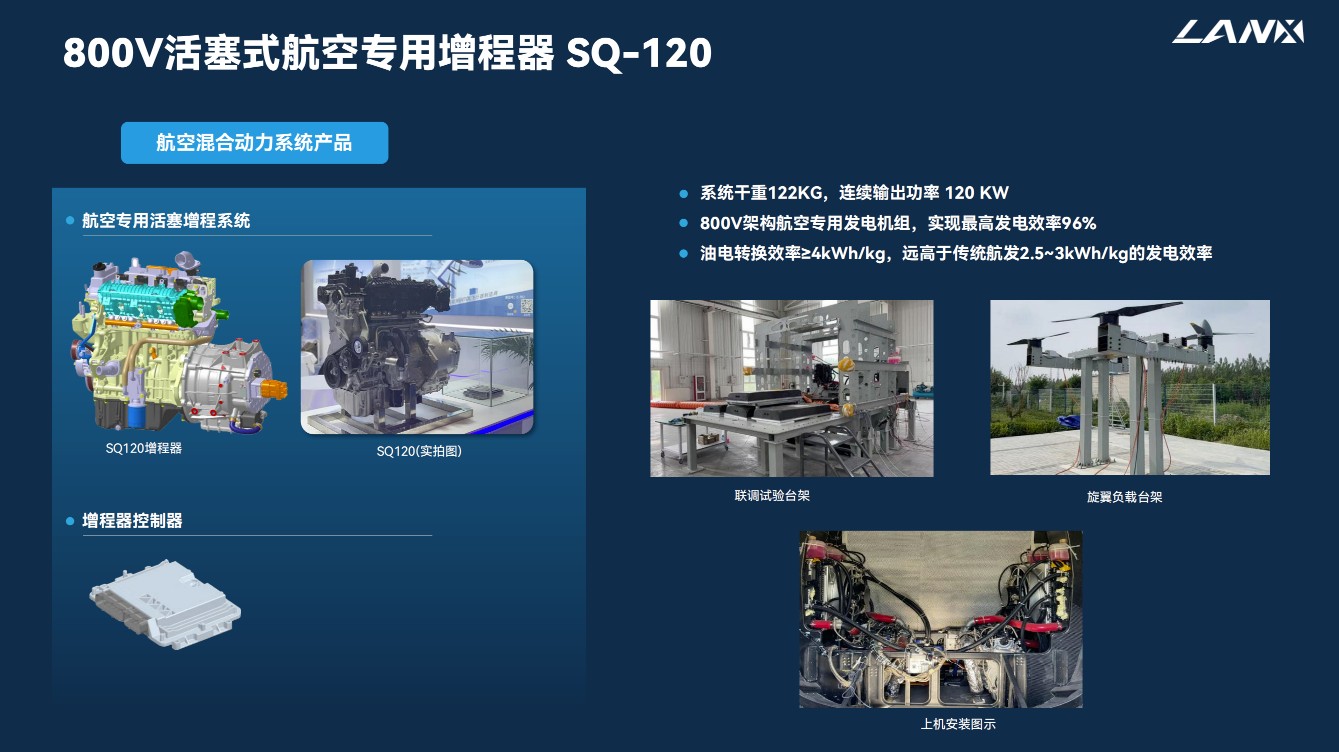
800V Piston-type Special Aviation Range Extender SQ-120
Focusing on this route, Lanxiao Aerospace has self-developed the 800V piston aviation range extender SQ-120 for the LX-1. Based on the technically mature 1.5T turbocharged direct injection engine, combined with the newly developed 800V SiC architecture special aviation generator assembly, the SQ-120 achieves an oil-electric conversion efficiency of 4kWh/kg and a continuous output power of 120kW, meeting the goals of high power density, wide operating voltage and high-altitude insulation. At the same time, Lanxiao Aerospace also independently developed the range extender controller, which further optimizes the energy management of the power system.
At present, the self-developed hybrid system of Lanxiao Aerospace has achieved 100% domestic production. Subsequent aircraft and power systems will continue to iterate around scenario adaptation for landing, airworthiness verification, reliability and mass production cost.
Building a Local Avionics Platform That Is Certifiable, Mass-Producible and Evolvable
Guest Speaker: Sun Peng, General Manager of Jitai Aviation Technology. He once served as Vice President of ZTE and Vice President of Himalaya. With more than 25 years of experience in the communications, Internet and avionics industries, he has long been deeply engaged in the fields of avionics and intelligent flight, focusing on the architecture and key technologies of avionics systems for new aircraft such as eVTOL and large cargo UAVs.
Key Sharing Words: Low-altitude economy, intelligent flight, avionics architecture, secure digital infrastructure
Intelligent flight is an important capability for low-altitude aircraft to reduce operating costs and realize commercial value. To improve the intelligence level of aircraft, in essence, is to enable the avionics system to realize high-dimensional decision-making based on data, and form task processing such as environmental perception, information fusion and auxiliary decision-making. The architecture will gradually evolve from the relatively scattered "federated" system to a more centralized and open computing and network platform.
Sun Peng summarizes the current pain points faced by low-altitude avionics into four categories: first, poor communication, the coverage continuity and stability of air-ground connection above 300 meters are insufficient; second, insufficient environmental perception capability, lack of aviation-level situational awareness products; third, the black-box integration mode limits the OEM's control over the underlying architecture and product iteration; fourth, some suppliers have insufficient airworthiness design and evidence preparation, which may increase the OEM's certification difficulty.
Based on this judgment, Jitai Aviation has deployed products around the underlying capabilities such as continuous connection, continuous monitoring and intelligent auxiliary decision-making, including multi-mode airborne data link, airborne TSN network and computing platform, and supports applications such as visual perception.
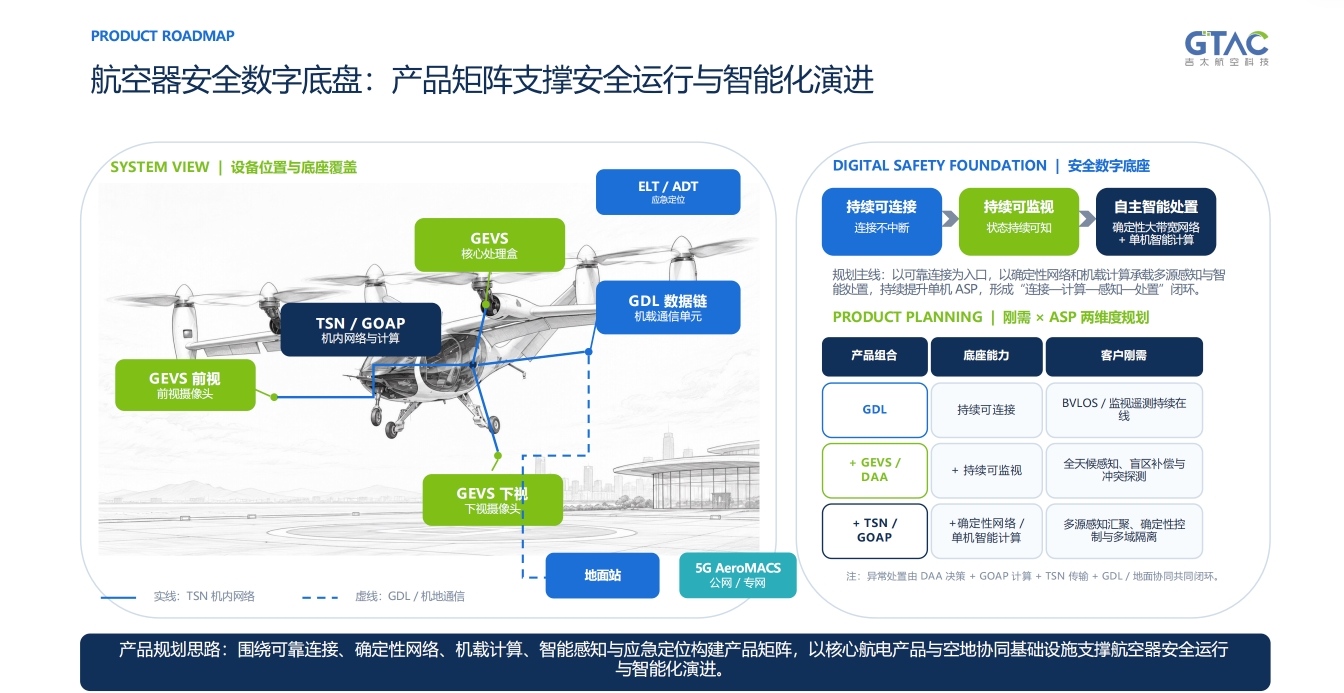
Jitai Aviation Avionics Product Matrix
Regarding the airborne avionics architecture, Sun Peng proposed a "waist-thinning" model: The OEM takes charge of defining the middle layers such as data semantics, communication contracts and network configuration, creating conditions for continuous innovation of upper-layer applications and multi-source supply, replacement and upgrade of underlying hardware.
Correspondingly, there is the "separate governance of large and small brains" architecture: The flight control domain is equivalent to the "cerebellum", responsible for stable, safe and verifiable control execution; the intelligent domain is equivalent to the "cerebrum", processing high-dimensional information such as visual perception and data fusion, and supporting function iteration. The two domains are connected through a deterministic network, and their mutual influence is controlled through network and system architecture design.
Among them, the airborne data link combines 4G/5G public network and private network, and can select the communication link according to route coverage and business requirements. Under specific field test conditions, the communication distance of a single station can reach 110 kilometers, and the link throughput reaches 8Mbps.
In terms of airborne networks, Jitai Aviation takes the lead in promoting the group standard of airborne TSN (Time-Sensitive Networking) of the Chinese Society of Aeronautics and Astronautics, providing solutions from end systems and switches to computing platforms. TSN can provide deterministic communication capability with a communication bandwidth of 1000Mbps, a delay of less than 25μs and jitter of less than 1μs when passing through a switch, and a time synchronization accuracy of less than 500ns. By accessing data from different devices and traditional buses into a unified network, TSN also helps simplify the network architecture and reduce cable weight.
Sun Peng believes that the important goal of domestic substitution is to ensure supply chain security. The gap between Chinese and foreign avionics systems is mainly reflected in the richness and supporting capability of the industrial chain. Between traditional large aircraft avionics and industrial-grade solutions, the low-altitude industry needs a local avionics platform that is "certifiable, mass-producible and evolvable", so that OEMs can have more controllable and sustainable supply options in model certification and long-term operation.
In the Post-GPS Era, Third-Generation Gyroscopes Ensure Flight Safety
Guest Speaker: Wang Fei, Founder and General Manager of 208 Advanced Technology. With a doctorate degree, he has been deeply engaged in the R&D of high-end inertial devices for more than 20 years, and has won the National Science and Technology Progress Award and other honors. He led the team to develop the only large laser gyroscope in China, broke through the first series of functional chips for laser gyro drive in China, and realized the low-cost large-scale manufacturing of laser gyroscopes.
Key Sharing Words: Inertial navigation, gyroscope, flight control core, laser + hemispherical resonator + quantum
Inertial navigation is a sensor-based navigation system that measures the linear motion and angular motion of the carrier through accelerometers and gyroscopes, and then estimates the position and attitude information of the carrier. Wang Fei explained its function with the metaphor of "invisible cerebellum": for an aircraft to fly stably, it must first accurately perceive pitch, yaw and roll, and when satellite signals are unavailable, inertial navigation can also provide autonomous positioning capability.
Satellite navigation and inertial navigation are not in a substitute relationship. Satellite navigation can provide accurate position, but cannot independently provide complete attitude information, and is easily affected by occlusion, interference and deception; inertial navigation does not rely on external signals, but its error accumulates over time, thus affecting the accuracy.
Therefore, the two are often used in combination in practical systems to balance positioning accuracy and autonomous navigation capability when satellite signals are limited. Wang Fei believes that in low-altitude flight environments such as urban canyons and electromagnetic interference, inertial navigation is highly autonomous and highly credible, and is an important part of the safety foundation of the low-altitude economy.
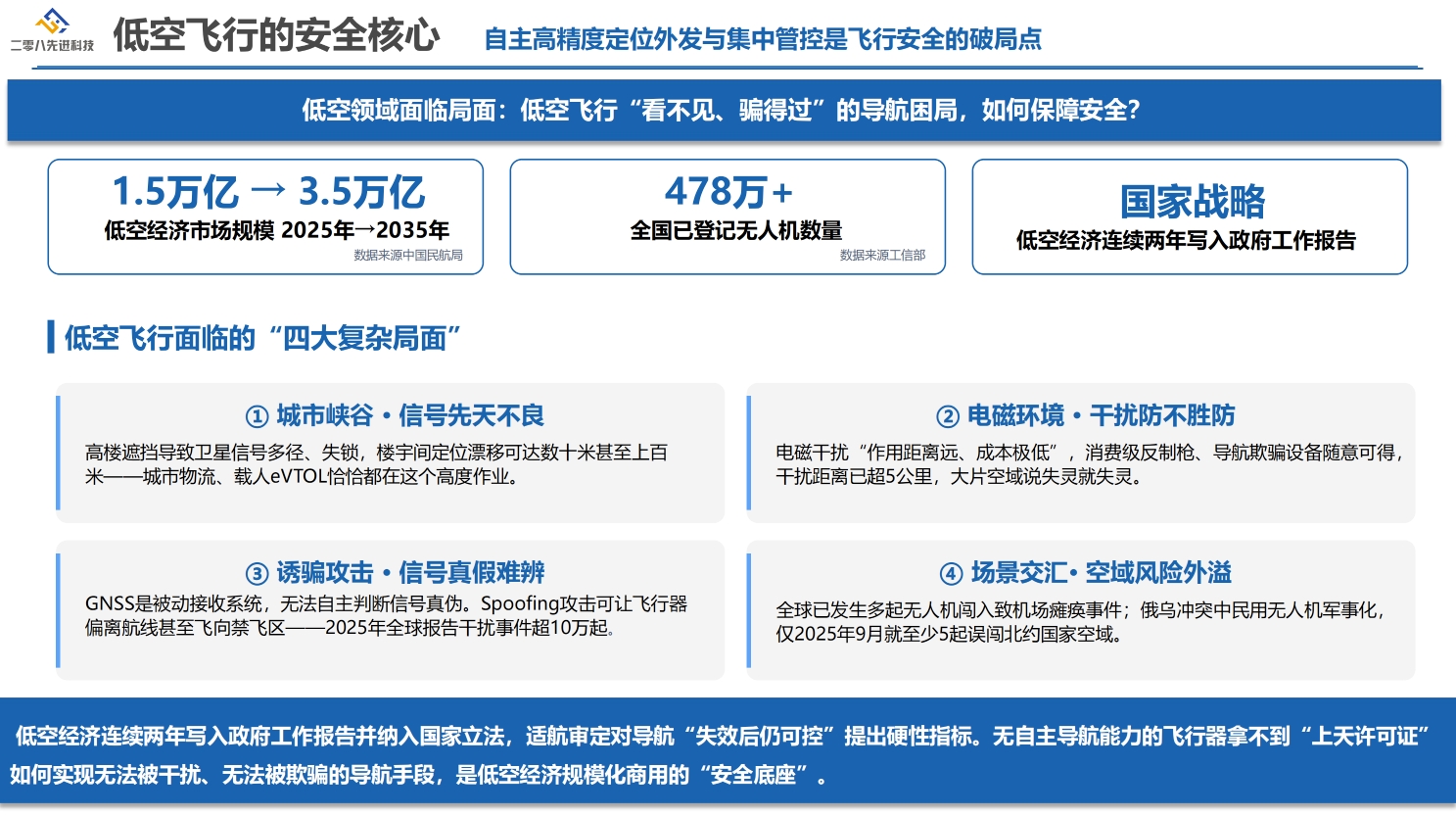
Analysis of Complex Situations Faced by Low-Altitude Flight
208 Technology divides its technical route into three echelons: laser gyroscopes, hemispherical resonant gyroscopes and quantum gyroscopes — using the more mature laser gyroscopes to support current products, advancing the engineering application of higher reliability with hemispherical resonant gyroscopes, and taking quantum gyroscopes as cutting-edge technical reserves.
In the direction of laser gyroscopes, the team relies on self-developed special chip modules to achieve 100% domestic production of external drive circuits, whose volume, weight and cost are all reduced to less than one third of the original. Based on this technology, the team launched the 30-type small laser gyroscope, which is mainly oriented to scenarios with limited satellite navigation such as UAVs and underwater submersibles.
In the direction of hemispherical resonant gyroscopes, the integration of the engineering prototype and environmental tests have been completed, and the eVTOL on-board test flight and commercial satellite carrying verification are being promoted; for quantum gyroscopes, the team carries out technical research and quantum improvement of traditional optical gyroscopes through cooperation with the industrial incubation platform of the International Quantum Academy (Shenzhen).
In addition to device R&D, in terms of scenario empowerment, 208 Technology is cooperating with leading domestic eVTOL enterprises to develop a "one main, two backups" inertial active navigation architecture: high-precision laser gyro inertial navigation is used as the main inertial navigation, and hemispherical resonant gyro inertial navigation and MEMS gyro inertial navigation are used as backups, so as to improve the navigation continuity of the aircraft when satellite signals are limited or a single system fails.
What Are People Discussing About Domestic Substitution in Aviation Manufacturing?
We have selected some representative questions from the live interaction session and the guests' answers, which are presented after editing and sorting.
Q1: Will the development of range extenders consider the turboshaft hybrid route in the future?
Wang Gang: It will be considered. At present, the main advantage of the piston range extender is economy, but its power-to-weight ratio is inferior to that of the turbo-electric system. In plateau scenarios, the payload capacity of the piston scheme will drop significantly; in scenarios with extreme requirements for high-speed performance, its power output is also difficult to meet the demand. In contrast, the turboshaft route has obvious advantages in these two types of scenarios. At present, Lanxiao is cooperating with turbo-electric system manufacturers, and will launch aircraft adopting the turbo-electric form in the future.
Q2: Lanxiao both manufactures complete aircraft and sells range extenders to other OEMs. Will this weaken the competitiveness of its own aircraft business?
Wang Gang: The competition is not that direct. Different aircraft models will continue to differentiate in payload, application scenarios and mission positioning, and may not form direct competition. More importantly, as an emerging product, both suppliers and OEMs are still groping their way forward. Lanxiao's range extender has completed flight test verification on its own aircraft, and such actual flight experience can in turn provide trust endorsement for other customers.
Q3: Under the "waist-thinning" architecture, how to divide the boundary between avionics suppliers and OEMs?
Sun Peng: The purpose of the open architecture is to increase revenue and reduce expenditure and accelerate iteration, and the boundary will be gradually divided in the process of joint definition. Taking the network as an example, the OEM is responsible for system integration and configuration, and the supplier is responsible for underlying equipment R&D. Upper-layer application-oriented capabilities such as flight control algorithms can also be independently developed by the OEM if they are regarded as core capabilities.
Q4: Why choose TSN as the R&D direction of airborne network?
Sun Peng: The core advantage of TSN is determinism, which can control end-to-end jitter within 1 microsecond and avoid delays of control instructions caused by other data. The relevant standards released by IEEE in October 2025 further provide reference. At the same time, TSN has sufficient bandwidth, has been applied on a large scale in industries such as electric power and automobiles, and also has certain advantages in cost. Therefore, we believe that it is at least one of the alternative directions for the next-generation aviation bus.
Q5: How far are hemispherical resonant gyroscopes and quantum gyroscopes from mass application?
Wang Fei: The hemispherical resonant gyroscope is close to the stage of engineering and mass production, but at present it is not as competitive as the laser gyroscope in terms of accuracy and mass production cost; the