Why does a company with 1,800 employees have 8,000 AI employees?
An enterprise with 1,800 human employees has more than 8,000 AI employees. 5,000 AI assistants and 3,000 AI experts, making the human-to-AI ratio reach 1:4 — this is the current organizational structure of Sensors Data.
"In fact, there are no real front-line employees now. People at the most front line have all become managers, and what they manage is AI," Jiang Ping, co-founder, President and CFO of Sensors Data, told 36Kr.
This B2B company that started with enterprise data analysis is conducting an experiment with its own platform product Octo: how organizations can truly work with AI, and how to calculate the accounts of this transformation.
From Data Mining to "Organizational Intelligence"
Founded in 2006, Sensors Data has long been deeply engaged in enterprise-level data analysis and data mining. In Jiang Ping's words, what Sensors Data has been doing all along can be summed up as "building data-driven trustworthy productivity".
After entering the AI era, Sensors Data has gone through four iterations in the field of enterprise AI: the first generation is the enterprise WeChat brain in the era of small models; the second generation is Copilot; the third generation is single-agent Agent; the fourth generation is the current Octo — Organizational Intelligence.
The product form of Octo is similar to existing enterprise-level IM tools, but Jiang Ping believes that the underlying logic is completely different. "The original tools have historical burdens, and humans are the absolute subjects inside. But we have built the Octo platform, whose native residents are AI," Jiang Ping emphasized that what Sensors Data is making is not office software, but enterprise-level services, and Octo is more like "a dojo where AI works" — humans give instructions to AI, and the two work together to promote business implementation.
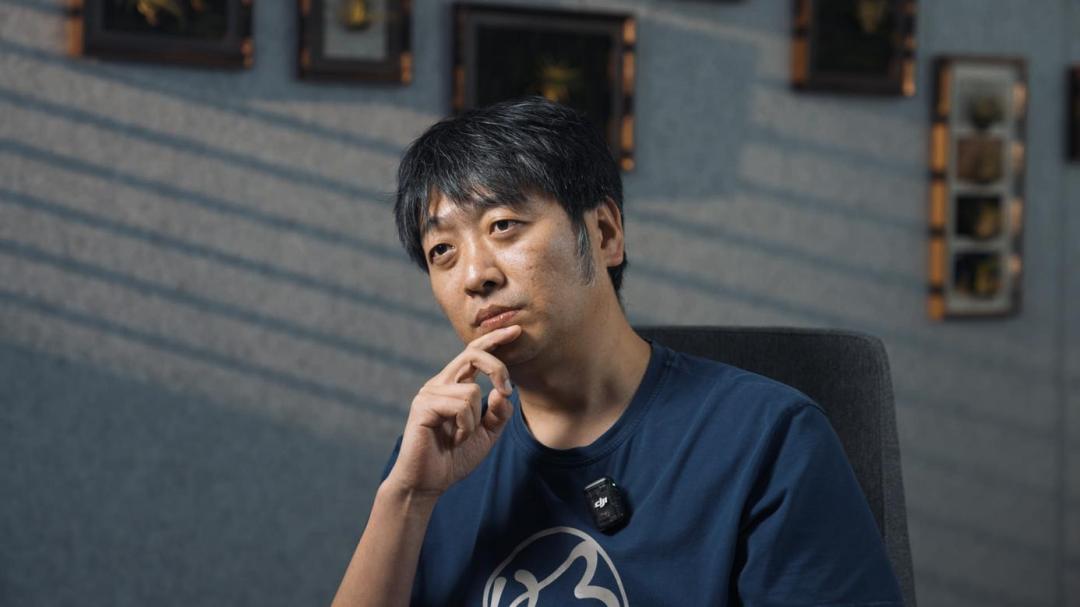
△ Jiang Ping, co-founder, President and CFO of Sensors Data
He calls this logic IoA (Internet of Agent): to build a collaboration network between Agents, so that they can exchange context with each other, and humans only need to "put forward requirements, review results, and formulate some collaboration rules between AIs". Just like the Internet does not solve the problem of "one computer per person", but how computers are interconnected, what Octo needs to solve is how the Agent network operates. Jiang Ping said, "Providing each person with an AI assistant is only the most superficial layer."
An overseas marketing case best illustrates this logic. A Chinese brand of swimming pool robots for overseas markets wants to carry out influencer marketing in the US market, and the whole process is divided into five steps: consumer insight planning, influencer screening, influencer outreach, status management, and campaign review. "It used to take 4 people a week to complete... roughly 20 person-days (equivalent to 20 working days of workload)," Jiang Ping said. Now, for the same process, one person with multiple AIs completes the division of labor on the Octo platform, "we have now achieved it in 8.5 hours."
Sensors Data's own finance team is also a typical case. AI enables penetrating data governance, which means starting from the total revenue, penetrating layer by layer downwards: Revenue → Department → Salesperson → Order → PO → Acceptance Note → Invoice → Payment Received → Cash Flow, the full link is queryable. "I used to think that it was pretty good to finish the horizontal field governance, but after AI came, I found that my penetration capability was insufficient." After the data is connected, AI querying data and automatically generating dynamic reports have become daily operations. This workflow is implemented by the finance team in an AI-Native way, without any participation of developers.
However, to run this process stably, a layer of Infra is required to support it.
What Does Infra Look Like in the Agent Era
Sensors Data's infrastructure has been deployed on Tencent Cloud since the PC era, the mobile Internet era to the big data era. Tencent Cloud is also a long-term partner of Sensors Data.
When asked about the long-term cooperation between Sensors Data and Tencent Cloud, Jiang Ping's explanation is very straightforward: "99.9% of our cloud resources are on Tencent Cloud. Only by continuing to use Tencent Cloud can the assets accumulated in the mobile Internet era and the big data era be connected with the assets of the current era." In his eyes, the cost of changing cloud providers is almost equivalent to giving up all historical accumulation.
Entering the Agent era, the core requirement of Sensors Data at the infrastructure layer has become to provide each AI with an independently isolated operating environment, which is equivalent to opening a separate computer for each Agent on the cloud. When Agent applications perform deep reasoning tasks, they may maintain a resident state — without the support of the Infra layer, long tasks cannot run stably at all. The self-developed sandbox at the bottom of Tencent Cloud Agent Runtime is doing exactly this: millisecond-level startup, providing each AI with an independently isolated operating space, so that long tasks and real-time responses can run at the same time.
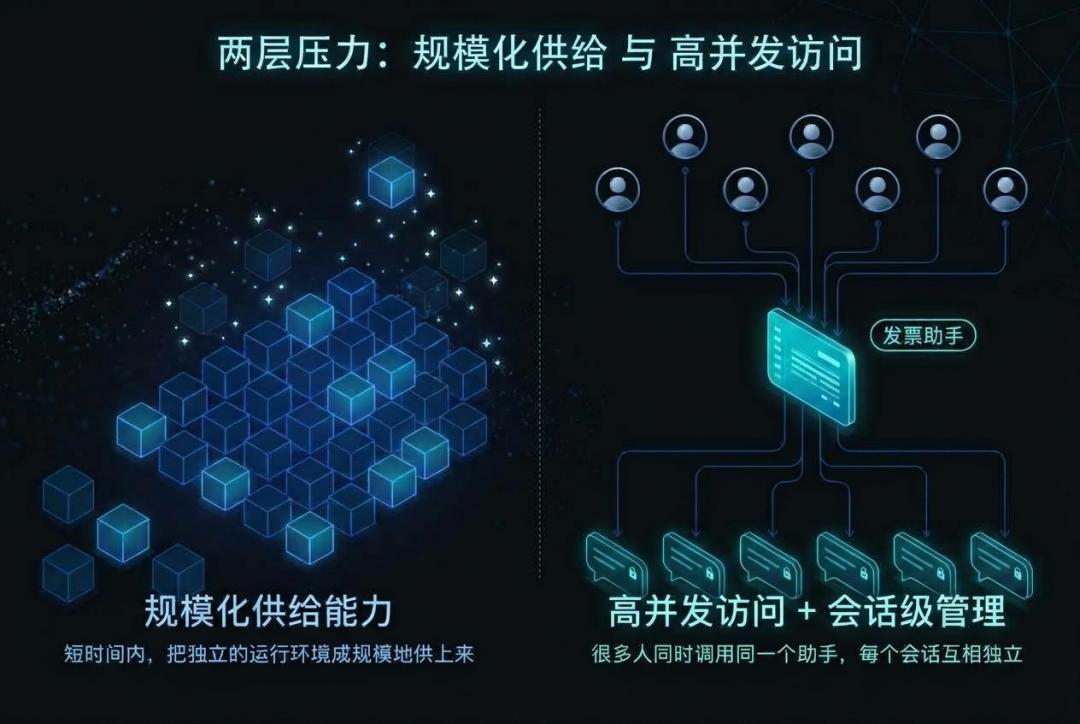
Another reason for choosing Tencent Cloud is its scale. Jiang Ping cited an extreme scenario: an automobile enterprise with 100,000 employees needs to build 100,000 sandboxes from scratch, and at the same time, these 100,000 people may share the same "invoice assistant" — which requires both breadth and depth. These two requirements have completely different requirements for concurrency capability: the former tests the large-scale supply capability, while the latter tests high-concurrency access and session-level management. For Sensors Data, the core value of Tencent Cloud is that it supports the bottom line when Sensors Data serves a large number of enterprise customers. In Jiang Ping's words, "Only Tencent can guarantee to provide Sensors Data with such a large concurrency volume, which allows me to scale freely."
In the Agent Online era, the access of AI to the organizational system also brings another problem: permission boundary. "What humans can access, AI can access" — as the assistant is the extension of human, the permissions should be equal, but expert AI only needs to solve fixed problems and does not need to understand the private life of employees. The logic of this set of permission isolation and control needs to be designed clearly at the Infra layer, otherwise security and trust issues will erupt centrally during large-scale deployment.
At the same time, Jiang Ping also believes that Tencent has a natural advantage in product design — "imperceptibility", which makes users not notice the existence of the tool, but only feel the result. Not perceiving its existence is the highest praise for infrastructure. Jiang Ping's answer is very straightforward: "From the PC era, the mobile Internet era to the current big data era, Sensors Data has been using Tencent's Infra very stably."
The account of this Infra belongs to the operation level. What enterprises cannot avoid is another account: is it worth hiring digital labor?
Digital Labor Is Coming, How to Calculate This Account
NVIDIA CEO Jensen Huang has described AI agents as the "digital labor" of enterprises in the past two years, believing that they will work collaboratively with human employees. He divides labor into three categories: real labor, digital labor (AI Agent) and physical labor (embodied robots). Jiang Ping believes: "Digital labor has really arrived, that is Agent. Physical labor is still in the stage of demonstration."
The commercialization of digital labor has currently formed three basic models: monthly subscription fee, Token fee, and FDE fee. The third model is being promoted by companies such as OpenAI, Anthropic and Palantir. HSG summarizes this trend as "the transformation of the software industry to the technology service industry" — selling digital labor, no matter it is done by human or AI, taking responsibility for the results.
Sensors Data chooses to firmly follow the open source route. "Open source means that this money cannot be collected." The License fee is discarded accordingly, and the revenue source turns to Token fee and FDE fee, while FDE needs to be deployed deep into the customer's enterprise, which is essentially paying by results.
But whether enterprises will buy FDE ultimately depends on the change of input-output after the introduction of AI. For enterprises that really care about economic value, Jiang Ping gives a ROI formula: 1:1.5. The total of labor cost and AI cost, the corresponding revenue must reach at least 1.5 times to basically break even. "If I spend 10 million, I can get 15 million in revenue, which is roughly break even." This formula is applicable in scenarios such as e-commerce, short videos, overseas marketing, and AI short dramas — the main cost of these industries is content production and ad placement, which is exactly the part that AI can greatly reduce.
There is also a practical problem: enterprises have very different levels of understanding of the ROI of hiring "digital labor". In Jiang Ping's view, enterprises that are still asking "is AI worth it" are looking at this matter with "classical thinking".
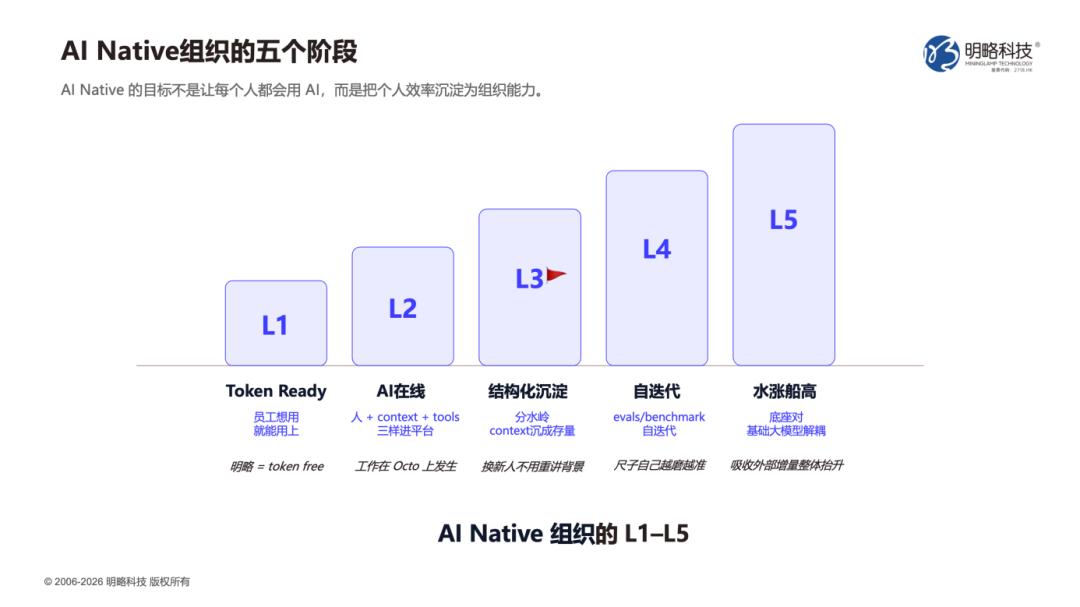
No matter which level they are at, Jiang Ping's suggestion is to start from L1, which he calls Token Ready, to solve the cost problem of employees using AI first. "You can give him a monthly reimbursement of 700 yuan, which is enough to buy at least DeepSeek and Kimi."
L2 is called Agent Online, which connects AI to the organizational system to solve the permission problem — "What humans can access, AI can access" is logically reasonable, but the actual implementation involves a large number of internal security and trust considerations of the enterprise. The following stages are L3 knowledge graph precipitation, L4 AI scenario closed loop, and L5 overall organizational self-operation. "Most enterprises should solve L1 first, and then talk about L2."
When this road goes to the end, the organizational structure itself is also changing. "The biggest change is that there are no absolute front-line employees anymore." No matter the senior management or ordinary employees, the people at the most basic level manage AI. At the same time, the value of the middle layer that is only responsible for conveying information between superiors and subordinates is rapidly diluted. "Without Know-How and taste, you will be in an awkward position in this organization in the future."
1,800 humans, 8,000 AIs, maybe this ratio will change in the future. Sensors Data is walking on this road itself, and also passing this logic to its customers.