Anthropic has declared that "programming interviews are dead", so what can programmers rely on to prove their capabilities?
The impact of AI on junior engineers can hardly be summed up unilaterally by either "empowerment" or "replacement".

Figure|The voluntary separation plan Microsoft recently issued to 60,000 employees
Felix Rieseberg, Hiring Manager at Anthropic, recently put forward a rather optimistic judgment for junior engineers: "Hunger beats tenure".
His reasoning is that in the past, the influence of engineers was largely limited by experience, that is, how many frameworks they are familiar with, how many systems they have written, whether they can quickly complete implementation, and so on; but AI is reducing the scarcity of these capabilities.
If a newcomer can identify important problems, they can quickly build prototypes with the help of AI, without having to spend years accumulating execution capital first.

The advice he gave is, do not only focus on the tasks assigned to you at work, understand the company's business goals, come up with a sufficiently important idea, and then implement it as soon as possible.
In his blog, he also cited the example of two relatively junior engineers who built a prototype of the Claude Code graphical interface over a weekend, with the first public version released about eight days later.

So many people once bought *Algorithms and Data Structures*, hoping to open the door to good jobs and a better future through it. Now the demise of programming interviews is just another milestone for software engineering to move towards a higher level of abstraction.
Prototypes quickly produced by AI are not just technical demos, but more like a communication method that bypasses organizational seniority. Rather than waiting for others to trust your judgment, it is better to directly turn the judgment into something visible.
It is easier for individuals to deliver results, which does not mean that companies need more newcomers
But also at Anthropic, another internal research report in mid-October provided a set of less reassuring data.
Since the beginning of 2025, the proportion of junior employees in its technical department has dropped from 21% to 14%; the proportion of junior technical recruitment has fallen even faster, from 27% to 9%.
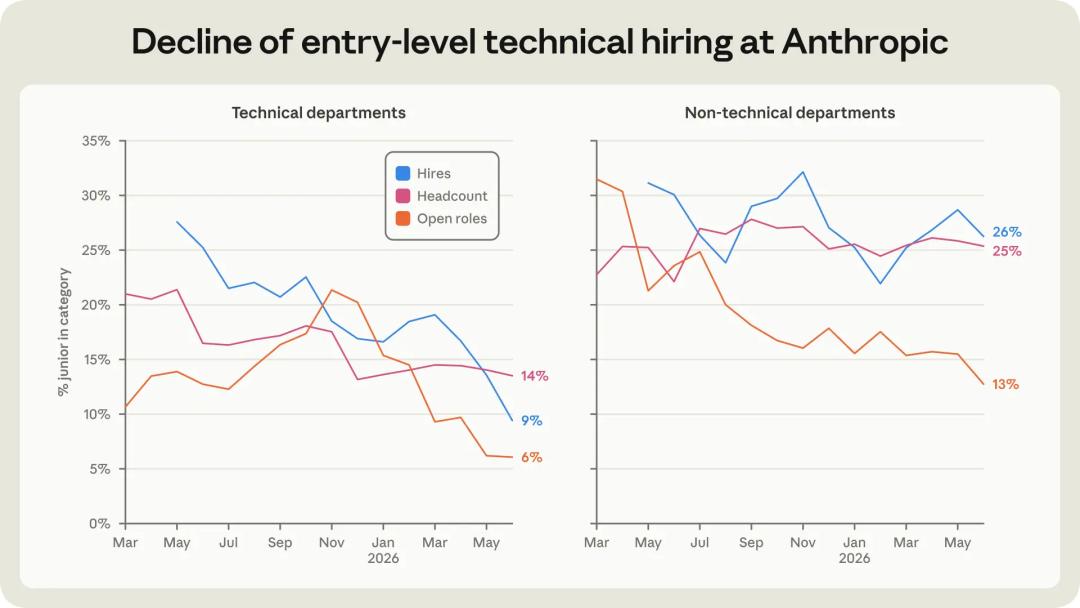
Figure|The number of entry-level positions at Anthropic has decreased. The left side is the technical department, and the right side is the non-technical department. Blue represents the proportion of junior employees among newly recruited employees, pink represents the proportion of junior employees among existing employees, and orange represents the proportion of junior positions among recruitment positions.
These two pieces of information seem contradictory, but they answer two different questions: How much impact can a newcomer who has already got an opportunity create? How many junior execution positions should a company that heavily uses AI set up?
And the reason may be the same, that is, "execution" is becoming cheaper.
Because execution is no longer expensive, a newcomer can use AI to complete work that used to require more people and longer time to complete; also because execution is no longer expensive, organizations may no longer need a large number of junior positions to obtain this execution capacity.
The rise of individual leverage and the contraction of entry opportunities are two sides of the same coin.
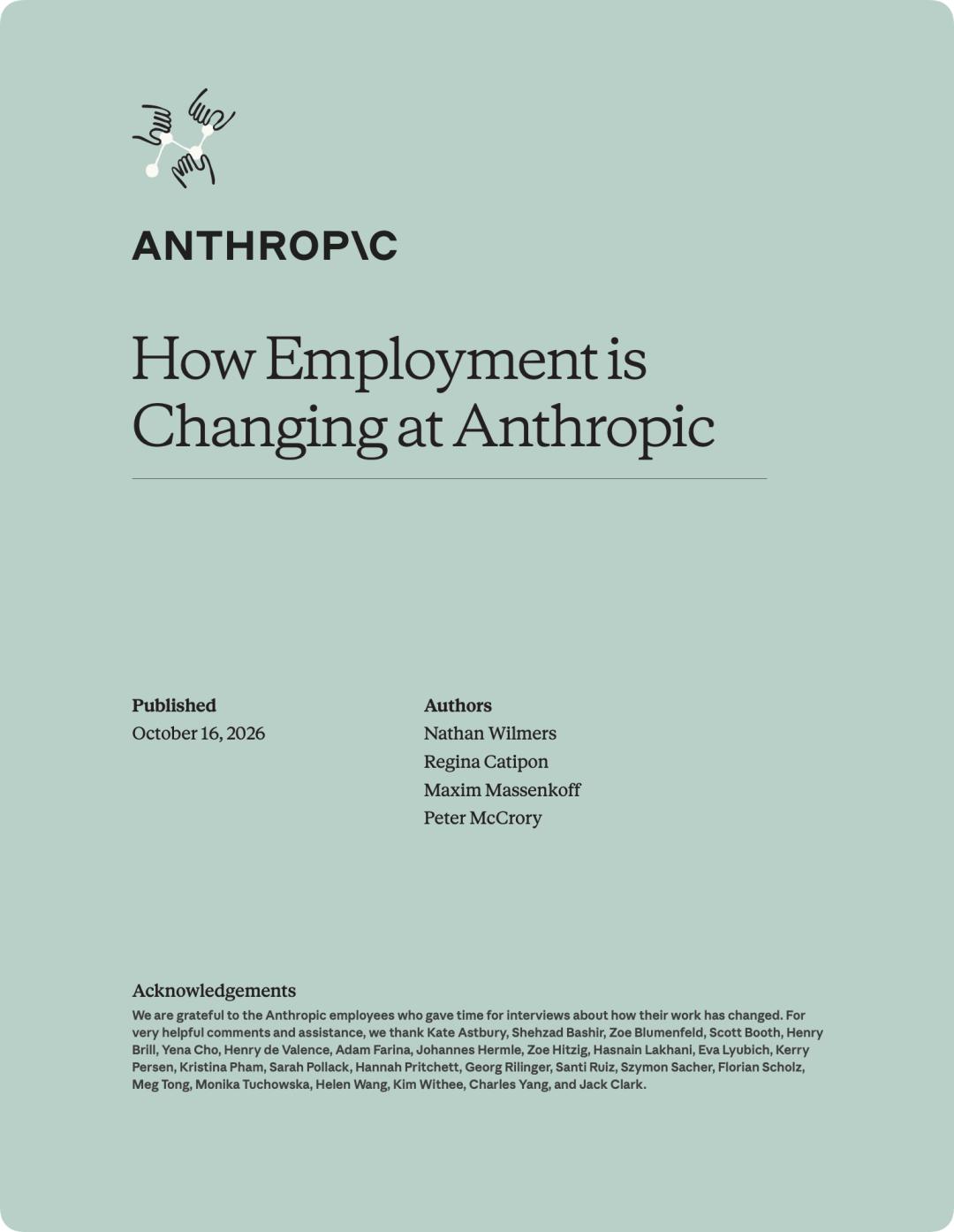
Figure|Report "How is the employment situation at Anthropic changing"
Of course, a decline in proportion does not mean that the absolute number of junior employees has decreased in the same proportion. The report also clearly points out that the absolute number of technical recruitments at Anthropic is still growing, but functions such as sales, finance and recruitment are expanding faster.
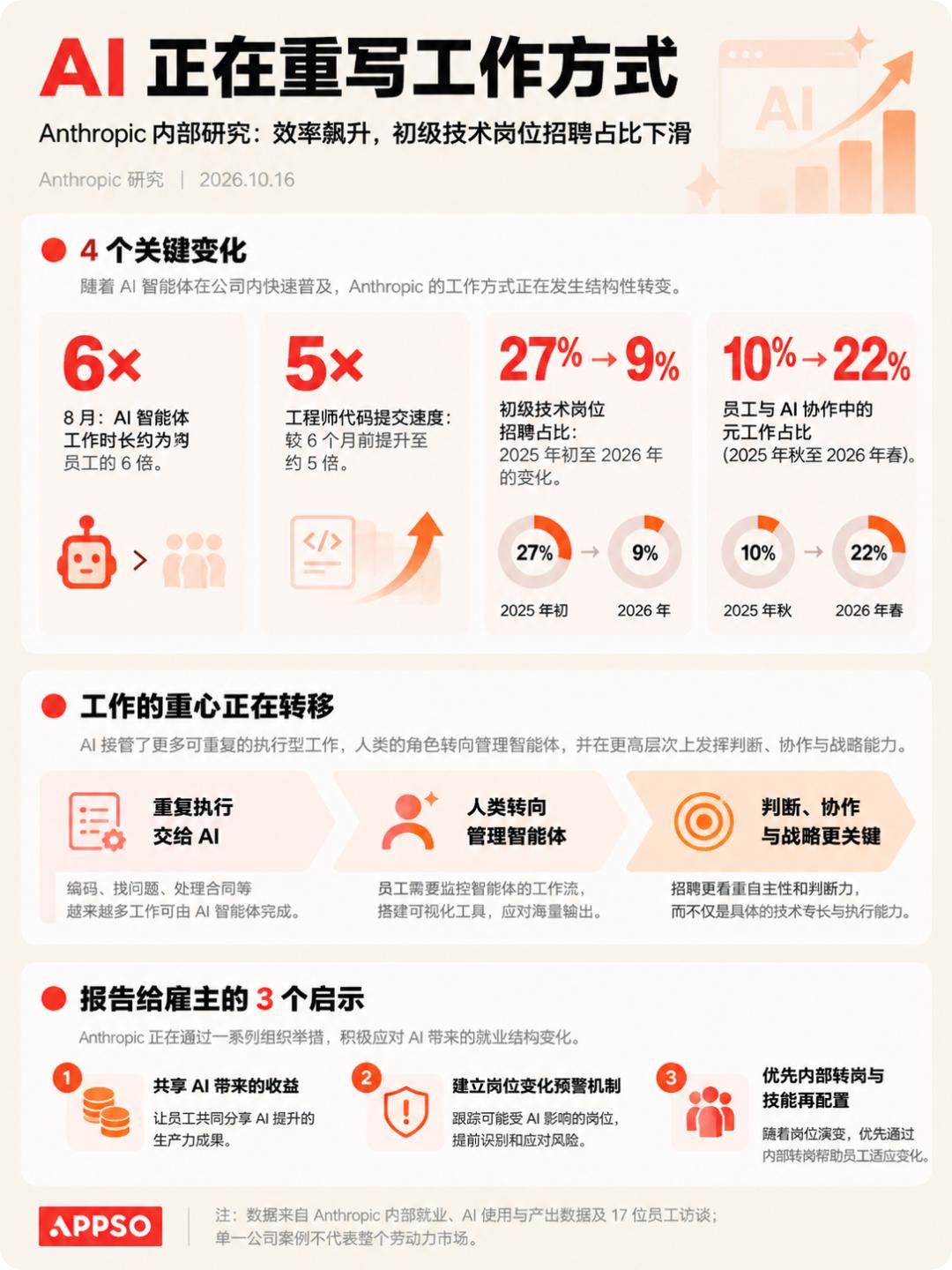
This is only an internal sample of a fast-growing company with extremely high AI usage. It cannot directly represent the entire software industry, let alone attribute all changes to AI.
But it at least reminds us that "AI can empower engineers" and "AI will increase engineering positions" are not the same proposition.
The value of engineers is moving towards both ends
The re-pricing of execution does not mean that engineering capabilities are no longer important. It more likely means that the value of engineers is shifting from the standardized implementation link to both ends of the work.
One end is upstream judgment: What problems are worth solving? What do users really need? What should a prototype verify? Among multiple solutions that can be quickly implemented by AI, which one should be chosen?
The other end is downstream control: Is the system reliable? Are the permissions appropriate? Can the results be reviewed? When deviation occurs, can people intervene in time?
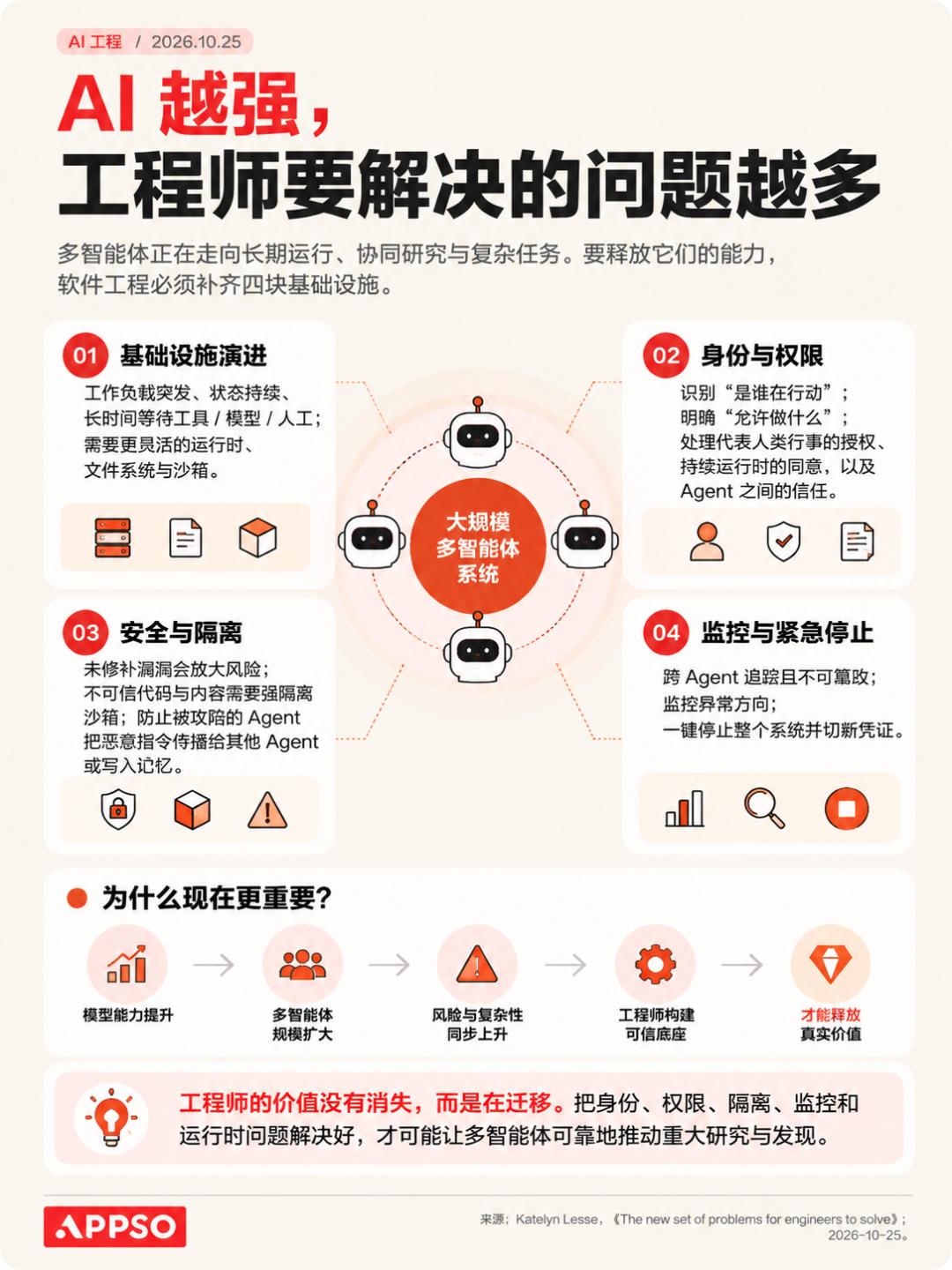
Katelyn Lesse, Head of Platform Engineering at Anthropic, recently also published an article titled *A New Set of Problems That Engineers Need to Solve*. She also started with the "identity crisis" of engineers, as AI takes over more and more programming work, some people feel that their skills are losing value.
But the real situation is that the more AI can work autonomously, the more engineers need to solve the problem of "how to make it work reliably, safely and controllably".

She believes that in the next one or two years, multi-agent systems will bring a large number of engineering problems worthy of in-depth research; she summarizes the engineering challenges brought by multi-agent systems as infrastructure, identity and permissions, security and isolation, as well as monitoring and emergency stop.
These problems do not disappear automatically just because models are better at writing code. On the contrary, they will become more important as the number of agents, permissions and running time increase.
A compromised agent may pass injected instructions to other agents; an agent that works on behalf of users for a long time requires clear and continuous authorization; when thousands of agents run at the same time, monitoring that cannot be tampered with by themselves and a stop mechanism that can truly shut down the entire system are also required.

Figure|Netflix documentary "The Looming AI Revolution"
These are still very "hard" engineering problems.
Therefore, what AI compresses is the execution process in the middle section with clear boundaries and relatively certain answers. The closer to the two ends of "deciding what to do" and "ensuring the system is controllable", the more difficult it is to cancel human responsibilities.
This puts more practical requirements on "seniority". Familiarity with frameworks, libraries and implementation skills is still useful, but the accumulation should eventually be reflected in human decision-making, such as whether you can avoid detours, identify problems covered by prototypes, and discover risks before the system expands.
For newcomers, the area where opportunities increase is that it is easier to verify ideas after putting them forward. The new pressure is that delivering a piece of runnable code is increasingly difficult to prove one's contribution alone.
The changes in Anthropic's recruitment also confirm this point: hiring managers are increasingly emphasizing candidates' autonomy and judgment, and relatively speaking, they no longer place so much emphasis on narrow domain expertise and specific implementation capabilities.
The real problem is the first step on the career ladder
However, telling junior engineers that "you need to show judgment" also brings a new problem: Where does judgment come from?
Felix, Hiring Manager at Anthropic, said on his blog that he does not have a complete answer yet, he is looking for small prototypes that can reflect product taste, user empathy, and principled thinking in resumes and portfolios.
Obviously, judgment usually does not appear out of thin air, but is gradually formed in real problems, failure feedback, collaboration conflicts and responsibility taking. Although the past junior positions involved a lot of repetitive execution, they also provided an entry point for observing complex systems, participating in real decision-making and accumulating organizational trust.
If these positions are compressed, companies may simultaneously increase two things: the requirements for newcomers' judgment, and the difficulty for newcomers to obtain judgment experience.
"Building a prototype over a weekend" can help individuals prove their potential, but it cannot solve this structural problem on its own. Prototypes can show taste and initiative, but maintaining real systems, understanding long-term consequences, coordinating different teams, and taking responsibility for mistakes still require a continuous learning environment.
Therefore, what enterprises need to redesign is not only the interview questions, but also the junior positions themselves.
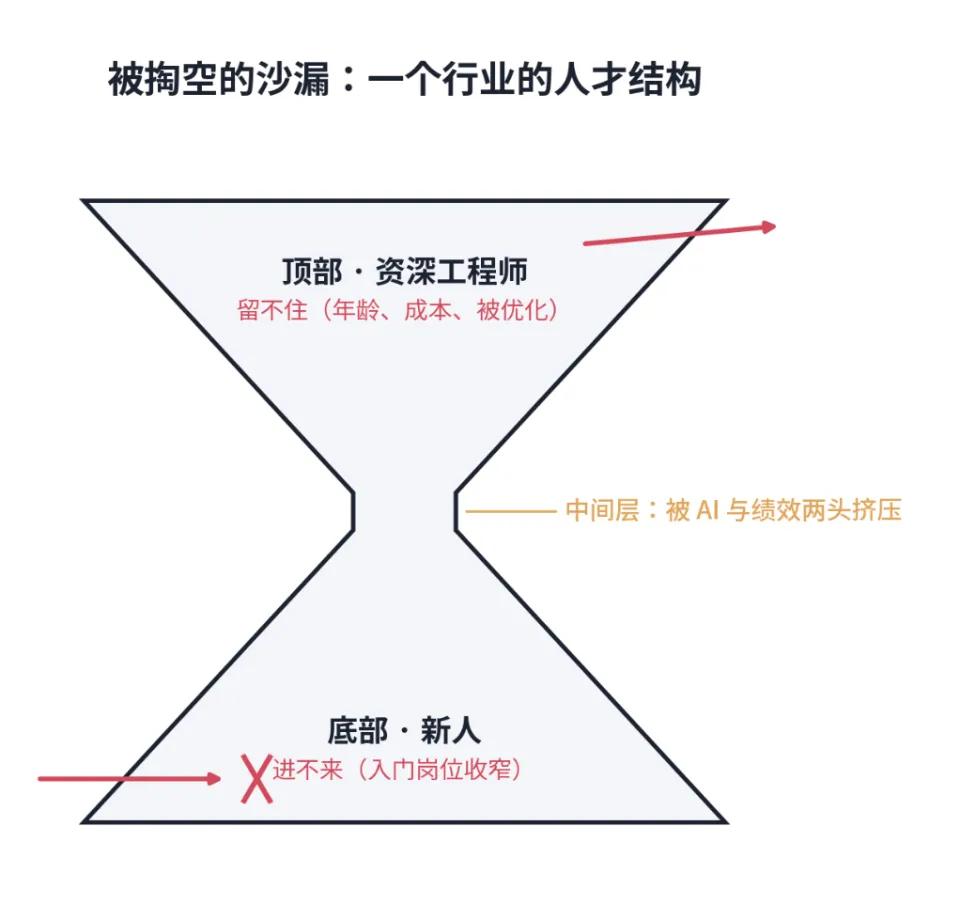
If junior positions no longer mainly provide cheap execution, can they be more clearly positioned as an apprenticeship for judgment. Let newcomers take charge of real problems with clear boundaries, review AI outputs, participate in scheme selection, explain their own mistakes, and gradually take responsibility for the results?
Similarly, recruitment cannot only look for people who already have the conditions to make excellent personal projects, otherwise "valuing prototypes over seniority" may also form a new screening bias. After all, not everyone has sufficient time, equipment and trial-and-error space.
AI may make a newcomer with ideas be noticed faster, and it may also make newcomers who have not yet got a platform harder to be noticed.
In the past, "being able to write code" itself was an important admission ticket; in the future, it may increasingly become a basic capability.
The new difference lies in whether we can find problems worth solving, command AI to complete them, and judge whether the results are trustworthy.
But for enterprises, the problem cannot stop at finding people who already have these capabilities. "Hunger beats tenure" may hold true in some scenarios, but hunger will not automatically grow into judgment. It still requires real problems, continuous feedback and opportunities to take responsibilities.
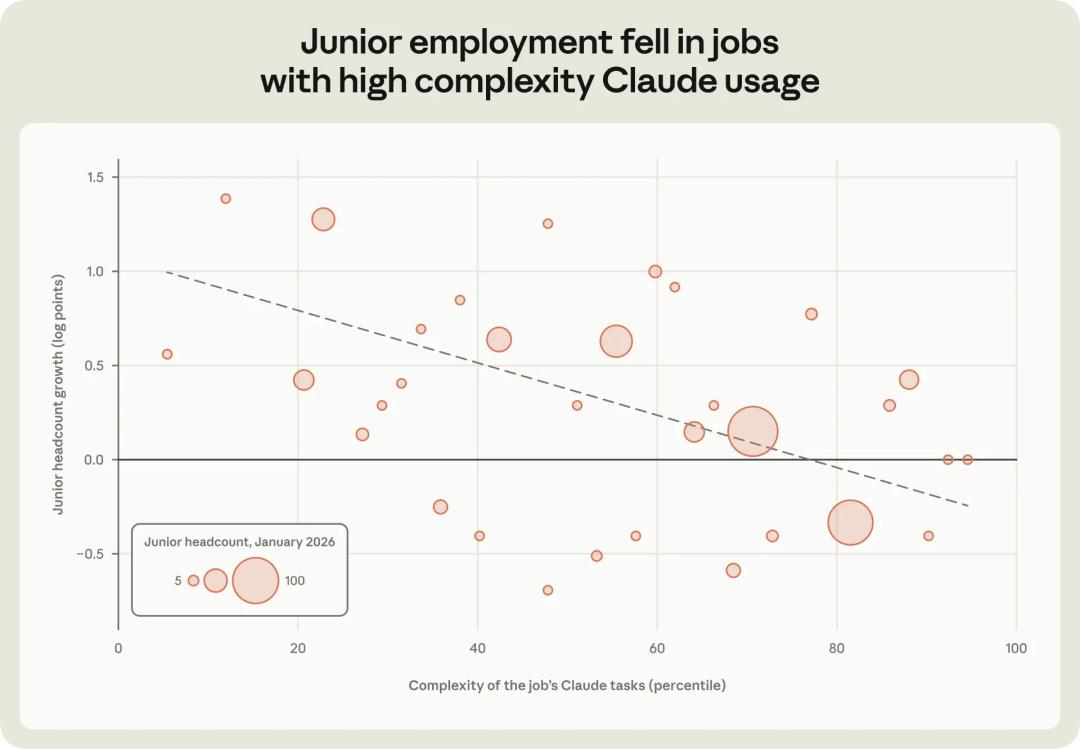
Figure|The relationship between Claude usage and employment changes of junior employees in different positions. The horizontal axis is the complexity of tasks processed by Claude, and the vertical axis is the growth of the number of junior employees (logarithmic points). Each circle represents a job category. The larger the circle, the more junior employees this occupation had in January 2026. The dotted line tilts from upper left to lower right, indicating
When the old first step of the career ladder begins to loosen, where should the next generation of senior engineers grow up from?
This article is from the WeChat official account "APPSO", written by the team that discovers tomorrow's products, and published with authorization from 36Kr.