Going Global Compliance Enters the Agent Era: Chuangjietong Releases Compliance Brain 2.0
Shenzhen Chuangjietong Technology Co., Ltd. officially released "Compliance Brain Agent 2.0". Targeting overseas enterprises and practitioners, this product currently covers tax rules of more than 50 countries and regions, accumulates over 34 million pieces of intellectual property data, and fully covers compliance rules of all cross-border platforms. The product is connected to more than 300 official information sources for daily updates. This upgrade transforms the product from a Q&A tool into a closed-loop Agent of "Perception-Decision-Execution", supports the open ecosystem of MCP and Skill, and can integrate third-party Agents to work collaboratively.
AI Agent Lands in Vertical Industries: Cross-border Compliance, From "Finding Available Information" to "Getting Things Done":
When an enterprise is preparing to enter a new market, it needs to figure out three things: What are the compliance requirements for local company registration, whether there is a similar risk for trademarks, and how to calculate VAT amount?
These three things used to mean: going through official websites of governments of various countries and platform policy documents, confirming one by one with lawyers or service providers, and manually sorting them into executable lists. For large sellers who operate dozens of companies and hundreds of stores at the same time, the complexity of this process will increase exponentially.
The rules are scattered, change rapidly, and the conditions are complex, making it difficult to identify risks, track progress and implement execution under the scenario of multiple companies, multiple stores and multiple systems — this is a long-standing structural problem in the field of cross-border compliance. General search tools can provide you with information, but cannot judge whether the information is applicable to your specific scenario; general AI Agent can answer questions, but cannot directly call business systems to complete tasks.
In 2026, the red ocean of AI Agent at the general conversation level has been fiercely competitive, but vertical Agents that can truly "get things done on behalf of people" are still scarce. Cross-border compliance is one of the scenarios with the highest threshold and the clearest willingness to pay — rules span different legal jurisdictions, change on a weekly basis, and the cost of errors is store suspension or fines. Whoever first runs through the closed loop of "Perception-Decision-Execution" in this scenario will get the sample of vertical Agent implementation.
In October 2026, Shenzhen Chuangjietong Technology Co., Ltd. released "Compliance Brain Agent 2.0", trying to provide a closed-loop answer of "Perception-Decision-Execution" in the vertical field of cross-border compliance.
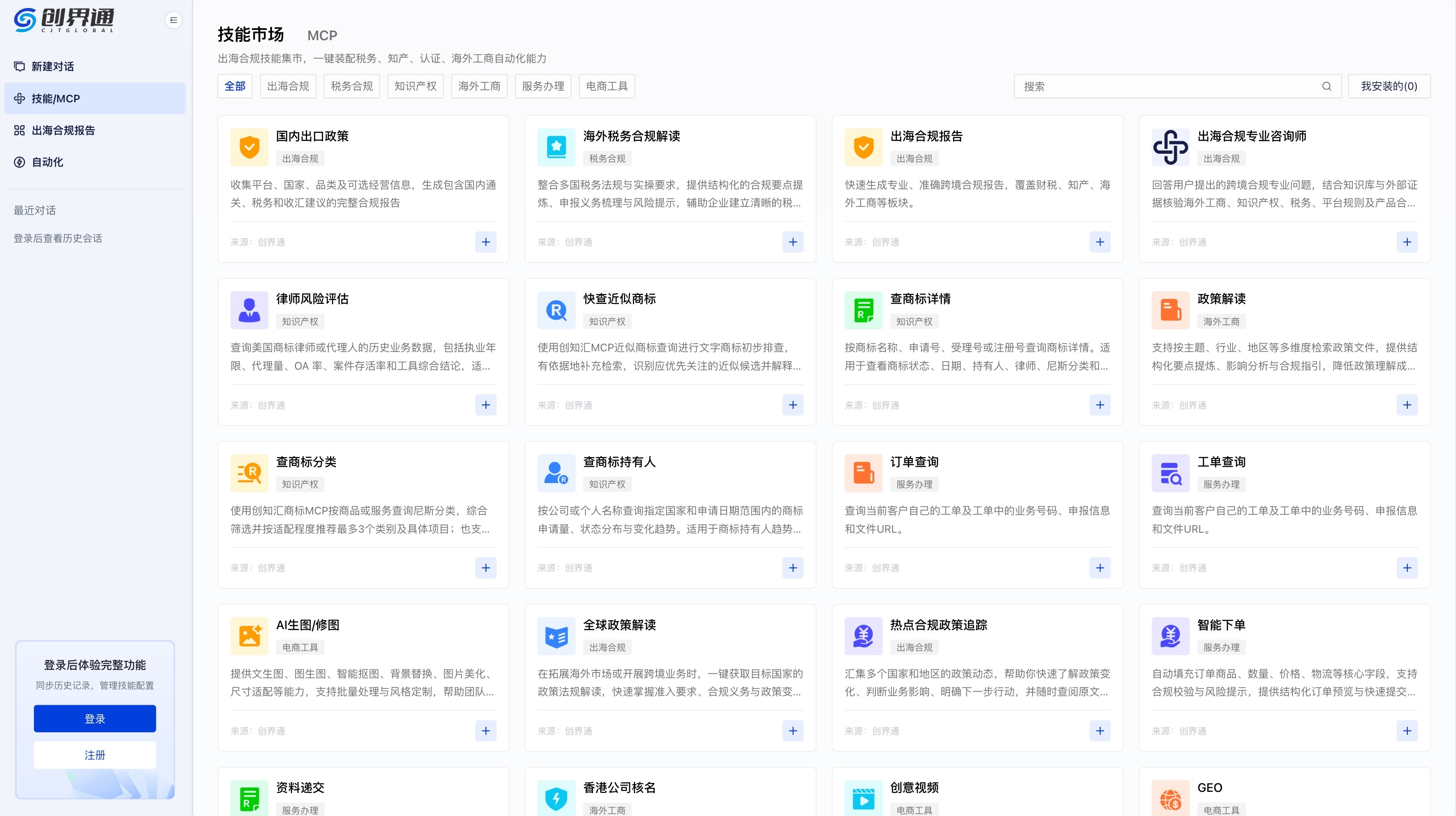
Industry Insight: Compliance is Not About "Finding Information", But About "Getting Things Done"
Chuangjietong's understanding of the pain points of cross-border compliance is built on a core judgment: the difficulty of compliance work does not lie in acquiring information, but in judging the applicability of information and converting judgments into executable actions.
There are three layers of logic behind this judgment:
The first layer: Information timeliness. Tax systems, platform rules and trademark examination standards of various countries change frequently, and manual tracking is bound to lag behind. Compliance Brain is connected to more than 300 official information sources for daily regular updates, combined with real-time search capability, ensuring that the response speed to policy changes is not "weekly" or "monthly", but "daily".
The second layer: Conclusion credibility. AI "hallucination" is a fatal risk in compliance scenarios. Each round of answers from Compliance Brain is cross-verified by three channels: expert knowledge base, official information sources and real-time search. Important conclusions are attached with sources, applicable conditions, uncertainty descriptions and confidence levels. What users get is not just "what it is", but "why it is, under what conditions it applies, what to pay attention to, and what to do next".
The third layer: Execution and implementation. Between knowing "how to do it" and actually "getting it done", there is a series of actions including tool call, system docking, progress tracking, etc. Compliance Brain is directly connected to the global trademark database of more than 34 million entries, Tax Intelligence Calculation Tool, and order/work order system, allowing users to complete the whole link from consultation to handling in the same conversation entrance, without having to configure tools by themselves or switch between systems repeatedly.
These three layers of logic correspond to the three core capabilities of Compliance Brain: professional and reliable, active execution, and global visibility.
Three Types of Real Scenarios: Decision-making, Risk, Execution
The first type: Decision-making — How AI Helps You Make Judgments
Common scenarios for sellers: Entering new markets + impact analysis of policy changes
When an enterprise is preparing to enter a new market, or the rules of the target market change suddenly, the most time-consuming part is not "finding information", but judging whether the information is applicable to its own specific conditions.
In the past, this meant going through official government websites of various countries and platform policy documents, confirming one by one with service providers, and manually sorting them into executable lists. However, the rules often change the moment you finish sorting.
The practice of Compliance Brain Agent 2.0 is: combining the country, subject, product and business stage, directly output applicable conditions, handling processes, document lists and risk warnings — with basis, applicable conditions and next-step guidance. When policies change, it will distinguish current rules, future effective rules and transition arrangements, explain the impact combined with the specific conditions of the enterprise, and explain by different scenarios when conditions are insufficient, instead of generalizing that "all enterprises are affected".
The delivered value behind it: The mode is transformed from "people look up policies" to "AI provides judgments", and the decision-making cycle is shortened from "weekly level" to "minute level".

The second type: Risk category — How AI Helps You Detect Problems in Advance
Common scenarios for sellers: Trademark layout risk assessment + multi-store compliance health diagnosis
A typical scenario: dozens of companies and hundreds of stores, with compliance status scattered in various systems, no one can tell which has gaps, which has the highest risk, and what the progress is — even the managers themselves may not be able to clarify these issues. When the platform warning arrives, it is already too late and you have to "put out the fire".
Compliance Brain Agent 2.0 turns compliance into an operation report:
l Trademark layout: Call the global trademark database of more than 34 million entries, combine approximate retrieval and Nice Classification, output similar risk lists + key category suggestions + items to be verified, which can be directly used for brand decision-making before application.
l Multi-store diagnosis: Put companies, stores and compliance assets into the same workbench, quantify the gaps into numbers, AI diagnoses each store, gives early warning of high risks, and updates automatically after completion.
The delivered value behind it: Compliance handling is transformed from "putting out fire after receiving a warning" to "setting priorities in business regular meetings". Sellers' accounts are more stable, funds are safer, and expansion is faster.

Fast Check Similar Trademarks, A Sharp Tool for Multi-store Merchants to Layout Trademarks
The third type: Execution category — How AI Helps You Get Things Done
Common scenarios for sellers: Tax calculation + service progress query
Between knowing "how to calculate tax" and actually "getting the result", there is a series of actions including data entry, caliber confirmation, result review, etc. Between knowing "where the work order is" and actually "checking the status", there are cross-system logins and repeated inquiries.
Compliance Brain Agent 2.0 is directly connected to the Tax Intelligence Calculation Tool and order/work order system:
l Tax calculation: Input business conditions, output tax calculation reference + description of key input and calculation caliber, the results can be reviewed and supplemented with data, avoiding "black box calculation".
l Progress query: Directly query the status of orders, work orders and services within the authorization scope, so that both customers asking for progress and internal status verification have the same basis.
The delivered value behind it: Transformed from "how to do it" to "I will do it", the execution actions are closed-loop in the conversation without switching systems.

Technical Depth: Three Core Capabilities Support Professional Barriers
The professionalism of Compliance Brain Agent 2.0 does not come from the claim that the underlying model is stronger, but from the deep integration of accumulated industry cases, continuously updated official knowledge and business systems into systematic capabilities.
It has covered tax and product certification data of more than 50 mainstream countries/regions around the world, accumulated over 34 million intellectual property data, realized full coverage of compliance rules of mainstream cross-border platforms, and updated in real time 24 hours a day.
Supporting this capability are three core technologies:
1. Ontology-driven Cognition and Reasoning Hub
Taking compliance knowledge graph and data middle platform as the underlying ontology architecture, it standardizes and models core entities such as countries, subjects, platforms, tax types, trademarks, qualifications and their relationships, forming a unified semantic layer. On this basis, the large model xHarness framework serves as the reasoning engine, deeply understands user intentions and decomposes tasks, accurately maps natural language to entities and processes defined by the ontology, and realizes the leap from Q&A to workflow execution. At the same time, the memory and context mechanism anchors a single conversation to the enterprise-specific ontology instances (such as specific business status, post permissions), so that the Agent can continuously understand the business.
2. Multi-Agent Collaborative Execution Network
Based on the professional domain boundaries defined by the ontology, a Multi-Agent matrix is constructed. The main Agent is responsible for global scheduling, and professional Agents in intellectual property, taxation, EPR, product certification and other fields perform in-depth execution in their respective ontology sub-domains, forming a collaborative network of perception-decision-execution. Through the MCP+Skill open ecosystem, the Agent can call tax calculation tools, trademark databases and RPA automation capabilities, convert the abstract processes in the ontology into specific cross-system operations, and truly realize the completion of compliance work.
3. Trustworthy Real-time Knowledge Supply and Evolution Closed Loop
Relying on RAG triple deep retrieval, it integrates more than 300 official information sources and expert knowledge bases in real time, ensuring that the knowledge input into the Agent ontology is authoritative, time-sensitive and traceable. Combined with the security and controllability mechanism, it strictly defines the scope of data authorization and confidence level expression to ensure that the output can be reviewed. Finally, through the self-evolution closed loop, taking the real feedback of users as the criterion, it continuously identifies knowledge gaps and iterates data sources and execution loops, promoting the dual self-optimization of Compliance Brain in ontology architecture and execution capabilities.
To understand the value of Compliance Brain Agent 2.0, an effective reference system is the general AI Agent. The difference between the two is not in the underlying model, but in the depth of system integration:
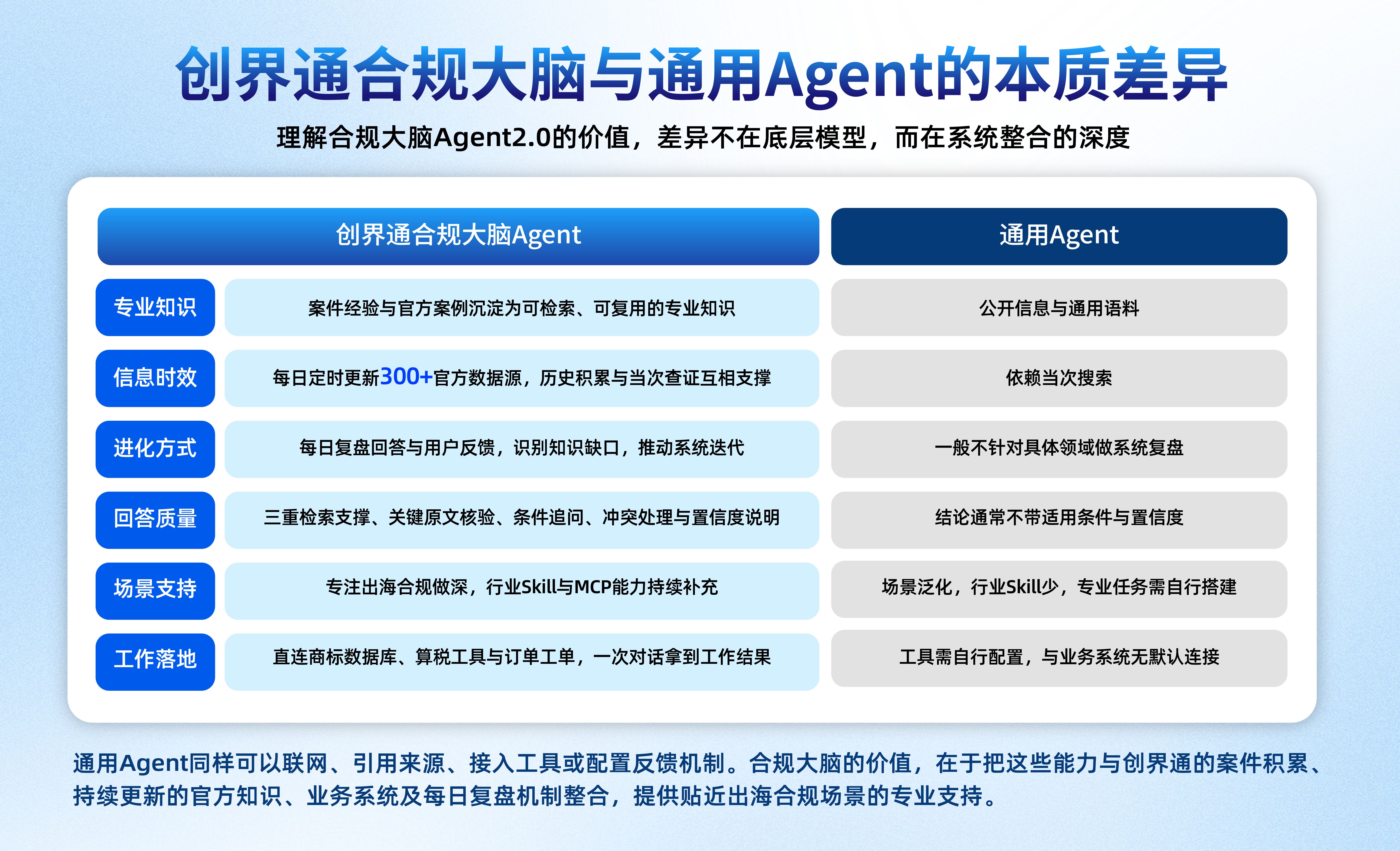
General AI Agent can also access the Internet, cite sources, access tools or configure feedback mechanisms. The core value of Compliance Brain lies in deeply integrating these capabilities with Chuangjietong's accumulated cases, continuously updated official knowledge and business systems, to provide professional support close to the cross-border compliance scenarios.
Vision: From Compliance Brain to AI Operating System for Overseas Enterprises
Chuangjietong is committed to building "Compliance Brain" into an "AI operating system for overseas enterprises" or "digital employee", deeply covering the four modules of compliance, customer acquisition, operation and growth, promoting the intergenerational leap of enterprises' global compliance operation from "knowledge retrieval" to "intelligent execution";
Behind this direction is the evolution of digital demand of overseas enterprises from "single-point tools" to "system collaboration". Compliance is not an isolated link, but deeply coupled with supply chain, marketing and finance. An AI Agent that can understand the overall business, actively execute tasks and continuously evolve is far more efficient than multiple independent tools that are separated from each other.
Chuangjietong Compliance Brain Agent 2.0 is officially released, marking that cross-border compliance has entered the "intelligent execution era" from the "information retrieval era". In the field of cross-border compliance with strong professionalism, complex rules and frequent changes, the value of AI lies not only in "answering questions", but also in "completing tasks". When the Agent deeply connects global taxation, intellectual property rights, platform rules and business processes, and builds an automatically operating compliance infrastructure, it is no longer an auxiliary tool, but a "digital employee" in the team.
For overseas enterprises, the criteria for selecting compliance tools are being redefined: from "how complete the knowledge base is" to "how complete the execution closed loop is". This may be a microcosm of the implementation of AI Agent in vertical fields.