After watching the first AI theatrical feature film, I take back my words that *Niu Lai* is the worst film of the year.
Chinese-language films in 2026 are absolutely packed with constant unexpected phenomena.
In the first half of the year, two Chinese-language films *Grandma's Love Letter* and *Welcome to Dragon Restaurant* delivered a refreshingly novel viewing experience. In the second half of the year, another two distinctive works emerged: the public opinion sensation *Bull Comes*, and the currently screening AI theatrical film marketed as "the first domestic AI feature film". The two works reached the same end through different paths, bringing about another form of "refreshing novelty".
On October 23, the AI film *Sanxingdui: Past of the Future* (hereinafter referred to as *Sanxingdui*) produced by Bona Pictures was released. The production team revealed in interviews that its investment cost exceeded 10 million yuan. In sharp contrast, according to data from Maoyan Professional Edition, as of press time, the total box office of the film was only 1.348 million yuan, and the estimated box office share for the production side was merely 430,000 yuan, which may not even cover the computing power cost of this AI film.
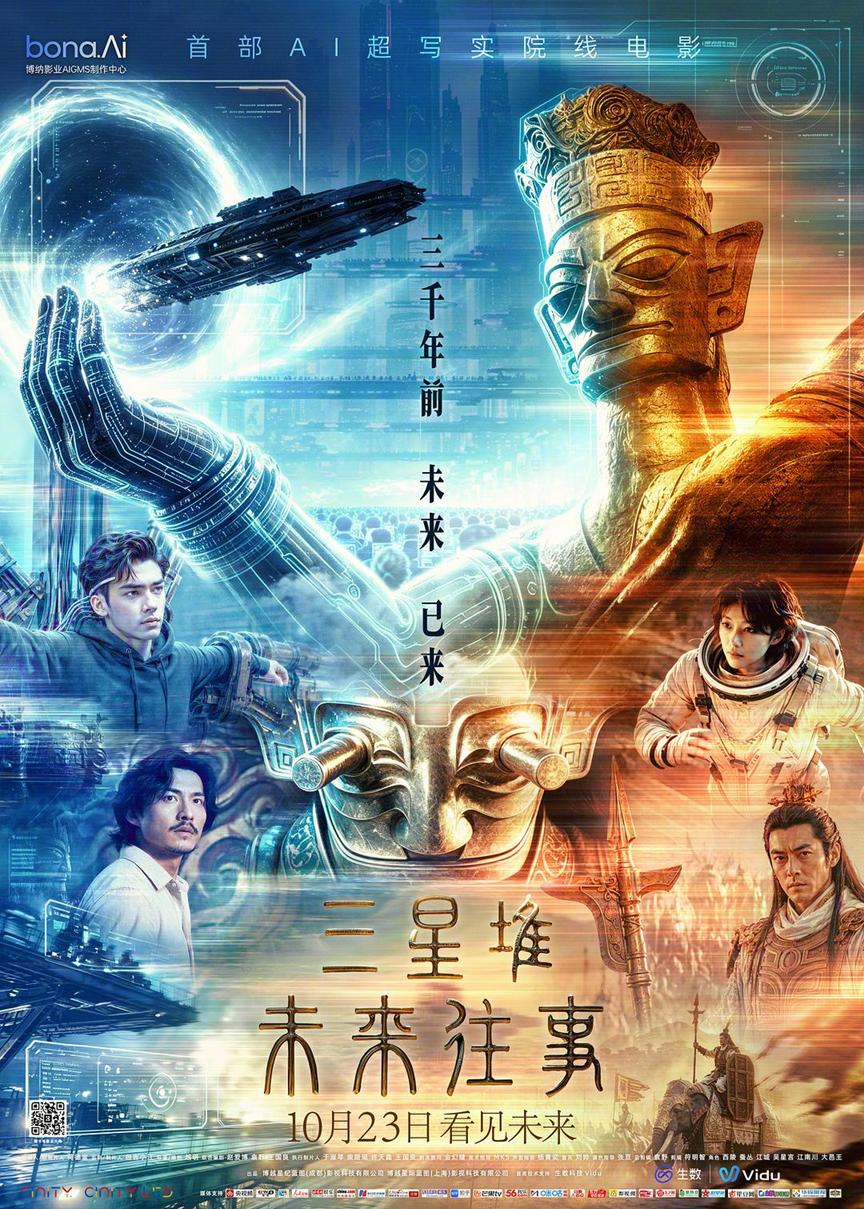
*Sanxingdui: Past of the Future* positions itself as "the first AI hyper-realistic theatrical film". (Photo / *Sanxingdui: Past of the Future*)
The capital market's reaction was even more absurd. One month ago, on the first trading day after *Sanxingdui* was scheduled for release (September 28), Bona Pictures hit the 10% daily limit up. On the fourth day after its release (October 26), the stock directly hit the 10% daily limit down during trading hours. Even though the stock price rebounded with fluctuations in the following days, as of press time, its share price had fallen by nearly 10% compared to the first day of the film's release.
On social platforms, some bloggers described their viewing experience of the film as "mental abuse" and "worse than watching *Bull Comes*". More netizens' doubts about *Sanxingdui* focused on the question: "There are tons of free AI short dramas online, why should I pay to watch this?"
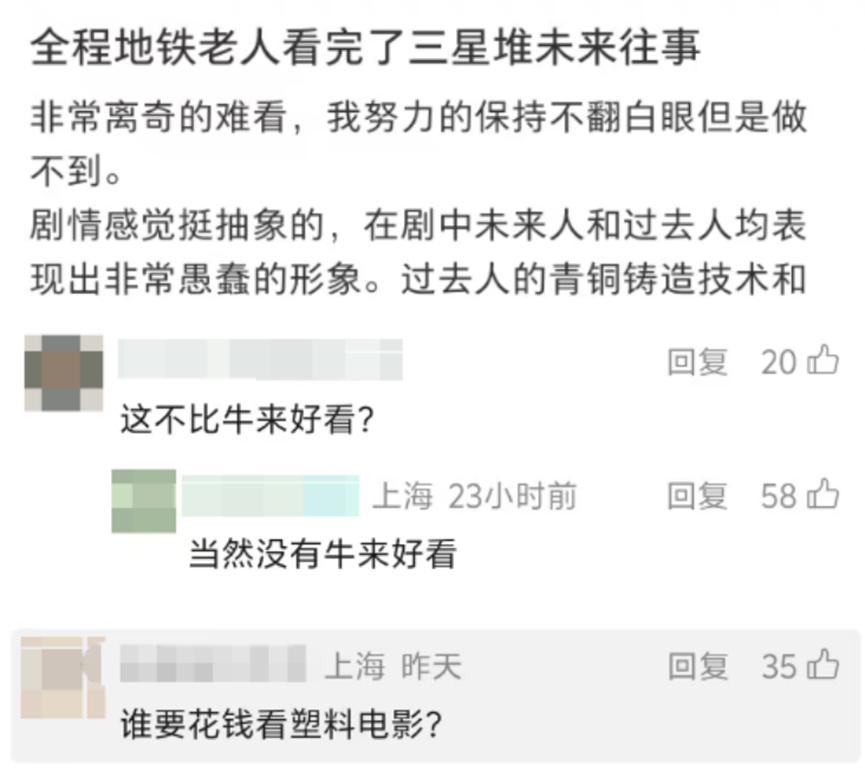
Netizens' discussions and doubts about *Sanxingdui: Past of the Future*. (Photo / Screenshot from social platforms)
With the same confusion, and the promise from my leader that "the ticket fee will definitely be reimbursed later", I spent 45 yuan buying a ticket and walked into the cinema, accepting the 100-minute siege launched by AI against the human prefrontal cortex.
Who could have imagined that this film with all visuals generated entirely by AI tells a story about how the abuse of AI will lead to a world crisis. What a dark humor.
Ten-million-yuan AI blockbuster lost to *Bull Comes* made manually with only 50,000 yuan
Data from Maoyan Professional Edition shows that in the 6 days since its official release, the average number of audiences per screening of *Sanxingdui* has never exceeded 2, and it even dropped to only 0.3 on October 26. On a weekday afternoon, the screening I attended was even above the average level. Surprisingly, there were two other audiences besides me in the huge theater.
I did not see any pre-screening advertisements during this viewing. Before the film started, there were only the regular civilized viewing and fire safety short videos, as well as the trailer for another Bona Pictures AI film *Off-Plan: Guanghan Operation*, which is reportedly in production but not yet scheduled for release. After the familiar dragon logo of China's film regulatory approval appeared on the big screen, an extra line of AI reminder text popped up, indicating that all visuals and part of the dubbing of this film are generated by AI.
The general plot of *Sanxingdui* is roughly set in the future, where a super AI called "Super Brain" that claims to be able to deduce the future appears in society. The Super Brain takes over most industries, and the wealthy who can afford its huge usage fees rush to implant chips in their brains to connect to the Super Brain. Like all cyberpunk-themed works, the gap between the rich and the poor in the society depicted in the film widens. One day, the Super Brain collapses due to excessive deduction of the future, the world order collapses, and the doomsday arrives.
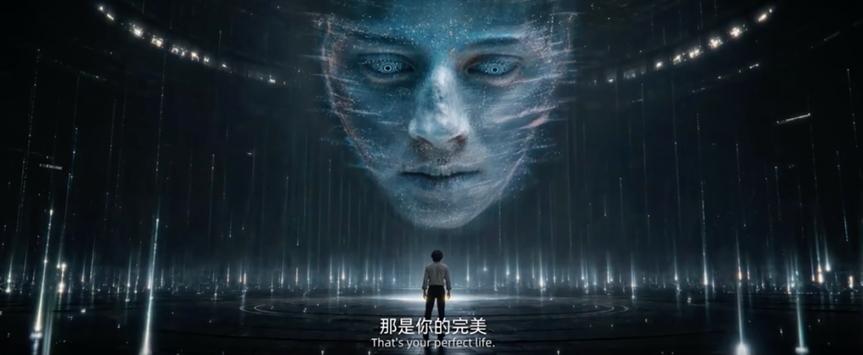
The consciousness of the "Super Brain" in the film is presented in the image of the virtual human figure in the picture. (Photo / Screenshot from the trailer of *Sanxingdui: Past of the Future*)
Thus, the heavy responsibility of saving the world falls on a female astronaut. She injured her brain in an accident in her early years, which unexpectedly made her one of the few people in the world who cannot connect to the Super Brain. Therefore, she takes another kind-hearted AI system, gets on a spaceship and travels through a wormhole to the past, trying to tell people 50 years ago about the risks of the Super Brain. However, she accidentally travels back to Sanxingdui more than 3000 years ago, so she chooses to convert the secret into binary code and hide it in the inscriptions on Sanxingdui bronze wares.
The following plot is about how the female protagonist in the past tries to influence history and pass on information, and how the male protagonist living in the future discovers the secret of Sanxingdui and foils the conspiracy of the evil Super Brain AI in one go.
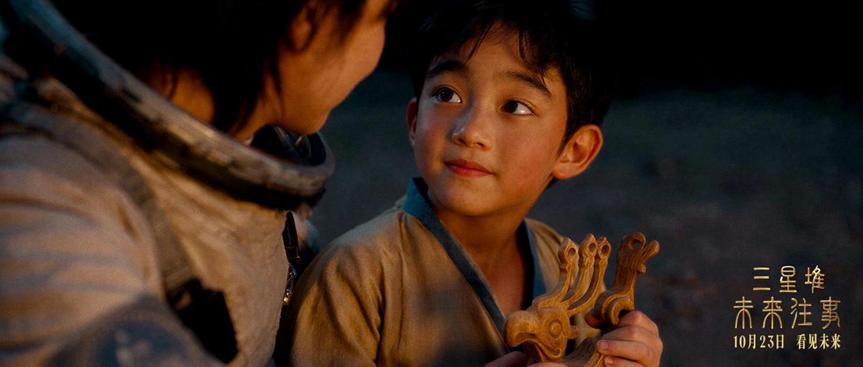
In the film, the female protagonist who travels from the future to ancient times teaches Can Cong, the ancient Shu king, how to make bronze wares and how to encode with binary code. (Photo / *Sanxingdui: Past of the Future*)
It has to be admitted that this setting of "ancient mythology + cyberpunk" might have felt refreshing if it was released two years ago, but it pales in comparison at the moment when AI short dramas are everywhere.
In the world of AI short dramas, all pets can speak, time-travel and rebirth systems are offered like free giveaways. Some people travel back to the Qin Dynasty to be the health consultant for Qin Shi Huang, or travel to ancient times to enlighten apes. Cyberpunk and weird rule-breaking themes are ubiquitous, even aliens have to recite lines like "Rules are set, so you can eat without heartburn". The anti-expectation and anti-routine designs are pushed to the extreme.
In contrast, the plot of *Sanxingdui* appears rather orthodox and conventional. On the macro level, it follows the classic plot of the good side defeating the evil AI, and it draws on the mystery of Sanxingdui culture and the cultural pride of Chinese people.
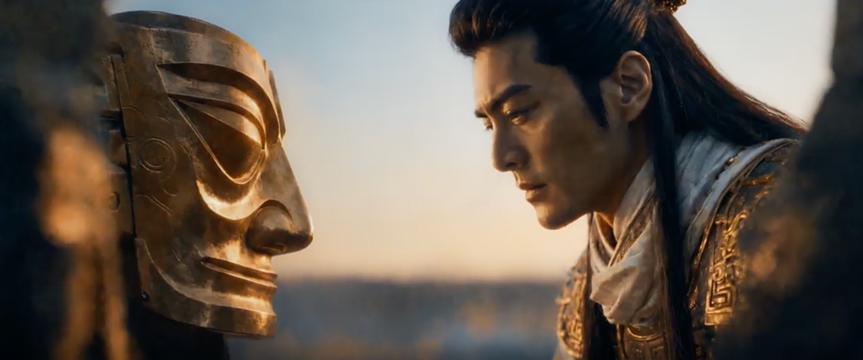
The appearance of elements related to Sanxingdui culture is the highlight of the film. (Photo / Screenshot from the trailer of *Sanxingdui: Past of the Future*)
*Sanxingdui* cannot compete with the fearless online AI short dramas in terms of creative ideas, and it is also late in terms of AI visual technology.
As is known to all, AI video tools have iterated extremely fast in the past six months. The launch of Seedance 2.5 has collectively upgraded the visuals of AI short films on the market in the past three months. However, as a theatrical film with a long production process that needs to go through censorship procedures, some of the visuals in *Sanxingdui* were produced a long time ago, which still have obvious AI incongruity, and there are many unique AI problems that can now be recognized by audiences, such as over-sharpened visuals with a strange greasy texture.
To give a further example, the mouth movements of the characters when they speak in the film are rather awkward. Every opening and closing of the mouth looks like they are straining, as if there is a piece of dried naan hidden behind their molars that needs to be chewed to pieces. At the same time, all characters have similar smiling lips with sharp mouth corners. The corners of their mouths always stay upturned when speaking, and cannot open fully.
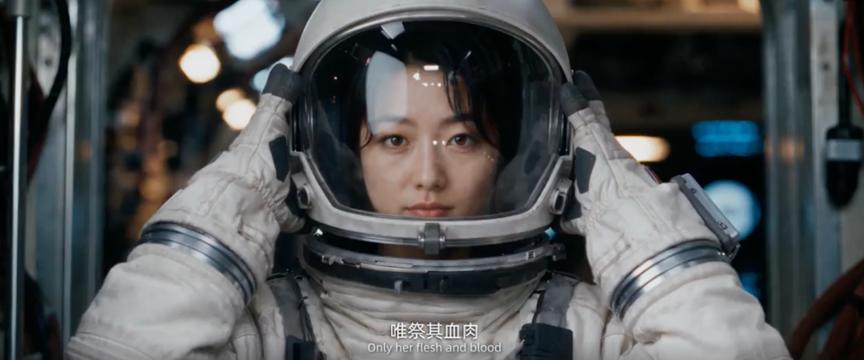
Many AI-generated portraits have the mysterious smiling lip feature. (Photo / Screenshot from the trailer of *Sanxingdui: Past of the Future*)
The expressions that characters can make switch between two extremes: either the rigid panic with wide open mouth and staring eyes, or the calm and indifferent look with little change. Even though the plot goes through grand scenes such as the end of the world, spaceships falling from the sky, and wars between countries, the protagonists all stay calm, as if only the corners of their clothes are slightly dirty.
If you look closely, you will find that the facial expression changes of the characters when their emotions fluctuate are concentrated on the mouth. But probably due to the limitations of AI technology, all changes present a similar mouth-pursing effect: the protagonist purses their mouth angrily, purses their mouth forbearingly, purses their mouth when deep in thought, purses their mouth unwillingly... A few of the pursed mouth expressions even look exactly like the abstract meme of "I can't hold it back anymore".
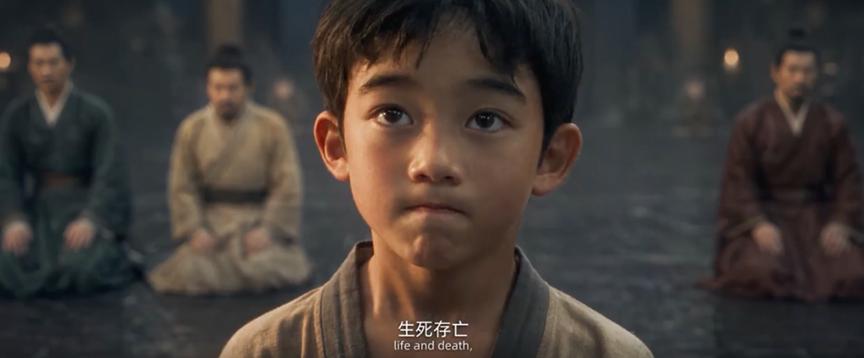
A large number of similar pursed mouth expressions appear in the film. (Photo / Screenshot from the trailer of *Sanxingdui: Past of the Future*)
These details with AI incongruity are not unique to *Sanxingdui*, most AI short films on the market have the same problem. They are not easy to be noticed when displayed on mobile phone screens, but once projected on the large cinema screen, they immediately trigger a strong "uncanny valley effect".
What's more, the biggest "original sin" of *Sanxingdui* is that it requires paid viewing.
When you scroll across an AI video you don't particularly like on your phone, you can swipe away quickly. But when you watch an AI theatrical film, after paying the sunk cost, you will be forced to sit in the seat and watch it for 100 minutes by the mentality of "I've already paid for it".
The form of theatrical films is destined to raise the viewing threshold of works, and at a time when audiences' tastes are getting more and more demanding, this threshold is not easy to cross.
Saved 300 million yuan in special effects fees, but drove away all audiences
Before the film was released, the production team of *Sanxingdui* had been interviewed by many media outlets to introduce the creation process of this film.
According to a report by *Economic Observer*, the production team first tested the waters by making a 13-episode AI sci-fi short drama *Sanxingdui: Future Revelation*, which was launched on Douyin in July 2024 and has accumulated over 200 million views across the whole network so far. The success of the short drama gave the team great confidence, and the idea of making an AI feature film was thus born. An insider of Bona Pictures introduced: "This is a project approved by Chairman Yu Dong."
However, free short dramas and paid theatrical films obviously operate under two completely different market logics. Zhang Yi, CEO and chief analyst of iiMedia Research, mentioned in an interview with *Chang'an Street Insider* that according to case survey data, users' acceptance of AI content has clear stratification:
AI manhua dramas and short dramas have the highest acceptance, followed by AI long dramas, while the threshold for theatrical AI films is currently the strictest and highest.
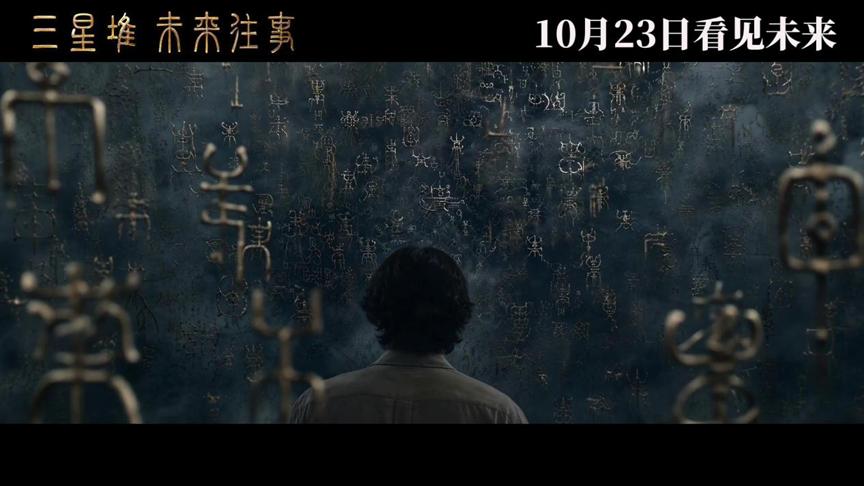
The public has different levels of tolerance for AI films and AI short dramas. (Photo / Screenshot from the trailer of *Sanxingdui: Past of the Future*)
Even if we ignore all the stiffness of AI-generated visuals and analyze the film from other dimensions, *Sanxingdui* is still far from being a high-quality work.
AI films have indeed realized the "zero-cost special effects" experience that traditional films never had before. Every frame can be generated by AI to create extremely complex grand scenes, but at the same time, AI films have lost many basic standards of traditional films.
The 100-minute *Sanxingdui* exposes the natural flaw of AI films that the rhythm tends to be too uniform. Probably because maintaining the consistency of characters, movements and space for a long time is still a difficult problem for AI video generation, most of the shots in *Sanxingdui* are short shots, and dense shot transitions appear many times.
When the characters are just saying a few ordinary lines, the camera repeatedly switches between over-the-shoulder shots and different perspectives, and the picture refreshes every one or two seconds, but there is no special causal relationship or emotional progression need between the previous and subsequent shots.
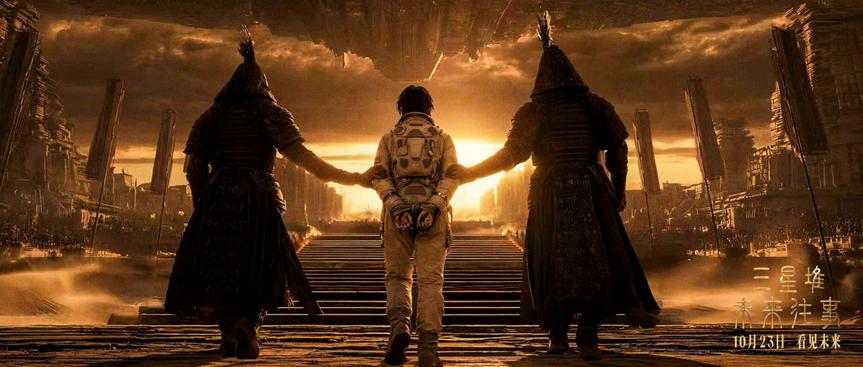
The defect of AI's long shot capability limits the editing style of AI films. (Photo / *Sanxingdui: Past of the Future*)
Fast camera