European natural gas prices are approaching 100 euros
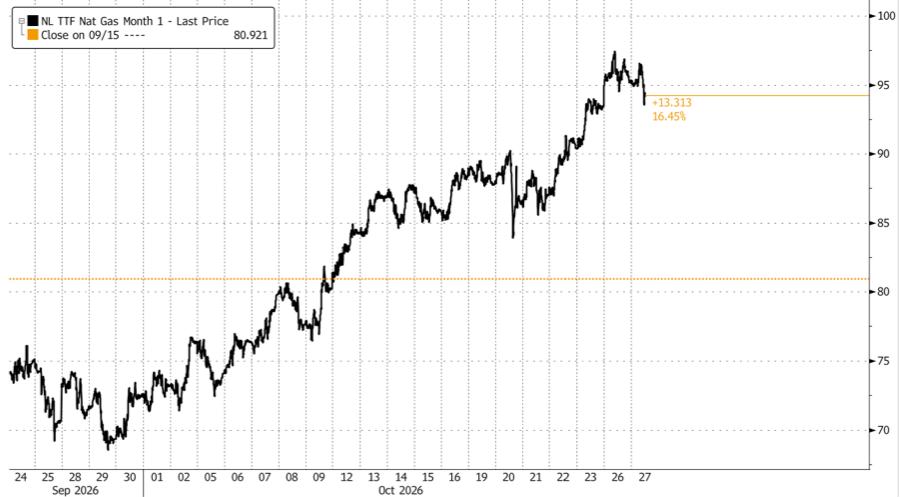
The European natural gas market is facing tests at the start of winter. With a new round of cold waves approaching, TTF, Europe's benchmark natural gas price, has approached 100 euros per megawatt-hour.
In contrast, US natural gas futures prices have continued to fall recently, dropping to the lowest level since April this year, as abnormally high temperatures across the contiguous 48 U.S. states have curbed heating demand. This weather pattern is likely linked to the climatic impacts brought by the El Niño phenomenon, and also highlights the increasingly divergent trends of the two major European and American natural gas markets.
It is reported that starting from this weekend, temperatures in parts of the European continent will be significantly lower than the same period in previous years, expected to be 2 to 3 degrees Celsius lower. At the same time, northeast China, Japan and South Korea will also usher in a new round of cold waves, with temperatures significantly below the seasonal average.
Amid the release of the above weather forecast, European natural gas prices have continued to rise. On Monday, European benchmark natural gas futures prices once broke through 97 euros per megawatt-hour for the first time since the 2022 energy crisis, with a year-to-date increase of about 234%.
European natural gas inventories are also a source of concern for the market. At present, the inventory level of gas storage facilities in Europe is only 75%, while the average level in the same period over the past 10 years is about 90%.
Data released by Gas Infrastructure Europe last Thursday showed that EU natural gas inventories have declined for the first time since the beginning of this year. This change is worrying, because when the EU enters the seasonal natural gas inventory consumption period, the inventory level is already lower than that of the same period in previous years, leaving very limited buffer space to withstand the impact of successive cold waves.
Data from the think tank Bruegel shows that as of October 24, the inventory rate of EU gas storage facilities was only 74.6%, lower than 82.9% in the same period last year, and far lower than 98.5% in the same period of 2023. The Institute for Energy Economics and Financial Analysis (IEEFA), an energy research institution, pointed out that this is the lowest level for the same period since records began in 2011. Some countries have even consumed their winter inventories ahead of schedule.
Insufficient inventory buffers mean that Europe will increasingly rely on the international natural gas market and have to compete with Asian buyers for limited supplies. Against the backdrop of the still chaotic situation at the Strait of Hormuz, a key maritime transport corridor, the market may need a sharp rise in natural gas prices to balance the contradiction between tight supply and growing demand.
In addition, Russian natural gas supply is also facing further contraction. Russian LNG still accounted for about one-fifth of EU LNG imports in the second quarter of this year, but the EU plans to fully ban imports of Russian LNG starting from January 2027. IEEFA estimates that affected by factors including the relevant ban, the EU may need to reduce its natural gas consumption by about 7% compared with the previous winter.
Andrew Pedrini, a meteorologist at atmospheric science research firm Atmospheric G2, said that the market's biggest concern before the arrival of winter may be "multiple regions with strong energy demand experiencing cold weather at the same time".
The situation on the other side of the Atlantic is completely different. Due to the recent warmer weather in the contiguous 48 U.S. states, U.S. natural gas futures have fallen sharply in recent weeks, dropping to the lowest level since April this year.
Commodity Weather Group, a meteorological forecasting agency, expects that the combined period of October and November in the U.S. will be the third warmest for the same period since records began in 1950. This further strengthens the market's expectation of warmer winter weather in the U.S., and the El Niño phenomenon is considered to be one of the factors affecting this weather pattern.
Analysts said: "High European natural gas prices may last throughout the winter and even extend to 2028. If winter temperatures are normal, the Middle East conflict ends within this year, and Qatar and the United Arab Emirates resume normal LNG production in early 2027, the inventory rate of European gas storage facilities may still drop to 17% to 20% by the end of March next year. If the winter is abnormally cold, the inventory level may drop further, and Europe will have to compete for the remaining supplies in the Asian market at higher prices."
This article is from the WeChat official account "Cls.cn", written by Niu Zhanlin, and published by 36Kr with authorization.