Latest Ranking of the Top 10 Cities by GDP!
In the first three quarters of 2026, the top 10 Chinese mainland cities by GDP have all been announced.
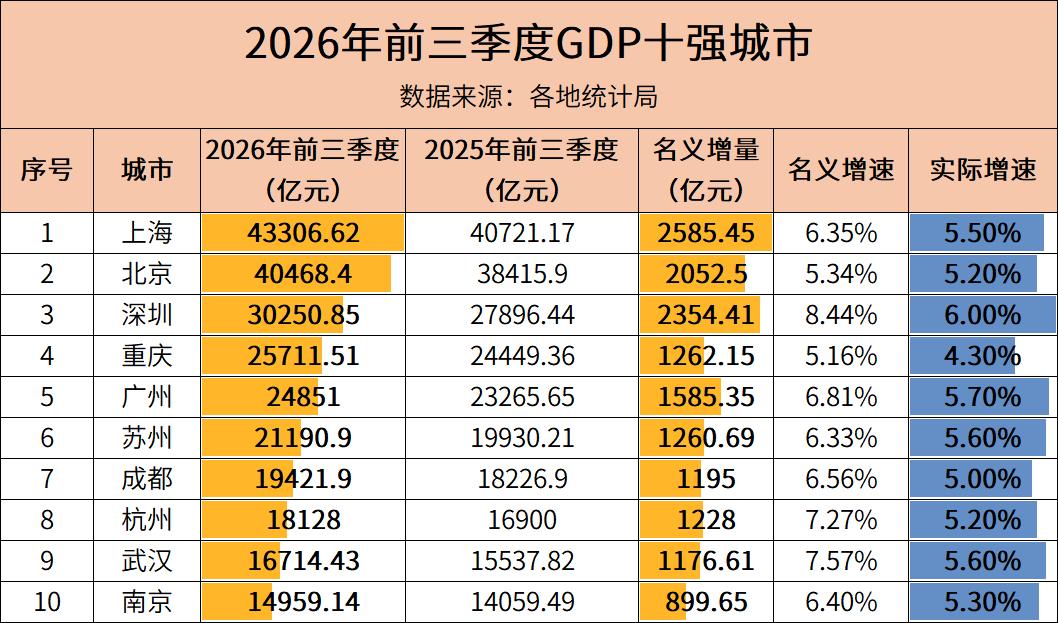
In terms of total volume: Shanghai ranks first, Beijing second, Shenzhen third, and Chongqing fourth. In terms of growth rate: Shenzhen takes the first place, Guangzhou the second, and Suzhou and Wuhan tie for the third.
Among them, Shenzhen took the first place among the top 10 cities with a 6% growth rate, and Guangzhou ranked second with a 5.7% growth rate. It is worth mentioning that Guangzhou's 5.7% growth rate has hit a new high in the same period in the past five years.
Among the top 10 cities, only Chongqing's growth rate is lower than the national average, with a 4.3% growth rate below the national average of 4.6%, which is mainly dragged down by the secondary industry, especially the slowdown in the growth of the new energy vehicle industry. Shenzhen has caught up with the AI hardware trend this year, with both industry and foreign trade booming. The three major pillars of Guangzhou's industry (automobile, petrochemical, electronics) have rebounded significantly, driving the GDP growth rate to rebound.
01
Shanghai is sprinting towards the 6-trillion-yuan mark, Shenzhen is sprinting towards the 4-trillion-yuan mark
In terms of total economic volume, the economic aggregate of leading domestic cities continues to reach new levels.
In the first three quarters, Shanghai's GDP reached 43306.62 billion yuan, with a year-on-year growth rate of 5.5%, continuing to hold its position as China's top economic city. Calculated according to the current growth pace, Shanghai's full-year GDP is expected to exceed 6 trillion yuan, making it the first city in China to enter the 6-trillion-yuan economic aggregate tier.
Beijing ranks second, with a GDP of 40468.4 billion yuan in the first three quarters and a growth rate of 5.2%. Relying on its stable industrial and resource advantages, its full-year economic aggregate is expected to approach the 5.5-trillion-yuan mark.
Shenzhen, ranking third, is enjoying a strong growth momentum, with a GDP of 30250.85 billion yuan in the first three quarters. With a 6% growth rate, it is expected to successfully break through the 4-trillion-yuan mark for the whole year.
The complete ranking and economic aggregate of the remaining top 10 cities are as follows: Chongqing ranks fourth with 25711.51 billion yuan, Guangzhou ranks fifth with 24851 billion yuan, Suzhou ranks sixth with 21190.9 billion yuan, Chengdu ranks seventh with 19421.9 billion yuan, Hangzhou ranks eighth with 18128 billion yuan, Wuhan ranks ninth with 16714.43 billion yuan, and Nanjing ranks tenth with 14959.14 billion yuan.
Apart from the growth rate, the nominal increment of GDP can more intuitively reflect the real economic expansion capacity of cities.
Data shows that Shanghai ranks first steadily with an increment of 2585.45 billion yuan; Shenzhen ranks second with an increment of 2354.41 billion yuan; Beijing ranks third with an increment of 2052.5 billion yuan; Guangzhou ranks fourth with an increment of 1585.35 billion yuan.
02
Industry: Wuhan takes the lead, Chongqing is relatively weak
As the core driving force of economic growth, industry has become the key for many cities to achieve breakthrough development.
In the secondary industry data, Wuhan performs outstandingly with a growth rate as high as 10.3%; the secondary industry of Shenzhen and Suzhou grows by 7.3% simultaneously, tying for the second place. While the secondary industry of Chongqing only has a growth rate of 1.7%, with weak industrial growth, which is also the main reason dragging down its overall growth rate.
When broken down into the added value of industries above designated size, the gap between cities is further widened.
Wuhan takes the lead by a large margin with an ultra-high growth rate of 17.5%, with industrial production capacity and emerging industry production capacity being released intensively; Shenzhen (9.5%) and Suzhou (9.1%) follow closely, with strong manufacturing resilience; the total industrial added value of Shanghai increases by 5.5%, with steady quality improvement; the growth rate of industries above designated size in Chongqing is only 3.5%, and industrial growth has slowed down to some extent.
The slowdown of Chongqing's GDP in the first three quarters of this year is mainly due to the pressure on the industrial sector. The core of the weakening industry lies in the sharp drop in the growth rate of the once highly explosive intelligent connected new energy vehicle cluster, which fell from the high growth of 25.9% in 2024 to 3.5% this year.
03
Nanjing, Chongqing and Suzhou have their respective performances
Putting aside the total GDP data, by disassembling the five core indicators of service industry, industry, consumption, investment and foreign trade, we can more clearly see the industrial advantages and development shortcomings of the top 10 strong cities, and the differences in the growth patterns of various cities are also obvious.
As the core pillar of stabilizing employment and expanding domestic demand, the performance of the service industry varies from city to city. Among the top 10 cities, Nanjing's service industry grows by 6.4%, ranking first; Guangzhou's service industry grows by 5.9%, ranking second, which is also the city with the highest service industry growth rate among the four first-tier cities; Chongqing ranks third with a growth rate of 5.8%. In contrast, the service industry growth rate of Wuhan is only 3.3%, which is at a relatively low level among the top 10 cities.
The recovery of the consumer market shows a clear differentiation trend, and the overall domestic demand is under pressure.
Among the top 10 cities, the year-on-year growth rate of total retail sales of social consumer goods of 6 cities has declined, and only 4 cities including Shenzhen, Chongqing, Guangzhou and Chengdu maintain positive growth.
Among them, Chongqing ranks first with a retail sales growth rate of 3.1%, and Guangzhou ranks second with 2.5%, which fully reflects the recovery vitality of the consumer markets of the two cities.
Fixed asset investment is also generally weak, and half of the cities are in negative growth. Among the top 10 cities, the fixed asset investment growth rate of 5 cities has declined, with Nanjing seeing the largest decline of 12.2%; Wuhan down 9.8%, Suzhou down 8.8%, Shenzhen down 5.2%. While the two super cities of Beijing and Shanghai maintain relatively high growth, Shanghai's fixed asset investment grows by 4.3%, and Beijing by 3.9%.
The foreign trade sector is highly resilient, becoming a dark horse of growth in many cities.
Among the top 10 cities, only Nanjing's import and export volume has declined, and all other cities have achieved positive growth. Among them, Suzhou's foreign trade growth rate is as high as 51.9%, with amazing explosive force; Shenzhen's high growth rate of 38.8% once again proves that foreign trade is the core ace of its economic growth.
Based on all the data, we can see that among the top 10 cities, Chengdu maintains positive growth in a number of economic indicators. While cities such as Wuhan and Suzhou have distinct characteristics, belonging to the "unbalanced growth" type, which rely on strong industry and foreign trade to drive the economy.
Wuhan's economic growth is very representative: fixed asset investment and retail sales of consumer goods are both in negative growth, and the service industry growth rate is relatively low, but with the ultra-high growth rate of 10.3% in the secondary industry and 17.5% in industries above designated size, it has successfully driven the overall GDP growth by 5.6%. The release of emerging production capacity such as integrated circuit wafers and smart home appliances has become the core support for industrial growth.
Suzhou's logic is basically the same: both fixed asset investment and consumption have declined, but it has maintained an economic growth of 5.6% relying on the 7.3% growth rate of the secondary industry and the foreign trade growth rate of over 50%.
This article is from the WeChat official account "City War", author: Lao Qiao, published with authorization from 36Kr.