Jensen Huang staked 20 billion yuan on Mark Zuckerberg.
Zhidx News reported on October 27 that NVIDIA announced today that it will invest 30 billion US dollars (about 200 billion yuan) in Meta's equity issuance. At the same time, the two sides will expand cooperation on the personal agent product Muse and the Muse series of models to improve the reasoning and training performance of the models.
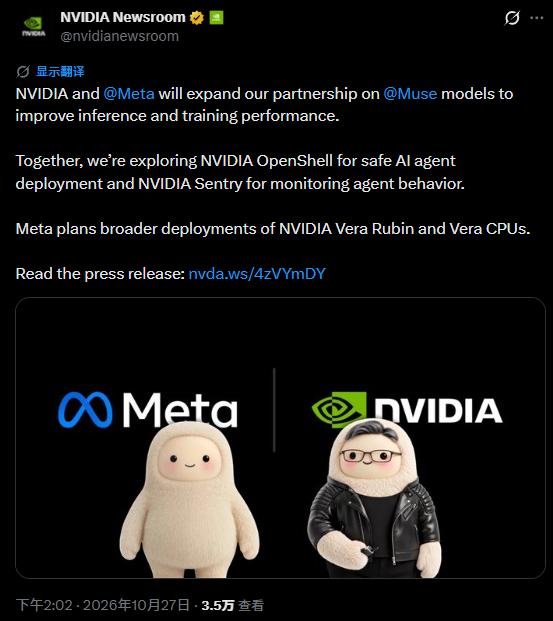
NVIDIA's announcement (Source: X Platform)
This investment by NVIDIA is part of Meta's larger financing plan. On October 26, Meta released an announcement stating that it plans to carry out a $950 billion (about 6.335 trillion yuan) fundraising, raising $350 billion through underwritten public share offerings on the one hand, and then raising another $600 billion through a market issuance plan. In addition to NVIDIA, AMD and Broadcom also intend to invest in Meta.
Meta expects its full-year capital expenditure to be between 1350 billion and 1450 billion US dollars (about 9.013 trillion to 9.68 trillion yuan), and this round of financing will support its growing capital expenditure.
NVIDIA's announcement shows that in addition to financing, Meta and NVIDIA plan to carry out optimization cooperation in all links to maximize the performance of AI infrastructure and improve total cost of ownership. At present, Meta's Muse model is already running on NVIDIA's infrastructure. When the Muse Wonder model was released in October this year, it achieved cutting-edge benchmark test performance.
This cooperation also involves the recently highly popular personal agent product Muse. In early September this year, Meta officially launched Muse, a general-purpose agent with cross-network service capabilities. 10 days after its launch, Muse topped the overall free app chart on the US App Store.
Meta's stock price skyrocketed due to the popularity of Muse, once hitting a high of $779.82 per share, with a total market value approaching 2 trillion US dollars. After Muse, personal agents have also become a new battlefield for AI giants. Recently, foreign companies including OpenAI and Anthropic, as well as domestic enterprises such as Alibaba, Ant Group, Manus and Tencent, have successively launched agent products with similar ideas.
In this cooperation, Meta will consider adopting NVIDIA's OpenShell secure agent reference architecture, including OpenShell for secure deployment and Sentry for monitoring agent behavior.
Meta also plans to expand the deployment of NVIDIA's infrastructure, including Vera Rubin and Vera CPUs for next-generation AI agents, to maximize performance per watt. Meta will also deploy NVIDIA Spectrum-X Ethernet networking and BlueField-4 to improve network efficiency and throughput.
At last week's Meta earnings call, Mark Zuckerberg, founder and CEO of Meta, said that about one and a half months after Muse was launched, more than 10 million people in the United States and Canada have configured the Muse personal agent, with a daily active usage ratio of about 25%. Shopping is one of the most common usage scenarios, with more than a quarter of users participating, and the average order value exceeds 200 US dollars.
Zuckerberg said that Muse has shown clear product-market fit, and he hopes to develop Muse into a product serving billions of people in the future.
At the time of this financing, Meta's stock price has fallen for several consecutive days. As of the close on October 26, US Eastern Time, Meta's stock price fell 1.88% to $630.56, with a total market value of 1.61 trillion US dollars (about 10.71 trillion yuan).
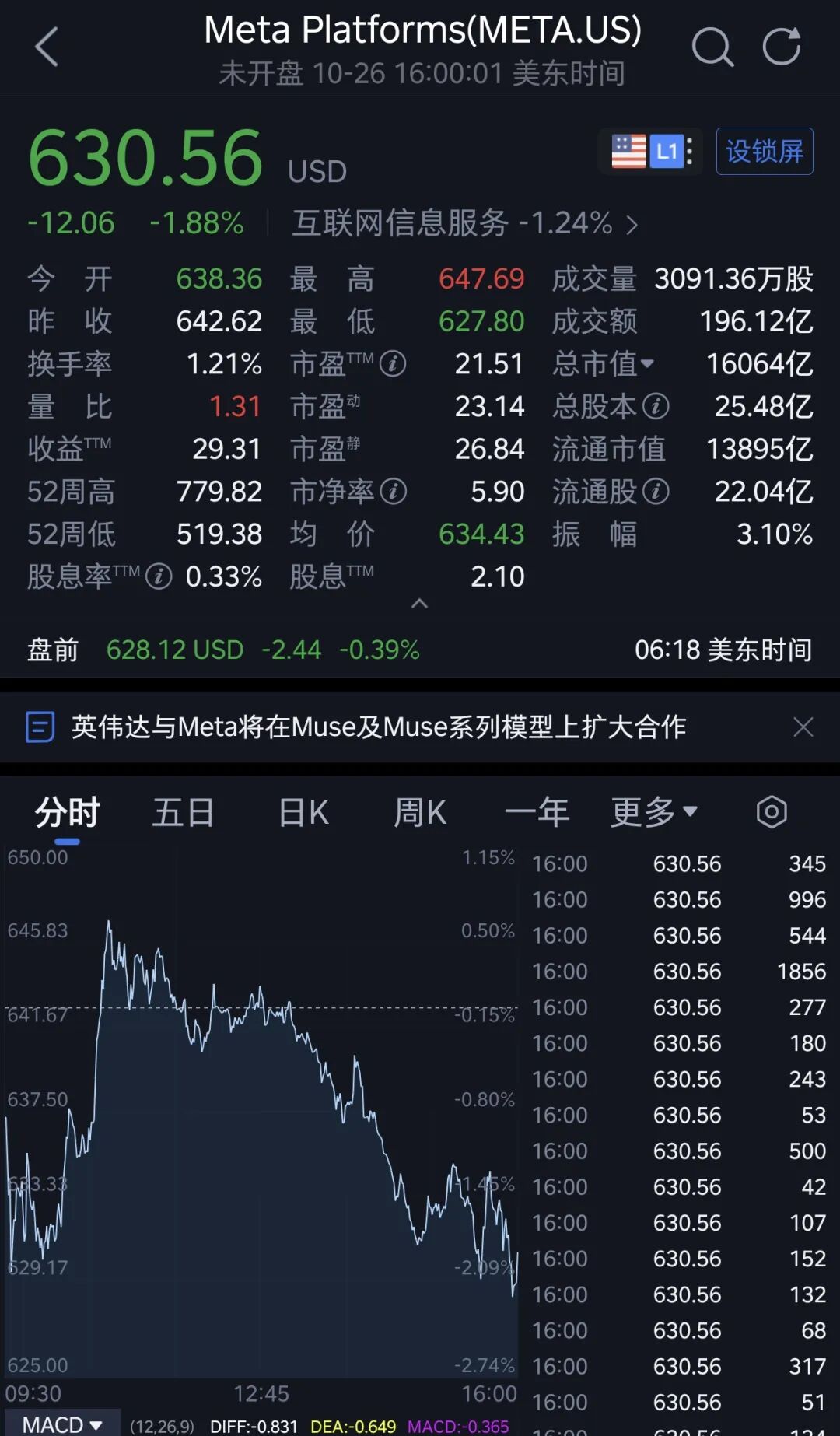
Meta's stock price (Source: Tencent Stock Select)
Conclusion: Agents Are Accessible to Ordinary Users, Collaboration Between Application Layer and Computing Power Layer Becomes Increasingly Important
When AI agents begin to reach ordinary users, the collaboration between the application layer and the computing power layer has become more important. For Meta, whether Muse can move from early user growth to large-scale, sustainable use remains to be tested by the market.
For NVIDIA, the popularization of agent applications is expected to further drive demand for model training, reasoning and underlying infrastructure.
This article is from the WeChat Official Account "Zhidx" (ID: zhidxcom), written by Chen Junda, edited by Li Shuiqing, and published with authorization by 36Kr.