5 Steps to Settle on a Restaurant: "What to Eat Later" Perfectly Cures Young People's Choice Paralysis
At a time when most local life platforms are frantically adding features, stacking lists, piling up reviews, and stuffing short videos, the local life track seems to have entered an era of information overload. However, for young people standing at the crossroads of commercial districts, when the surrounding catering options are extremely similar, what they lack is no longer richer information, but a decision-making mechanism that can be quickly implemented. A WeChat mini-program named "What to Eat Later" is trying to tap into this "underwater rigid demand" ignored by major tech giants.
From decision paralysis to physical randomness, reconstruct the catering selection link
The birth of "What to Eat Later" stems from the real pain point of its founder Xu Xinmei. As a student at Hunan Normal University, she found that the biggest obstacle users face when choosing a restaurant is "decision fatigue". Traditional platforms throw the right of choice to users through reviews and rankings, which instead lengthens the decision-making process.
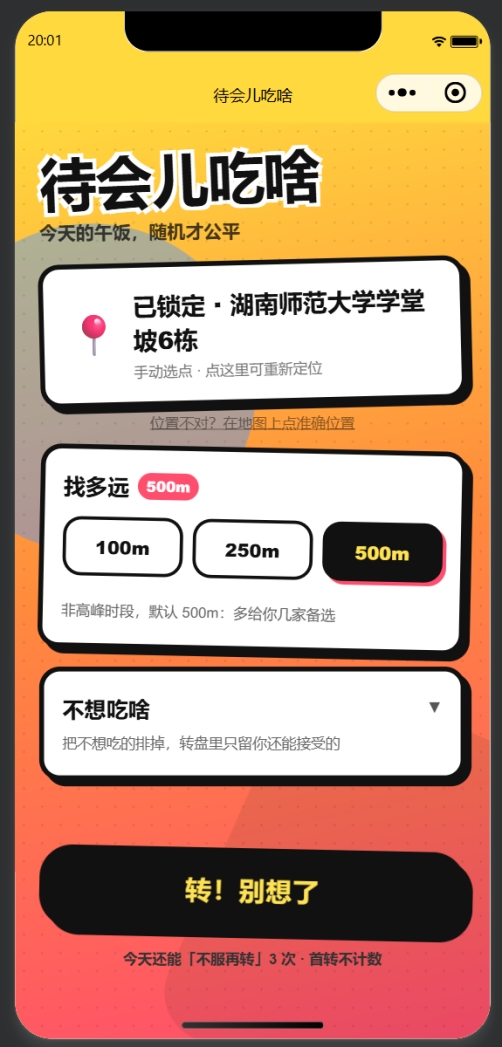
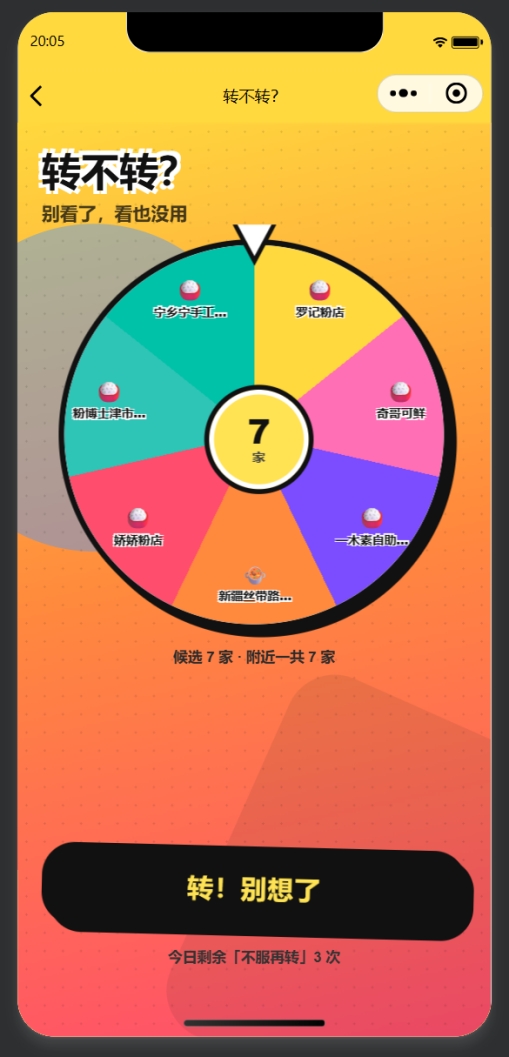
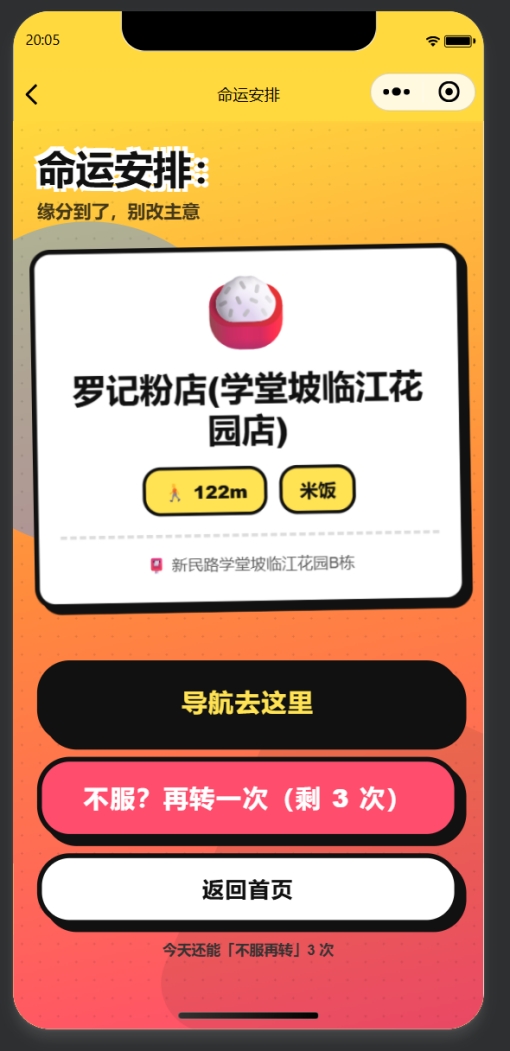
To this end, this product has made extreme subtraction. After users open the mini-program and authorize location access, they only need to select the search radius, uncheck the food categories they don't want to eat today (such as hot pot and fast food), click "Spin" to randomly lock a real store through a physical turntable, and trigger navigation with one tap. The whole process only takes 5 steps, without any interference from graphic reviews. According to the team, to ensure that the search results do not exceed the set range, the product does not rely on the default parameters of the official SDK, but conducts strict secondary radius verification on the client side to strictly adhere to the safe boundary set by users.
Decoupled underlying architecture, building technical barriers with geek spirit
As a very early-stage project, its technical architecture shows a high degree of completeness. At present, the project has realized full-link real machine operation, the mini-program package size is only 112KB, the UI is rendered purely with CSS and emojis, and even the turntable animation does not use Canvas.
The more core barrier lies in its data source facade architecture. Facing the black box risk of the underlying map SDK (for example, some official SDKs will cause callback deadlock when there is no road data), the team independently developed an independent dataSource adaptation layer. At present, no matter which map manufacturer's POI data is accessed at the bottom, the switch can be completed by modifying only one line of code, with zero changes to the upper business page. This highly decoupled design greatly improves the project's ability to resist risks when dealing with interface changes in the early stage. The project code is open source on GitHub, which records various engineering pitfalls in detail, and has certain potential for geek reputation in the technical community.
Tap into the exposure of long-tail merchants to find incremental value in local life
In terms of business model, the project avoids the high paid ranking and commission deduction model of traditional platforms. For long-tail merchants in commercial districts (high-quality small shops lacking online operation capabilities), "What to Eat Later" has designed a lightweight advertising mechanism based on the "blind box" logic: merchants can purchase weight improvement packages for specific off-peak hours (such as low passenger flow periods) to obtain random exposure opportunities at extremely low cost.
At present, the project is in a very early stage where the technical closed loop has been completed and the commercial closed loop is to be verified. The marginal cost of a single decision is extremely low (within the free API quota). The team plans to raise a seed round of financing of 100,000 to 300,000 RMB to run through the minimum unit economic model of the first commercial district around Changsha University Town, and cooperate with 3 to 5 local merchants to verify the willingness to pay for "off-peak exposure".
Team background: A geek model driven by a single full-stack developer and AI
At present, the team has only one full-time member, Xu Xinmei. As an independent developer, she takes charge of the whole process from product definition, interactive design to full-stack development. With the help of AI-assisted programming tools, she alone achieves the iteration speed that could only be completed by a small team in the past.
Facing the crowded market with giant players, the team believes: "What major manufacturers do is information distribution and transaction closed loop, and what we do is the final step after the list page. We don't want to replace review platforms, we just want to be the button that helps users stop hesitating." In the future, the project will open up a partnership mechanism to find business partners who understand the resources of local life merchants, and jointly promote the implementation of commercialization.