Zhang Yiming takes the top spot, Liang Wenfeng leads AI hard-core technology to the forefront of the wealth stage
On October 27, the *Hurun China Rich List 2026* was released. There are 263 newly listed entrepreneurs in total, and the total number of people on the list reaches 1,529, hitting the highest record in the 28-year history of the list. The total wealth of the listed entrepreneurs amounts to 32 trillion yuan, representing a 7% year-on-year increase.
Compared with previous years, the most notable change this year comes from the top group of the new faces list. The newly listed hard technology entrepreneurs are concentrated in high-growth tracks such as large AI models, AI chips, humanoid robots, commercial aerospace, and semiconductor display. Representative figures include Liang Wenfeng of DeepSeek, Wang Xingxing of Unitree Robotics, Wang Zhiyong of HKC, Liu Debing and Tang Jie of Zhipu AI, Chen Weiliang of Metax Tech, Yan Junjie of MiniMax, as well as Zhang Changwu, Kang Yonglai and Yang Yiqiang from the commercial aerospace track. New wealth no longer mainly comes from consumption, real estate or traditional internet platforms, but from technological breakthroughs, industrial valuation revaluation and capital market pricing.
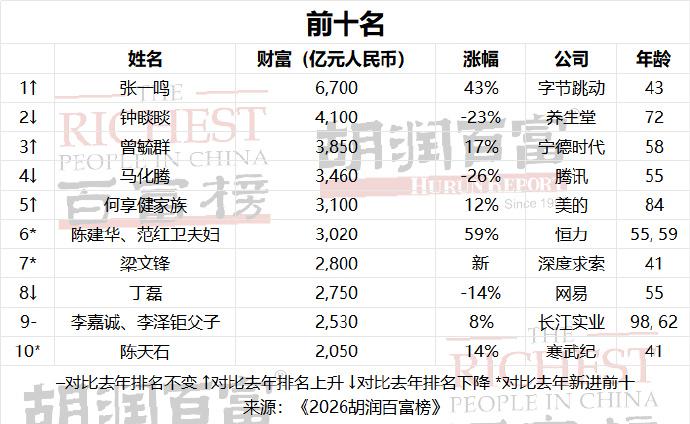
The most significant change in this list is the shift of the richest man. 43-year-old Zhang Yiming, founder of ByteDance, saw his wealth increase by 200 billion yuan, becoming China's richest man for the second time with 670 billion yuan and refreshing the wealth record of China's richest man. Its wealth growth is mainly driven by the progress of AI business which further pushes up the company's valuation, and ByteDance's current valuation has reached 3.3 trillion yuan.
The top ten welcomes three new faces, namely Chen Jianhua and Fan Hongwei couple from Hengli Group, Liang Wenfeng of DeepSeek, and Chen Tianshi of Cambricon, with prominent hard technology attributes.
Liang Wenfeng Leads the New AI Forces
Liang Wenfeng is the most high-profile newcomer on this year's list. The 41-year-old founder of DeepSeek ranks 7th on the overall list and 1st on the new faces list with a fortune of 280 billion yuan on his first appearance. DeepSeek quickly gained market attention with its open-source large model route, and the company's valuation has climbed to 500 billion yuan. Liang Wenfeng's listing is of landmark significance: large AI models have moved from the technological narrative stage to the wealth realization stage, and open-source models, computing power ecology and industrial applications are being re-priced by the capital market.
Chen Tianshi ranks 10th with a fortune of 205 billion yuan, an increase of 25 billion yuan over last year. As a representative domestic AI chip enterprise, Cambricon has benefited from the explosion of AI computing power demand, and its market value has risen sharply, pushing its founder's fortune into the top ten. This shows that the AI wealth chain is not only at the algorithm layer, but also extending rapidly to chips, computing power infrastructure and the semiconductor industrial chain.
Chen Jianhua and Fan Hongwei couple from Hengli Group rank 6th with 302 billion yuan, with their wealth increased by 112 billion yuan. Hengli has expanded from the traditional chemical fiber business to integrated refining and chemical, new materials and high-end shipbuilding equipment fields. It has gained a firm foothold in the global shipbuilding market relying on orders for ultra-large oil tankers, and achieved substantial wealth growth driven by the outbreak of shipbuilding business, representing that traditional leading enterprises seize the cycle dividend relying on industrial upgrading.
Batch of Hard Tech Players Listed on the Rankings
Among the newly listed entrepreneurs, the hard technology track also takes the leading position. Wang Xingxing, founder of Unitree Robotics, has a fortune of 69.5 billion yuan, ranking 2nd on the new faces list and 78th on the overall list by wealth scale. 36-year-old Wang Xingxing represents the new wealth force in the humanoid robot track. Unitree Robotics was listed on the Sci-Tech Innovation Board this year, and its market value once soared to 440 billion yuan on the first day of listing. According to the calculation node of the list on September 1, Wang Xingxing's corresponding wealth fell back to 69.5 billion yuan. Nearly 80 entrepreneurs from the robot track are on the list this year, and Wang Tao of DJI still ranks the highest in this track with 110 billion yuan.
Wang Zhiyong, founder of HKC, has a fortune of 64.5 billion yuan, ranking 3rd on the new faces list and 84th on the overall list by wealth scale. 56-year-old Wang Zhiyong represents the semiconductor display panel direction. As one of the important domestic display panel enterprises, his listing shows that midstream hardware links such as semiconductor display and optoelectronic manufacturing still occupy an important position in the wealth map.
A number of entrepreneurs in the AI industry echelon are also on the list. Liu Debing of Zhipu AI has a fortune of 39.5 billion yuan, Tang Jie of Zhipu AI has a fortune of 27.5 billion yuan, and Yan Junjie of MiniMax has a fortune of 22.5 billion yuan. The three are rooted in the research and development of basic large models and algorithms. Chen Weiliang of Metax Tech has a fortune of 37.5 billion yuan, focusing on AI GPU chip R&D to provide a computing power base for large models. These new faces together constitute the wealth map of the AI industry entrepreneur group. From basic models, algorithm R&D to computing power chips and application ecology, AI is forming the ability to create wealth on a large scale.
New Commercial Aerospace Players Make Concentrated Appearance
In this year's Hurun China Rich List, commercial aerospace is one of the fields with a large number of new hard technology faces. Hurun Research Institute specially mentioned that three rocket founders from the commercial aerospace track are on the list for the first time, namely Zhang Changwu of LandSpace, Kang Yonglai of Tianbing Technology, and Yang Yiqiang of CAS Space.
Zhang Changwu, 43, founded LandSpace in 2015. The company's core product Zhuque-3 adopts the liquid oxygen methane, stainless steel body, and landing leg vertical recovery route. At 7:35 on August 19, 2026 Beijing time, the Zhuque-3 Y2 rocket completed its orbital launch, and at around 7:43, the first stage successfully soft-landed at the Minqin landing site in Gansu. This is China's first land recovery of the first stage of an orbital launch vehicle, and also the first time a Chinese private rocket has completed the whole process of orbital launch plus recovery. LandSpace's IPO application on the Sci-Tech Innovation Board is currently suspended due to financial statement update, with planned fundraising of 7.5 billion yuan. The company's revenue in 2025 was 52.09 million yuan, with a net loss of 1.711 billion yuan, and it is expected to make a profit as early as 2029.
Kang Yonglai once served as the director of the launch vehicle overall research office and deputy chief designer of the model at China Academy of Launch Vehicle Technology, and founded Tianbing Technology in 2019. The company focuses on medium and large liquid launch vehicles, and Tianlong-2 achieved its maiden flight successfully in 2023. Tianbing Technology was previously valued at about 22.5 billion yuan. According to reports from media such as Taibao Network in July 2026, its valuation is expected to exceed 30 billion yuan after the new round of financing is completed.
Yang Yiqiang once served as the first administrative chief responsible person of China's first air-launched launch vehicle at China Academy of Launch Vehicle Technology, and later engaged in research on reusable launch vehicles within the system of the Institute of Mechanics of the Chinese Academy of Sciences. CAS Space is the first mixed-ownership commercial rocket enterprise in China, with products including the Lijian series of rockets. CAS Space's revenue in 2025 was about 277 million yuan, which is at a relatively high revenue scale among private rocket enterprises. Its market share in the private commercial rocket sector calculated by the weight of launched payloads in 2024 and 2025 was about 50% and 63% respectively. The company's IPO application on the Sci-Tech Innovation Board is also suspended due to financial statement update, with planned fundraising of 4.18 billion yuan, and the post-investment valuation of its latest external equity financing is about 15 billion yuan.
AI Becomes the Largest Engine for Wealth Growth
From the perspective of industry structure, AI has become the largest single wealth growth engine of this year's list. According to statistics from Hurun Research Institute, 10.4% of the listed entrepreneurs take AI as their leading business direction, while there were almost no listed entrepreneurs whose main business is AI on the list before 2019. The proportion of the semiconductor industry has risen to 6.9%, making it one of the fastest growing industries. The robot sector accounts for 4.9%, and high-end equipment accounts for 6.4%.
At the same time, the wealth of traditional consumption and internet platforms generally adjusted downwards. Zhong Shan Shan's wealth shrank by 120 billion yuan, Ma Huateng of Tencent saw his wealth decrease by 119 billion yuan, and Lei Jun of Xiaomi saw his wealth drop by 157 billion yuan. This does not mean that these enterprises have lost their value, but indicates that the driving force of wealth growth is switching. The last round of expansion cycle dominated by mobile internet, new consumption and platform economy has become stable, and the new round of technological cycle dominated by AI, computing power, robots, semiconductors and commercial aerospace has begun to dominate wealth distribution.
The signal conveyed by this list is very clear. The registration-based IPO system, hard technology industrialization and global AI competition are jointly reshaping the wealth map of Chinese entrepreneurs. Zhang Yiming leads the whole list with 670 billion yuan, and a group of hard technology entrepreneurs are listed on the list in a concentrated manner, covering multiple directions such as large AI models, humanoid robots, semiconductor display, AI chips and commercial aerospace. Liang Wenfeng leads this group of new faces with the 7th place on the overall list, Wang Xingxing and Wang Zhiyong are within the top 100, and other new hard technology players are listed but not in the top 100. Whether they can enter the top of the wealth list in the future depends not only on the scale of the enterprise, but also on whether they master core technologies, have sustainable commercialization capabilities, and can form pricing power in the global industrial chain.
This article is from the WeChat Official Account "Rongzhong Finance" (ID: thecapital), written by Dai Xianchao, and published with authorization from 36Kr.