Guangzhou's GDP growth rate hits a five-year high.
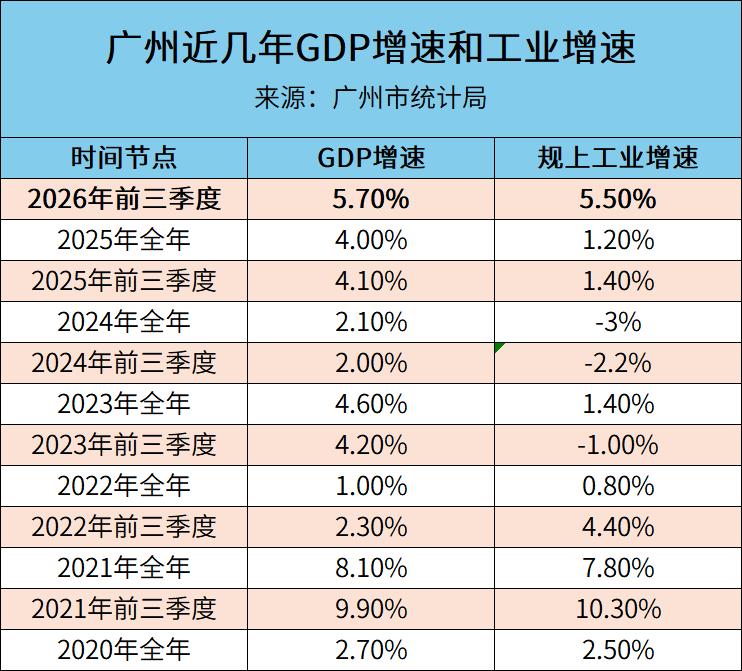
Yesterday, Guangzhou released its economic data for the first three quarters. Its GDP reached 2.4851 trillion yuan, representing a 5.7% year-on-year increase at constant prices, a net increase of 158.535 billion yuan over the same period last year, with the growth rate 1.1 percentage points higher than that of Guangdong Province.
First, the key highlights:
Compared with its own performance, the 5.7% growth rate marks the highest level Guangzhou has recorded in the same period in the past five years. Compared with other cities, this growth rate is second only to Shenzhen among the top 5 cities, higher than that of Beijing, Shanghai and Chongqing. The nominal growth rate (without considering price changes) is 6.81%, ranking second among the five major cities, second only to Shenzhen.
01
The key driver behind the rebound of Guangzhou's GDP growth is still the industrial sector.
In the first three quarters, the added value of Guangzhou's primary industry reached 20.8 billion yuan, up 2.4% year on year; the added value of the secondary industry hit 576.3 billion yuan, up 5.1%; the added value of the tertiary industry stood at 1.888 trillion yuan, up 5.9%.
The recovery of the secondary industry is of critical importance. Looking back at the past few years, from 2022 to the first half of 2024, the growth rate of Guangzhou's industrial enterprises above designated size was only 1.8%, -0.9% and -0.8% respectively, lingering at a low level for a long time and even showing negative growth. The industrial growth rate in the first half of 2025 was only 0.7%, with weak recovery momentum.
However, in the first three quarters of this year, the added value of Guangzhou's industrial enterprises above designated size increased by 5.5% year on year, far exceeding the level of the same period in previous years. Guangzhou's industry has long been known for its "three major pillars": the automobile manufacturing sector grew by 5.4%, the electronic information manufacturing sector delivered a standout performance with a growth rate of 10.7%, and the petrochemical manufacturing sector increased by 5.3%.
If the industrial sector acts as the variable, the service sector is the fundamental base, serving as the anchor stabilizing the city's entire economy. From January to August this year, the operating revenue of Guangzhou's service industries above designated size increased by 11.6% year on year, among which producer services made outstanding contributions: the internet, software and information technology services sector grew by 10.4%, and digital-related services have maintained sustained vitality.
The consumption side is recovering steadily. In the first three quarters, the total retail sales of consumer goods in Guangzhou reached 836.322 billion yuan, up 2.5% year on year, ranking first among the four first-tier cities in terms of growth rate.
In terms of fixed asset investment, the overall figure saw a slight increase of 0.6%, with obvious divergence in internal structure. Industrial investment showed strong resilience, rising by 5.0% year on year, among which industrial technological transformation investment surged by 15.1%, as a large number of enterprises are updating their equipment and upgrading production lines. However, pressure remains in traditional sectors: infrastructure investment decreased by 5.6%, and real estate development investment dropped by 8.8%.
In addition, investment in high-tech manufacturing surged by 31.5%, investment in information software and technology services increased by 68.7%, and investment in electronic and communication equipment manufacturing rose by 37.9%.
In terms of capital attraction capacity, as of the end of September this year, the balance of local and foreign currency deposits in Guangzhou reached 10.29 trillion yuan, up 6.8% year on year.
Transport passenger traffic data can also reflect the vitality of the city from the side. In the first three quarters, the total passenger traffic volume of Guangzhou reached 291 million person-times, up 7.9% year on year. Among them, Baiyun Airport delivered an exceptionally strong performance, with passenger throughput hitting 67.09 million person-times, up 9.8% year on year, returning to the top spot among single airports nationwide.
02
After looking at Guangzhou's data, let's take a look at the data of Shanghai, Beijing, Shenzhen and Chongqing.
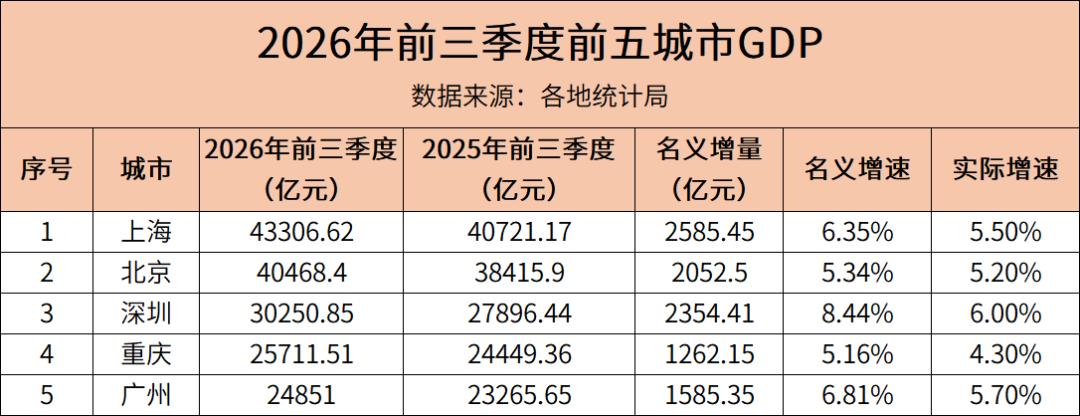
Among first-tier cities, Shanghai is sprinting towards the 6-trillion-yuan mark, Beijing is targeting 5.5 trillion yuan, and Shenzhen's growth rate continues to lead all first-tier cities.
In the first three quarters of 2026, Shanghai's GDP reached 4.330662 trillion yuan, with an actual growth rate of 5.5%, higher than the national average growth rate of 4.6%. Calculated based on the current momentum, Shanghai's full-year GDP is expected to exceed 6 trillion yuan, becoming the first city in China to cross the 6-trillion-yuan threshold. Shanghai's full-year GDP in 2025 was 5.670871 trillion yuan.
Beijing's GDP in the first three quarters was 4.04684 trillion yuan, up 5.2% year on year. Calculated at this growth rate, the annual economic aggregate this year is expected to approach 5.5 trillion yuan, and it is expected to join the 6-trillion-yuan camp in the next two to three years.
Chongqing recorded a GDP of 2.571151 trillion yuan in the first three quarters, with an actual growth rate of 4.3%, lower than the national average level of 4.6%.
Shenzhen's GDP in the first three quarters was 3.025085 trillion yuan, with an actual growth rate of 6.0%, ranking first among the four first-tier cities. Its nominal increment reached 235.441 billion yuan, the second largest nationwide, second only to Shanghai.
Shenzhen's sustained high growth rate is driven by the industrial and foreign trade sectors. Data shows that the added value of Shenzhen's industrial enterprises above designated size increased by 9.5% in the first three quarters, 0.8 percentage points faster than that in the first half of the year; the total import and export volume reached 4.652817 trillion yuan, surging by 38.8% year on year.
This article is from the WeChat Official Account "City War", written by Tinghai Moyu, published with authorization from 36Kr.