After the solution is successfully verified at a single workstation, how can industrial embodied intelligence move towards large-scale application?
Introduction
After a robot completes tasks at one workstation, how can it be deployed to more production lines? Recently, ABB and Intrinsic have tried to reduce redundant investment in robot development and deployment through application tools and open reference solutions respectively. With the gradual deepening of industrial embodied intelligence applications, on-site adaptation, delivery cost and long-term operation capability have become key issues to be solved for large-scale application.
Combined with 2026 China Industrial Embodied Intelligence Industry Development Research Report from iResearch, this paper sorts out the development path from single-point task verification, project experience reuse to continuous operation, discusses how process packages, task templates and deployment specifications support subsequent delivery, and how to verify application value through operation performance, deployment efficiency and customer repurchase.
On October 15, ABB released an AI solution for apparel logistics, which integrates pre-trained visual models, dedicated tools and rapid retraining capabilities into the sorting module. According to ABB, this solution can reduce engineering and commissioning workload by up to 75%, and support model update and optimization after robots are put into operation.
Earlier on September 22, Intrinsic announced the open source of some core capabilities of its robot platform, and opened a set of reference solutions for machine tool loading and unloading. Developers can call tools such as motion planning, grasping planning, simulation and calibration to complete customization based on existing solutions.
The two enterprises adopt different approaches, but both are trying to reduce redundant work in application development and deployment. For factories, after a robot completes tasks at one workstation, when moved to a new production line, it still needs to adapt to different equipment, incoming materials and process requirements. How many of the verified skills and processes can continue to be used? How many parts need to be redeveloped and commissioned? These problems affect the time and cost of the next deployment, and also determine whether single-point applications can be replicated more efficiently.
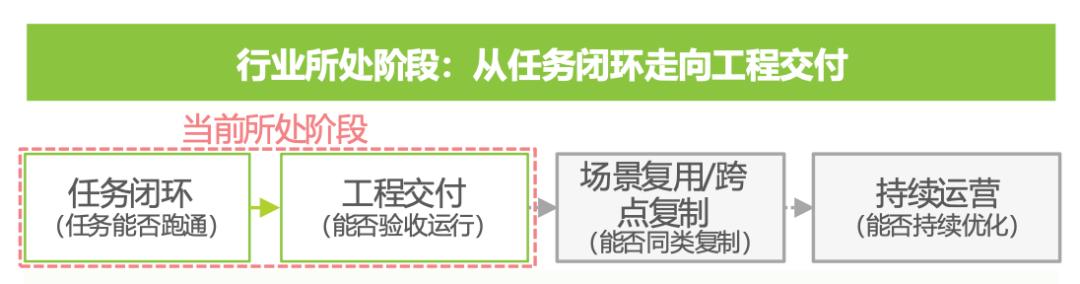
iResearch's 2026 China Industrial Embodied Intelligence Industry Development Research Report sorts out the development path from task closed-loop, engineering delivery to capability reuse and continuous operation. Among them, precipitating project experience into task templates, process packages and deployment specifications is an important link connecting single-point implementation and large-scale application. After one workstation is successfully operated, how to make the accumulated capabilities serve more production lines is becoming a question that industrial embodied intelligence needs to answer.
Single-point task validation to lay a foundation for subsequent applications
Successful task completion in industrial sites requires meeting multiple requirements simultaneously. The system should not only complete the actions, but also meet the production rhythm, quality and safety standards, be able to judge results, handle exceptions, and connect with the previous and subsequent processes.
Whether a single-point task can form a delivery foundation requires verifying the operation performance under specific equipment, process and on-site conditions, and meeting the customer's acceptance requirements. Tasks such as fixed-station loading and unloading, rule-based grasping and sorting, in-plant handling and distribution usually have clear boundaries and easily quantifiable value, making it easier to complete these validations first.
The verification of single-point tasks provides a starting point for similar applications, but subsequent deployment still needs to face on-site differences. The equipment, materials, tooling, interfaces and rhythm requirements of different factories are not exactly the same. After the original solution enters a new environment, re-adaptation, joint debugging and verification may still be required, which affects the deployment cycle and delivery cost.
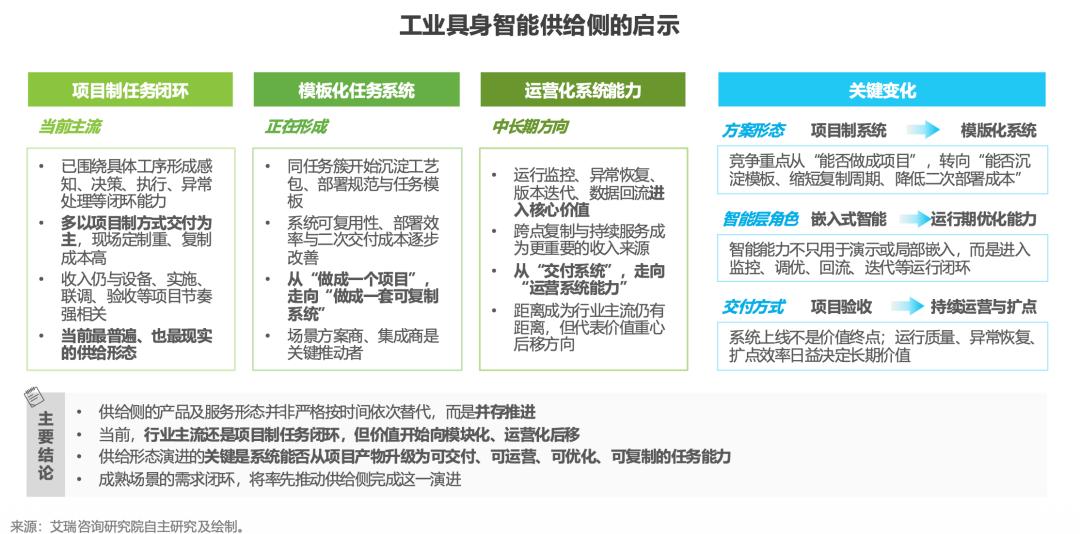
At present, the supply of industrial embodied intelligence is still dominated by project-based combinations, which usually include execution base, capability module, scenario solution and integrated delivery. Capabilities such as perception, decision-making, execution and exception handling have been organized in specific projects, but on-site customization is heavy, and the degree of experience reuse still has room for improvement.
Therefore, an important direction for subsequent development is to clarify which contents in similar tasks can be reused and which contents still need on-site adaptation from completed projects, so as to reduce redundant investment for the next delivery.
From project experience to task templates: which capabilities can be reused?
The experience accumulated from industrial projects involves multiple links: how process requirements are imported into the system, how operation steps are organized, how abnormal situations are handled, and how equipment and software complete joint debugging. Sorting out these experiences is an important foundation for forming reusable capabilities.
The value of the templated task system lies in converting the common experience in similar tasks into reusable delivery capabilities.
Reusable contents include process knowledge, task procedures, skill invocation, exception handling and implementation commissioning experience. These contents need to be gradually organized into process packages, task templates and deployment specifications to support subsequent delivery of similar tasks. Supporting development, simulation, commissioning and operation tools also help improve deployment and maintenance efficiency.
These capabilities need to be accumulated around specific tasks. Tasks such as fixed-station operation, logistics circulation, and semi-structured sorting have different requirements for perception, control, scheduling and exception handling, and the reusable contents and adaptation scopes are also different.
For tasks with clear boundaries and stable processes, process and deployment experience is easier to precipitate. With the increase of task objects, environmental disturbances and exception types, the system needs to handle more changes, and the template also needs to be continuously verified and improved under different conditions.
Large-scale application can be promoted from multi-point verification of the same task cluster, and then gradually explore cross-production line and cross-factory applications. The original task template can be used as a basis, but it still needs to be adapted in combination with the equipment, processes and interfaces of new sites. Templating cannot be understood as direct application in all scenarios.
Whether task templates can improve delivery efficiency needs to be verified through re-deployment. Whether the delivery cycle, commissioning man-hours and secondary deployment cost are reduced, and whether similar tasks can run stably at other points are all important bases for judging reuse capabilities.
When project experience can continuously enter products, tools and delivery specifications, the knowledge accumulated in a single implementation is more likely to support subsequent businesses, and promote the supply to develop from project-based task systems to templated task systems.
From delivery acceptance to continuous operation: large-scale application requires long-term support
With the increase of deployment points, the value of the task system extends further to the operation stage. After the equipment is launched, operation monitoring, exception recovery, on-site optimization and version maintenance need to continuously support production tasks.
Continuous operation needs to focus on the operation quality after the system goes online, as well as the subsequent optimization and point expansion efficiency. Whether tasks can be completed stably for a long time, whether exceptions can be identified and recovered in time, and whether the updated version is applicable, will all affect the actual application effect of the system.
The data, failure samples and manual intervention records accumulated during operation can also be used to improve models, control strategies, skill parameters and task templates. These feedbacks help to improve existing capabilities and provide a basis for subsequent deployment of similar tasks.
The accumulation of delivery experience, operation feedback and operation and maintenance system further expands the service content that enterprises can provide. Operation monitoring, continuous optimization, version iteration and point expansion support are gradually becoming important components of the task system, and continuous service has also become a development direction worthy of attention.
At present, project-based task closed-loop is still the mainstream, templated systems are being formed, and operational system capabilities still have a certain distance from becoming the mainstream of the industry. Different supply forms will coexist and advance, and their maturity also depends on scenario conditions and enterprise capabilities, which cannot be understood as a uniform replacement process.
To evaluate the progress of large-scale applications, both on-site and commercial signals need to be observed. Task success rate, rhythm, continuous operation duration, exception recovery time and takeover rate reflect the operation quality of the system; deployment cycle and secondary deployment cost reflect delivery efficiency; whether customers repurchase and whether they expand the deployment scope provide further verification for the sustainability of application value.
Conclusion
From successful operation at one workstation to stable operation at more sites, industrial embodied intelligence needs to continuously accumulate reusable task capabilities. Process packages, task templates, deployment tools and operation and maintenance systems convert the experience in specific projects into the foundation for subsequent applications; continuous operation supports these capabilities to be verified and improved under more conditions.
Focusing on the application and development of industrial embodied intelligence, iResearch's 2026 China Industrial Embodied Intelligence Industry Development Research Report also systematically sorts out the industry development background, technical framework, industrial chain division of labor, scenario maturity and commercialization path, and analyzes the development direction of task delivery, cross-point replication and continuous operation. For more research findings and industry insights, you are welcome to click "Read the original text" at the end of the article to get the full report and further understand the development landscape of China's industrial embodied intelligence industry.
This article is from the WeChat official account "iResearch" (ID: iresearch-), author: iResearch, published with authorization from 36Kr.