The exorbitant profits from token reselling are a thing of the past. How many viable ways to stay afloat are left for AI transit platforms?
This year, you may find one extra item in your Double 11 shopping cart: Token.
Recently, large model companies including Alibaba Cloud, DeepSeek, Zhipu, MiniMax, Kimi and others have successively entered e-commerce platforms, making AI subscriptions and Token top-ups a new category for this year's Double 11. Tokens, which have been placed on e-commerce shelves, are being promoted in bundled packages just like mobile data traffic. It is reported that Tmall is also communicating with manufacturers, planning to design combined packages centered on demands for learning, family use, home studios and more.
Nowadays, large language models have become common productivity tools, and there is no shortage of paying users among both enterprises and individuals. Behind this consumption boom, the related business is reaching a fork in the road: consumer demand is growing, but not all Token-selling businesses can make sustainable profits.
Apart from the consumption entrances actively operated by large model manufacturers, the AI intermediate layer built around various models is going through a major upheaval.
Discounts and huge profits coexist on the same screen
In the past few years, from aggregation platforms connecting hundreds of models to independent manufacturers providing inference services, and small API transfer stations that attract users with low prices, all stand between model supply and user demand, and have formed different profit-making paths.
Overseas OpenRouter is a representative of model aggregation platforms, with a gross profit margin of 71%. In August this year, payment giant Stripe announced that it had reached an agreement to acquire OpenRouter. The two parties did not disclose the transaction price, but media reports said the deal was worth more than 8 billion US dollars. Stripe introduced in its acquisition announcement that OpenRouter connects more than 400 models and over 80 suppliers.
The value that makes it favored is not only helping users buy Tokens, but also helping developers make choices among model capabilities, price, speed and reliability according to task requirements. For enterprises, they do not need to build an access system for each model separately, but can manage calls through a unified platform and dynamically select models according to specific tasks.
The domestic player "Silicon Flow" has another model worth observing. According to its public business introduction, Silicon Flow provides serverless Token services, dedicated instances, inference acceleration, private deployment and other products, connects different models, computing power resources and system software, enables models to run on GPUs and AI chips from different manufacturers, and then provides inference capabilities to developers and enterprises in the form of Token services or other technical solutions.
As of June this year, the Silicon Flow platform has more than 10 million registered users, over 13,000 enterprise customers, with a daily average Token throughput of about 578.5 billion times, and a single-day peak exceeding 1.07 trillion times. Up to now, Silicon Flow has completed 7 rounds of financing, with a valuation of 7.74 billion yuan, and has submitted a listing application to the Hong Kong Stock Exchange.
It is worth noting that in the large model industry chain, "transfer station" is not a business category with clear boundaries. A number of small API transfer stations have quickly gathered a group of users by relying on model interfaces, convenient payment and price differences. Such transfer stations provide pre-recharge, unified interfaces or bundled quotas, making it easier for users to call overseas models, while offering very attractive prices.
Tech Planet found that the API quotations given by some transfer stations on the market are almost "sharply discounted" compared with the official standard prices. Taking Claude Fable 5.1 as an example, the official standard API charges 10 US dollars per million input Tokens and 50 US dollars per million output Tokens. On the quotation page of a certain transfer station, the same-named model only costs 1.5 US dollars per million inputs and 7.5 US dollars per million outputs, which is about 15% of the official price.
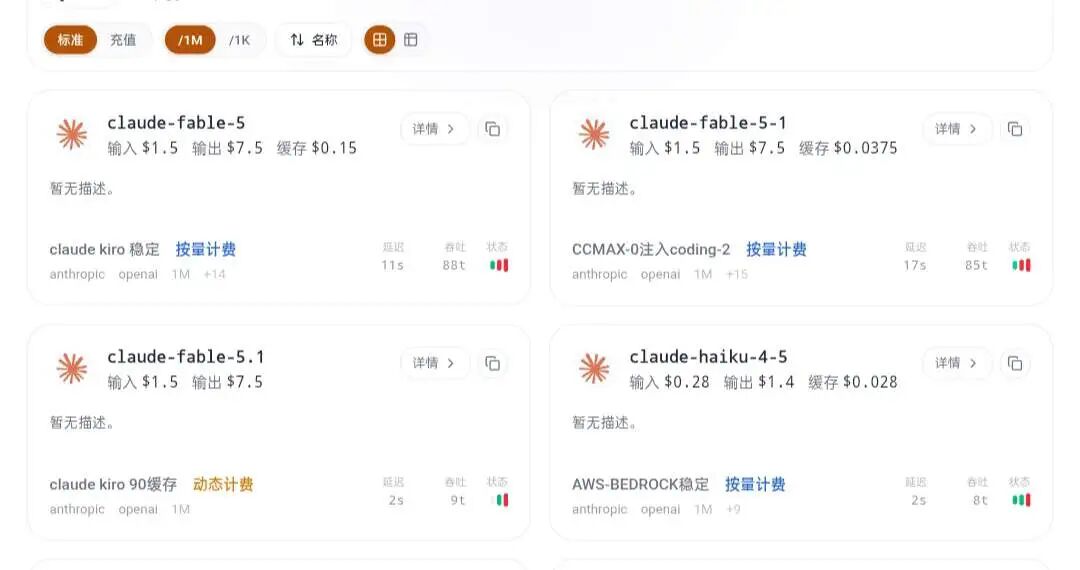
Source: Quotation page of a certain API transfer station.
Even around transfer stations, dedicated price comparison websites have emerged to help users compare quotations, actual exchange rates and recharge costs on different platforms. Standing on the consumer side, it is hard not to be tempted when seeing full-screen "original manufacturer discounts".
At the same time, Tech Planet learned that in addition to directly selling API quotas, some transfer stations have launched another model closer to account trading: selling finished accounts bundled with subscription packages. For example, a platform sells old Claude accounts and Pro subscription packages at a price of 150 yuan per month, and promises to guarantee the first login of the account and subscription services, but cannot guarantee the subsequent risk of account bans.
"There are too many Claude account bans in China," said the operator of the platform. This risk does not come out of nowhere. The transparency data disclosed by Anthropic shows that from January to June 2026, the company banned a total of 11.4 million accounts; during the same period, it received about 398,000 appeals, of which about 42,000 appeal results were overturned.
Hidden risks behind the huge profits of Token business
"There is no such thing as a free lunch", which is a well-recognized consensus among many API transfer station users.
For low-price resources, most transfer stations attribute the sources to a wide range of upstream channels: some strive for discounts by large procurement scale, some use the preferential quotas issued by model manufacturers, and some buy subscription packages and then split the call quotas in them for resale to earn the price difference. These public upstream channels are already considered "formal" ways, but what really needs to be guarded against may be the model itself behind the low price.
On the API transfer station, the model name displayed on the platform is filled in by the platform itself. That means the model actually called in the background may not be the real "full-capability" model. Many users posted that when they really use the model to complete complex tasks, the performance of the models on some transfer stations often shows obvious decline.
This suspicion does not entirely come from users' subjective speculation. In March this year, the research team of the CISPA Helmholtz Center for Information Security in Germany published the paper Real Money, Fake Models: Deceptive Model Claims in Shadow APIs, which carried out a systematic audit on third-party "shadow APIs". The results show that the output performance of some services has significant differences with the official API, with the maximum performance difference reaching 47.21%; in the model fingerprint test, 45.83% of the tests failed to pass the identity verification.
In the user circle of API transfer stations, the situation of "substituting inferior models for the marked ones" has long been an open secret. As a result, model detection tools and various special prompts to identify diluted models on transfer stations have also appeared on the market. Before recharging the transfer station service, many users will choose to test the interface with a transfer station evaluation website first.
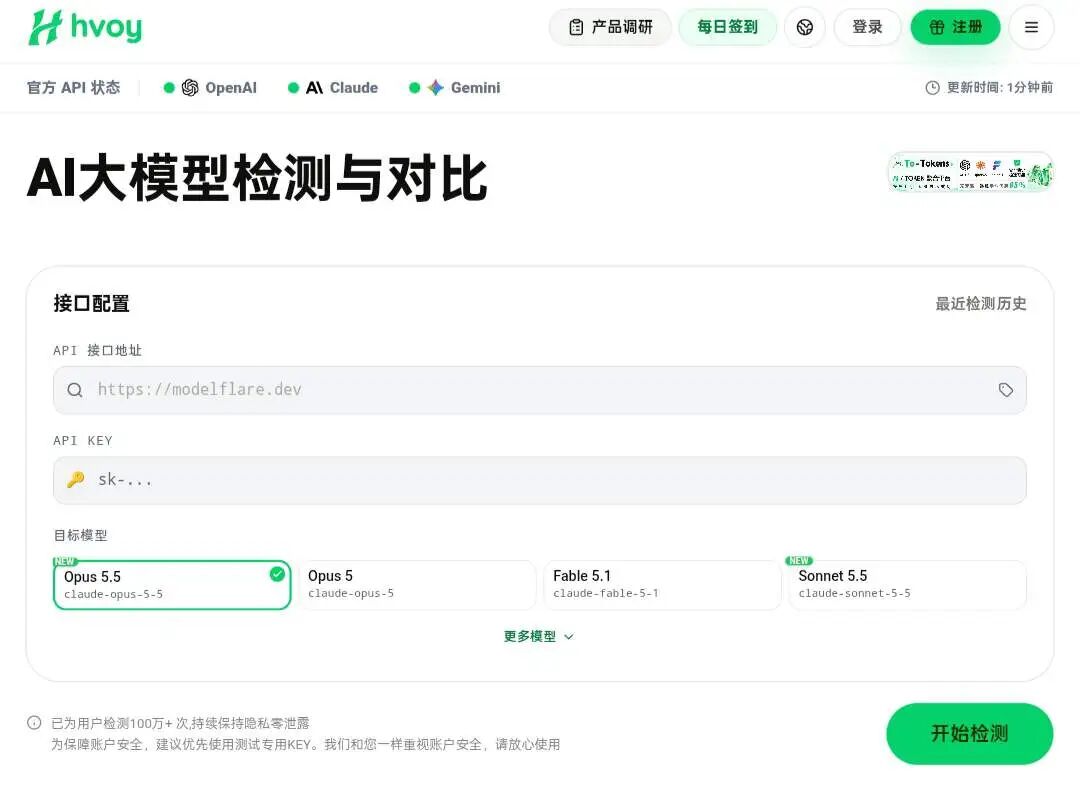
Source: A certain transfer station evaluation website.
"The transfer station business has deep hidden risks, you have to find a trusted one," a user shared his experience: after finding that the model provided by a certain transfer station had obvious performance problems, he did not get a proper solution. The platform operator originally said that a refund was available, but the user's account was directly deleted after he provided his email address.
In addition, there are compliance and data security risks behind low prices. Since April this year, regulatory authorities have begun to frequently release relevant risk warnings. On September 15, in the typical law enforcement cases announced by the Cyberspace Administration of China, API transfer stations were named publicly for the first time. Two websites operated by a Jiangsu-based technology joint-stock company called interfaces of multiple large model products through the "API transfer station" method to provide external dialogue and Q&A services. The cyberspace department's verification found that the enterprise failed to carry out security assessments as required and had content security risks, then legally ordered it to make corrections, and strictly punished the relevant responsible persons with a warning.
Even domestic models have been involved in this wave of controversy. Stars 404, partner of hvoy.ai, recently shared publicly that in the transfer services he observed, the "dilution" problem of domestic models is more prominent, and he specifically mentioned that Kimi and GLM are "both severely affected areas".
Nowadays, domestic models are also becoming an important choice for global developers. OpenRouter's weekly data shows the weight of domestic models in the global call market. In the week from October 5 to 11, 2026, the global total Token consumption reached 172 trillion, of which Chinese models accounted for 86.74 trillion, exceeding 50%.
The greater the demand, the more market space the intermediate services around model calls should have. However, even if the business is compliant and more technical investment is made, it may not be able to make profits. For example, "Token factory" Silicon Flow, which not only distributes domestic models but also adds inference optimization, achieved a revenue of 55.33 million yuan in 2025, with a sales cost of 68.632 million yuan, an overall gross profit margin of -24%, and a net loss of about 345 million yuan for the whole year.
Large models are very popular, but Token business is not a profit-making business that can succeed only with traffic.
How many viable development paths are left for AI transfer stations?
The business of AI intermediate layer is getting more and more difficult, and the Token market has also ushered in new outlets and opportunities.
After a number of transfer stations were shut down, platforms that tried to transform in a compliant manner appeared on the market. Different from the past of relying on non-transparent upstream channels and attracting users by price difference, such platforms hope to re-establish a stable supply and service system by obtaining official authorization from model manufacturers. Accordingly, authorized procurement, technical services and compliant operation will bring additional costs, and the pricing will be higher than that of gray market transfer channels.
Another path is to sell Tokens in a larger service system.
Cloud manufacturers such as Alibaba Cloud, Volcano Engine and Tencent Cloud have resource advantages that transfer station platforms cannot replicate. Model calls can be provided in bundles with computing power, storage, data management, security capabilities and enterprise applications, and customers are not just buying an API interface, but a complete set of services that can be connected to existing businesses. For enterprises, although the unit price of Token is important, deployment cost, service stability, technical support and data management will also affect their final choice.
Operators are trying to turn Tokens into another type of "data package". Recently, the three major domestic operators have successively launched Token-related packages, packaging model call quotas into monthly subscription products similar to mobile data traffic, and trying to lower the consumption threshold through methods such as phone bill payment and cross-platform use, covering domestic models including DeepSeek, Kimi, Tongyi Qianwen and more.
Compared with the way of finding transfer stations, recharging and configuring interfaces by themselves, this product form is closer to the communication services familiar to ordinary users, and is expected to expand the market with the help of operators' original user reach and billing systems. For operators, how to make users easier to find the entry, understand the package rules, and keep using them in daily scenarios may be the problems to be solved next.
However, there is still a certain distance from the launch of packages to the formation of large-scale usage. China Telecom took the lead in launching a national trial commercial Token package at the group level in May this year, and set up a special entry in its official App, where users can search for keywords to find the corresponding package tiers. The relevant services of China Mobile and China Unicom are mostly in the provincial pilot stage, and at present, localized packages are only launched in a few regions such as Shanghai, Beijing and Hubei.
It is more noteworthy that the competition in the Token business is shifting from "how much to sell" to "how to provide better model intelligence".
For example, Nexus launched by the AI inference platform Fireworks, focuses on helping customers select appropriate models according to task requirements through methods such as automatic model routing, to reduce AI programming costs. Relevant promotions claim that the cost can be reduced by up to 50% to 75%, and the specific effect depends on the task type, model selection and evaluation standards. What it targets is the efficiency space in the process of model calling.
The demand for Tokens is still growing, but when more and more players start to sell Tokens, what really determines who can stay in the market will be who can continuously provide value that users are willing to pay for beyond price.
This article is from the WeChat official account "Tech Planet" (ID: tech618), written by Hua Wei, and authorized for release by 36Kr.