Europe is growing anxious amid the AI war.
By the time the AI competition has evolved to where it is today, even Germany can no longer sit on the sidelines.
Recently, German Chancellor Merz welcomed Jensen Huang, founder of NVIDIA, in Berlin. Representatives of German industrial giants including Siemens, Mercedes-Benz, and Audi all showed up, with all topics pointing to the same thing: how AI can enter factories and transform the manufacturing industry.
Beneath this scene lies deep-seated anxiety across Europe.
Two hundred years ago, Europe reshaped the fate of humanity with steam engines and internal combustion engines. But by the era of the internet and chips, the right to speak gradually fell into the hands of the United States.
Today, as the AI wave sweeps across the globe, the United States is reaping huge dividends with its chips and models, China is bringing AI into industrial scenarios, while Japan and South Korea occupy the upper reaches of the supply chain for semiconductor materials and storage.
Only Europe seems to be trapped in the glory of the last era.
I. The "Lost Three Decades" of the Industrial Leader
The decline of Europe today was foreshadowed decades ago.
In the 18th century, the British pushed manual workshops into the factory era with steam engines. In the 19th century, the Germans built a rigorous industrial empire spanning from laboratories to workshops with Siemens' electric motors and BASF's chemical laboratories. This mechanism that rapidly translates scientific research into products was once Europe's most solid foundation of confidence.
However, when the world moved into the semiconductor and internet era, this set of gears began to turn slower and slower.
While the United States used venture capital in Silicon Valley to spawn Google, Microsoft and Amazon, and rapidly rolled out a technology to the whole world relying on its unified domestic market, Europe fell into long-term internal friction. It has the world's strictest legal system, a fragmented market of 27 member states, and a capital system that is not friendly to trial and error.
ASML from the Netherlands has built the most sophisticated extreme ultraviolet lithography machines in the world, but its former CEO Wennink once called out loudly before stepping down that Europe is losing its soul of innovation, because people here are used to lingering in rules and regulations instead of creating the future.
This disconnection reached a peak when generative AI exploded.
When OpenAI's ChatGPT was launched, European industrial giants were surprised to find that although they owned a large number of top laboratories and Fortune Global 500 factories, they did not have a single ticket to participate in the top table of the AI industry.
II. The Four-Power Game at the Global AI Table
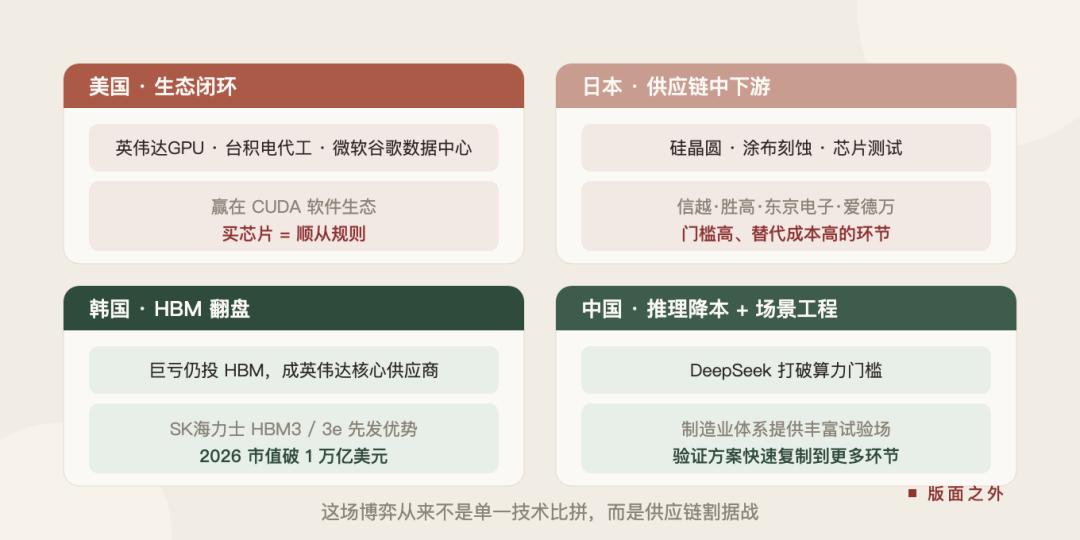
If we break down the AI industry, this global game has never been a competition of a single technology, but essentially a series of brutal supply chain carving-up wars.
The United States is playing a domineering closed ecological loop. NVIDIA sells GPUs, TSMC handles chip manufacturing, Microsoft and Google build data centers, and OpenAI and Anthropic work on cutting-edge large models.
The most terrifying thing about NVIDIA is not how expensive its graphics cards are sold, but the software ecosystem built around CUDA. The more code, development tools and underlying optimization experience developers accumulate over the years, the higher the cost of migrating to other platforms. As a result, chips are no longer just hardware products, but also the entry to the entire computing system.
Purchasing its chips is equivalent to submitting to its rules.
Japan may not hold the most high-profile large model products in the AI field, but it occupies an important position in several unavoidable underlying manufacturing links. Shin-Etsu Chemical and SUMCO's semiconductor-grade silicon wafers, Tokyo Electron's coating and etching equipment, and Advantest's chip testing systems form the infrastructure for chip manufacturing.
Japan has not abandoned its own AI industry, but precipitated its industrial advantages in the core links in the middle and lower reaches of the supply chain that have high thresholds and high replacement costs.
South Korea has staged a comeback relying on AI.
In 2023, the global memory chip market suffered a severe cyclical downturn, and SK Hynix was under huge profit pressure. But under the shadow of huge losses, the company still maintained its R&D and production capacity investment in high-bandwidth memory (HBM).
With the explosion of demand for high-throughput memory bandwidth from AI accelerators, SK Hynix, relying on its first-mover advantage in HBM3 and HBM3e, has become a core supplier of chip manufacturers such as NVIDIA. By 2026, its market cap historically exceeded 1 trillion US dollars.
With a financial comeback story, Hynix proved that as long as it grasps the throat of AI computing power, a company on the verge of loss can also stage a turnaround.
China has demonstrated the dual driving forces of inference cost reduction and scenario engineering. The launch of the DeepSeek R1 model in early 2025 poured a basin of cold water on the Silicon Valley computing power camp. With an extremely low price and a clever architecture, it broke the threshold that only hundreds of billions of dollars can be invested to build a leading model.
At the same time, the drop in model usage costs further activated China's huge manufacturing system, providing a rich test field for AI, and also giving verified solutions the opportunity to be quickly replicated to more production links.
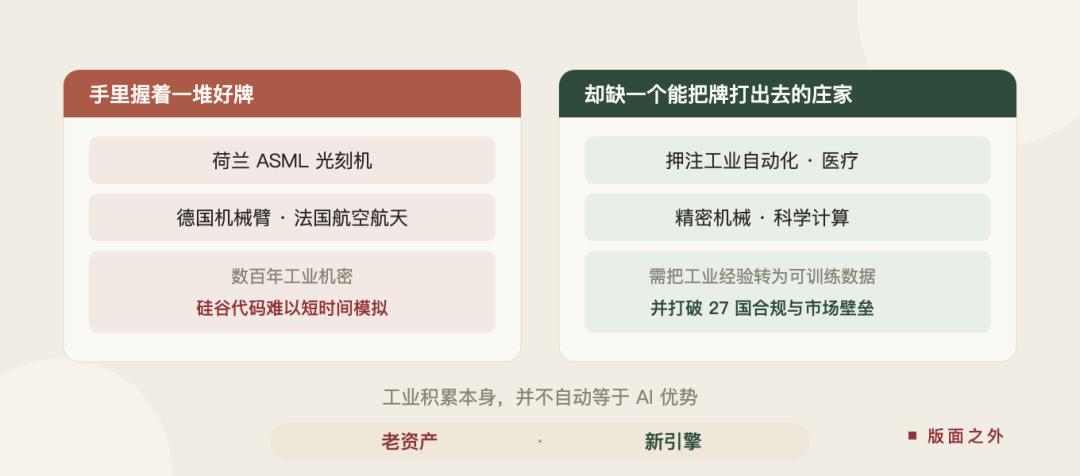
In contrast, Europe, although it has ASML's lithography machines and France's Mistral open-source models, is more like a pile of loose sand.
It holds a lot of good cards in its hand, but lacks a dealer who can play the cards well.
III. Too Many Rules, Too Little Capital
Europe actually did try to save itself.
France once gave birth to the most eye-catching AI unicorn in Europe, Mistral AI, whose founders came from OpenAI and DeepMind. But at the critical moment when the company urgently needed hundreds of millions of dollars for model iteration, the local capital pool in Europe failed to keep up.
Since 2024, Mistral has successively introduced a 15 million euro strategic investment from Microsoft, and deeply bound its large model distribution to the Microsoft Azure cloud platform. Later, Silicon Valley giants such as NVIDIA also followed up one after another.
Greater embarrassment is hidden in the factories that Europe is proud of.
According to the official EU plan, the government intends to allocate hundreds of billions of euros to build "AI super factories" in various countries, hoping to use public capital to help enterprises fill the gap in computing power.
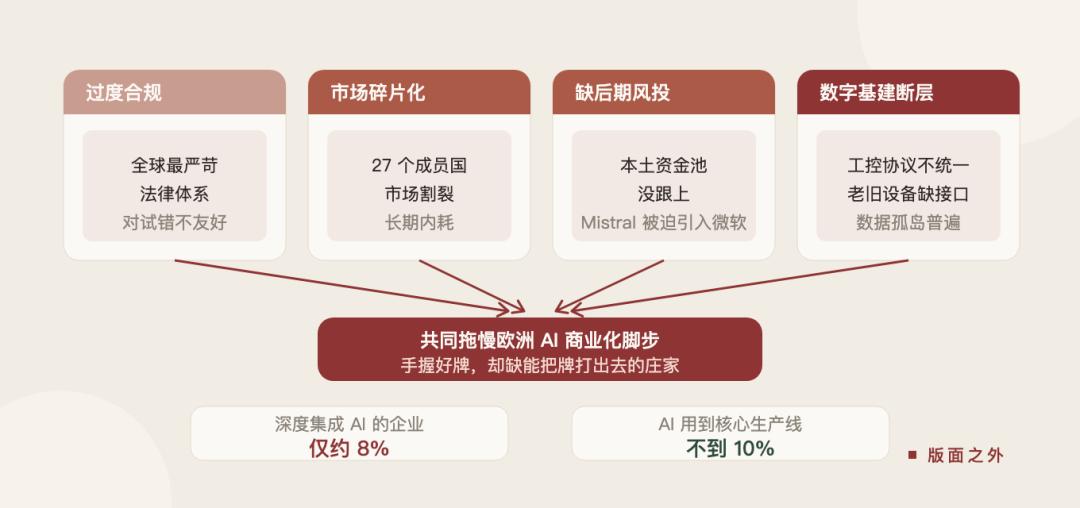
However, when the technical solutions are actually implemented at the factory level, engineering personnel often face more basic digitalization gaps. A large number of small and medium-sized factories have extremely high-precision machine tools, but the underlying industrial control protocols (such as OPC UA) are not unified, old equipment lacks standardized data collection interfaces, and data silos are widespread.
The data released by the European Commission intuitively presents this gap.
As of 2024, only about 8% of enterprises in the EU have deeply integrated AI technology into their core business processes. Data from the OECD shows that less than 10% of European manufacturing enterprises have actually applied AI to their core production lines.
Excessive compliance costs, fragmented local markets, lack of late-stage venture capital that provides continuous funding, plus the pressure to make up for the lessons of the underlying digital infrastructure in factories, have jointly slowed down the pace of Europe's AI commercialization.
IV. Jensen Huang's Business Calculation
It is in this atmosphere of passivity and anxiety that Jensen Huang came to Berlin with NVIDIA's solutions.
NVIDIA announced that it will add nearly 10 billion US dollars of investment in Europe, not only investing in German robotics and medical AI startups, but also directly tying up with Siemens and Audi to promote physical AI in Germany.
What Jensen Huang values is not to make Europeans use a few more chatbots. He is targeting the manufacturing data and engineering experience accumulated in German factories for decades.
Take the industrial simulation platform cooperated by Siemens and NVIDIA as an example. Enterprises can build a digital twin model of the production line in the virtual space, test the production process and equipment configuration, thus greatly reducing the trial and error cost before actual deployment.
For Germany, whose GDP growth rate has been sluggish for years and is overwhelmed by high energy costs and export pressure, using AI to improve total factor productivity is an important option to maintain its industrial status.
But this kind of cooperation also brings new issues: if the software simulation, robot control and algorithm training of the European industrial community are all built on NVIDIA's system, what NVIDIA gains is not just a chip sales revenue, but may evolve into the basic platform of the industrial system.
What Jensen Huang brought is not only an opportunity, but also a new multiple-choice question: Can Europe reshape its industrial competitiveness with the help of American technology while retaining enough independent space?
V. Fleeing from Silicon Valley
Europe has finally clearly realized that going head-to-head on the track of general large models and pure computing power stacking is not its advantage. It began to put more chips on the fields it is best at: industrial automation, healthcare, precision machinery and scientific computing.
Dutch lithography machines, German robotic arms, French aerospace, these industrial secrets that have been precipitated for hundreds of years are real data that Silicon Valley cannot simulate in a short time with code no matter what.
However, industrial accumulation itself does not automatically equal AI advantages.
Only by converting these industrial experiences into trainable data and scalable commercial products, and breaking the compliance and market barriers between the 27 countries, can Europe truly turn old assets into new engines.
The second half of the global AI competition has spread from the virtual digital world to the real physical world.
Jensen Huang knocked on the door of Europe with computing power, and whether Europe can regain a firm foothold depends on whether it can find its own irreplaceability in Silicon Valley's computing system.
Words Beyond the Layout
Technological revolutions never rank people by seniority.
The advantages accumulated in one era may be a starting point in the next era, or may become inertia.
Industrial history does not reserve seats for anyone.
This article comes from the WeChat official account "Beyond the Layout", author: Huahua, published with authorization from 36Kr.