HolonIQ's latest report: Tech giants are deepening their in-depth cooperation with universities, and the proportion of AI-related collaborations has risen from 2.1% to 12%
Five years ago, among every 100 global higher education cooperation initiatives, only around 2 involved AI and data. Today, this figure has risen to 12.
On October 23, education market research institution HolonIQ released "2026 Q3 Education AI Observatory Report", disclosing the latest changes in cooperation between global universities and AI enterprises.
Behind the growth of cooperation, universities' demand for AI is expanding. Some higher education institutions have started providing AI services to all teachers and students, while others are cooperating with technology enterprises to develop courses and competence certifications. What schools procure, what enterprises provide, and what new skills students need to master are becoming the core concerns of the new round of educational AI cooperation.
40% of Projects Invested in Skill Training, Global AI Education Layout Priorities Emerge
Judging from the project distribution in the third quarter, the investment direction of global educational AI is focusing on talent cultivation.
HolonIQ data shows that in the third quarter of 2026, among global education AI-related initiatives, skill training and competence improvement account for 40%, and degree and curriculum system construction account for 23%, with the two totaling 63%. In contrast, national strategies and investments account for 10%, scientific research institutions and computing power construction account for 9%, and other types account for 18%.
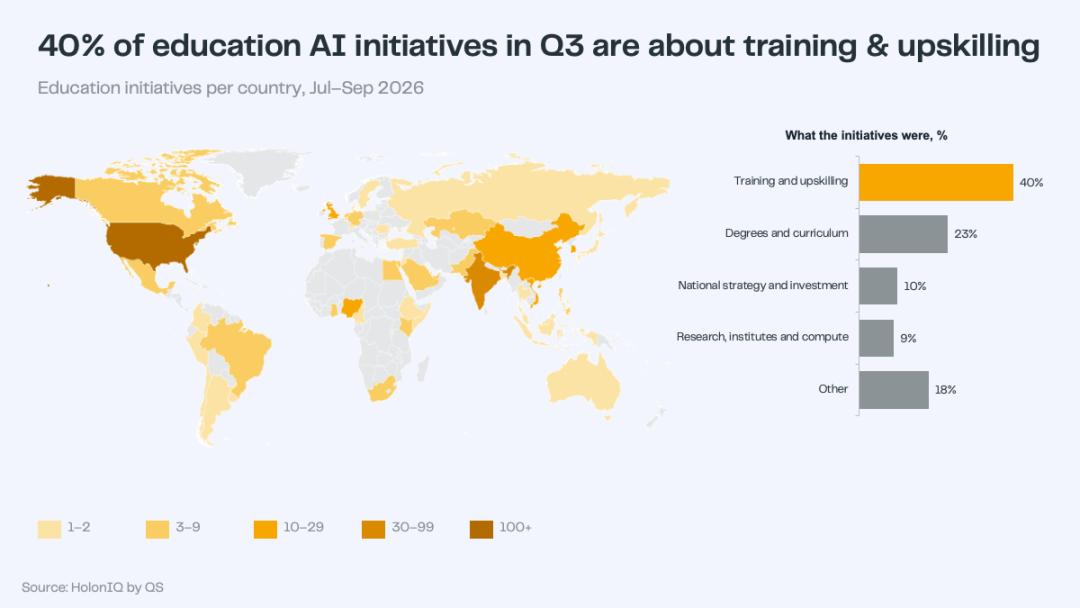
Regional distribution and type proportion of global education AI-related initiatives in Q3 2026, Source: HolonIQ by QS
From a regional perspective, the United States is the country with the most active education AI-related initiatives, with more than 100 projects in the third quarter. The United Kingdom falls in the range of 30 to 99 projects, while countries including China and India are in the range of 10 to 29 projects. Some countries in Europe, Southeast Asia and South America also have relevant layouts. However, these figures reflect the number of initiatives and do not directly represent the actual investment scale and application effectiveness.
The accelerated popularization of AI applications has also pushed various countries to further clarify the usage rules for AI in schools. In the third quarter, the Commission on Higher Education of the Philippines issued Memorandum Order No. 21, establishing a national framework for the use of AI in teaching, scientific research and operations in colleges and universities. The state of Florida in the United States requires 28 public colleges under its jurisdiction to prohibit students from using AI in graded assignments in principle, unless permission is obtained from the instructor.
HolonIQ's statistics found that from July to September, the number of AI policy entries related to higher education increased fivefold, among which the number of guiding principles and policy frameworks was about twice that of direct bans. The report cites research from QS showing that 67% of scholars and 62% of students use generative AI every week.
As AI has become a daily tool in schools, countries not only need to standardize the application of the technology, but also need to consider how to integrate AI competencies into curricula and talent cultivation. While policies are gradually being improved, cooperation between universities and technology enterprises is developing to a deeper level.
From Procuring Tools to Co-building Curricula, AI Enterprises Go Deep into Universities
AI enterprises are becoming important participants in global university cooperation.
The HolonIQ report points out that in 2026, the number of native AI enterprises participating in higher education cooperation has exceeded that of online course partners who were previously more active in the education cooperation market. The scope of cooperation between universities and technology companies has gradually extended from software procurement to curriculum construction, competence certification and teaching infrastructure.
First of all, AI products have begun to enter the unified service system of colleges and universities.
INSEAD and the University of Sydney have already provided ChatGPT Edu to all students, faculty and staff. Through the unified deployment of schools, teachers and students can use AI in learning, teaching and research, and universities can also centrally manage accounts, usage permissions and data.
This kind of cooperation is different from the situation where individual teachers use AI tools on their own. Schools need to consider whether products can meet the teaching needs of different courses, and how to manage the usage of teachers and students and data security in the long term. For model developers, universities have thus become important institutional clients.
Secondly, some colleges and universities have begun to co-develop talent cultivation systems with AI enterprises.
In July this year, Western Governors University (WGU) in the United States announced a strategic cooperation with Anthropic. The two sides plan to explore new learning systems and competence certification methods around the changes of job skills in the AI era, to help learners master the technical capabilities required by the job market in a timely manner.
WGU is a large-scale online university in the United States, adopting a teaching model that measures learning outcomes by competence mastery. In this cooperation, Anthropic will provide model usage quotas, engineering technology and platform resource support. The two sides will explore the use of AI to identify skill needs, develop learning content, and establish a corresponding competence evaluation mechanism.
In addition, colleges and universities are also cultivating AI talents by setting up new majors and scientific research projects. This year, Kean University in the United States announced the launch of a Bachelor of Science in Artificial Intelligence program, becoming the first university in New Jersey to offer such an undergraduate program. Seoul National University, Hanyang University and other universities in South Korea are also building AI semiconductor-related research institutions to strengthen technical research and talent cultivation.
These cooperations reflect different paths of AI construction in universities. Some schools choose to procure mature products to introduce AI into the existing teaching system; others adjust curriculum settings, major directions and competence certification around AI, and carry out construction together with technology enterprises.
For education service providers, the business scope of university AI cooperation has expanded accordingly. In addition to products such as intelligent tutoring and teaching management, new cooperation demands have also emerged in curriculum development, major construction and skill certification. As model developers directly enter universities, traditional edtech enterprises need to find new competitive advantages among teaching content, service capabilities and the actual needs of schools.
Schools are adjusting their cultivation systems, while enterprises have more direct requirements for AI talents. After technology enters specific work scenarios, how to enable employees to master relevant skills and how to evaluate learning outcomes are becoming new issues in the vocational training market.
Enterprises Increase Investment in AI Training, Skill Certification Becomes New Opportunity
While colleges and universities accelerate the construction of AI courses, enterprises also begin to cultivate talents according to their own business needs.
The HolonIQ report mentions that technology companies and industrial employers are increasing their AI-related investment. Among them, Microsoft plans to invest about 2.5 billion US dollars to build an AI deployment team, and AWS invests 1 billion US dollars to form an AI engineer team to help customers apply artificial intelligence to actual businesses. Industrial equipment manufacturer Caterpillar has committed to investing 100 million US dollars to support the cultivation of talents in AI, robotics and related technologies.
Although the specific uses of these investments are different, they all reflect that enterprises' demand for AI application capabilities is increasing. As AI enters links such as R&D, production and enterprise management, simply mastering the basic operation of tools is no longer enough. Enterprises also need talents who can develop and deploy AI systems and apply them to specific businesses.
To meet such demands, some technology companies have already started to organize talent training directly.
On October 2, Anthropic announced an investment of 100 million US dollars to launch Claude Frontier Academy, planning to train 10,000 frontier deployment engineers by the end of 2027. The first batch of participating enterprises include Accenture, Bain, Deloitte, McKinsey, Morgan Stanley and others.
This program is targeted at engineers with a software development foundation, and the training is carried out directly around the real AI deployment projects of enterprises. Trainees first receive centralized training, complete simulation projects and assessments, then enter a 12-week practical phase, apply Claude to the specific business of their own enterprises with the support of Anthropic engineers, and obtain skill certification after passing the final assessment.
From forming professional deployment teams to directly carrying out engineer training, technology enterprises are combining technology application with talent cultivation. The training content is also more closely aligned with job demands, and curriculum design, project practice and competence certification are all carried out around specific business scenarios.
This change brings new cooperation opportunities to vocational colleges and education and training institutions. Enterprises can carry out training on their own, or cooperate with external institutions to develop job-specific courses, organize practical training and provide skill certification. Compared with general basic AI courses, enterprise-oriented training requires a better understanding of the work processes of specific industries, and helps employees solve practical problems.
From this round of global layout, AI education is no longer just a market where schools procure technical products. Universities, technology companies and industrial employers are participating in talent cultivation from different directions, and the business space of education enterprises is accordingly extending to vocational training and enterprise services.
Original Link:
AI Applications in the Education Sector This Quarter - Q3 2026
https://www.holoniq.com/notes/ai-in-education-this-quarter---q32026
This article is from the WeChat Official Account "Duojing" (ID: DJEDUINNO), written by Xie Qi, authorized for release by 36Kr.