AI Self-Help Guide for Traditional Product Managers: Are You Still Drawing Prototypes and Writing PRDs in 2026?
A 6-year veteran e-commerce product manager submitted a 48-page Axure prototype on his third day at work, only for the document to be put aside after 5 minutes of review — he split the core problem of "making large language models understand user intent" into more than 200 if-else interaction rules. In the AI era, the skills of drawing prototypes and writing PRDs are depreciating, and the truly valuable capabilities are defining "what counts as correct", designing human-AI collaboration, and calculating Token cost budgets.
At the end of last year, a new colleague joined our team. He had 6 years of experience as an e-commerce product manager, with an impressive resume and background from top-tier tech companies.
In his first week on the job, I asked him to deliver a plan for an intelligent customer service system. Three days later, he submitted a 48-page Axure prototype — every page state, every button interaction, and every exception prompt was drawn meticulously.
I put it down after only 5 minutes of reading.
— Not because the work was poorly done, on the contrary, it was too "perfect" in the old paradigm.
He forcibly broke down the essential problem of "letting the large language model understand user intent and give reasonable responses" into more than 200 if-else interaction rules. This incident made me quite emotional — this guy has no problem with his competence, but the entire work paradigm has changed, yet he is still using an old map to find a new road.
The skills you are proud of are depreciating
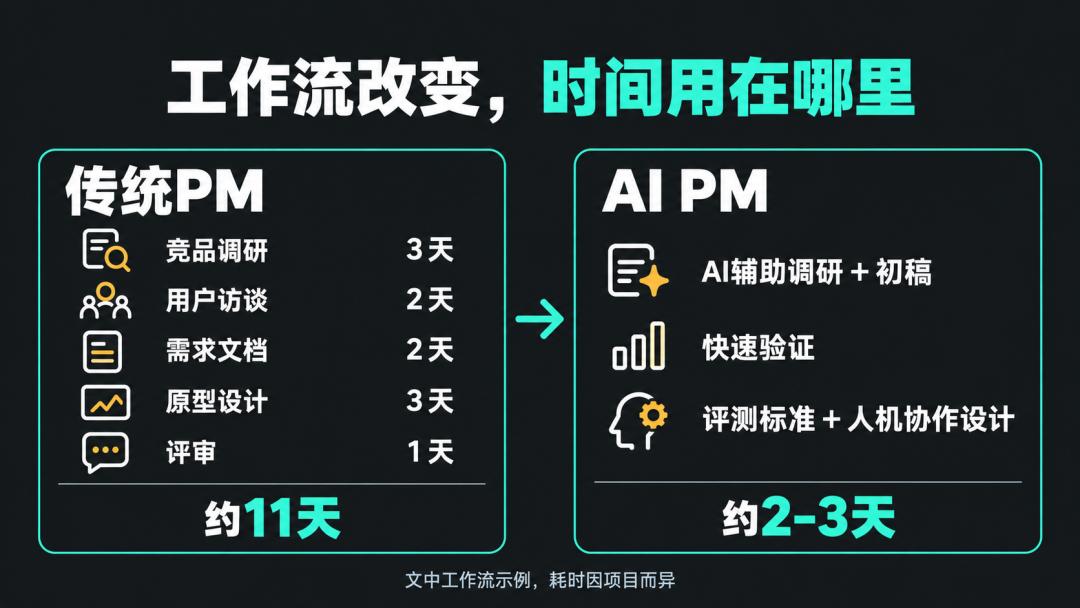
I went through this stage myself. Two years ago, to launch a new feature, the work chain for product managers was like this: 3 days for competitor research, 2 days for user interviews, 2 days for requirement documentation, 3 days for prototype design, 1 day for review, which takes at least two weeks in total.
What about now?
I throw screenshots of competing products, user feedback, and historical data to AI, and I can get a nearly complete first draft in half an hour. I no longer draw prototypes, and directly ask AI to generate an interactive front-end demo. During the review, what everyone sees is a clickable product, not a static wireframe.
This is not to show off efficiency.
What I want to say is, when the time for "delivering outputs" is compressed to one-tenth of the original, it is really dangerous if you don't know what to do with the remaining 90% of your time.
The anxiety of many PMs is not "Will AI replace me?", but "The skills I have always been proud of — drawing prototypes, writing detailed PRDs, and aligning fields with developers — are suddenly worthless."
My daily work now is completely different from three years ago
If you don't draw prototypes or write PRDs, what do AI product managers do all day? Let's talk about the things I spend the most time on now.
1. Define "what counts as correct"
This sounds easy, but it is extremely difficult to execute.
Traditional software is fixed when there are bugs, and launched when the logic is correct. The most frustrating part of AI products is that you cannot measure them by "right or wrong".
We have a contract review Agent, whose task is to identify risk clauses in contracts.
If it misses one risk clause, is that a bug?
If it finds the clause but the description is not very accurate, is that a bug?
If it marks a non-risk clause as risky, is that a bug?
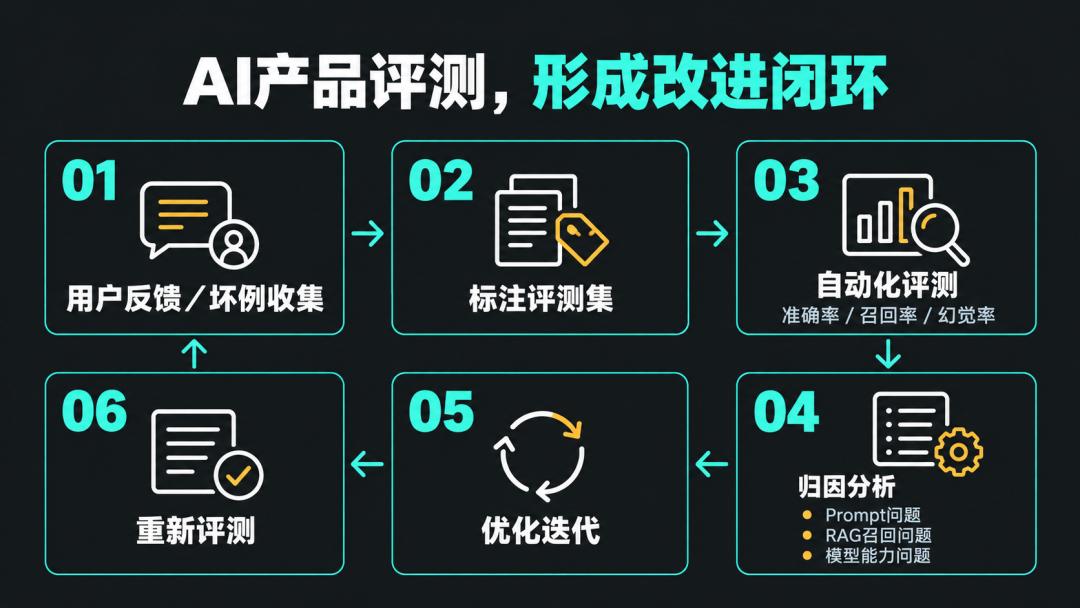
There are no standard answers to these questions, but as a product manager, you must give clear standards — work with the business side and algorithm team to define each rule one by one, label each case one by one, and build the evaluation dataset one by one.
This work is tedious and tiring, but it is the most hardcore daily routine for AI PMs.
You are not defining what the product looks like, you are defining the passing line for AI.
2. Design how humans and AI collaborate
Traditional PMs design the interaction between humans and interfaces, while AI PMs design the collaboration mode between humans and a "not entirely reliable smart assistant".
You need to figure out which links can be fully automated by AI, which links must be checked by humans, how to provide fallback solutions when AI makes mistakes, and how to let users know "the AI is not very sure about this result".
Last year, we developed a document generation tool, and the first version was fully automated — users get the result with one click. After launch, the complaint rate was extremely high.
It was not because the generation quality was poor, but because users psychologically did not trust a black box. Later, we added a step of "AI generates draft → highlights uncertain parts → user confirms or modifies → finalize the document", and the user retention rate doubled directly.
As you can see, this change has nothing to do with technology at all, it is purely the skill of product design.
3. Calculate the cost budget
Many PMs in transition have no concept of this at all.
The marginal cost of traditional software after launch is close to zero, but every additional user of an AI product will consume more Tokens.
The first thing I do when initiating a project now is not to draw a prototype, but to take out a calculator — how many Tokens are consumed per call? What is the daily active user volume? What is the monthly cost? Can we use small models for simple problems and only call large models for complex ones?
Last quarter, we cut a feature with amazing Demo performance. After calculating the cost, we found that the annual Token cost would be more than 3 million, while the expected incremental revenue was less than 1 million.
Being able to calculate this account is far more valuable than being good at drawing prototypes.
The most common failures I have seen on the transition road
In recent years, I have led many colleagues who are in transition, and interviewed many candidates, and several typical failure modes are very representative.
Some people spent three months taking training courses to learn Python and machine learning, and only got a superficial understanding of TensorFlow. When asked in the interview "How do you optimize the RAG recall rate?", they still had no idea.
You are a product manager, not going to become an algorithm engineer.
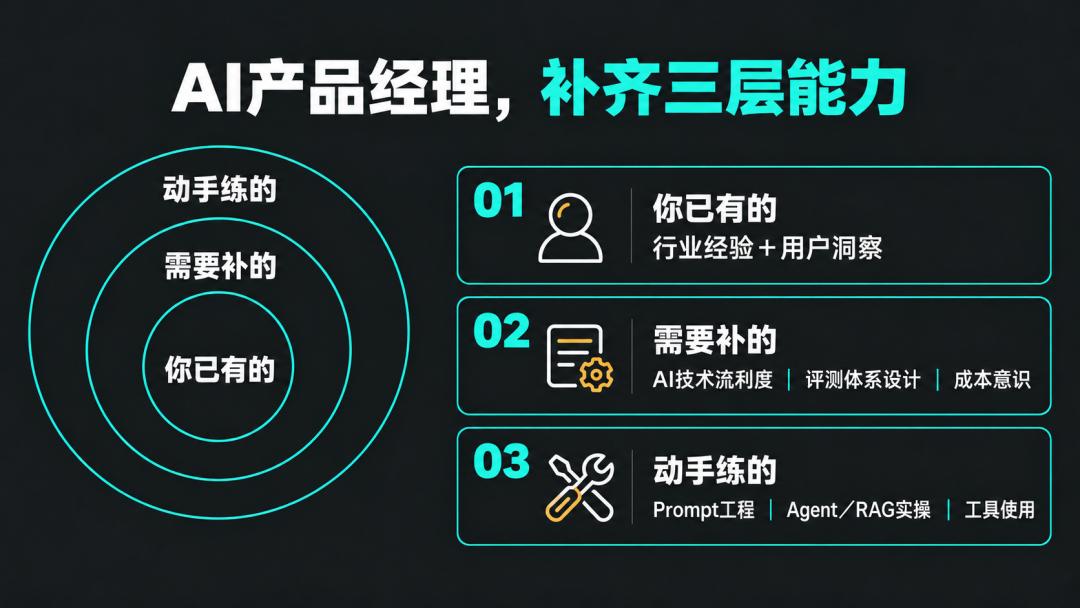
What you need is "technical fluency" — being able to understand what engineers are saying, and being able to judge whether a requirement is technically feasible.
This is developed through hands-on project practice, not by watching online courses.
Some people write "proficient in using ChatGPT" on their resumes.
It is 2026 now, this is just like writing "can use WeChat" in 2015. What interviewers want to see is what business problems you have solved with AI, what solutions you chose, how the effect is quantified, and what pitfalls you encountered.
If you don't have relevant cases, the fastest way is to do it yourself — spend two weekends on Coze or Dify to build an industry knowledge Q&A Agent, and go through the complete process from data cleaning, Prompt tuning to evaluation. This process itself is the best resume material.
There is another most regrettable situation: people think that "understanding AI" is enough, and discard their past industry experience as a burden.
You have worked in e-commerce for 5 years, and are very familiar with user decision-making paths, return rates, and customer service scripts — these are your greatest assets. What is most lacking now is not "generalists who understand AI", but AI experts who understand the industry. A PM with 3 years of experience in financial risk control who develops a compliance review Agent will outperform any newcomer who only understands technology.
What can you do tomorrow?
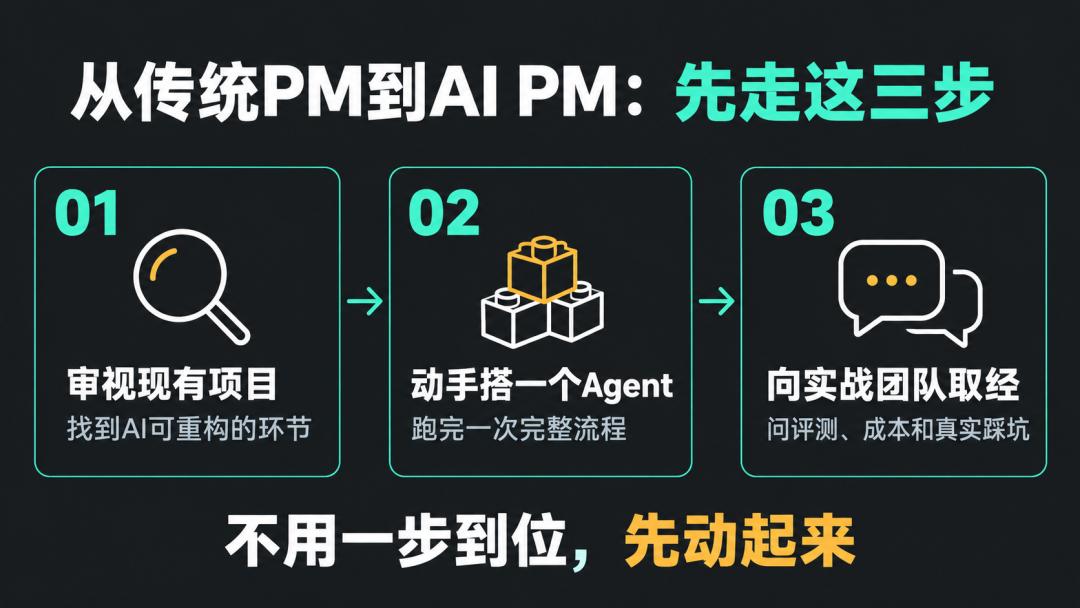
You don't need to achieve everything at once. Take the project you are working on now, and think it over: if an AI capability is added, which link will produce qualitative change? Don't think about superficial things like "adding a chatbot", think about whether the process itself can be reconstructed.
Then build an Agent, anything is fine. One that helps you sort out meeting minutes, one that monitors competing products, or one that analyzes user feedback. In the process of building, you will naturally understand what Prompt engineering is, what RAG is, and what tool calling is. It is more useful than reading any tutorials.
Then talk to a team that is working on AI projects — don't just listen to them brag about how cool their Demo is, but ask what pitfalls they encountered after launch, how they did the evaluation, and how they controlled the cost. These real experiences are hard to find on the Internet.
AI product managers are not a new species. The user insight, business judgment, and cross-team coordination capabilities you have accumulated in the past are all not outdated. What is really outdated is only the way to manage a full-of-uncertainty system with deterministic methods.
Accept this, and you have already taken the hardest step.
The above is the real experience of a person who has been doing AI products for many years and has stepped into countless pits. You are welcome to share your transition experience or the problems you are struggling with in the comment area — mutual communication may be more useful than just listening to me.
This article is from the WeChat Official Account "Everyone is a Product Manager" (ID: woshipm), author: Coffee Without Sugar, published with authorization from 36Kr.