Just now, the largest open-source community on Reddit has imposed a full ban on AI, and Linux and Python have been delisted.
Something absolutely absurd and surreal has just happened in the open source community.

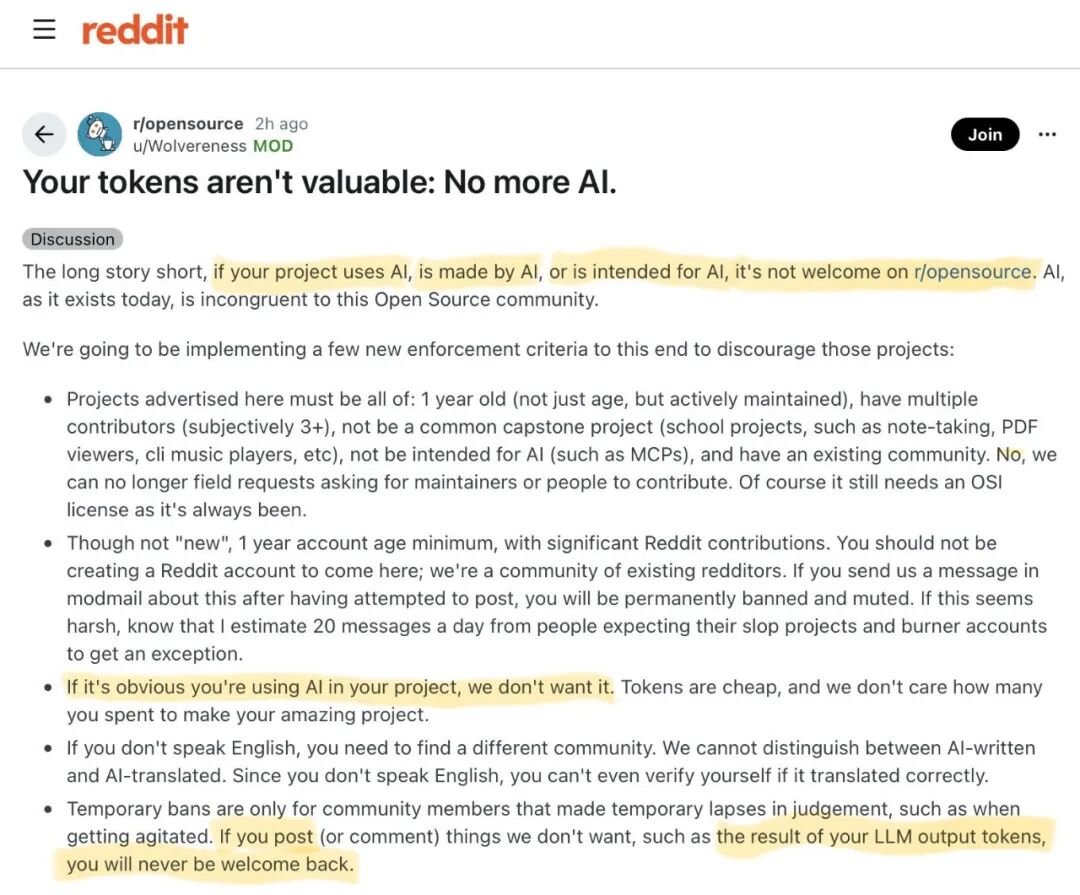
Reddit's largest open source community r/opensource has suddenly rolled out a sweeping ban —
Starting today, any projects that use AI, are AI-generated, or are specifically built for AI will be completely banned!
Moderator u/Wolvereness took a tough stance in the pinned long post, stating explicitly: As long as your project uses AI, is written by AI, or is designed to serve AI, r/opensource will never welcome you.
The post immediately went viral across the whole network, and the comment section exploded with heated discussions.
Soon someone spotted a fatal logical loophole: according to this rule, Linux, the greatest open source project in human history, has already been "expelled" from the community.
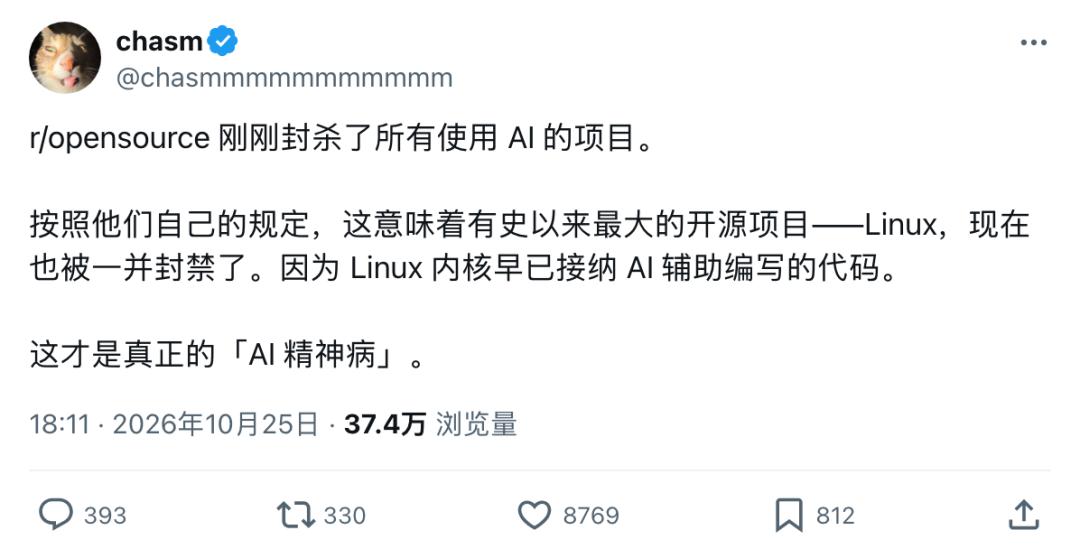
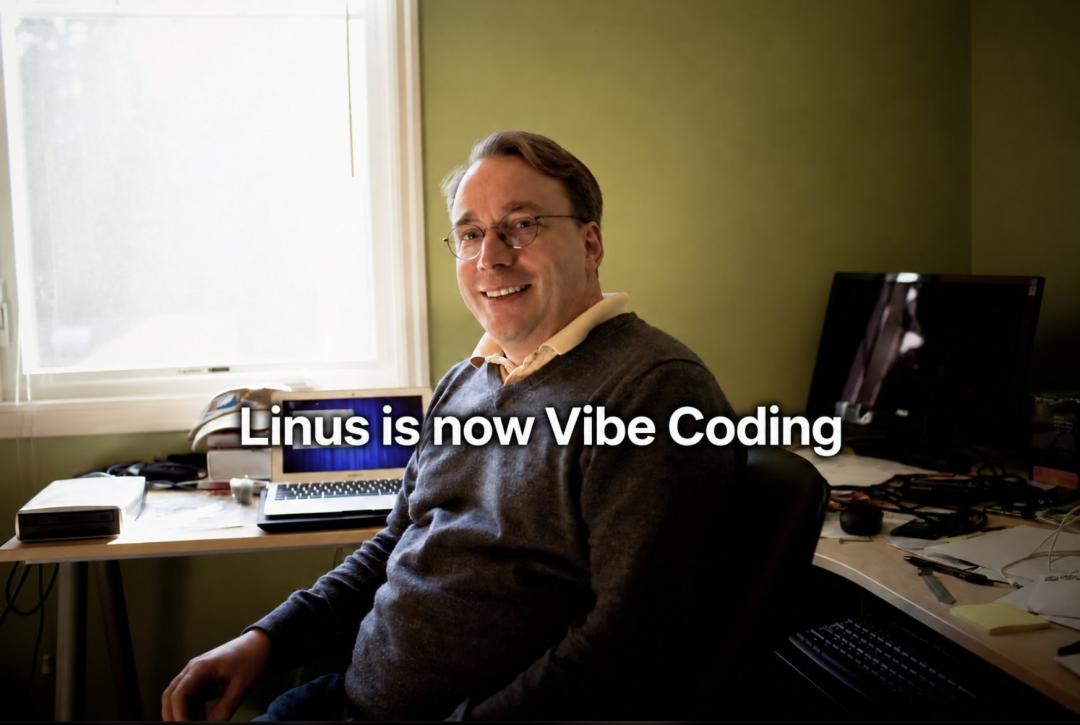
The father of Linux has long been using Claude Code to assist in writing Linux code.
A community that takes "openness and freedom" as its core belief has begun to implement "AI bloodline censorship", and the very target of this censorship is the founding father of the open source spirit.
This scene is arguably the biggest dark humor in the open source circle in 2026.
The sweeping ban: Your tokens are worthless
The origin of this storm traces back to the pinned announcement posted by r/opensource moderator u/Wolvereness on the evening of October 24 Eastern Time.
Just from the title, the smell of gunpowder is immediately overwhelming — Your tokens are worthless, stop working on AI projects.
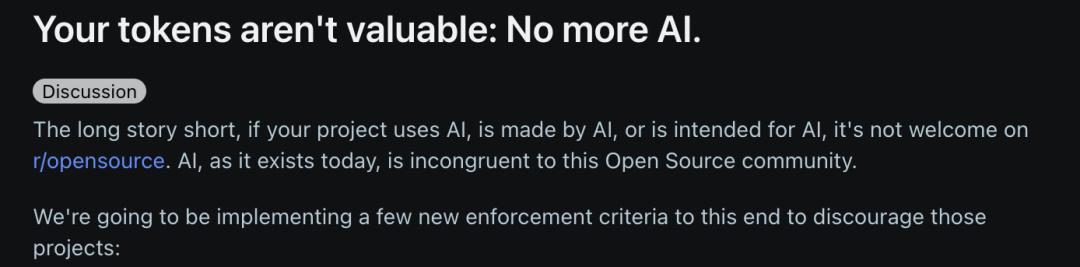
The post gets straight to the point: the moderator states bluntly that AI in its current form is completely incompatible with this open source community.
Subsequently, in this announcement targeting nearly 400,000 members, a series of the strictest "five new rules" in history were released one after another.
- Project access threshold set to the maximum level
The first rule strictly restricts project eligibility. Any open source project posted in the community must simultaneously meet several hard requirements: being actively maintained for at least 1 year, having more than 3 contributors, and having an existing established community, and cannot be common beginner practice projects such as note-taking apps or PDF readers.
Immediately after that, the moderator added a special note: "No, we no longer accept posts looking for maintainers or recruiting contributors."
These two rules combined directly create an absurd dead loop.
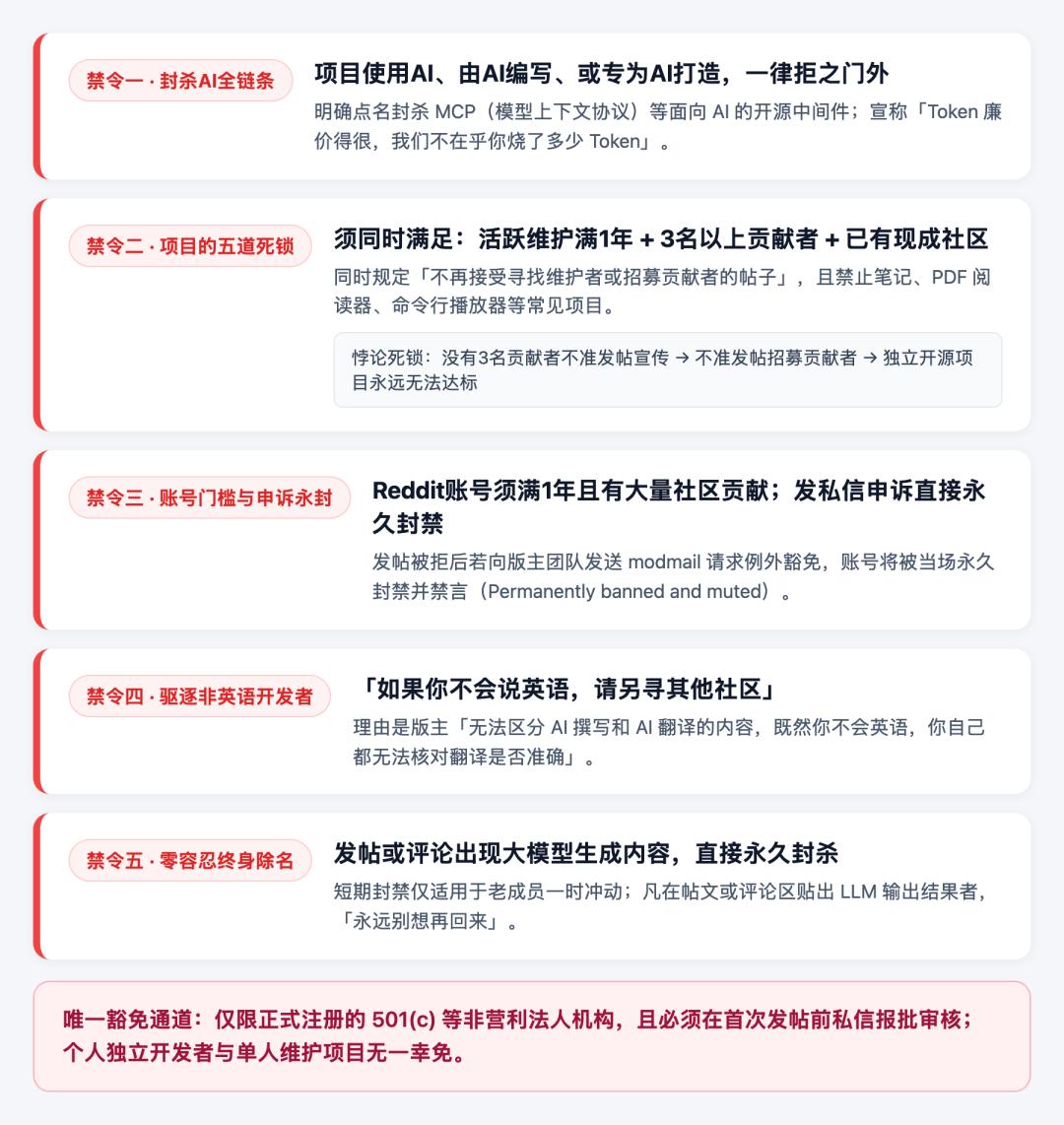
A newly born independent open source project is not allowed to post until it has at least 3 contributors; but if the developer wants to recruit people to get 3 contributors, the community rules prohibit posting recruitment requests.
Even if all the code is handwritten by humans without a single line of AI assistance, as long as it is middleware that serves AI, it is also included in the ban. The announcement explicitly named and banned MCP, wiping out the entire open source Agent toolchain at one stroke.
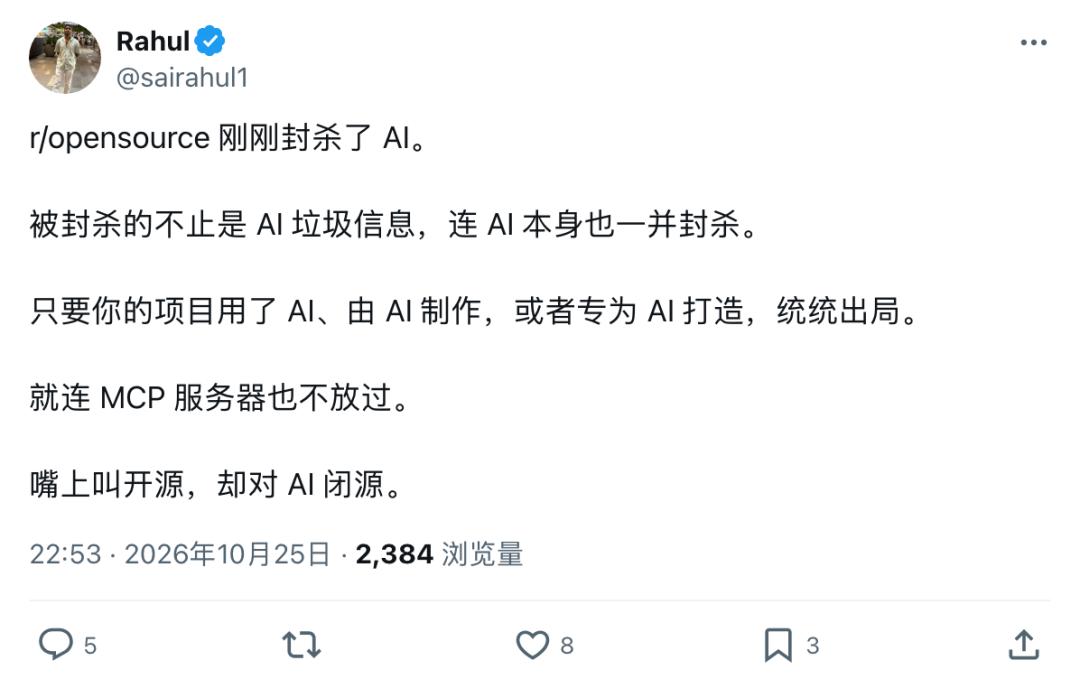
- Account background checks are also mandatory
The second rule strictly restricts accounts and appeal channels. The poster's Reddit account must have been registered for at least 1 year and have a large amount of historical contributions.
Once a post is blocked, anyone who sends a private message to the moderator to plead for exemption will be permanently banned and muted immediately. The only entities that can apply for exemption in advance are officially registered non-profit organizations such as 501(c) entities.
- Any project that is found to have used AI will result in an immediate ban from the community
The original wording of the post is very harsh: Tokens are very cheap, we don't care at all how many tokens you burned to make this "amazing project".
- Cannot speak English? Please find another community
What makes developers around the world even more disappointed is the expulsion order specifically targeting non-native English speakers.
The original wording of the new rule states: "If you cannot speak English, please go to another community. We cannot distinguish content written by AI from content translated by AI."
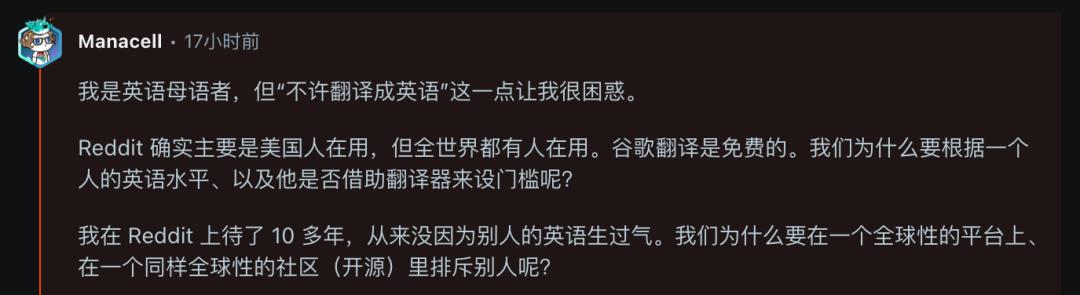
- Post AI-related content, get permanently blacklisted
The moderator then added another harsh note, stating that since the poster cannot speak English, they cannot even verify whether the translation is accurate by themselves.
Even if a non-native English-speaking programmer writes a top-tier open source tool, as long as they use translation software to translate the introduction post into English, they will be permanently removed as AI-generated garbage.
At the end of the announcement, the moderator coldly issued an order to leave: "If you don't like the idea of leaving this community to humans, let me know and I will show you the door."
After the ban was issued, the comment section immediately fell into chaos.
Some netizens said bluntly that it would be too absurd to ban the Linux kernel just because Torvalds used Claude to fix bugs.

Others said that they keep shouting about open source all day long, but the threshold they set is even higher than that of government institutions.

Linus boosted kernel performance 3x with Claude
As soon as this "pure-blood open source manifesto" was released, the tech community immediately pointed out its most absurd logical loophole.
If implemented strictly according to the literal rule of "no welcome as long as the project uses AI", Linux, the largest open source cornerstone in human history, will be the first to be expelled from r/opensource, and half of the modern software industry will be buried with it.
Tech blogger chasm posted a long list on X, listing 38 top open source projects that can no longer be discussed under the new rules.
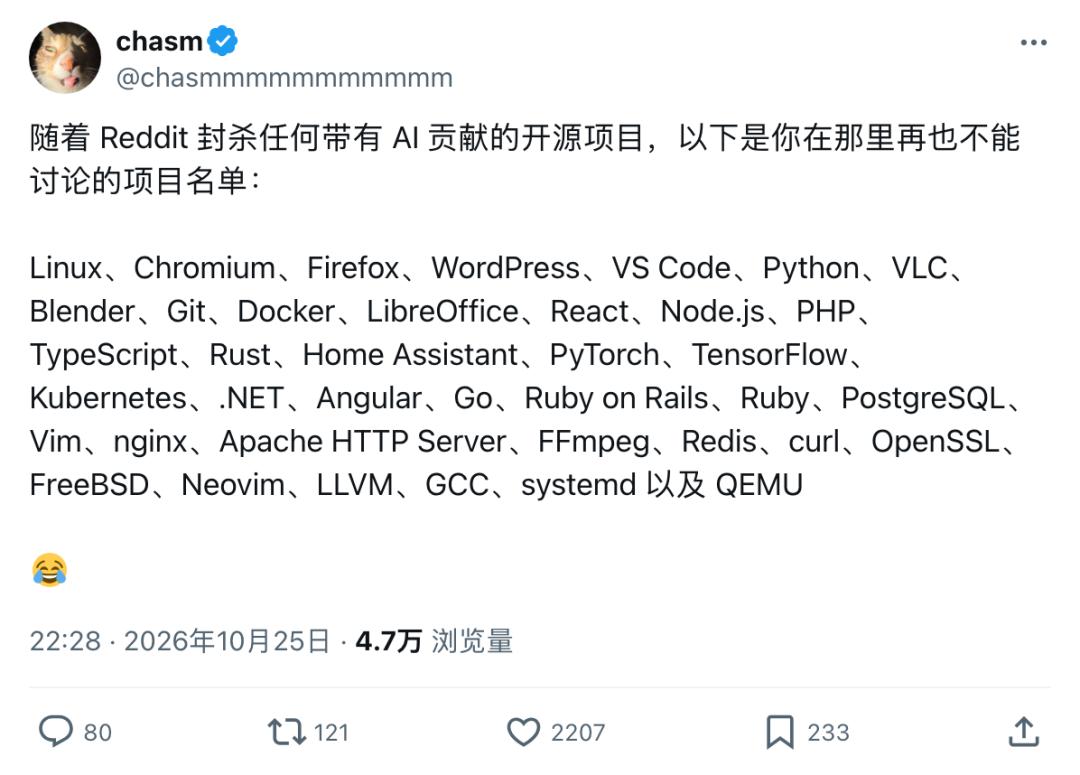
Linux, FreeBSD, systemd, QEMU at the OS bottom layer, Chromium, Firefox in the browser field, and Python, Rust, Go, TypeScript in programming languages are all on the list.
Even Git, Docker, LLVM, GCC, VS Code, FFmpeg and OpenSSL that developers use every day now have patches written or reviewed with AI assistance merged into their mainline code repositories.
The most dramatic part is that just 14 days before the moderator shouted "your tokens are worthless", Linus Torvalds, the founding father of open source, personally used AI to write a set of heavyweight Linux kernel patches.
On October 10, Torvalds created the noref-filemap-read-with-llm branch in his official Linux kernel repository, and submitted 8 kernel patches at once.
In the "Tools" field of the official submission record, Linus stated openly: "The code, test programs, the review behind the above list, and the first draft of this document are all completed by the large language model programming assistant Claude Code under my guidance."
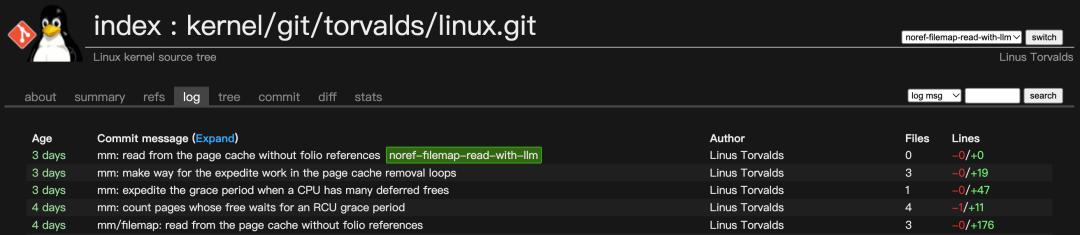
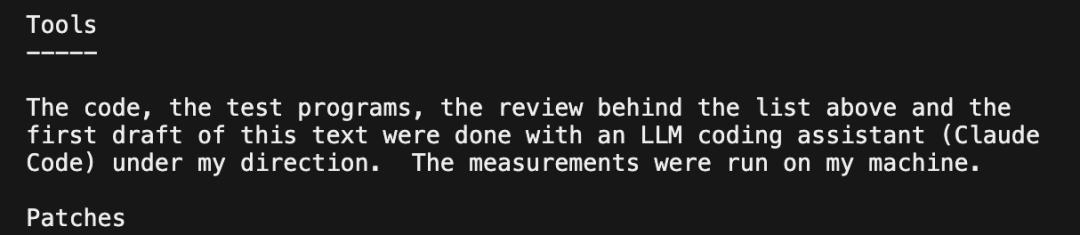
With Claude Code, Linus solved a concurrency problem that had plagued the Linux kernel community for two full years.
In the Linux page cache, when multiple CPU threads perform high-frequency small block reads on the same cached file at the same time, each thread has to repeatedly increment and decrement the reference count of the memory page, forcing all cores to queue up to compete for the same shared cache line.
On Linus's 4-core 8-thread Core i7-8565U laptop, when 8 threads perform 16-byte reads at the same time, up to 99.92% of the cross-core load is consumed on lock contention.
Linus guided Claude Code to use RCU (Read-Copy-Update) lock-free grace period to delay memory reclamation, so that reads do not need to modify the reference count every time, which increased the 8-thread read throughput from 10 million times per second to 33 million times per second, tripling the speed!
The kernel cycles for a single read also dropped sharply from 2950 to 725. The day before submitting the patches, Linus publicly praised at the European Open Source Summit: "When you use AI correctly as a tool, it makes programming much more fun."
The Linux kernel community has also officially merged the "AI Programming Assistant Specification" and "Tool-Generated Content Guidelines" this year.
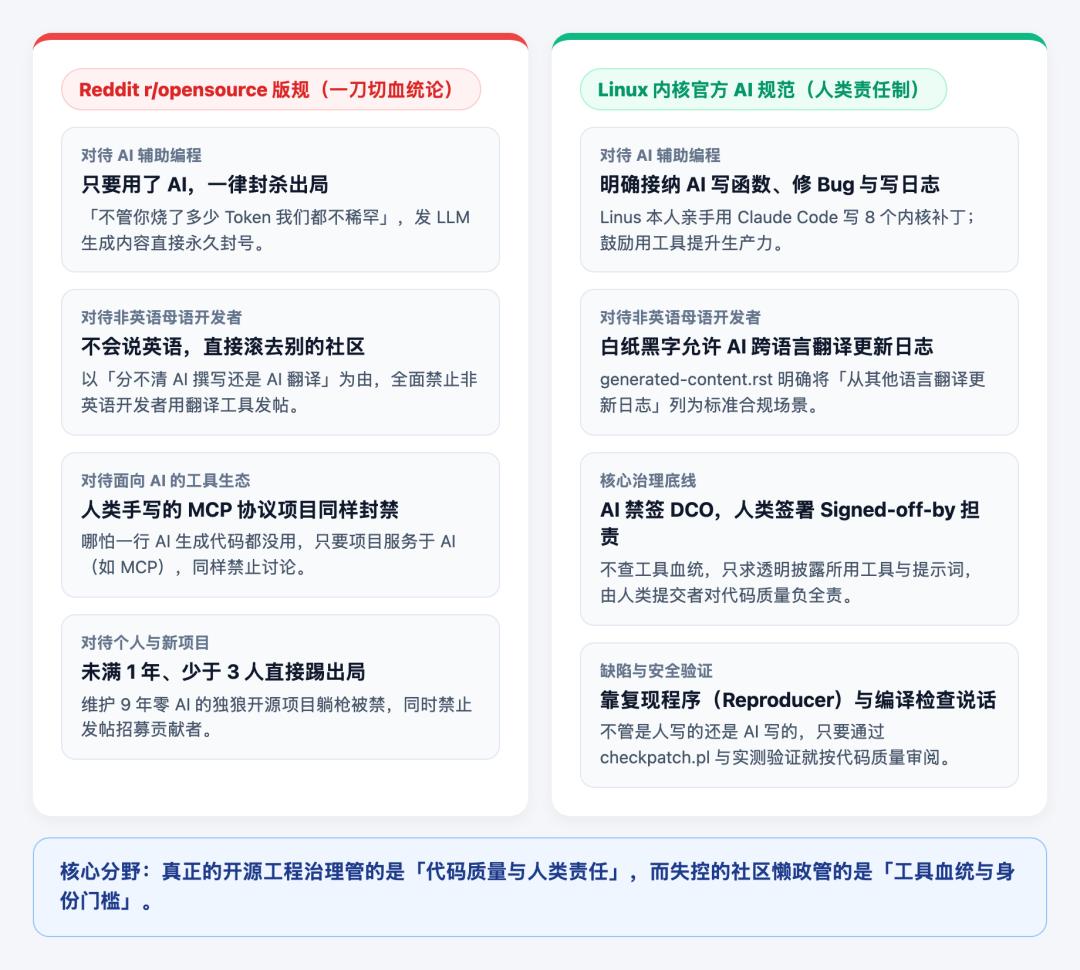
The Linux kernel never engages in "tool bloodline theory", and its established core principle is human accountability. AI can assist in bug checking, function writing, and documentation writing, but every line of code merged into the kernel must be reviewed by a human and signed with a Signed-off-by label to take full responsibility.
Moreover, the official Linux documentation clearly states that translating changelogs from other languages into English is a standard compliant use of tools, as long as it is clearly and transparently noted.
