Universal Beijing Resort is not as popular as people imagined.
01
On October 22, Comcast, the parent company of Universal Studios, released its financial results for the third quarter of 2026.
In this quarterly report, the actual financial status of the Universal Resort project located in Tongzhou, Beijing, was revealed. By the end of September this year, the total assets related to Universal Beijing Resort included in Comcast's consolidated statements amounted to approximately 7.7 billion U.S. dollars, while total liabilities stood at around 7.8 billion U.S. dollars. Just after celebrating its 5th anniversary, Universal Beijing has already recorded more liabilities than assets on its books.
It is worth noting that although Universal Beijing is not fully owned by the U.S. party, its related businesses are still included in Comcast's consolidated financial statements. Therefore, the asset and liability figures in the financial report cover the overall related businesses of the Beijing resort.
The financial data of the project company disclosed by Chinese shareholders also reflects obvious book pressure. The 2025 annual corporate bond report of BTG Group shows that Beijing International Resort Co., Ltd., the project company of Universal Beijing Resort, had total assets of 49.755 billion yuan and negative net assets of 641 million yuan by the end of last year. Based on the book data of this entity, Universal Beijing Resort is already in a state of insolvency.
In fact, the negative net assets of Universal Beijing Resort did not just appear recently. Comcast disclosed in its Q2 2026 financial report that the liabilities related to the Beijing project exceeded its assets, and this situation remained unchanged by the end of the third quarter.
On October 23, *Daily Economic News* reported on the changes in assets and liabilities of Universal Beijing. Reporters from the newspaper had previously sent interview emails to Comcast regarding the project's operating revenue and capital arrangement for new projects, but no reply had been received as of the release of the report.
Nevertheless, Comcast's management has previously talked about the operating pressure faced by the Beijing park. In September this year, Jason Armstrong, Chief Financial Officer of Comcast, stated at the Goldman Sachs Investor Conference that the Beijing park was affected by the weak macroeconomy, and the status of Chinese consumers has been transmitted to the company's business.
What deserves more attention than the inverted balance sheet is the profitability of Universal Beijing Resort. Financial presentation materials show that in the 12 months ending at the end of September this year, the adjusted EBITDA of Universal Beijing dropped to 100 million U.S. dollars from about 200 million U.S. dollars in the same period last year, a decrease of approximately 50%.
According to the follow-up rating report on BTG Group from China United Credit Ratings, the operating revenue of Universal Beijing Theme Park reached about 7.755 billion yuan in 2025, while its total profit still recorded a loss of 2.282 billion yuan.
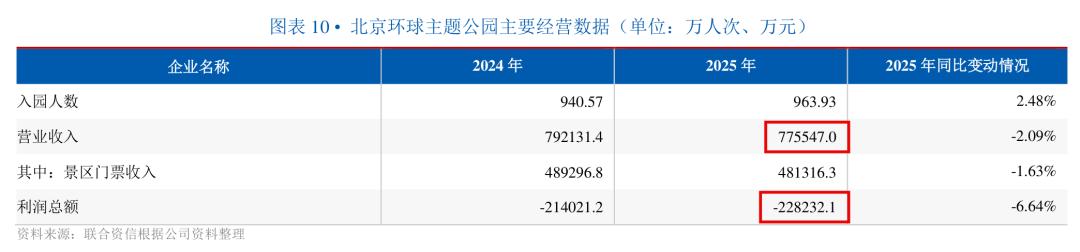
Image source: *2026 Follow-up Rating Report of BTG Group*
The report attributes the loss mainly to the large-scale upfront investment and heavy debt burden, with high depreciation and interest expenses continuously suppressing the project's profit.
From the group perspective, Comcast's total revenue in the third quarter is not optimistic overall. The global Universal theme parks division recorded revenue of 2.597 billion U.S. dollars, down 4.4% year on year, and the adjusted EBITDA dropped to 780 million U.S. dollars, down 17.1% year on year.
More importantly, Comcast is pushing forward a historic structural restructuring plan, which plans to spin off NBCUniversal (including theme parks) and Sky into independent listed companies by the middle of 2027.
As the countdown to independent listing starts, both the Orlando headquarters across the ocean and Universal Beijing Resort, which carries total liabilities of 7.8 billion U.S. dollars, must prove their own profit-generating capacity as soon as possible.
02
It needs to be clarified that negative book net assets do not mean that Universal Beijing Resort is about to face bankruptcy or debt repayment crisis.
Under the financial accounting standard, a considerable proportion of the 7.8 billion U.S. dollars in total liabilities is operating lease liabilities. The interest-bearing debts that Universal Beijing Resort actually needs to repay principal and interest amount to about 3.7 billion U.S. dollars, of which the principal of long-term loans accounts for around 3.3 billion U.S. dollars.
In other words, as long as the daily operation of the park remains normal, the interest on bank loans of Universal Beijing Resort can be serviced smoothly. However, more people are concerned about why an international theme park with top traffic and high ticket prices still cannot break even after five years of operation.
Speaking of which, over the past few years, I have visited all Universal Studios locations around the world. Earlier this year, I even flew to Orlando, USA with my child to experience the brand-new Epic Universe theme park built with huge investment.
While visitors are amazed by the peak level of sound, light and electric technology, I have increasingly clearly seen the common challenges faced by Universal Studios globally.
Taking Epic as an example, compared with its old rival Disney which has a steady stream of IPs, Universal Studios tends to make more aggressive investments in hardware facilities. From Super Nintendo World to the Ministry of Magic of Harry Potter, it has launched high-precision amusement projects such as multi-dimensional robotic arms and holographic projection.
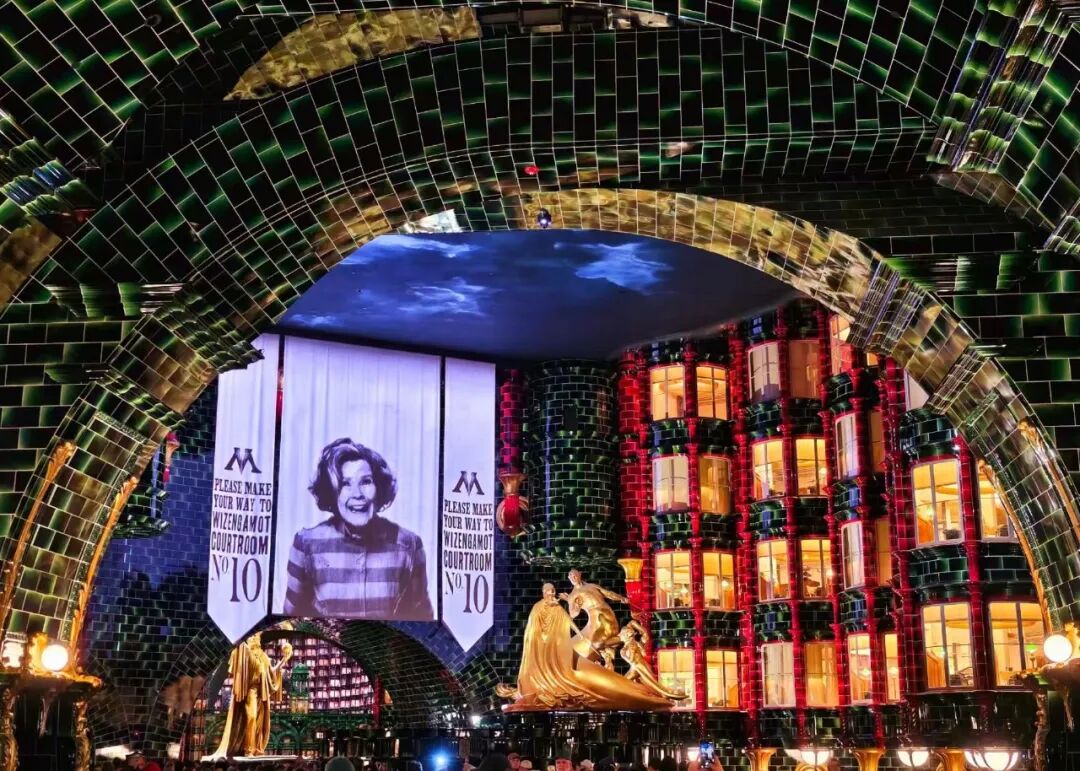
The Ministry of Magic of Harry Potter in Epic Park / Photo taken by TravelPress
Operators therefore have to bear the operating pressure brought by the complex facilities. During the earnings call in October this year, Comcast's management was still discussing the facility reliability and reception efficiency of Epic, even down to details such as whether employees can help visitors get on and off the rides at an appropriate speed.
As a result, even though the revenue of Comcast's global parks declined in the third quarter, the operating expenses of the segment still rose against the trend by 2.3% to 1.817 billion U.S. dollars. If the growth rate of passenger flow slows down, rigid depreciation and maintenance expenses will quickly erode the profit margin.
According to the report from China United Credit Ratings, the number of visitors to Universal Beijing Resort in 2025 increased by 2.48% year on year, but the ticket revenue decreased by 1.63%. While the passenger flow is still growing, the ticket revenue corresponding to each visit is under pressure.
For theme parks that need to continuously attract visitors, promotional offers have practical significance.
However, whether the visits brought by ticket discounts can generate sufficient revenue through in-park consumption depends on how visitors spend their day, and also on what experiences the current middle class is willing to pay extra for.
At this point, Universal and Disney are inevitably compared on the same competitive field.
If what Disney sells is fairy tales and emotional projection for all age groups, then even without large roller coasters, visitors are still willing to revisit the park repeatedly for character interactions and buy high-margin derivatives. In contrast, the IPs of Universal Studios such as Transformers and Fast & Furious focus on sensory stimulation. Some young visitors will leave in a hurry after finishing the rides, making it difficult to form a high-repurchase emotional long-tail effect.
What's more, the consumption psychology of the domestic middle class has undergone subtle changes. Facing travel bills that often amount to thousands of yuan, visitors are becoming more and more prudent in their spending on food, beverages and souvenirs.
This also means that visitors have more options to compare before departure. What Universal Beijing Resort needs to convince next are exactly those people who were once excited about it.
03
Objectively speaking, whether Universal Beijing Resort makes profit or loss, it should be viewed in the context of Tongzhou's urban planning.
In November last year, in the article *Why Ferrari Theme Park Settles in Tongzhou?* published by TravelPress, it was mentioned that the successive entry of international IPs into Beijing's sub-center is betting on the cultural tourism growth of the entire region.
The gathering of projects with different themes can provide reasons for visitors to extend their trips, and also spread the travel cost from afar to more experiences.
By October this year, new progress has been made in the cultural tourism layout of Tongzhou. Vertipark has entered the final sprint stage for opening preparation. The official has organized special recruitment events, releasing more than 200 operation and management positions. The latest reports show that the project is expected to be completed by the end of the year and meet the conditions for trial operation. Beijing Haichang Ocean Park has also entered the construction phase of the main structure above ground, and is planned to be ready for operation in 2027. Ferrari World, which was signed last year, remains the most noteworthy project in the subsequent regional layout.
Meanwhile, the accommodation demand brought by Universal Studios has a significant boosting effect on the entire cultural tourism industry in Tongzhou that cannot be underestimated.
Before the National Day holiday, I noticed that the Universal branch of Jianguo Hotel stated in an interview that 70% to 80% of its guests during the summer vacation were tourists visiting Universal Studios, with an average occupancy rate exceeding 80%.
From the perspective of Tongzhou, Universal Studios plays the role of attracting non-local tourists, and the benefits will gradually spread through accommodation and surrounding commercial facilities. What is more worth observing is whether visitors are willing to spend two or three days of their vacation in Tongzhou as surrounding projects are put into operation one after another. This also means that as the gold-lettered signboard of Tongzhou's cultural tourism industry, Universal Resort is exactly at the stage where its own content updates need to extend visitors' length of stay.
In September this year, Universal Beijing Resort announced that it will build Asia's first indoor themed ride experience of *Fast & Furious*, as well as the nighttime entertainment show on the Lagoon. The former is exclusively designed for Beijing, adopting a fully indoor form, while the Lagoon will add more nighttime park experiences through light and shadow effects and on-site interactions.
When talking about new facilities in existing parks, Comcast's management has also included new passenger flow and revisits into the return on investment calculation.
Placed in the context of Tongzhou, regional linkage will eventually be reflected in whether visitors are willing to buy an extra ticket and stay one more night. After more surrounding options are available, how much return Universal Studios can get from it will affect the effect of subsequent investments.
However, going back to the data-filled financial report released on October 22, Wall Street's patience for Comcast is limited after all. Can the roar of *Fast & Furious* engines, coupled with Tongzhou's continuously expanding cultural tourism blueprint, help Universal Beijing outperform the high annual depreciation and interest bills? The answer may not be revealed until the next five years.
This article is from the WeChat official account "TravelPress", author: Theodore Xishao, published with authorization from 36Kr.