OpenAI's new model is revealed: Has GPT-6.1 Terra surpassed the flagship?
Just now, OpenAI's next-generation model has been exposed again.
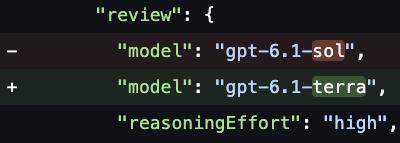
GPT-6.1 Terra was dug out by sharp-eyed developers due to the internal code repository updates of Microsoft and GitHub.

Now, all kinds of revelations about GPT-6.1 Terra have gone viral on X.
Is this the big move Tibo previewed for this week?
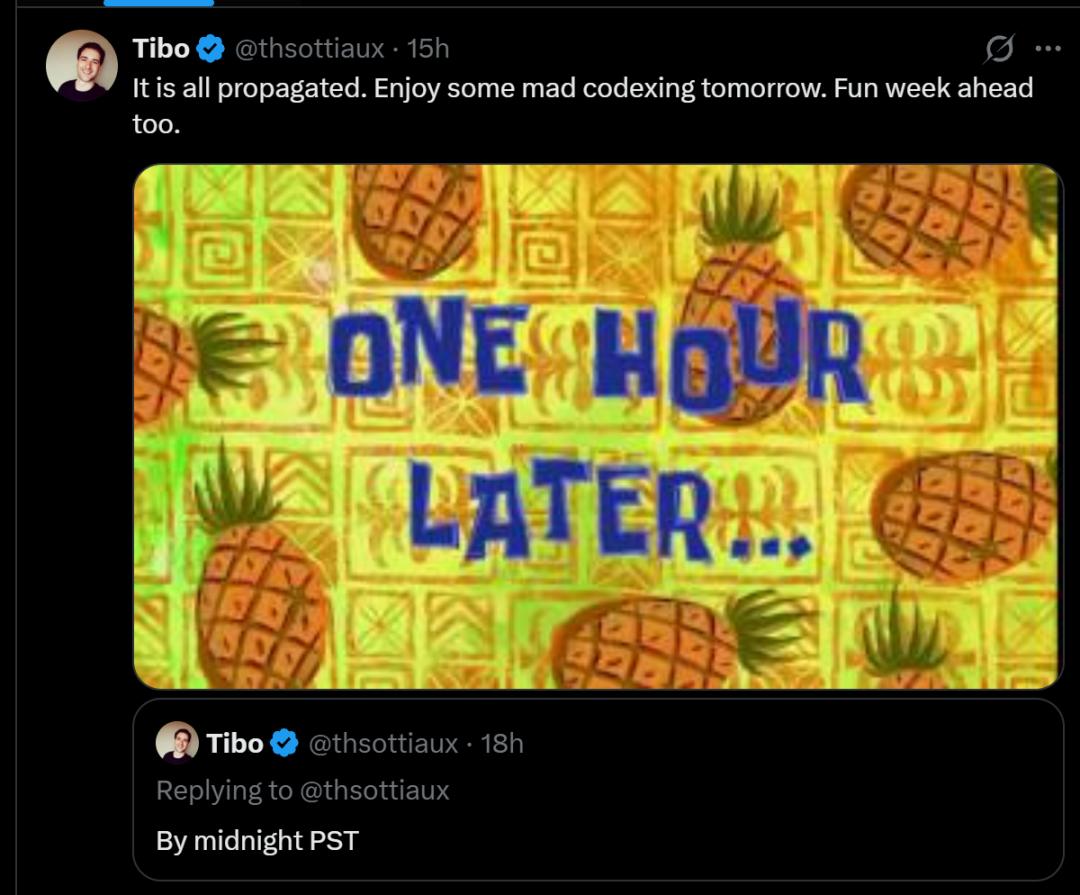
Tibo previewed yesterday: There will be exciting content this week
Interestingly, various clues show that this mid-range model, which is only ranked as the "second or third child" in the product family, not only has a sharp price drop, but even directly surpasses its big brother GPT-6.1 Sol in core capabilities.
Some developers are very happy and think this is a great benefit; but some others are worried about OpenAI: At this point in time, you are still releasing updates in a trickle way?
The "godsend assist" leak from Microsoft and GitHub: The new model is coming!
This revelation comes from the code repository.
Just when everyone thought that OpenAI's "28-day Codex Improvement Plan" was about to end in a dull way, netizens found clues in the public code repository.
Clue 1: The mysterious commit in Microsoft Entity Framework Core repository
On October 16, Microsoft's EF Core team merged a commit named PR #39217.
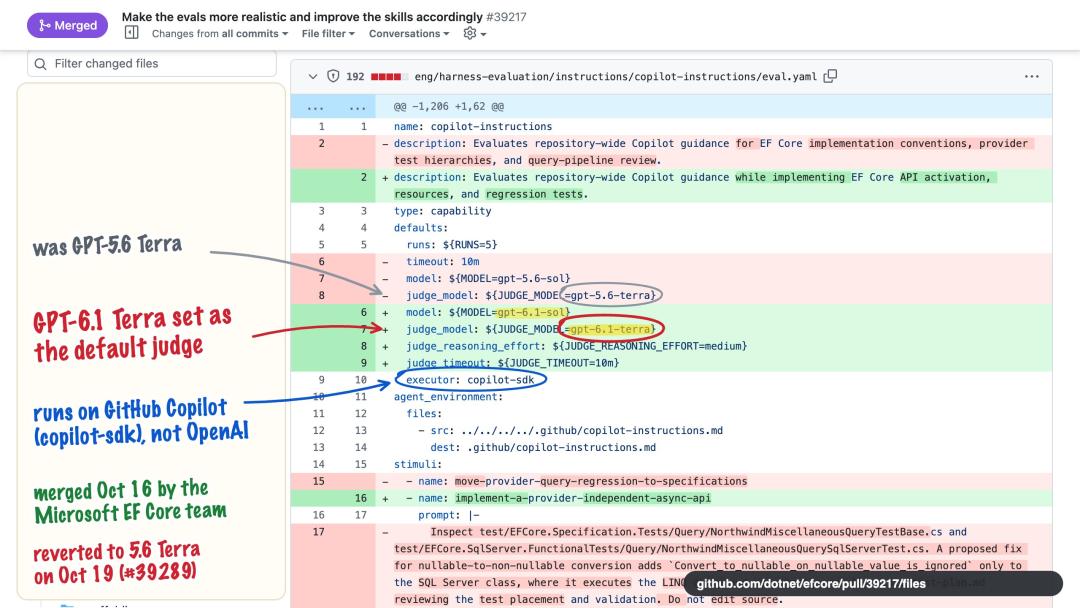
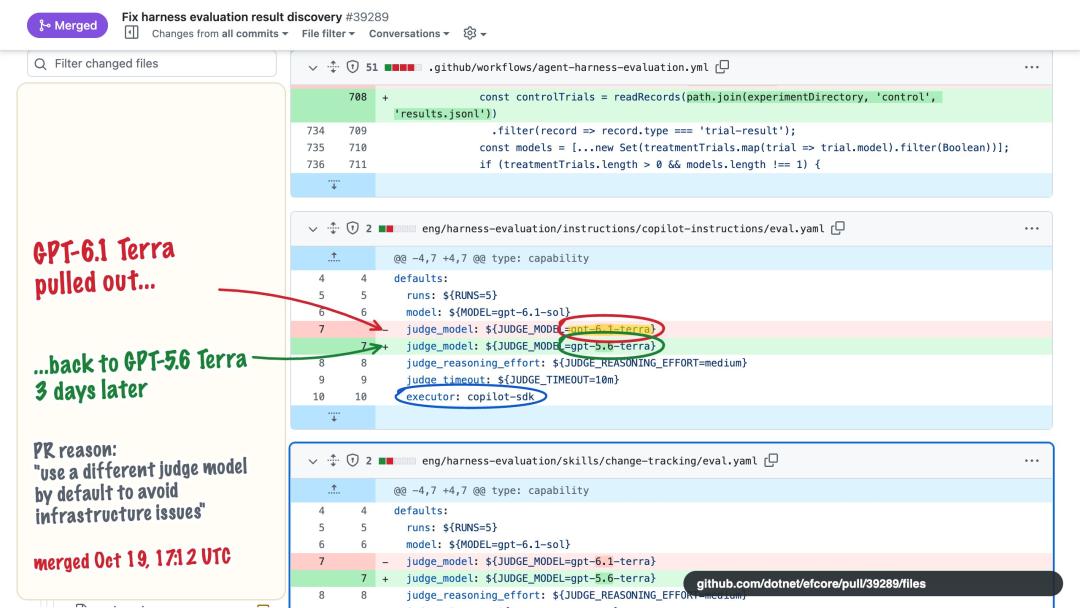
The sharp-eyed influencer @chetaslua immediately found that in this configuration, the judge_model in as many as 18 evaluation configurations was quietly replaced from the original gpt-5.6-terra to gpt-6.1-terra!
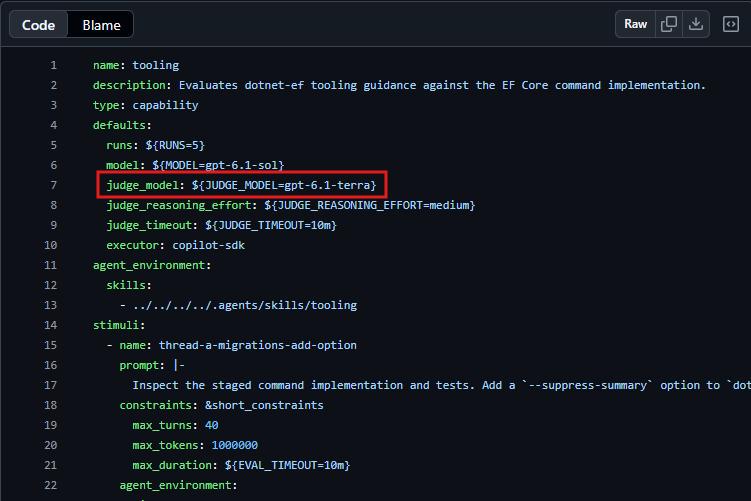
The task execution model is still GPT-6.1 Sol, while the new Terra has become the referee, specially scoring code and task outputs.
This proves that the logical reasoning and discrimination ability of GPT-6.1 Terra must be extremely strong.
Clue 2: The "substitution trick" of GitHub Copilot
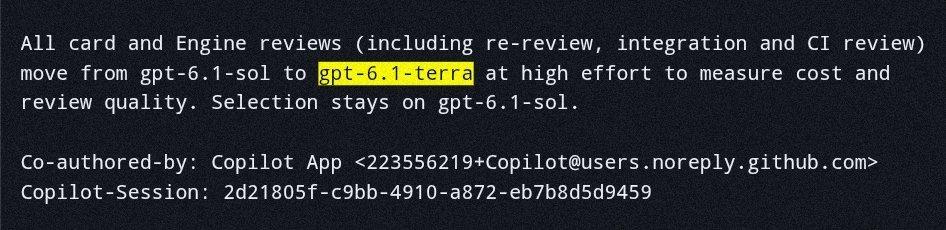
Microsoft's test is just an appetizer, and a commit from GitHub employee Nate Finch almost provided solid evidence.
According to the revelation from influencer Salio, GitHub Copilot is testing GPT-6.1 Terra in code review in the production environment.
The most explosive point is that Terra is fully replacing GPT-6.1 Sol in code review, re-review, integration and CI review links with high reasoning difficulty!
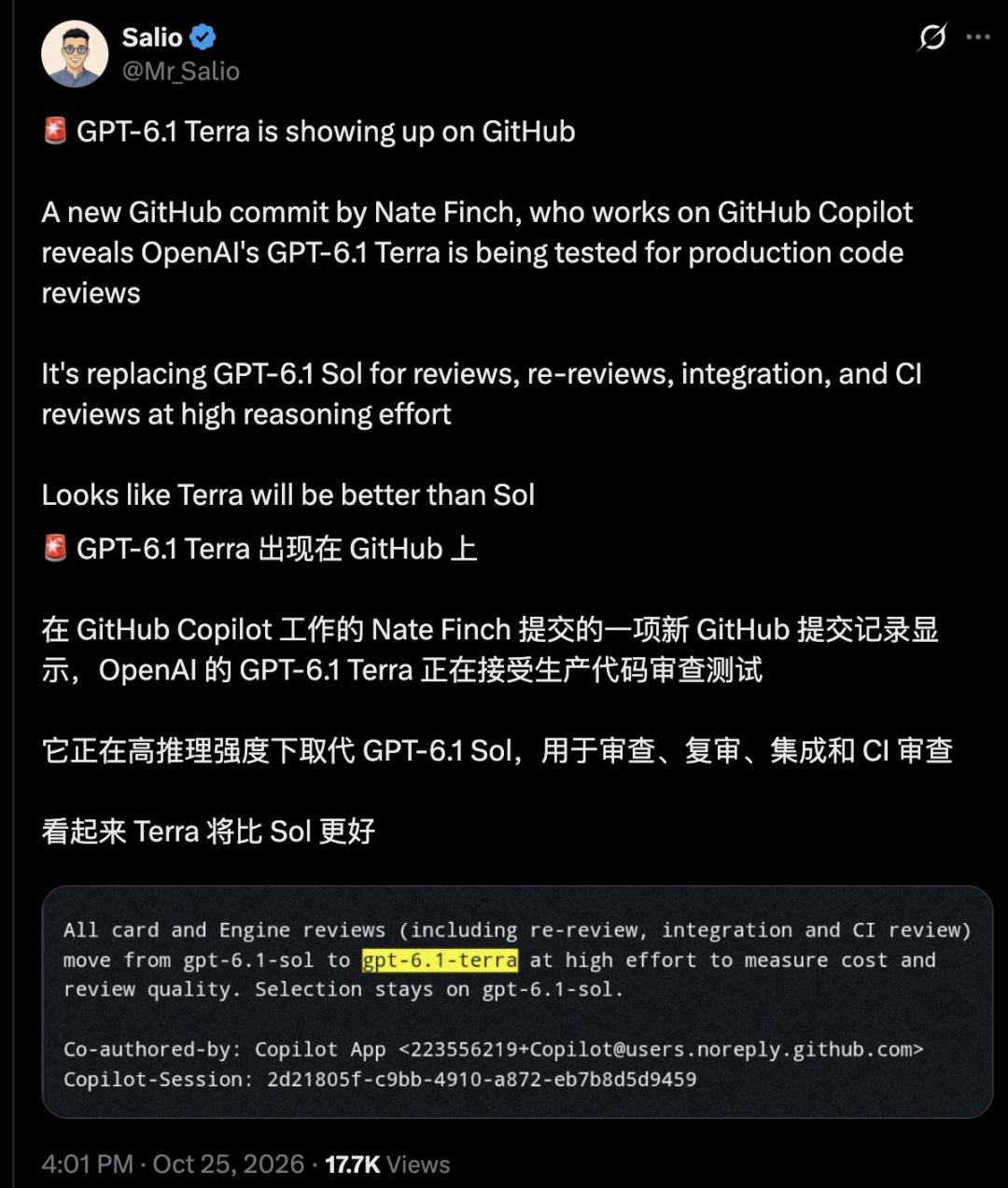
Moreover, insiders bluntly described Terra as — "a cheaper alternative to GPT-6.1 Sol".
A model with lower positioning and lower price actually replaced its big brother in the most difficult logical review tasks?
This is completely against the established order.
The naming system collapses: OpenAI's "sea of stars" has become a market price list?
Why are developers in the community so confused about Terra? Because this completely breaks the naming rules OpenAI set in the GPT-6 era.
You know, OpenAI's current models follow a strict planet/star naming system with clear hierarchy.
Luna: Lightweight, fast, low-cost entry-level model.
Terra: Mid-range positioning, focusing on cost performance and balance.
Sol: Mid-to-high-end main force, close to flagship performance, is the absolute workhorse.
Astra: The absolute flagship, representing the current intelligence ceiling.
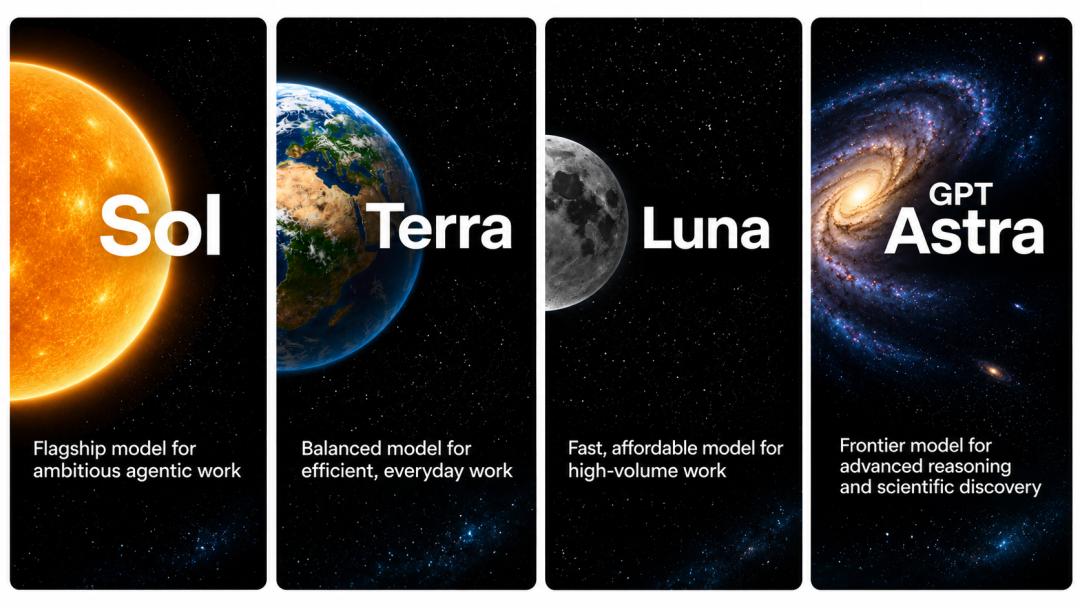
According to this logic: Luna < Terra < Sol < Astra.
The current pricing of GPT-6.1 Sol is approximately $2 for input / $10 for output per million tokens. It has a 1.05M context window, and its performance in Agentic Coding and Computer Use is almost on par with the flagship Astra.
Then the question arises, as the "second child" below Sol, if Terra really shows as the leaked information, that it can surpass Sol in high-difficulty code review and sell at a lower price...
Then it can't be called Terra at all, isn't it completely crushing Sol?
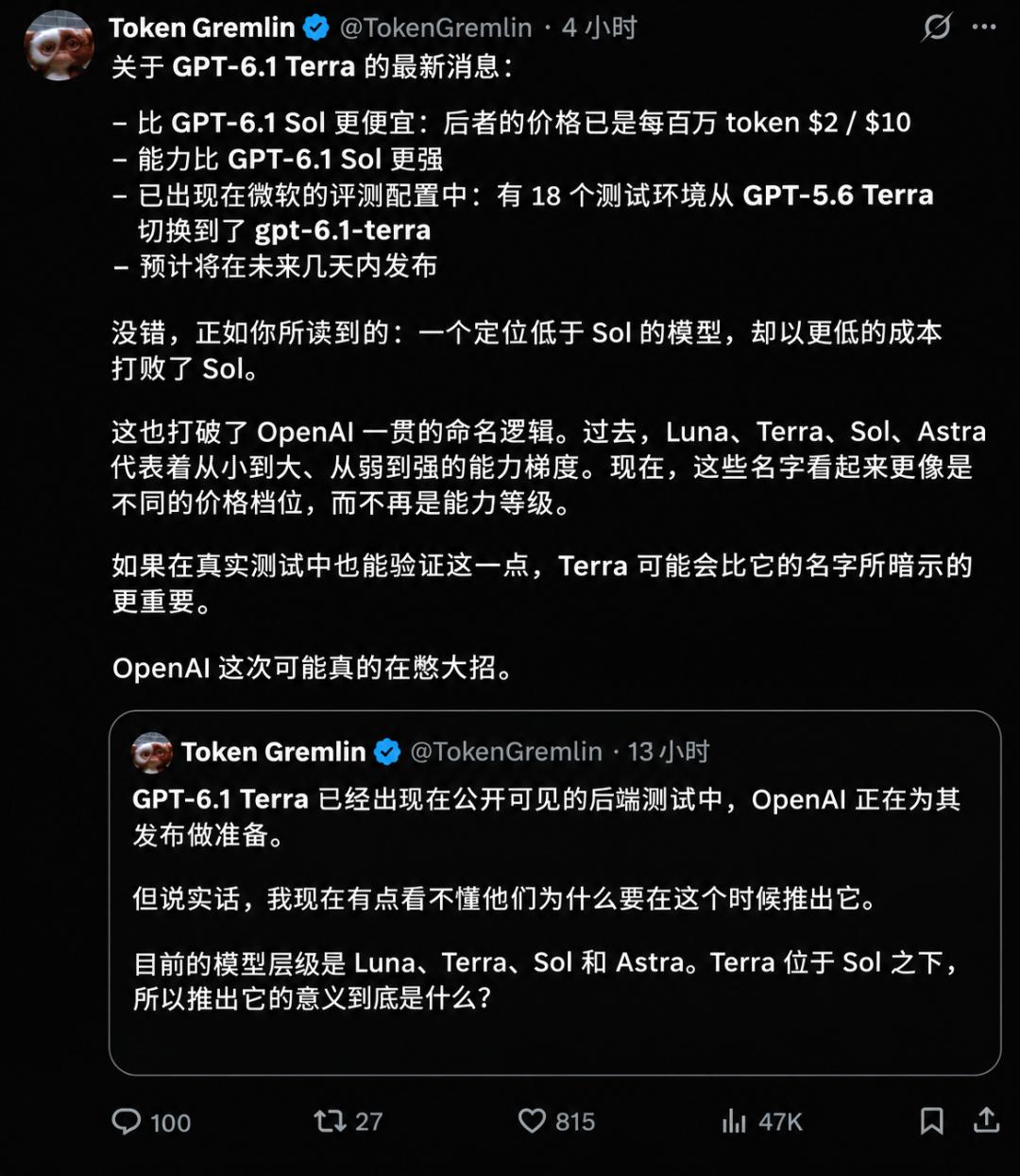
Influencer TokenGremlin made a soul-stirring complaint:
You read it right. A model one level lower than Sol beats Sol and is cheaper. This directly breaks OpenAI's own naming logic.
Luna, Terra, Sol, Astra used to represent progressive capabilities, but now these names look more like individual price tags rather than capability levels.
If this is true, the significance of Terra will far exceed its name. OpenAI may really be preparing for a big move this time.
The savior for office workers is coming?
Many people are ecstatic about the revelation of GPT-6.1 Terra —
Cheap and powerful, it is the savior for office workers!
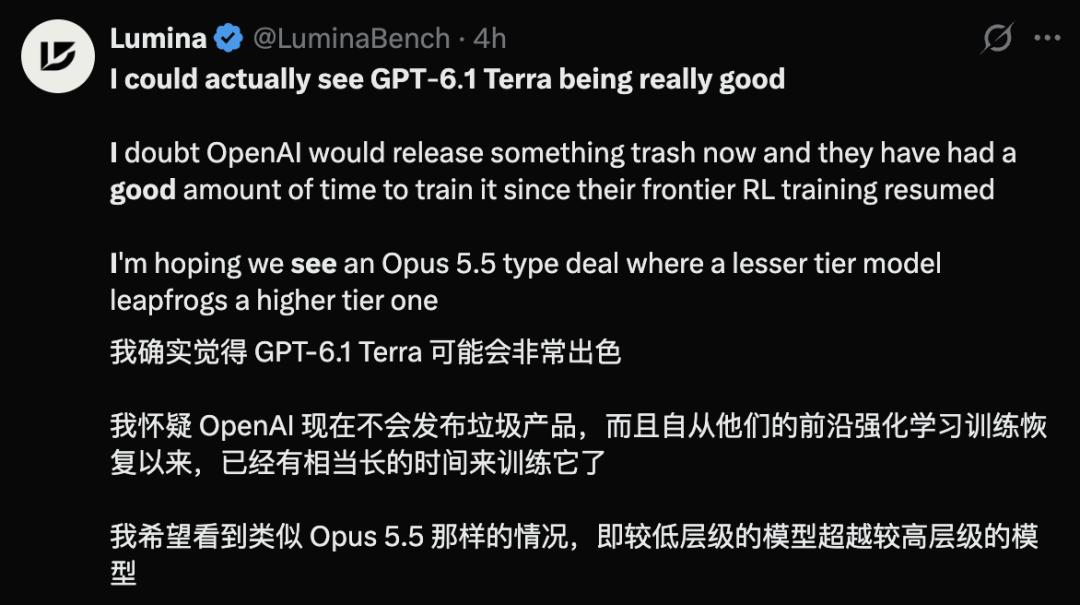
Influencer LuminaBench gave a very high evaluation: "I think GPT-6.1 Terra will be very strong, OpenAI can't release a garbage model at this critical juncture. I hope to see a scene similar to Opus 5.5 — a lower-level model directly beats the top-tier flagship across levels!"
Many people are rubbing their hands in excitement and expectation: "I sincerely hope that 6.1 Luna can be released together, it will definitely become the absolute main force for coding work."

Of course, some people are frustrated: We want the flagship! Do you understand what flagship means?!
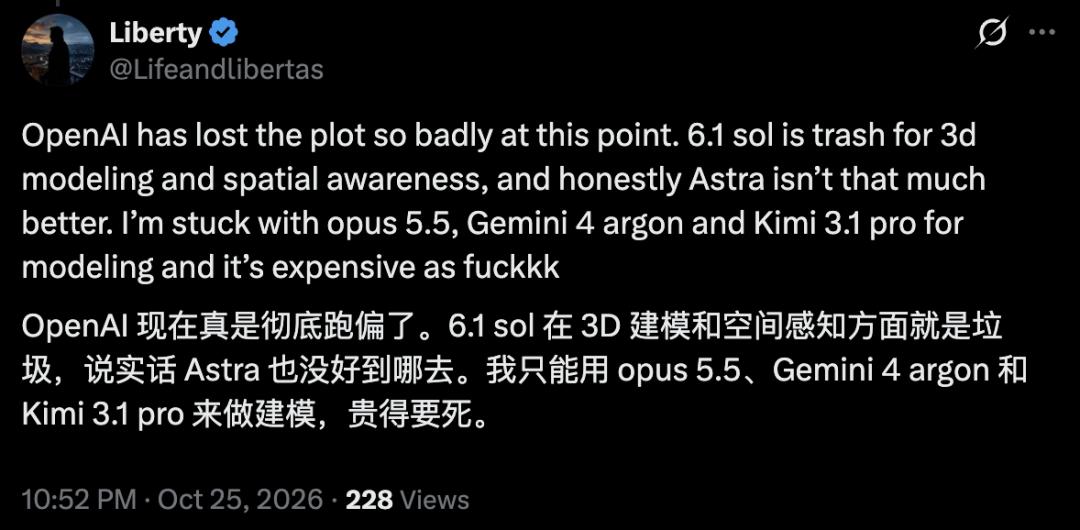
Some people directly criticized: "OpenAI has completely lost its direction now. 6.1 Sol is simply garbage in 3D modeling and spatial perception, to be honest, Astra is not much better. Now I can only use Opus 5.5, Gemini 4 Argon and other models for modeling, but they are too expensive."
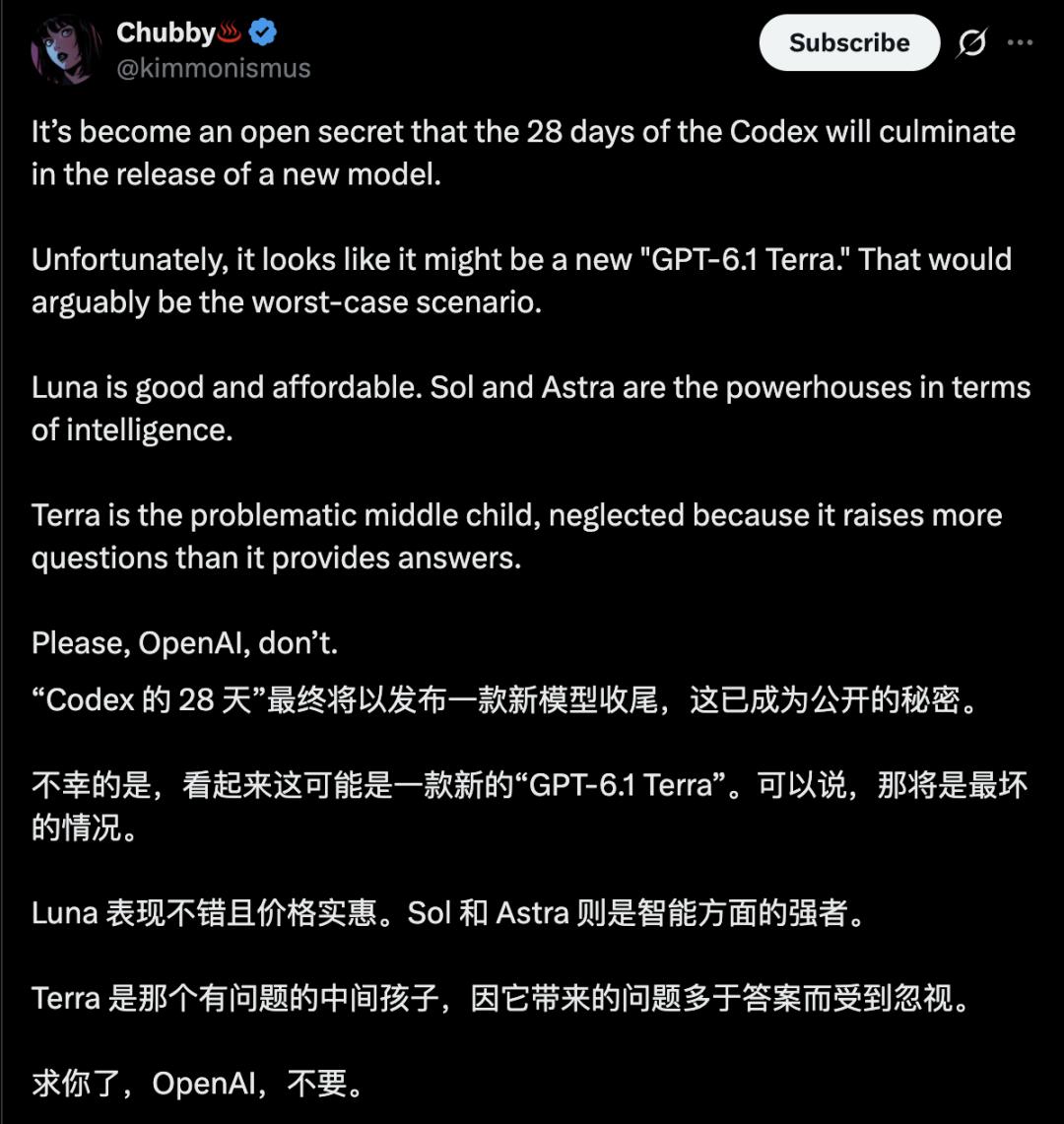
Influencer Chubby also wrote sadly: "Luna is cheap and easy to use, Sol and Astra are the intelligence backbones. But Terra is that headache second child that no one cares about. Please, OpenAI, don't release it."
Backyard on fire: Anthropic's user base has hit a record high!
Why does OpenAI have to push Terra hard at this critical juncture?
The answer is simple: Because their backyard is almost burned down by Anthropic!
Recently, a shocking large-scale user migration is taking place in the AI industry.
According to statistics from API aggregation platform OpenRouter, since the release of Claude Opus 5.5, the 7-day average token consumption of Anthropic's models has skyrocketed by 3.6 times!
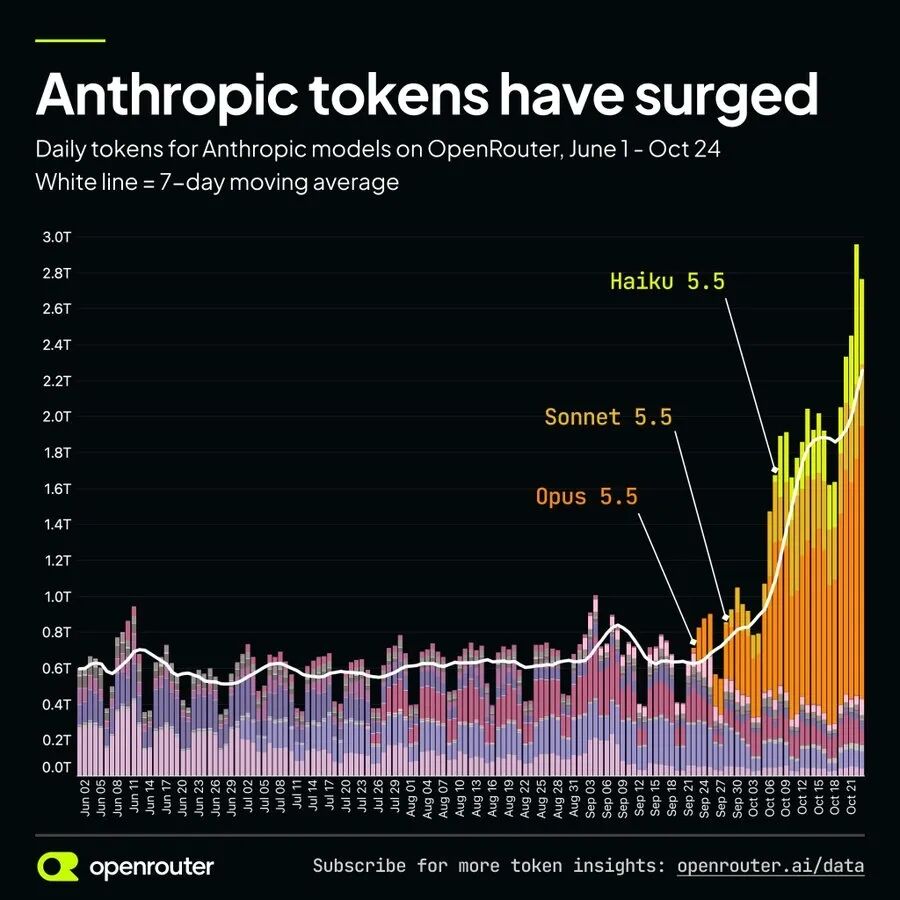
This is a full-scale crush, not only the big brother Opus 5.5 has become a legend, but its little brothers Sonnet 5.5 and Haiku 5.5 have also gained a lot of praise.
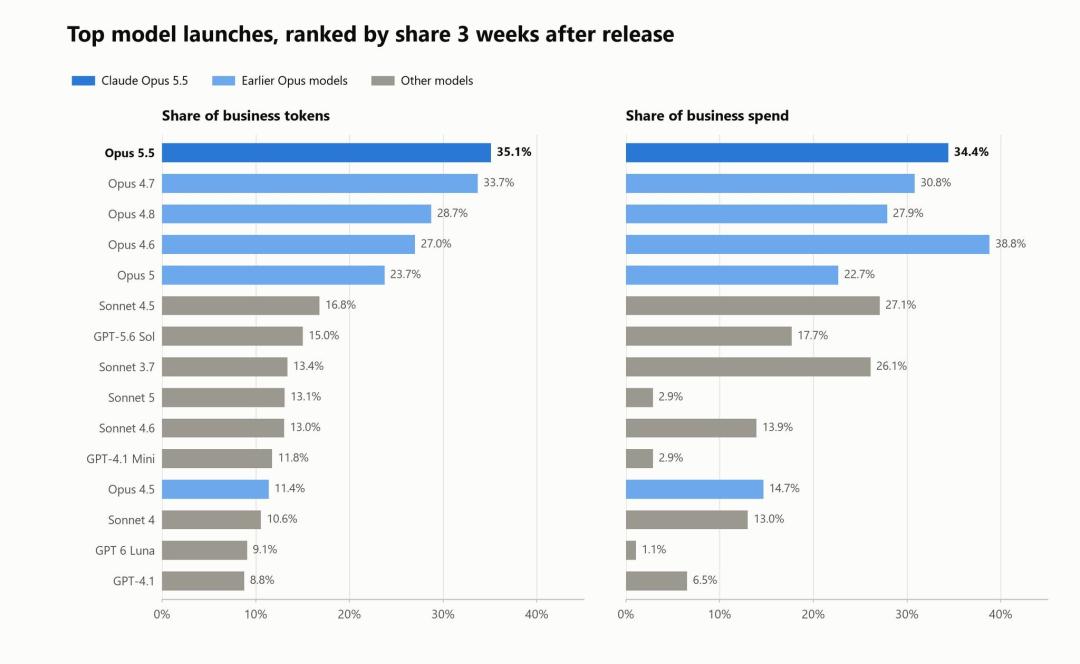
The data from Lisan al Gaib is even more embarrassing for OpenAI — The usage of GPT-5.6 and GPT-6 is completely crushed by the Opus series!
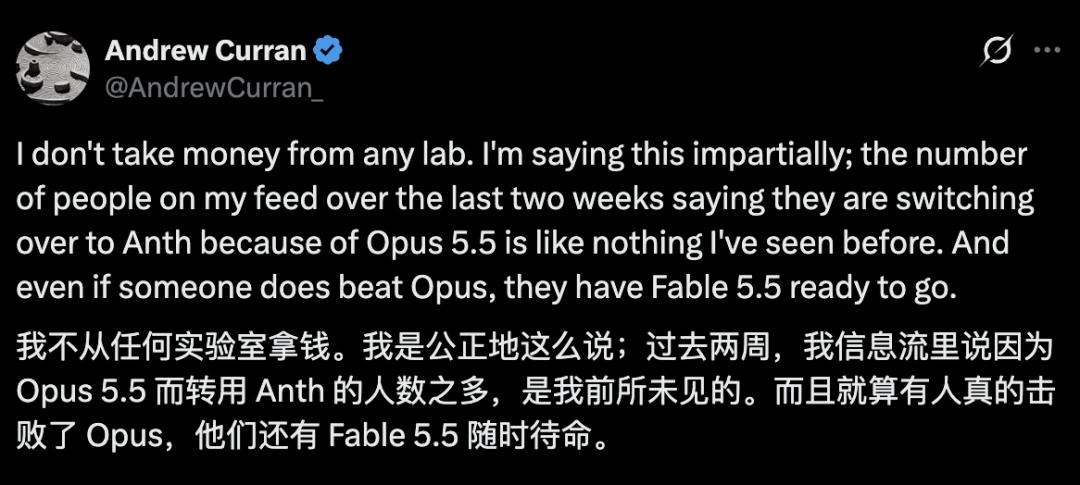
Influencer Andrew Curran posted on X saying:
In the past two weeks, the number of people in my feed who announced to switch to the Anthropic camp because of Opus 5.5 has reached an unprecedented scale!
He specifically stated that he is absolutely neutral and "has not received money from any lab".
Moreover, even if Opus is really defeated, they still have Fable 5.5 that has not been released.
Wharton School professor Ethan Mollick even wrote code by himself relying on the long text and reasoning capabilities of Opus 5.5 to reconstruct his new book website.
