Does the outcome of the China-US AI competition really depend on short dramas?
Two years ago, there was a topic on Zhihu: Why is it said that "the United States uses AI for entertainment, while China applies AI to industrial production"?
Back then, Sora, the U.S. text-to-video large model, made a sensational debut, with its generated videos being almost indistinguishable from real footage, sparking amazement and anxiety across the globe. At that time, China's DeepSeek had not yet gained widespread popularity, Doubao was still in its early growth stage, and the text-to-video large model Seedance was virtually unheard of.
Two years later, Sora was shut down, while domestically developed text-to-video large models including Seedance and Keling have risen one after another, leading to explosive growth of AI short dramas and video generation in China.
The debate over the different AI use cases between China and the U.S. has also taken a dramatic turn —
On social media, a new narrative has emerged that "the United States uses AI to boost productivity, while China uses AI to produce underdog short dramas", and the topic "55% of China's Token consumption is used for short dramas" once topped Weibo's hot search list.
More sharp remarks followed, with some people quoting a famous quote from Lu Xun, lamenting: Once again, the Chinese people have turned gunpowder into fireworks.
Does this seemingly pithy summary capture the full truth about AI in China and the United States?
Where on Earth Has the Computing Power Gone
This debate was triggered by a set of sharply contrasting data.
On October 10, a post spread across social platforms. The post claimed that 55% of China's Token consumption is used for the generation of short dramas, short videos and entertainment content, while 58% of Token consumption in the United States is used for programming, R&D and enterprise automation.
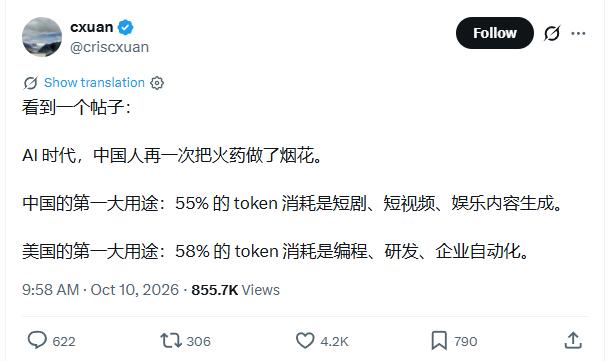
While one side is busy producing entertainment content, the other side is engaged in programming and R&D. Under this stark contrast, the post author lamented: "In the AI era, the Chinese people have once again turned gunpowder into fireworks."
After that, related topics continued to ferment on social platforms.
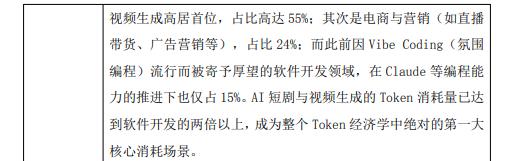
Some media outlets traced the source of the data: the Chinese data came from a *Investor Relations Activity Record* disclosed by A-share listed company Chinese Online in June this year. Chinese Online stated that among domestic AI Token consumption, short drama and video generation accounts for 55%, e-commerce and marketing account for 24%, and software development accounts for 15%. As for the so-called 58% U.S. data in the post, it was generally attributed to "public API Token usage" with no clear statistical source provided.
In the process of repeated retelling, the information has also been distorted.
"Token consumption" is equated with "AI computing power", "short drama and video generation" is simplified as "escapist drama", and "software development" is also changed to "used for R&D".
After several rounds of concept conversion, the information evolved into "More than half of China's AI computing power is used to produce escapist dramas, and only 15% is actually used for R&D". Some media then raised the question: "China's most scarce AI computing power, is it being used to make escapist dramas or to build the future?"
Simply put, Token consumption measures how much information the model processes and generates, while computing power consumption measures how many computing resources are actually required to complete these tasks. Even when processing the same number of Tokens, different models may require vastly different amounts of computing resources due to differences in scale, architecture, and reasoning methods.
This is similar to the number of steps and exercise calorie consumption in WeChat Motion: the number of steps reflects how far you have walked, but it does not directly determine how many calories you have burned. Walking 10,000 steps on flat ground and climbing a mountain can result in very different energy consumption levels.
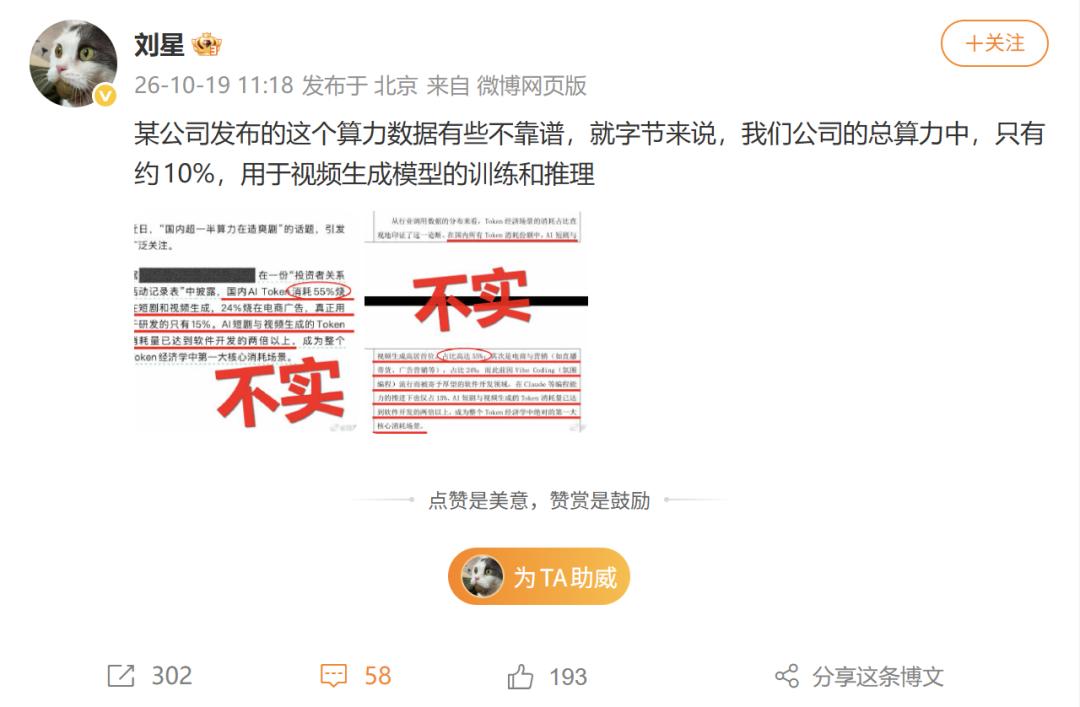
On October 19, Liu Xing, head of public relations at Doubao, publicly questioned that this set of data is not very reliable. He revealed that of ByteDance's total computing power, only about 10% is used for the training and reasoning of video generation models.
According to the verification of *NoNoise*, the information cited from Chinese Online itself also has many doubtful points.
First of all, the data source is difficult to verify, and the statistical scope is not comparable.
Chinese Online mentioned in the *Investor Relations Activity Record* that this set of figures comes from "industry call data", but did not further disclose the specific data source, statistical scope and method. No national industry statistical data that can independently verify this conclusion has been found in public channels so far.

And there is no clear original source for the U.S. data either.
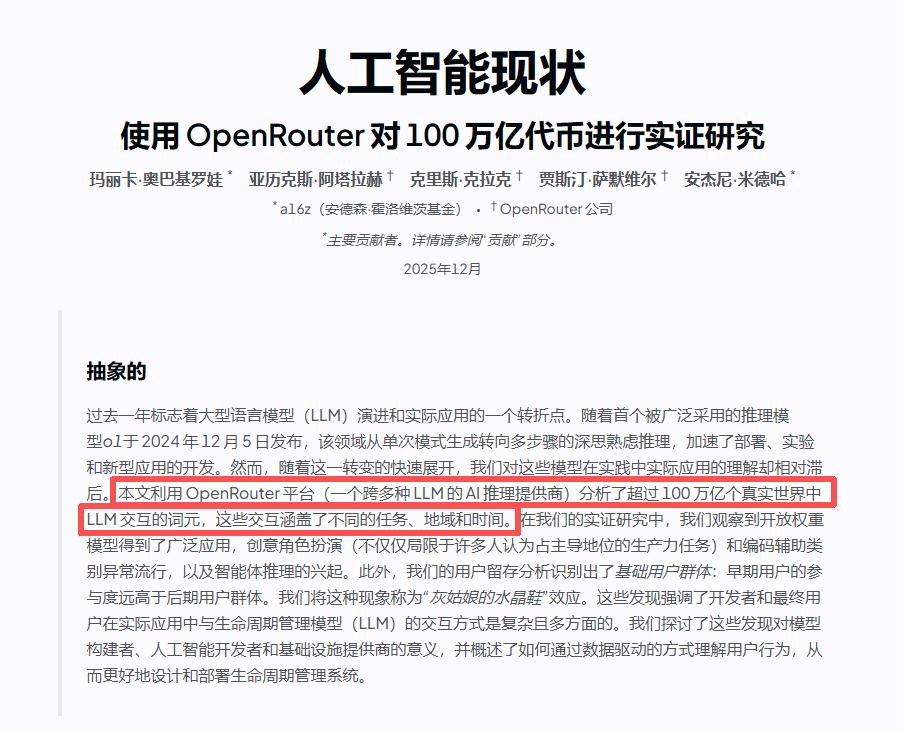
*NoNoise* found through review that in December last year, a set of similar figures appeared in the *State of AI* report jointly released by OpenRouter, an AI model API aggregation platform, and a16z, a U.S. venture capital firm.
The report analyzed Token usage of more than 100 trillion large language model interactions. At the end of 2025, programming and technology-related Token consumption of OpenAI models on the OpenRouter platform each accounted for 29%, adding up to exactly 58%.
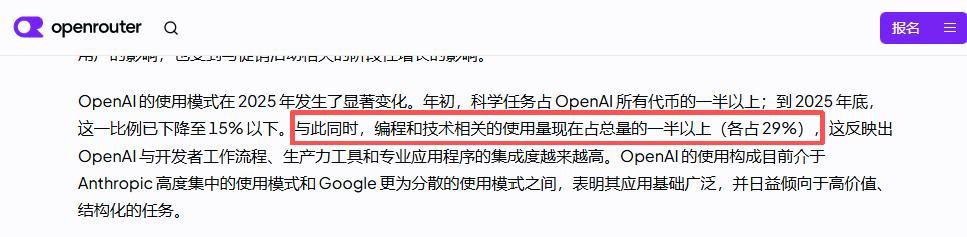
However, this data only reflects the usage of OpenAI models on the OpenRouter platform, not the overall AI usage in the United States. Moreover, the report only counted large language models and did not include the consumption of text-to-video models, which is not in the same statistical scope as the video generation data mentioned by Chinese Online.
Up to now, we have not found any Token consumption statistics that compare AI application scenarios in China and the United States according to unified standards.
Secondly, the country where a model is developed does not mean that the Tokens are consumed in that country. Chinese users may use overseas models such as ChatGPT and Claude, while U.S. users may also use Chinese models such as DeepSeek and Seedance.
This can be seen from the revenue structure of Chinese AI companies: at present, more than 60% of MiniMax's revenue comes from overseas, and about 70% of Keling AI's revenue comes from overseas.
In addition, the use of AI is scattered across different channels such as API calls, personal subscriptions, and on-premises enterprise deployments, making it difficult for third-party institutions to fully grasp these data.
Furthermore, although text and video Tokens share the same name, their measurement methods are not consistent. Even in some practical applications, the total number of Tokens processed by language models, especially multi-turn interactive Agents, may be larger than that of a single video generation task.
Therefore, simply adding up the two types of Tokens and judging the usage of different AI applications based on this is easy to mislead.
In that case, why can an unsubstantiated comparison of AI usage between China and the United States convince so many people?
Labeled AI in China and the United States
The exemplification theory in communication studies holds that when people judge complex issues, they are easily influenced by specific and vivid cases, and then use a few examples to infer the overall situation.
An AI short drama can spread rapidly on social media, while an AI Agent that greatly reduces cost and improves efficiency for a certain type of commercial work may not become a hot topic, so cognitive bias is more likely to form — the public opinion field tends to equate communication volume with industrial strength, and regard the most visible application as the most important application.
Since the beginning of this year, both the Chinese and U.S. AI markets have had sufficiently eye-catching cases.
In China, the average daily usage time of Hongguo Short Drama has exceeded that of Douyin and WeChat, forcing Tencent to re-bet on short dramas to seize users' attention. With the improvement of capabilities of video generation models such as Seedance, a large number of AI manhua dramas have emerged. The stereotyped "AI faces" have triggered the "uncanny valley effect" among audiences, and the templated line "it doesn't burn the heart" has become a popular internet meme.

In the United States, OpenAI shut down the once-sensational Sora, diverted more resources to programming and enterprise services, and competed with Anthropic. Sora was shut down not because it was not good enough, but precisely because it was highly capable and too cost-intensive. Watching Claude's programming capabilities drive Anthropic's ARR (Annual Recurring Revenue) to soar all the way, OpenAI naturally had to make trade-offs.
In the enterprise service market, the differences between China and the United States are also perceived by front-line entrepreneurs.
An entrepreneur who has been engaged in enterprise AI business in both China and the United States for many years told *NoNoise*, Compared with China, U.S. enterprise customers have stronger willingness to pay, and AI services are easier to form a sustainable business.
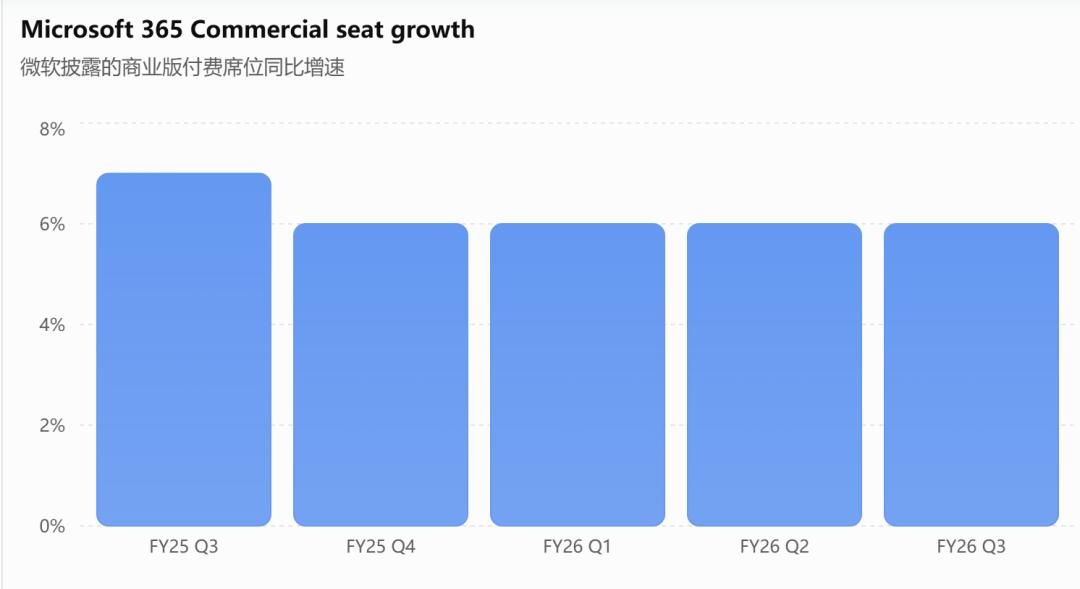
And these hot trends are also supported by corresponding data — enterprise business revenues of OpenAI and Anthropic account for 40% and 80% respectively, the number of paid seats for Microsoft's Microsoft 365 Copilot continues to rise, and U.S. software company Palantir has become the first AI commercialization stock relying on AI opportunities...
The thriving AI businesses in China and the United States are rooted in their respective industrial ecosystems.
In China, industries such as short videos, short dramas, and e-commerce marketing have long had huge demand for content production, which has given birth to a mature content industry and traffic distribution system. The commercialization mechanisms of short video platforms, short drama platforms, and live e-commerce are quite complete. The emergence of video generation models just meets the demand of these industries for cost reduction and efficiency improvement.
Most of the short drama practitioners we have recently contacted have shifted from live-action short dramas to AI short dramas, and e-commerce merchants are also using AI to batch produce and modify marketing materials to reduce costs and shorten the production cycle. Kuaishou's financial report shows that in the second quarter of this year, the placement consumption of AIGC short video marketing materials on the platform increased by more than 70% year-on-year.
In other words, the prevalence of AI short dramas is, to some extent, an extension of China's existing Internet industrial capabilities, and an inevitable result of the development of this industrial chain, but it is not the full embodiment of China's AI capabilities.
The commercialization of enterprise AI in the United States is also built on a mature system.
Companies such as Microsoft have long cultivated enterprises' payment habits of subscribing to software annually and purchasing by seat, and have established mature customer channels. After the arrival of AI, Microsoft embedded Copilot into the Office office system, Palantir connected AI to enterprises' original data and business systems, and Anthropic exported AI capabilities to enterprise customers through enterprise subscriptions and API services.
However, there are also intersections within the differences. Globally, AI video generation is by no means a niche business. According to Bloomberg, in September this year, the ARR of U.S. AI video company Runway has reached 200 million U.S. dollars, doubling within five months. Brands including Dolce & Gabbana are using its technology for advertising and marketing production.
Short dramas are not a unique preference of the Chinese market. PineDrama, ByteDance's overseas short drama application, has exceeded 100 million cumulative global downloads less than a year after its launch.
AI short dramas are not an original sin, and entertainment itself is not an original sin either. What is really worth asking is: when AI reduces the cost of content production to an unprecedented level, where will this efficiency improvement eventually flow?
If it enables more independent creators to have the ability to express themselves, and allows small teams to produce works that they could not afford in the past, then AI does expand the boundaries of creation.
But if it is mainly used to mass-produce content that better fits algorithm preferences, and compete for more user time at lower costs, then the productivity improvement brought by technology may be transformed into more efficient attention competition.
The uses of video models go far beyond that. Seedance has been used to produce multi-language product introductions, corporate training and other video content, and some enterprises are also exploring the use of video generation technology to synthesize robot training data and simulate extreme scenarios in autonomous driving.
Compared with complex commercial structures, it is obvious that people are more likely to remember several distinct labels.
Path Difference or Target Division?
A study released by Boston Consulting Group (BCG) in June this year pointed out that the United States, with its advantages in capital, talent and computing power, continues to invest in cutting-edge model R&D; while China pays more attention to the popularization of low-cost models and the diffusion of AI to the real economy.
Qi Ruifeng, co-founder of 01.AI and serial AI entrepreneur, introduced the concept of "Cost Play & Value Play" in an interview with *NoNoise*, that is, China tends to obtain revenue through low-cost and large-scale applications; while the United States tends to obtain revenue through high-value scenarios. This also explains why the two countries have different AI application forms, and why the same model capabilities may move towards different commercialization paths.
Of course, the focus of AI commercialization in the two countries