Total spending is close to 100 million yuan, and TV stations are setting off a boom in AI computing power procurement.
Two months ago, when *Entertainment Capital* reviewed the game of TV station carriage fee negotiations, it also mentioned that Gansu Satellite TV suspended its cable network carriage in four provinces including Heilongjiang, Jiangsu, Guangdong and Guangxi due to reduced financial support and mounting operational pressure. Shaanxi Radio and Television Network was even ordered by the court in the first instance to pay 70.19 million yuan in compensation for defaulting on the encrypted signal fees of CCTV channels 3, 5, 6, 8 and 16, and Star Satellite TV also ceased broadcasting quietly in May 2026. Several technology suppliers are jointly building the new infrastructure landscape of radio and television AI.
However, if you browse through government procurement websites and public resource trading platforms across the country, you will find another set of accounts showing that the radio and television system "dares to spend money".
According to statistics from *Entertainment Capital* on the recent bidding records of 259 radio and television, converged media and cultural tourism units across the country, among the 144 deduplicated records, there are at least 12 key projects involving the converged media technology base and digital intelligent upgrading, with a total procurement amount of 92.2849 million yuan. Among them, the 7 projects with a high proportion of "AI" related content in the announcement documents total 17.3486 million yuan.
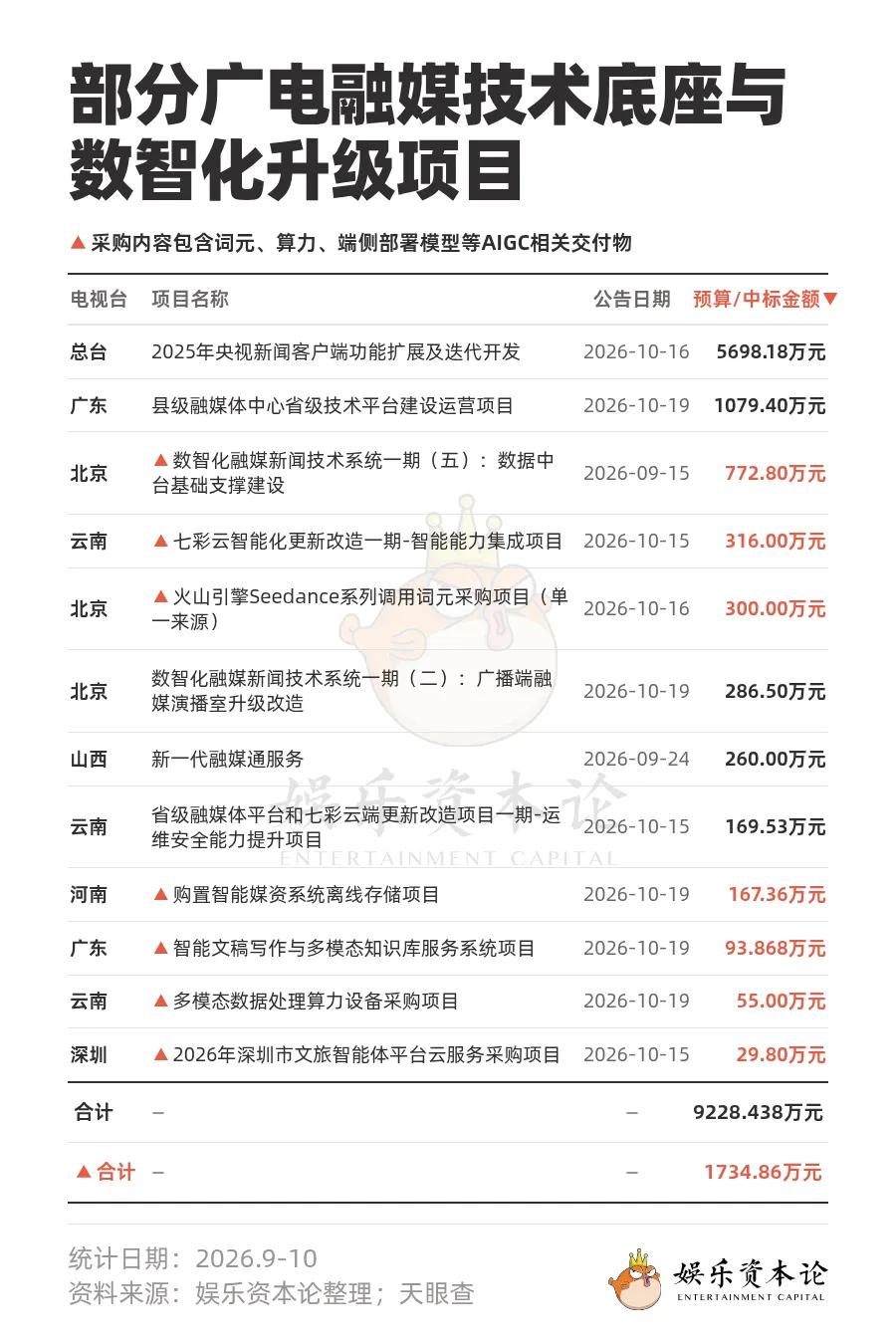
The most notable order comes from the procurement of "tokens".
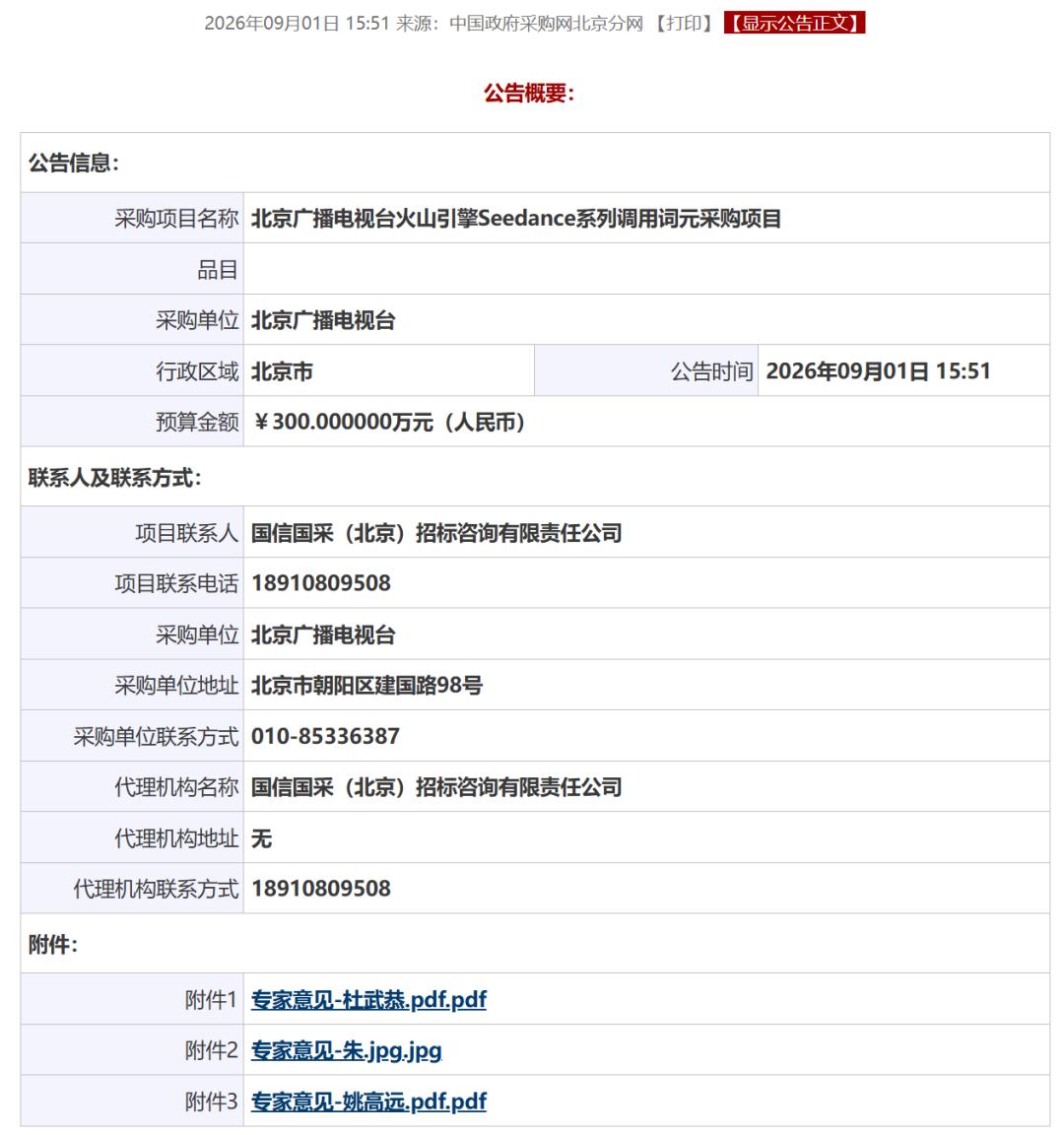
According to the contract announcement released by the Beijing Municipal Government Procurement Network in October 2026 and the previous transaction result announcement on the Beijing Public Resources Trading Platform, Beijing Media Network did not conduct public bidding, and directly purchased 3 million yuan worth of Seedance series video generation large model call tokens from Volcano Engine, a subsidiary of ByteDance, through a single-source procurement method. The contract performance period is 12 months, and the agency service fee is 29,450 yuan.
This procurement wave has long spread beyond first-tier cities including Beijing, Shanghai, Guangzhou, and strong media provinces such as Sichuan and Hunan, and extended all the way to the southwest border area like Yunnan. Even under the condition of capital shortage, traditional TV stations are still queuing up to spend millions of yuan on tokens and intelligent agent services, which shows that traditional TV stations are intensively looking for AI transformation paths, and the trend has shifted from "buying hardware and building systems" in the early days of DeepSeek to "purchasing call volume on an annual basis".
Now let's take a look at where TV stations actually spend their money, and which suppliers are taking over the market share that originally belonged to traditional radio and television system integrators.
3 million yuan to Volcano Engine can produce 67-150 hours of 4K video
In the spring of 2024, when *Entertainment Capital* reviewed the AIGC boom in the radio and television industry at that time, it wrote that TV stations across the country were competing for the title of "the first in the country", starting with mobilization meetings and the establishment of special studios. At that time, most of the generated images only stayed at the stage of simple scaling and displacement of static pictures. Adding AI creation watermarks and placing not-so-natural digital human anchors was enough to make TV stations hit the hot search list.
By the second half of 2026, the fanfare of promotion has faded, replaced by solid industrial applications. Different from the trend of purchasing all-in-one machines, self-owned computing hardware and self-deployment after the release of DeepSeek, purchasing tokens means that AI has changed from a one-off "project" to a monthly billed "utility bill", becoming a continuous expense, which means AI investment will be normalized.
One-off purchased hardware can deploy text models such as DeepSeek to help write copy, and run simple image generation models, but it absolutely cannot support industrial-level video generation tasks. Therefore, the AI budget of radio and television media has to shift from one-off hardware construction to API subscription.
On August 31, the Ministry of Industry and Information Technology's *Notice on Launching the Special Action for Cultivating Artificial Intelligence Application Service Providers* mentioned "exploring to increase the procurement of services such as large models, intelligent agents and tokens through modes including first-purchase and first-use, risk compensation and other methods". The next day, Beijing Media Network publicized the above procurement.

AI-generated image by *Entertainment Capital*
The latest version 2.5 of the Seedance model family procured this time was just released on June 23, and was put into large-scale external service at the end of July. Only version 2.0 and above support the capabilities mentioned in the public notice such as multiple reference materials and native 4K. The description of "accommodating 15 materials at the same time as full references" in the public notice corresponds to the 2.0 version of the model, while Seedance 2.5 is upgraded to support 50 reference materials with a maximum duration of 30 seconds.
It can be inferred from public reports and industry rumors that Beijing Media Network intervened in the test at a very early stage of the release of the Seedance model. The 4K model of 2.5 has only opened trial access for enterprise users by the end of October, but it is rumored that 20 works are currently using this model, and the first "S-level IP work of satellite TV" will be broadcast as early as next month.
According to the current pricing formula of Volcano Ark for the Seedance series, a 5-second 4K clip costs between 27 yuan and 62 yuan (when reference videos are included), and 3 million yuan is equivalent to about 67-150 hours of 4K materials, not counting the failed attempts of generation. *Entertainment Capital* has recently conducted a horizontal evaluation on the distribution price of Seedance 2.5 videos with 720P resolution in different AI video canvas workstation products, which can be used as a reference.
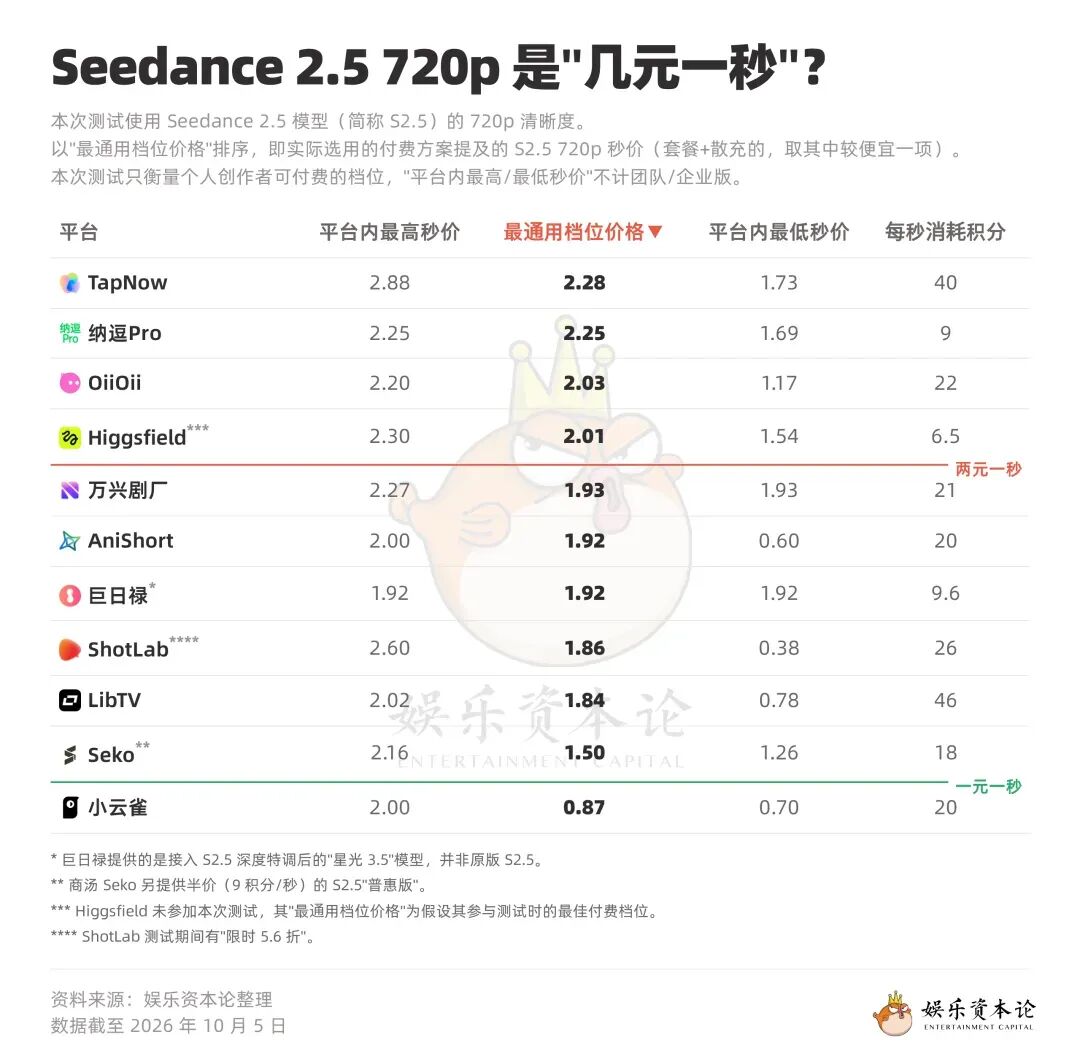
The reason for single-source procurement stated in the public notice is that "no other similar models have been found that can meet the above technical capabilities and production adaptation requirements at the same time", and Volcano Engine's service terms do not allow third-party resale, "the only legal supply subject is Volcano Engine".
This contract does not involve equipment procurement or software copyright transfer, but 12 months of call quota and a set of supporting services, including enterprise account opening, concurrency management, interface technical support, usage statistics, commercial authorization, after-sales guarantee, etc.
According to Volcano Engine's billing rules, the remaining tokens of the prepaid resource package will be automatically invalid after the validity period expires, and when the quota is exhausted within the validity period, it will automatically switch to pay-as-you-go post-payment. Therefore, it is impossible to expect this procurement to be "depreciated" and used for five or eight years.
According to the sorting out of industry media, in July, Sichuan TV's Sichuan Guancha reached a strategic cooperation with Volcano Engine, independently built an AIGC production platform, and purchased tokens worth tens of millions of yuan at one time. Volcano Engine opened the Seedance industrial-level API interface with concurrent carrying capacity of more than 400 channels for it, and connected more than 60 mainstream multimodal large models.
In April, Qingdao TV signed a contract with Volcano Engine, and released its own one-stop industrial creation and production platform for AI short dramas and manhua "Qingying Qingdrama" on April 23. By May, the daily token consumption of the "Qingying Qingdrama" platform had exceeded 2.8 billion, with more than 650 enterprises and teams registered for use.
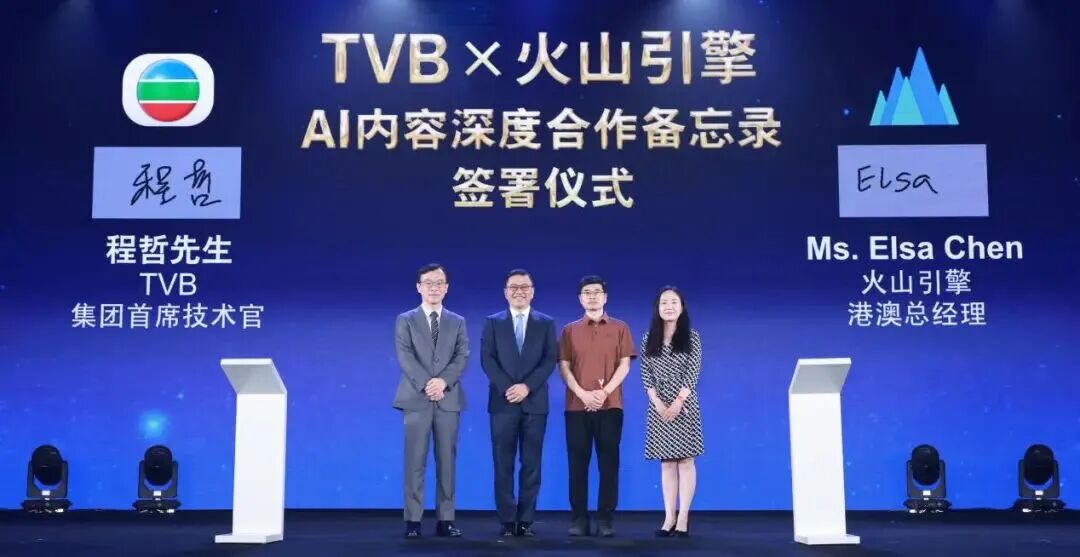
In June, Hong Kong Television Broadcasts Limited (TVB) also integrated Seedance 2.0 into its FF Studio to carry out AI short drama cooperation, and the short dramas produced will also be launched on Hongguo Drama simultaneously.
In fact, Volcano Engine's largest order is outside the TV station. ByteDance's joint venture won the bid for the "Hengdian Film and Television AI Service Platform Construction Project" of Dongyang Data Resources Co., Ltd. with 230 million yuan on October 13, with a budget of 235 million yuan. *Entertainment Capital* has written about this project last week, and the bidding documents require no less than 50 billion tokens for the pre-trained dataset.
As for Guizhou Radio and Television Network Media Group also signed a cooperation framework agreement with Volcano Engine on August 27, as a channel provider, Guizhou Radio and Television Group has a computing power infrastructure named "Guizhou Large Model Aggregation Comprehensive Service Platform", which is essentially a distribution contract for ByteDance's models to "connect to local businesses".
According to official data from ByteDance, driven by Seedance, the total daily average API token call volume of all ByteDance/Doubao large models reached 120 trillion in March, and exceeded 180 trillion in June.
Yunnan TV has the most intensive procurement actions within a week
If the media in Beijing, Sichuan, Qingdao and Hong Kong are generous because of their relatively solid financial foundation, this province in the southwest border will definitely surprise you.
Among the recent bidding lists monitored by *Entertainment Capital*, the single-province buyer with the most intensive procurement actions is Yunnan TV.
In just 6 days, Yunnan TV intensively promoted 3 key projects, including the "Colorful Cloud Intelligent Upgrading and Transformation Phase I - Intelligent Capability Integration Project" which started public bidding on September 23 and opened bids on October 15 (the winning bid amount is 3.16 million yuan), the "Provincial Converged Media Platform and Colorful Cloud Upgrading and Transformation Project Phase I - Operation and Maintenance Security Capability Improvement Project" (the winning bid amount is 1.6953 million yuan) that opened bids on the same day, and the "Multimodal Data Processing Computing Power Equipment Procurement Project" with a budget of 550,000 yuan.
Why did Yunnan TV intensively invest money in the intelligent transformation of "Colorful Cloud" at this point in time? As mentioned above, in the early stage of AIGC deployment in radio and television stations across various provinces, many of them intensively purchased one-off facilities and equipment such as DeepSeek all-in-one machines and digital human solutions, which can be used for a long time after one procurement. However, the local AI hardware deployed in the early years has gradually reached the stage of secondary investment and maintenance such as configuration upgrading.
Looking through Yunnan TV's business structure in recent years, it is easy to understand that this procurement expense is driven by both grassroots converged media operation tasks and cross-border communication tasks.
According to the introduction of the All-China Journalists Association in 2022, Colorful Cloud undertakes the construction and support of more than 55 county (city and district) converged media centers across Yunnan province, 61 county-level converged media centers operate independently on the "Colorful Cloud" APP, and it also operates the "Lancang-Mekong Audio-Visual Matrix", which requires mutual translation and broadcast between Chinese and five languages including Vietnamese, Lao, Burmese, Cambodian and Thai.
In order to solve the hard problem of multilingual communication, on August 8, 2024, Yunnan TV once jointly established a new technology experiment center with Tencent Cloud and many other units, focusing on R&D of precise recognition of ethnic languages, virtual digital human "Little Colorful Cloud" and intelligent audio and video analysis; by June 2025, Yunnan TV released the overall framework of the "Lancang-Mekong Communication Center" for South Asia and Southeast Asia, taking the "Colorful Cloud" converged media command platform as the technical base.

Last February, Yunnan TV accurately stepped into the DeepSeek boom. The 3D digital human anchor "Little Colorful Cloud" of the "Colorful Cloud" client accessed DeepSeek-V3, which is called "the first officially DeepSeek-connected media application in Yunnan". By March, it had included office documents, contract documents and technical materials into the RAG category based on the V3 model, which means the large model can retrieve these materials and provide question-and-answer services.
As DeepSeek was optimized for domestic chips, the self-deployed platform base was further upgraded last October. The "Artificial Intelligence Computing Power Platform Phase I Construction Project" was concluded at 2.18 million yuan to "provide multimodal large model reasoning services for media businesses". Two H3C UniServer R5300 G6 servers, the so-called "AI large model reasoning nodes", were delivered, each costing 490,000 yuan.
However, there is a contrasting episode in this wave of intensive procurement of Yunnan TV.
The 3.16 million yuan software intelligent integration project and the 1.6953 million yuan operation and maintenance security project were successfully opened for bidding, but the small computing power hardware order with a budget of only 550,000 yuan has been repeatedly aborted.
According to the competitive negotiation records, this "Multimodal Data Processing Computing Power Equipment Procurement Project" needs to purchase deep learning non-linear editing workstations, AIGC creation and annotation workstations, AIGC display large screens, Wi-Fi 7 routers and three-layer network management switches. The first negotiation was aborted, and the second and third negotiations had to be launched in mid-October.
In the same monitoring cycle, the "Media Core Content Cataloging Service Project" of Beijing Media Network was also declared invalid, and only the 980,000 yuan audio cataloging project was retained on the same day, which was won by Beijing Zhongshi Ruide that once participated in drafting industry standards.
The procurement of tokens and computing power worth millions or tens of millions of yuan went through smoothly without hesitation; the workstations and large screens worth 550,000 yuan, even with the name of "AIGC", cannot find enough bidders. This reflects the real situation on the supply side of radio and television AI procurement: the budget for non-standard hardware projects is too small, while people are willing to spend a lot of money on "single-source procurement".