Physicists are stunned: a 500-page doctoral dissertation that required a full year of manual calculations only takes Opus 5.5 10 hours to complete.
After mathematics, physics has also begun to collapse.
Physics professor Emre Onur Kahya fed the quantum gravity derivation process that he spent a full year handwriting nearly 500 pages during his doctoral period to Claude Opus 5.5.
As a result, Opus 5.5 only took 10 hours to completely reproduce the entire calculation!
Not only that, it also wrote a 183-page detailed derivation note by the way, generated the LaTeX source code, and even found multiple calculation errors in Kahya's paper from years ago.
Fortunately, the final result had no errors.
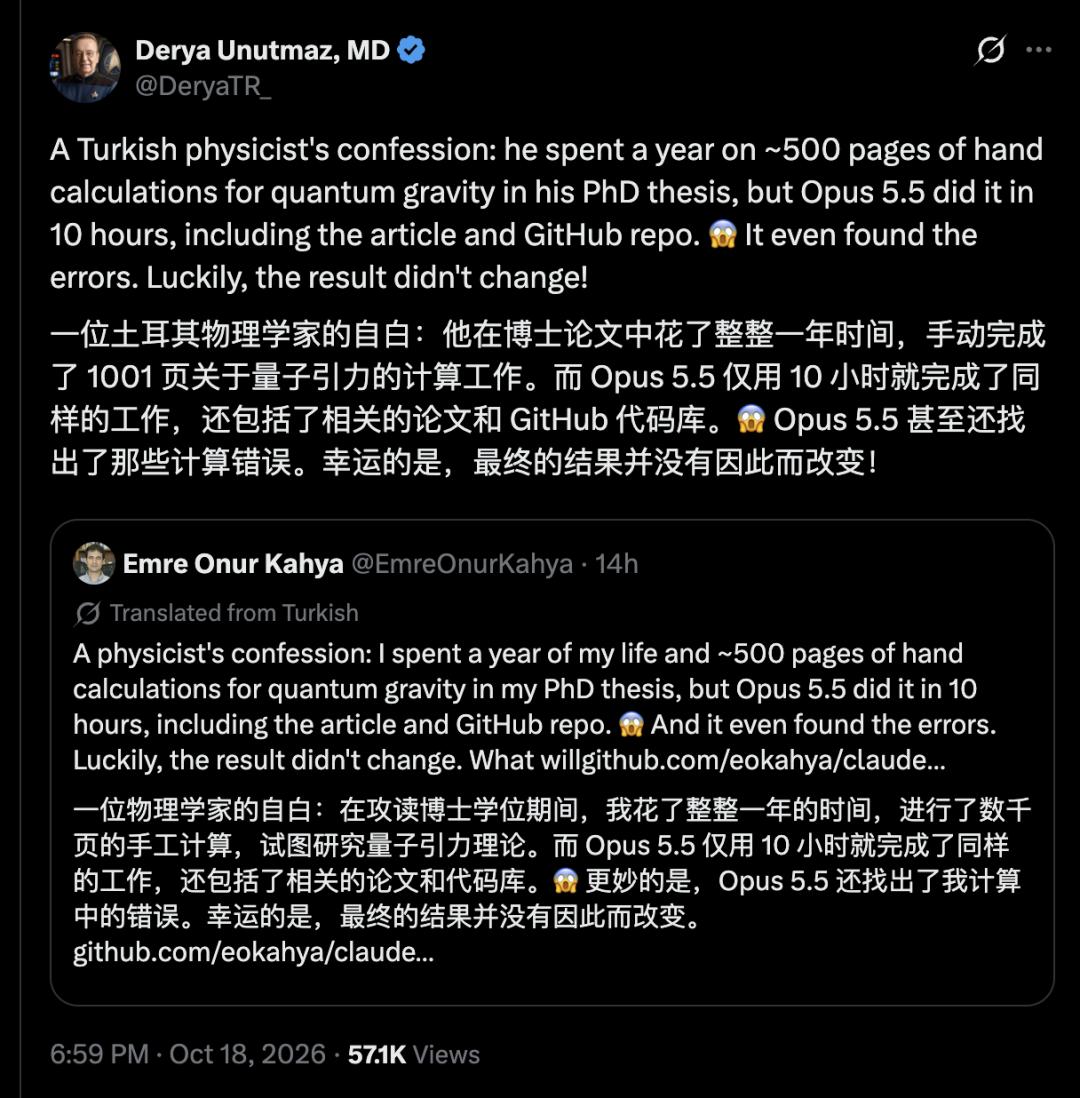
A human doctoral student spends a whole year on hard calculation, which is no match for 10 hours of AI running. Some people exclaimed: The monopoly position of knowledge-based professionals no longer exists!
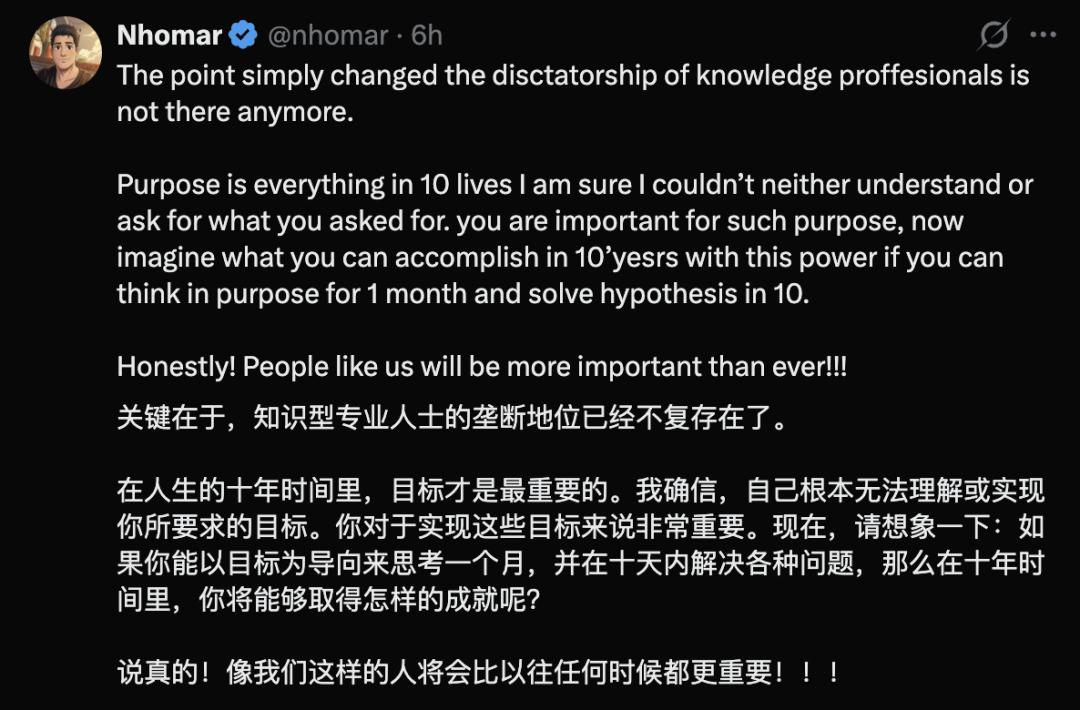
The physics community is about to face a major upheaval.
500 Pages of Youth and the Cruel Nature of Physics
Emre Onur Kahya, currently a professor at the Department of Physics Engineering of Istanbul Technical University, received his doctoral degree from the University of Florida in the United States in 2008.
The research direction of his doctoral dissertation is the correction effect of quantum gravity on scalar field equations during cosmic inflation, and he studied under the famous physicist Richard Woodard.
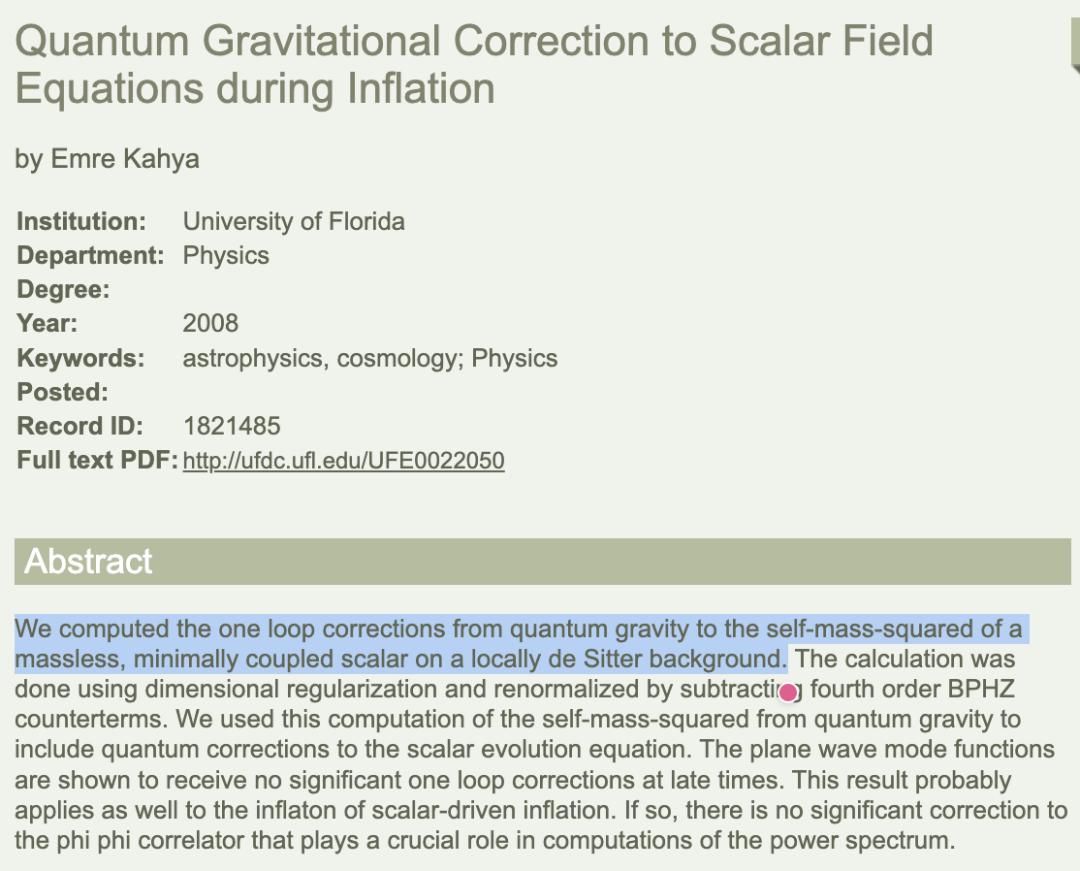
His research focuses on quantum field theory in curved spacetime, which sounds dizzying just by its name: "One-loop Quantum Gravity Correction to Scalar Self-Mass During the Inflationary Period".
In this scenario, spacetime is not flat, and gravity needs to be quantized. The expansion of every formula is accompanied by endless tensor algebra and Feynman diagram integrals.
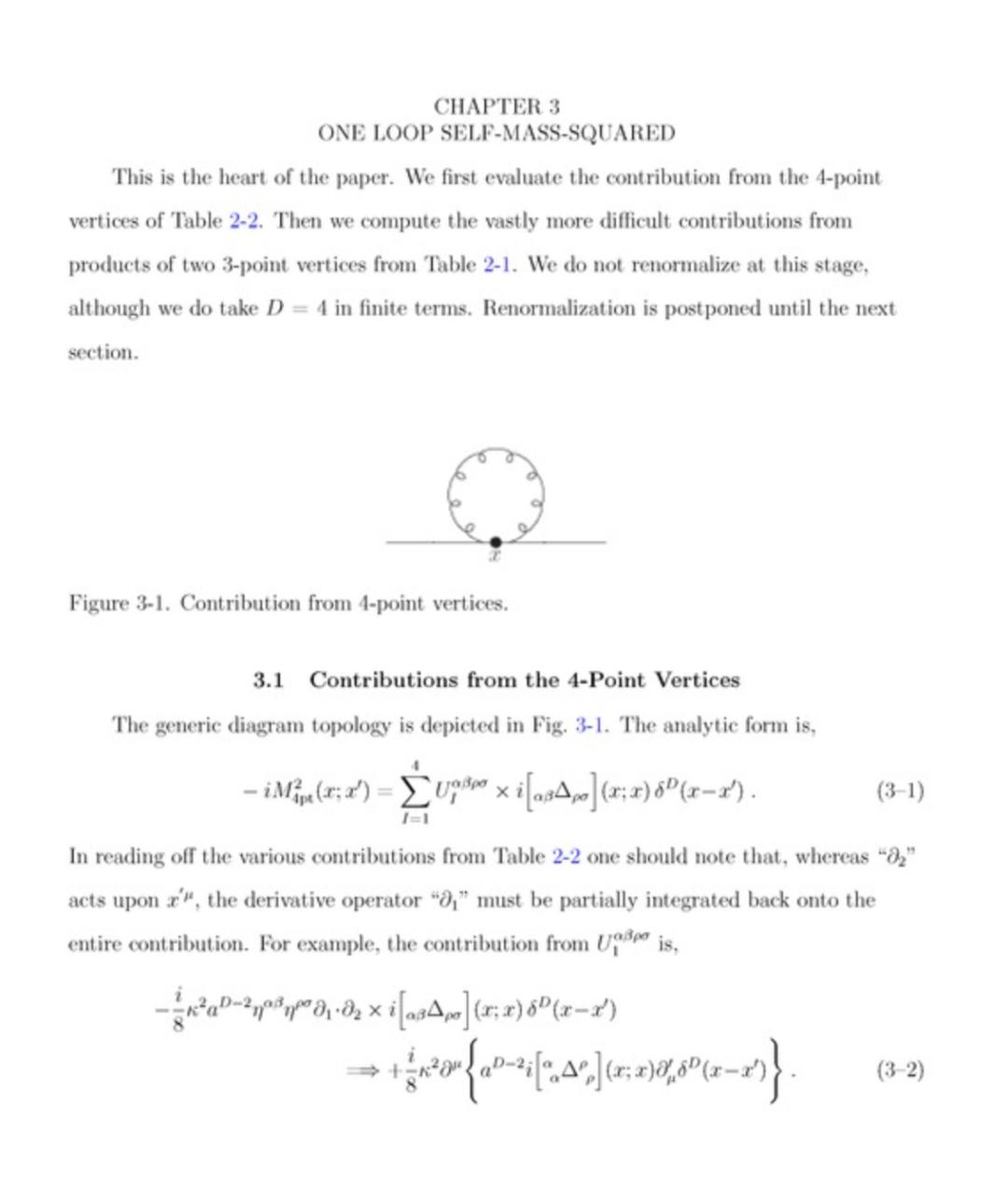
To calculate this "one-loop correction", Kahya needed to start from the most basic Feynman rules, handle divergence, perform renormalization, and calculate the late-time mode functions.

And there are no shortcuts here. You can only calculate step by step.
That whole year, his life was flooded with draft papers.
Nearly 500 pages of manual calculation process in total.
Every symbol, every integral upper limit, and every tiny correction term had to be deduced, recorded and checked by the human brain.
One wrong symbol could invalidate months of hard work completely.
That is the daily routine of theoretical physicists, and also the most brutal "physical labor" in the academic world.
They are ascetics of human beings exploring the truth of the universe.
Dimensionality Reduction Strike: The 10-Hour Miracle
At the beginning, when Kahya assigned this topic to Claude Opus 5.5, he might only be a little curious.
Quantum gravity, the pearl on the crown of physics, can AI handle it?
However, the operation of Opus 5.5 exceeded everyone's imagination.
It did not get stuck, did not generate hallucinations, and did not talk nonsense.
It works tirelessly, at a speed tens of thousands of times faster than humans, just like a super postdoctoral researcher.
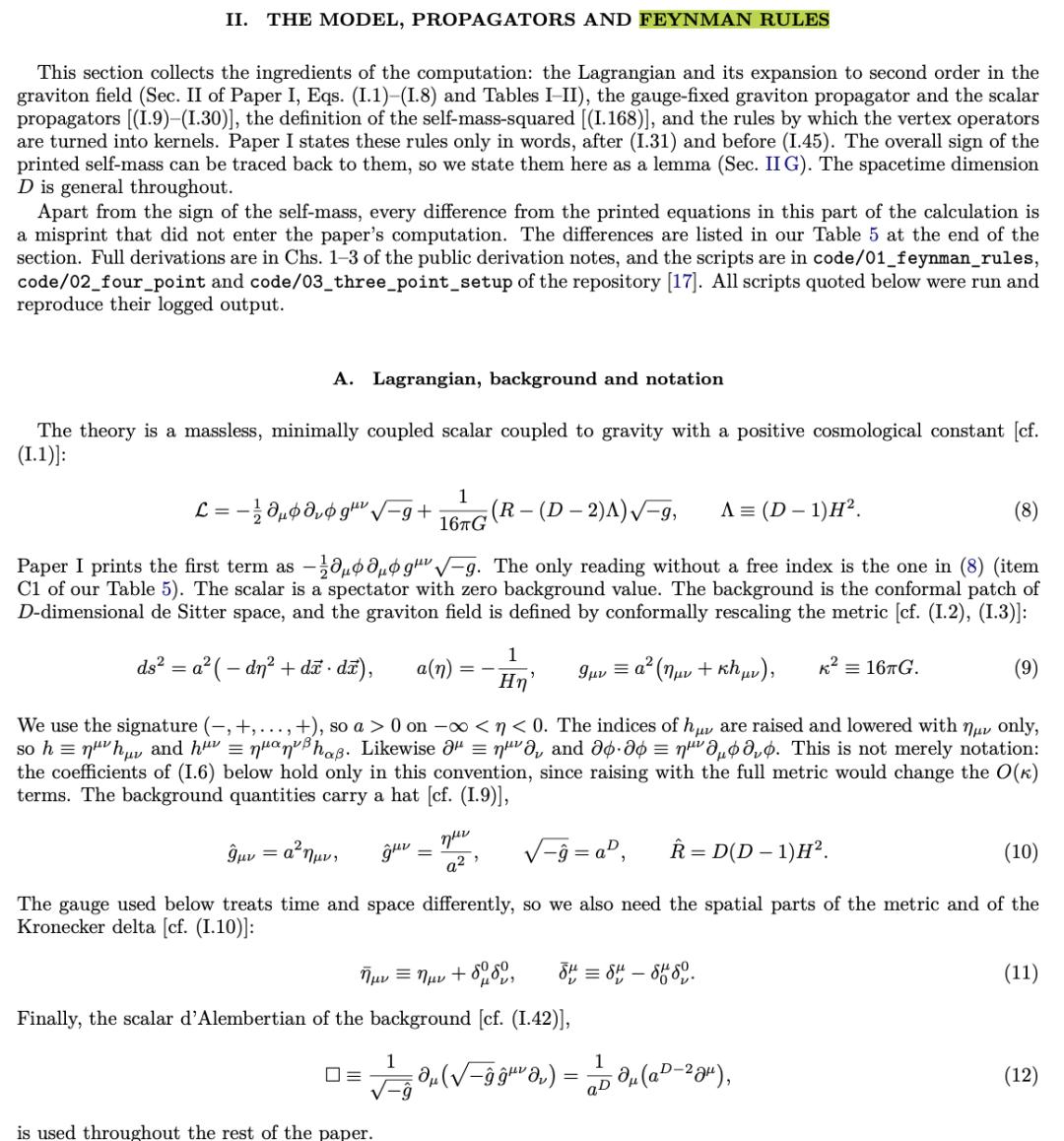
Step 1: Establish the rules.
The AI started directly from the Feynman rules. It clearly understood the background setting of curved spacetime.
Step 2: Hardcore derivation.
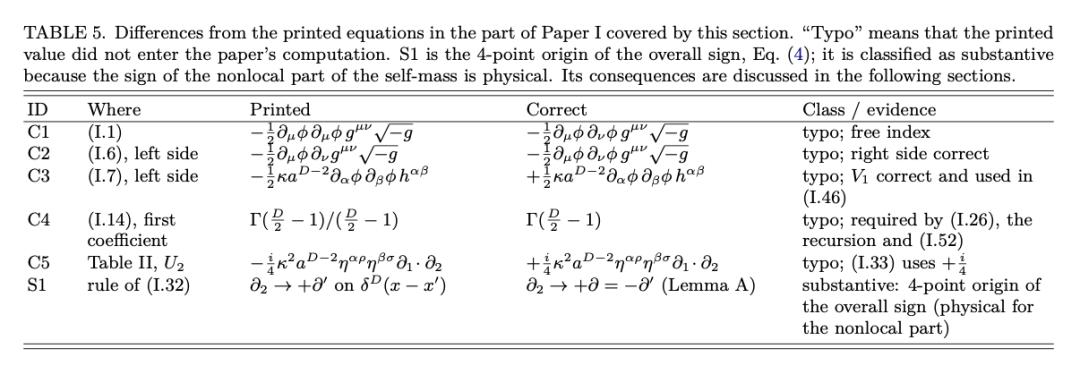
It began to reproduce Kahya's 500-page calculation. Tensor contraction, integral expansion, and separation of divergent terms. The AI moved forward step by step.
Step 3: Code verification.
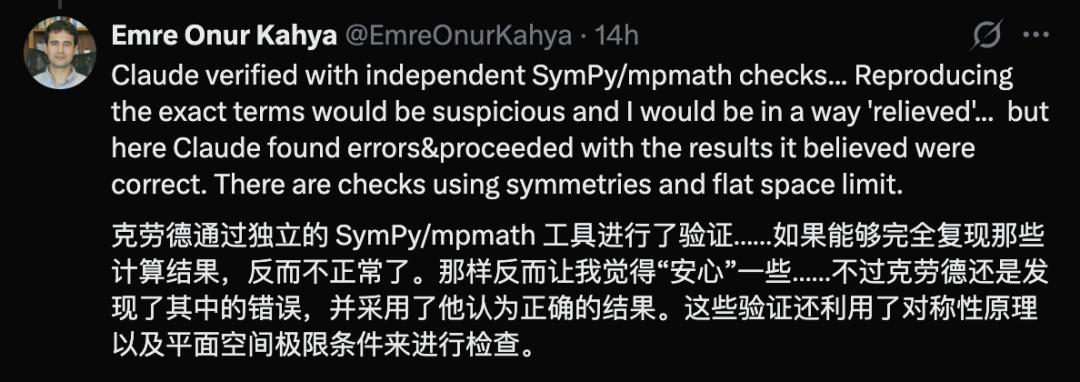
The most surprising part came. Opus 5.5 did not stop at symbolic derivation. It directly called two powerful mathematical libraries, SymPy and mpmath, and performed a total of 38 reproducible numerical verifications.
Symbolic derivation combined with numerical verification forms a flawless closed loop.
10 hours later, the screen stopped scrolling.
Opus 5.5 submitted its result.
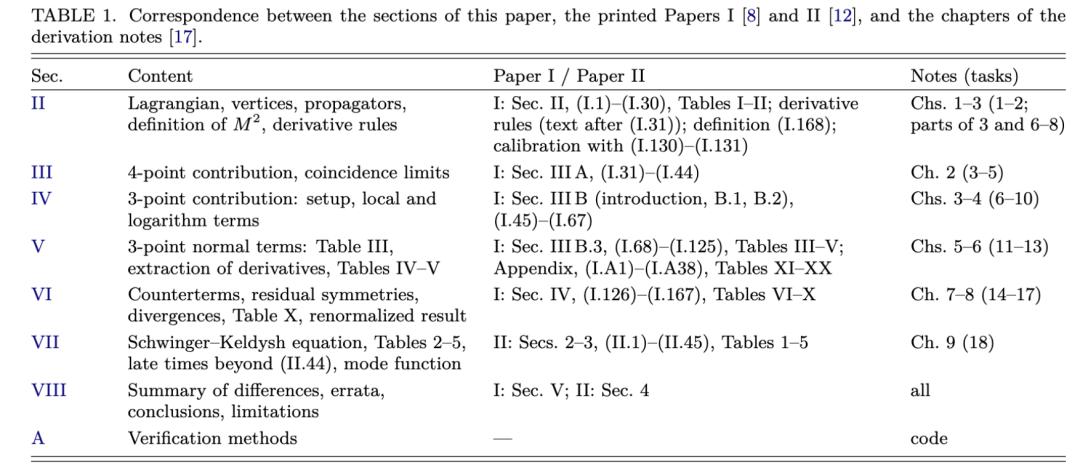
It did not output a bunch of messy results, but delivered a very complete set of academic assets:
A 183-page detailed derivation note.
Complete LaTeX source code of the paper.
All verification code scripts.
A detailed "error discovery list".
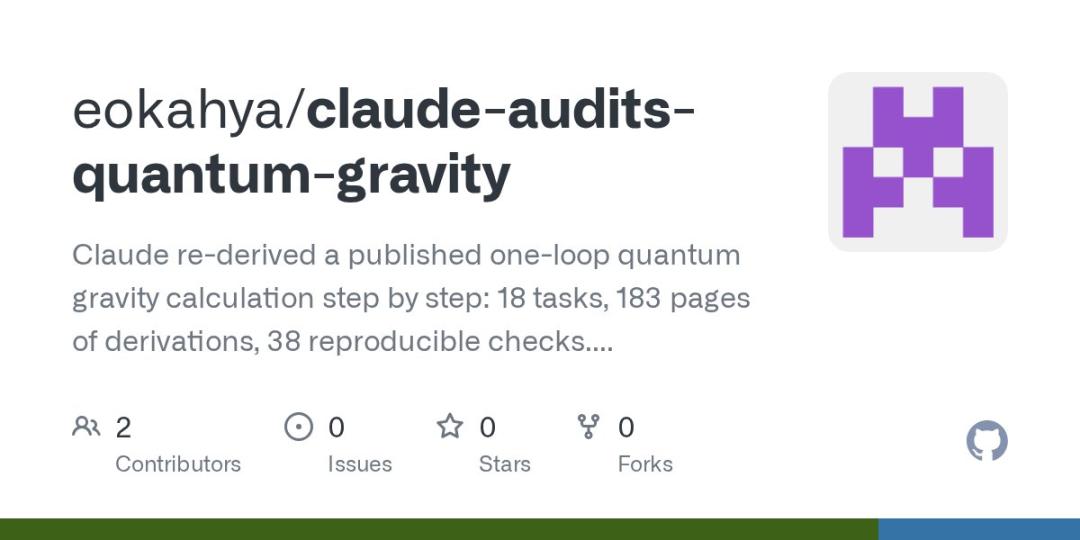
Link: https://github.com/eokahya/claude-audits-quantum-gravity/
1 year for humans, 10 hours for AI, the research efficiency has increased by 876 times.
AI's Critical Strike: "You Made a Miscalculation, But the Conclusion Still Holds"
For a scholar, the most shocking thing is not how fast AI can calculate.
It is AI telling you: The doctoral dissertation you were proud of back then had miscalculations.
Opening the "error discovery list", Kahya saw a very glaring fact. When auditing the 500-page manuscript, Opus 5.5 mercilessly pointed out many critical flaws.
1. Overall sign error.
This is the most common and most fatal mistake in physics calculations. Once the positive and negative signs are reversed, the physical meaning may be completely reversed.
2. Missing non-analytical terms.
In complex expansions, the human brain tends to ignore those tiny non-analytical terms, but the AI's logical chain is impeccable.
3. Constant errors and a large number of clerical errors.
During a full year of manual calculation, people will get tired and their attention will be scattered. It is inevitable to copy a wrong constant or write a wrong subscript.
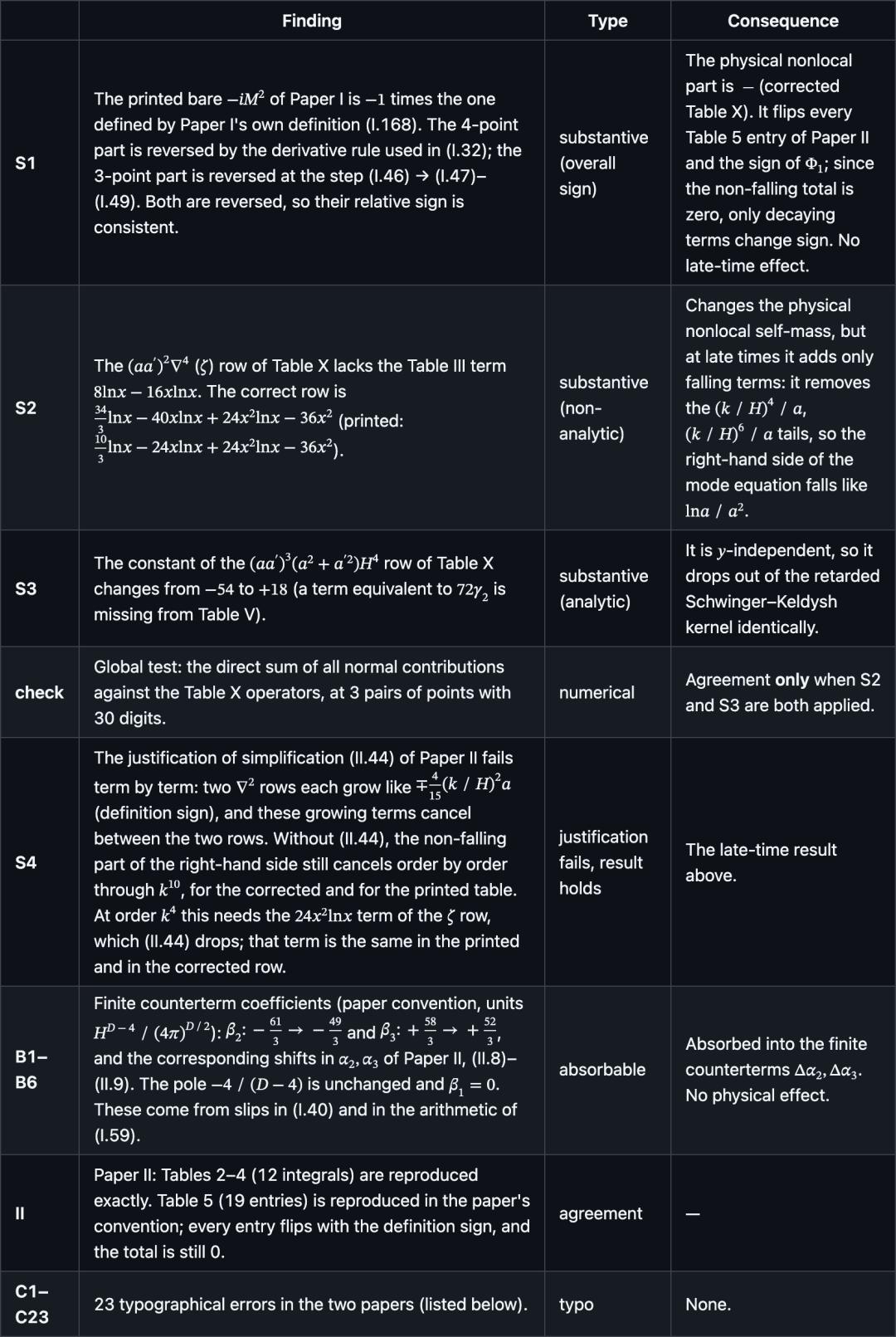
AI marked these errors one by one with extremely cold precision.
But the wonderful thing about physics lies in its robustness.
After correcting all these errors in signs, constants and non-analytical terms, Opus 5.5 recalculated the final result.
A miracle happened. The core physical conclusion remained unchanged.
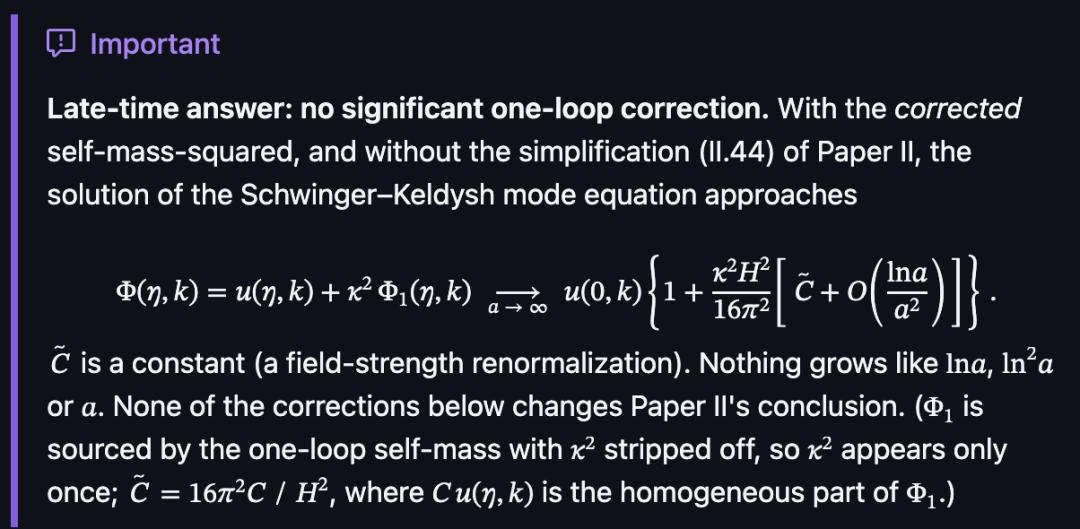
The late-time scalar mode function still has no significant one-loop correction.
It is an indescribable relief.
Kahya's physical intuition was correct, and the general direction was right.
But on the muddy path to the truth, he stumbled a few times and deviated a few steps.
And now, AI has turned this muddy path into a highway with a bulldozer.
"Existential Crisis": What on Earth Are We Doing?
This incident went viral on the Internet.
It is not only because of the huge gap between carbon-based intelligence and silicon-based intelligence, but also because of its symbolic meaning.
Kahya was outspoken on social media: "Opus 5.5 really makes people have an existential crisis."
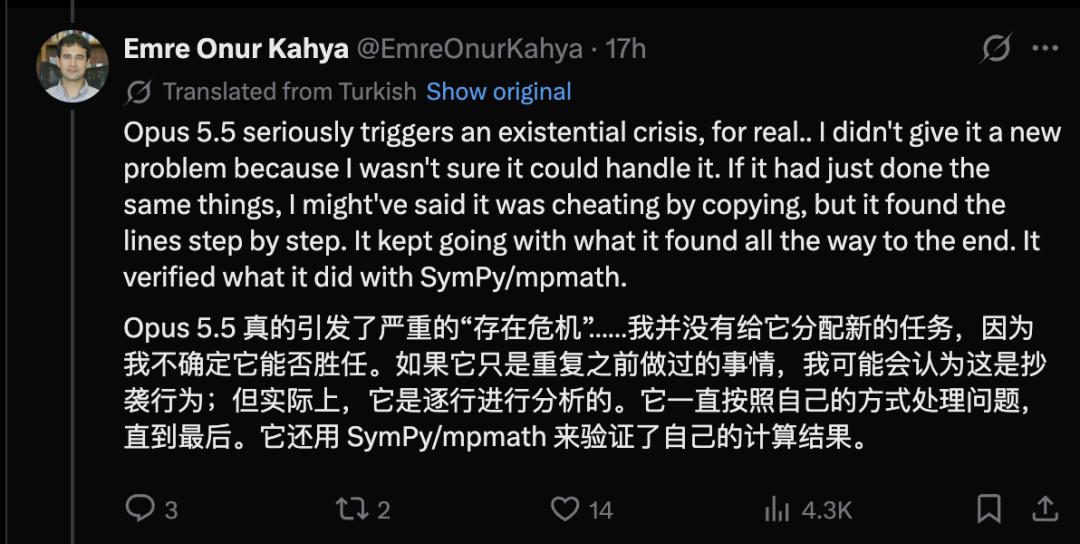
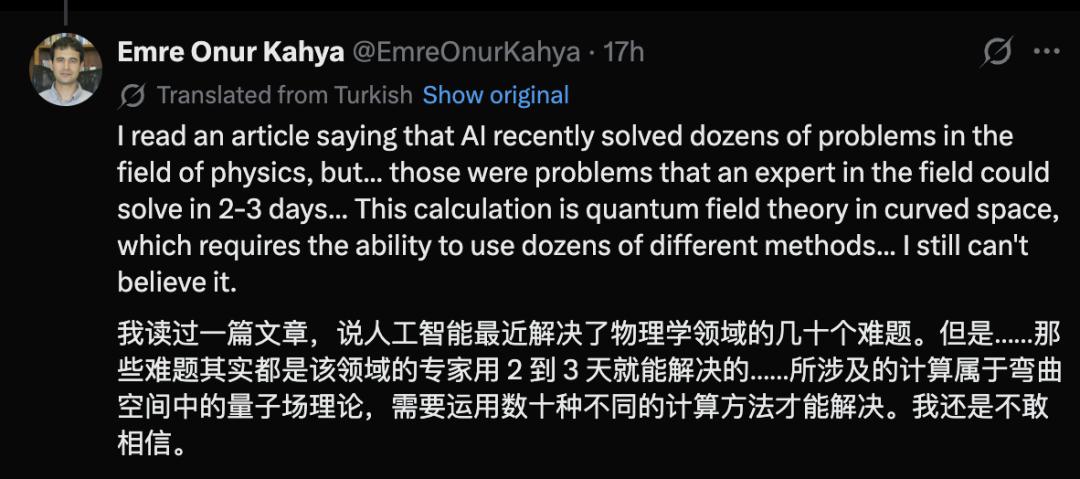
He emphasized a key point: This is by no means a simple after-school exercise, nor a problem that an expert can solve with a single shot.
This is quantum field theory in curved spacetime.
It requires the use of a variety of complex mathematical methods. It requires extremely high professional intuition. It used to be a restricted area that only a very small number of human elites could set foot in.
Now, the restricted area has been flattened.
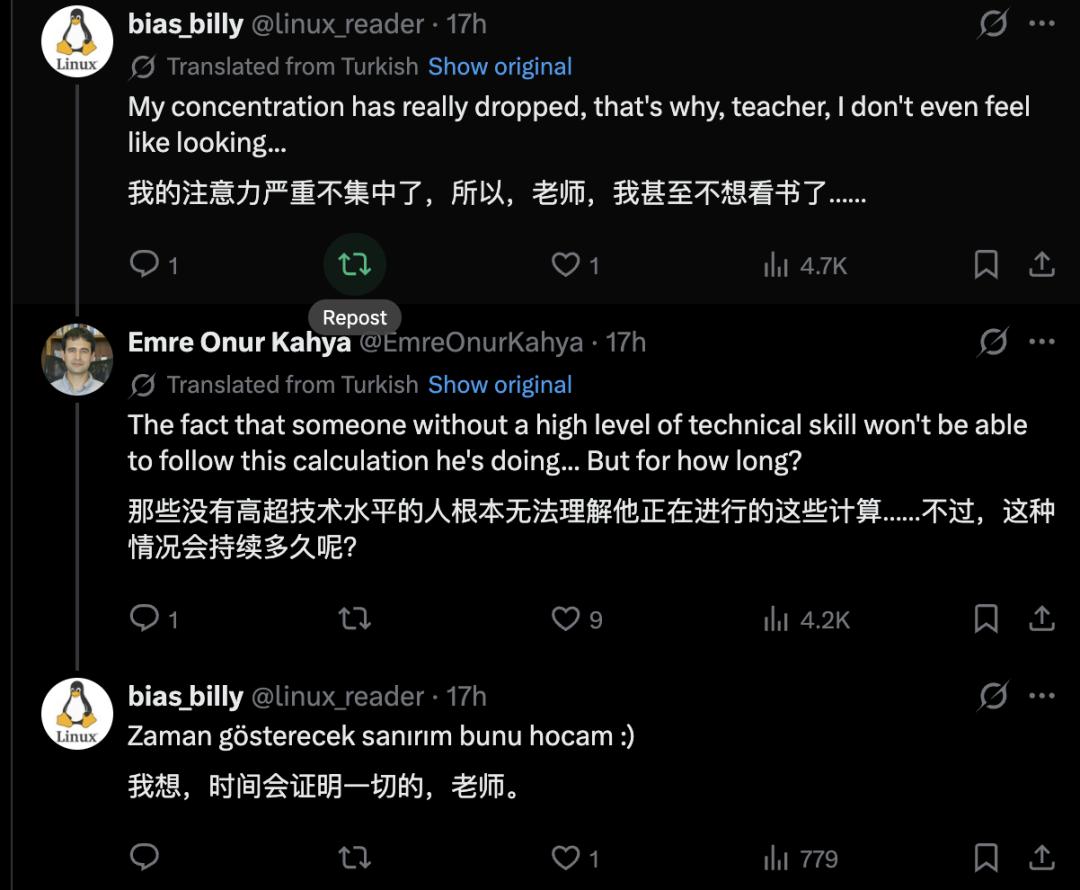
Now, theoretical physics graduate students, doctoral students, and even professors have to ask the same question:
If AI can perfectly and error-free complete the calculation work that takes me a year in 10 hours, what is the meaning of my existence?
For hundreds of years, breakthroughs in theoretical physics have often been accompanied by massive calculations.
From Kepler calculating the orbit of Mars, to Dirac deriving quantum mechanics, to the perturbation calculation of modern high-energy physics.
"Deriving formulas" is the basic skill of physicists, their muscle memory, and the stepping stone for them to obtain academic status.
Now, this skill has been hit by dimensionality reduction, just like the calculator eliminated the abacus, and the excavator eliminated the shovel.
Physicists suddenly found that the "shovel" they had polished for more than ten years had become scrap iron.
Kahya chose to embrace the future.
He directly packaged all the materials generated by Opus 5.5 into a GitHub repository (claude-audits-quantum-gravity), including the AI-generated derivation notes, the list of discovered errors, and all the