In China's internet sector, Tencent is the only remaining player that can put up a real fight against ByteDance.
Some people say that China's internet industry is entering the "ByteDance Era".
According to QuestMobile data, in the ranking of monthly usage duration of top 50 domestic apps in August 2026, the total duration share of ByteDance's product ecosystem has reached 41.8%, while Tencent's share has dropped to 28.6%.
Just a year ago, the gap between the two sides was only 3.3 percentage points, but now it has widened to 13.2 percentage points.
The daily active users of its independent short drama app Hongguo have exceeded 168 million, a year-on-year increase of 107%, surpassing the sum of daily active users of the four long video platforms Tencent Video, iQiyi, Youku and Mango TV; the average daily usage duration per user is about 125 minutes, even exceeding that of the two national-level apps Douyin and WeChat.
The divergence at the revenue level is equally drastic.
The latest data disclosed by The Information shows that in the first half of 2026, ByteDance's revenue was about 120 billion US dollars, a year-on-year increase of 30%. In the same period, Alibaba's revenue was 75.3 billion US dollars and Tencent's was 59 billion US dollars, totaling 134.3 billion US dollars. ByteDance's revenue alone is already close to the sum of Tencent and Alibaba.
On the other hand, other giants such as Baidu, NetEase, Meituan, Kuaishou... have either shifted their focus to AI, leading to a decline in their main business, or deeply cultivated vertical tracks, giving up the ambition of full-scale expansion... In short, the era of expansion marked by rapid market occupation and cross-border raids has come to an end.
When ByteDance breaks the boundaries of most tracks with algorithms and seizes users' time bit by bit, looking across China's internet industry, perhaps only Tencent has a full-track layout covering social media, content, games, e-commerce and other fields, as well as a basic traffic disk strong enough to compete with ByteDance.
But the positions of the two sides in the offensive and defensive competition have already swapped.
We have to admire ByteDance's outstanding strategy over the years: from the self-media era to short videos, then to large models and AI comic dramas, ByteDance has taken every step ahead of the industry trend, and firmly seized the opportunity to grow against the siege of other giants.
Looking at the current internet companies, apart from ByteDance, no other enterprise has the ability to bet on four nuclear-explosion-level apps in advance for four consecutive times. Only ByteDance has successively created Toutiao, Doubao and Hongguo.
The situation of a hundred schools of thought contending is hardly possible to reappear. For China's internet innovation, this is actually a regrettable thing. Now ByteDance has grown into the tallest towering tree in the whole forest, but we should not just indulge in the narrative that the dragon slayer eventually becomes the evil dragon.
What is more noteworthy is that the competition model that giants used to rely on investment and mergers and acquisitions of subordinate enterprises to "arrange troops and deploy formations" has been completely abandoned. The "benevolent big brothers" have all started to fight in person for a better tomorrow, but only ByteDance and Tencent are left that can launch full-scale competition in person.
From "Diplomatic Offensive" to "Head-on Fierce Competition"
In fact, in the early stage of the mobile internet dividend explosion, giants usually did not enter a new track in person when competing for it, but took capital as the link to enter the new track through investment, firmly holding their core basic disk, forming a chess game pattern of "the commander sits in the rear, and the subordinates charge at the front".
The most typical example is the AT war in those days.
Tencent focused on social media, Alibaba focused on e-commerce, and non-core tracks were handed over to invested enterprises. At that time, Tencent even made strategic investments in JD.com and Dianping. As for Alibaba, it handed over the social media sector to Weibo, Momo and Qupai. In their heyday, the capital maps of both sides covered e-commerce, food delivery, social media, pan-entertainment, finance, tourism, education... almost all segmented tracks.
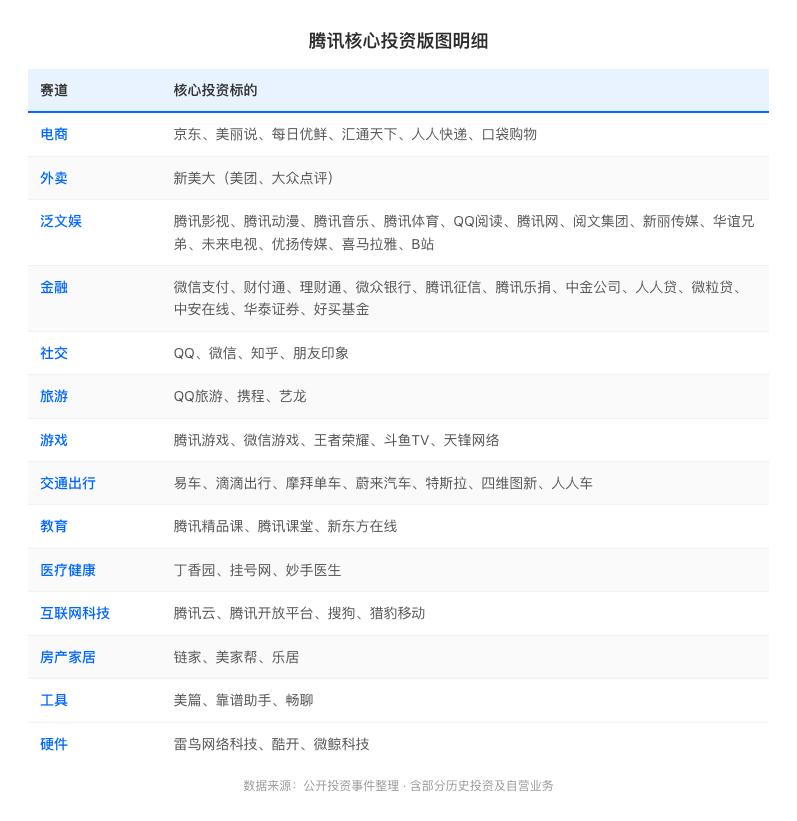
"Tencent's early lineup" —— Compiled and produced by the author team
This is the unique "romance" of the incremental era. As long as there are enough users, enough blank tracks and enough startups, capital can quickly occupy the market. But when this era passes, this strategy obviously no longer works. In the past two years, large internet companies have begun to control their capital output.
As early as 2023, data from IT Juzi showed that the total number of invested companies of the five major giants Tencent, Baidu, Alibaba, ByteDance and Meituan in the first half of 2023 was only 42, which was 1/3 of the same period of the previous year, with a year-on-year decrease of 66%.
At the end of the same year, according to the sorting out by reporters from Nanfang Metropolis Daily, the number of overseas investments made by seven internet enterprises including Tencent, Alibaba, ByteDance, Meituan, Xiaomi, Baidu and JD.com in 2023 was 113, 100 less than that in 2022.
In particular, Tencent, the "investment expert", had a maximum of 294 invested companies in history, but only 17 in the first half of 2023.
Alibaba's investment frequency is also very low, and it even rarely pays attention to the e-commerce retail industry that it is good at. After 2024, Alibaba once began to divest, and many enterprises including Intime Department Store, Grandbuy, Trendyol GO, Red Star Macalline, YTO Express, Sanjiang Shopping, Autjic Technology and Lingxi Games were sold or reduced their holdings by Alibaba.
The identity of the giants has changed from the benevolent big brother who made friends with heroes all over the world to the current state of running forward blindly alone, which only took a few years.
Why did this happen?
On the one hand, as the mobile internet has moved from the incremental era to the stock era, the logic of overseas investment has gradually collapsed. The old business model of "investing in a track and cultivating a unicorn" has almost disappeared. Small and medium-sized startups can hardly evolve into "dark horses" through traffic dividends, so the investment of large factories has naturally lost its basic significance.
More importantly, the trend-setting products that once supported half of the sky in the segmented tracks have encountered "crisis" one after another.
According to the *China Mobile Internet 2026 H1 Comprehensive Report*, the pattern of the mobile internet industry is accelerating differentiation. Among all industry apps, 28% of the industries are facing a year-on-year double decline in both user usage times and duration, such as automotive services, health and beauty, mobile social media and other industries, and 42% of the industries have a single decline in either usage times or duration.
On the other hand, after more than 20 years of development, the segmented tracks of China's internet industry have been basically filled, and almost all ToC fields have formed a pattern of head monopoly. The CR5 (concentration of top 5 enterprises) of industries such as e-commerce, food delivery, mobility, short videos, long videos, online literature, music, tools, office, medical care and education generally exceeds 80%.
There are no more industry trends in the tracks, so startups have no more growth stories, and large factories have lost the value of ecological investment accordingly.
Of course, the early strategy of "taking capital as chess pieces and traffic as moves" has one advantage:
Giants each hold their own basic disk, and the outcome will not hurt their own foundation. But in the ByteDance era, this giant began to enter the hinterland of other giants "without following the usual rules". Taking ByteDance and Tencent as an example, it is no secret that the two sides have entered each other's core business areas.
In the short video track, Douyin broke through Tencent's content defense line, forcing Tencent to develop Video Account in person; in the content track, Tomato Novels uses the free model to impact the paid system of China Literature; in the game track, Nuverse continues to erode Tencent's core game business; in the office track, Feishu is a direct competitor of WeCom...
In turn, Tencent has also begun to "pressurize" ByteDance everywhere:
As a rising star, Video Account is seizing the short video market, and its live streaming e-commerce business competes directly with Douyin E-commerce; while Hongguo dominates the short drama market, WeChat launched its own short drama app Lvpaopao... In short, you break into my core content field, and I will attack your e-commerce and short drama backyard. The front lines are intertwined, and there are head-on confrontations everywhere.
Once upon a time, the arena of China's internet industry was an open chessboard.
Now the chessboard is removed, there is no boundary between the two sides of the game, replaced by a fierce fight for every inch of land. It seems to declare that the era of deploying troops and formations has come to an end, and every war in the future will be a close hand-to-hand combat with no way to retreat. After turning this page, the background color of the next chapter of China's internet industry is destined to be more cruel than before.
Short Drama Becomes the New Battle Point
Perhaps, in this context, the launch of Lvpaopao appears particularly significant.
Admittedly, this is not Tencent's first layout in the short drama track, but it is definitely the most serious and formal attempt.
If we say that Tencent is the only player in the entire internet industry that can compete with ByteDance, then in the short drama industry, there is also only Tencent, especially the WeChat ecosystem. When short dramas first became popular, WeChat Mini Programs were the main playback channels. According to the report of *Science and Technology Innovation Board Daily* in December 2023, short dramas were broadcast on WeChat Mini Programs, accounting for about 80% of the total.
In other words, Tencent's ecosystem is naturally endowed with short drama genes.
Until 2026, although Hongguo is the dominant player in the short drama track, the monthly active users of WeChat short drama mini programs are still not to be underestimated.
According to the *2026 Short Drama Industry Insight Report* released by QuestMobile, the monthly active users of short drama mini programs in the WeChat ecosystem have reached 427 million, surpassing the total 335 million of all independent short drama apps; the number of short drama mini programs with monthly active users exceeding 1 million has also increased from 32 to 54. Judging from the scale alone, WeChat Mini Programs seem to have left independent apps behind.
At the same time, ByteDance has Tomato Novels to "nurture" Hongguo, and Tencent also has China Literature and Official Accounts to provide IP resources for Lvpaopao.
On October 19, WeChat and Video Account jointly launched the incentive activity "Phase 1: Official Account Novel Adaptation Micro Short Drama".
As for the gameplay, ByteDance relies on its powerful algorithm strategy, while WeChat has a huge social relationship chain and high national popularity.
So far, Lvpaopao has performed well. Gray-scale data shows that the average viewing duration per user of Lvpaopao is about 5 times the industry average, and the retention rate is more than 2.5 times; the AI short drama *Yaya the Movie Queen* has exceeded 100 million views 3 days after launch, reaching more than 10 million users on both platforms.
If Lvpaopao can go further, a new ecological cycle will be born:
Users follow the updates of novels on China Literature; adapted short dramas are launched on Lvpaopao; the highlight clips of hit dramas naturally flow to Video Account; plot discussions, character topics and famous scene memes will be deposited in Moments and group chats, fission and ferment through the social chain, which in turn drives the playback volume of the dramas and the subscription volume of the original novels.
This is an ideal state that even ByteDance cannot match.
Of course, this interlocking ecological ideal is still a theoretical blueprint after all. Whether Lvpaopao can shake Hongguo's leading position in the industry is still an unknown answer.
It is particularly worth noting that the 427 million monthly active users of WeChat short dramas are scattered in countless mini programs. In February this year, the two largest platforms "Zhang Yang Drama" and "Jiuqi Theater" both had monthly active users of more than 50 million, and no single product can match Hongguo's more than 300 million monthly active users on the independent app side.
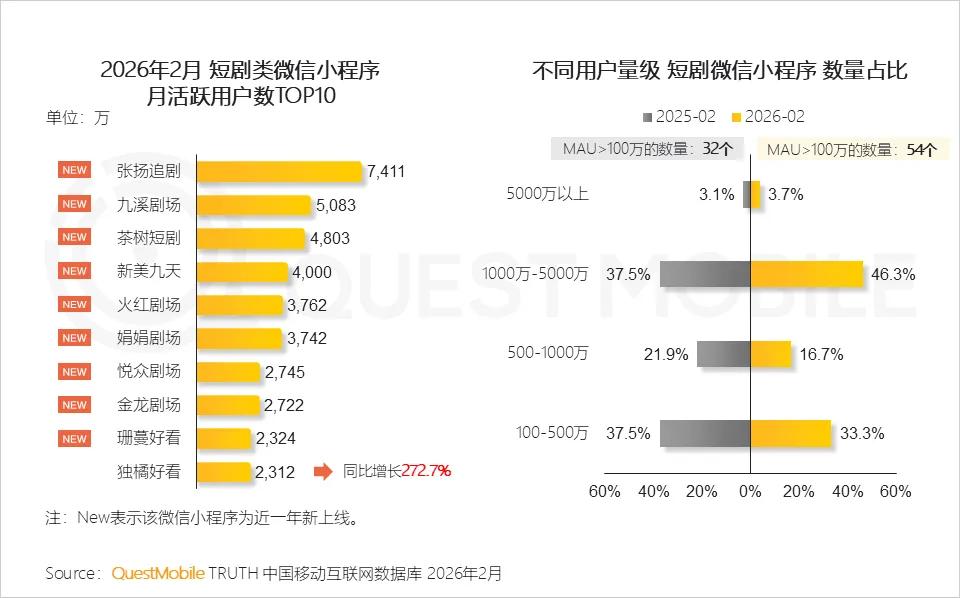
However, how to quickly gather the scattered traffic together is the first problem that Lvpaopao needs to solve.
In addition, shortly after the launch of Lvpaopao was announced, many media began to question it, and some media even said bluntly: Due to the different corporate tones, Tencent's development of Lvpaopao is "going against its own nature". But in any case, the confrontation between Lvpaopao and Hongguo is a necessary choice for Tencent, and it is also a landmark turning point for China's internet industry to officially enter the second half of stock competition.
For Tencent, the value of this counterattack does not lie in the competition for the short drama market, but in the foundation and future of the enterprise.
In the past year, ByteDance's ecosystem has eroded part of Tencent's user duration. The duration share of Tencent's top 50 apps has dropped from 31.9% in June 2025 to 29.7% in June 2026, while ByteDance's duration share has exceeded 40%. If Tencent does not take the initiative to attack, it is feared that ByteDance will continue to expand its control over users' time.
For the entire internet industry, users may not need too many short drama apps, but producers, creators and even a healthy internet ecosystem do need them.
It is undeniable that once Hongguo forms a monopoly in the track, it will most likely lower the content procurement price, extend the settlement period, compress the profit space of producers, and finally transmit the pressure layer by layer, forcing the content to slide towards low cost and homogenization. At present, low cost and homogenization have become the norm in the short drama industry.
A pattern of competition with multiple players will form a healthier industrial cycle.
Taking the initiative to enter the battlefield and attack is Tencent's unavoidable choice to defend its territory, and it is also the inevitable trend of the era when the increment of the entire internet industry has peaked.
No Final Ending
Back to the original question: Is Tencent really the only player in China's internet industry that can compete with ByteDance? The answer is yes. But this war is far from reaching the final outcome, and it is hard to say who will be the winner.
Although ByteDance's ecosystem has won a share of more than 40% in user duration and ranks first, if we look at the unique traffic of internet companies alone, the data in June 2026 shows that Tencent still ranks first, with unique traffic as high as 1.281 billion, followed by Alibaba with about 1.265 billion, and Douyin ranks third with about 1.259 billion.
This makes Tencent feel both happy and worried. The good news is that since the development of China's internet industry, the two traditional giants Tencent and Alibaba still rank first and second. Perhaps because the foundation is still solid, Tencent's marketing service revenue still increased by 22% to 43.6 billion yuan in the second quarter, becoming the main business with the fastest growth rate of the company.
The worrying part is that ByteDance's pursuit speed seems to be getting more and more fierce.
As for ByteDance, even though it has achieved brilliant results and its status in the internet industry is rising steadily, it is facing the dilemma of further monetization of traffic.
In September, *Jiemian News* and many