After securing $200 million in financing, Today AI answers ten core questions about Personal AI
Text by Deng Yongyi
Edited by Zhang Yuxin
In the past month, Personal AI products including Muse and Instinct have caused a global sensation and become the most high-profile AI entrepreneurship track. Among them, Muse surpassed 5 million downloads only 22 days after its launch — a milestone that ChatGPT took 56 days to reach back then, which has brought long-overdue recognition to the AI application track.
An AI company called Today AI may have started its exploration even earlier than Muse. Its founder Qi Junyuan once founded Teambition, and later took charge of various products at large tech firms including Alibaba and ByteDance. After forming the team earlier this year, Today AI has successively launched its international and domestic versions since September 9.
To put it in one sentence, what Today aims to build is a "personal assistant" for users. After users authorize Today to access their information and application data, Today will accumulate memories through continuous conversations, with the goal of becoming a universal assistant organized around "people" rather than tasks.
Compared with other Personal AI products, Today particularly emphasizes that AI assistants should "behave like humans". This insistence is reflected in every aspect of the product: users must give their AI assistant a name when registering; when interacting, Today has insisted on not dividing windows by tasks from the very beginning, and all interactions are completed in a single window.
Interestingly, many years ago when Qi Junyuan was still running his startup, Teambition also launched a product named "Today". He wrote at the product launch: "We hope it can know better than you all the things you need to do in a day, from trivial to-do items to important work tasks, from casual personal dates to formal company meetings, and even every article you need to read, then it will gently remind you what you should handle at the moment... Our expectation for it is very simple, that it should be easy enough to use."
Before Muse became a hit, many investors still considered this nothing more than a nice vision. But the Today AI team does not think so — in 2026, Claude Code and Cursor have proved that Agents can independently complete complex work in professional fields; many teams are focusing on model memory and context engineering and have made considerable breakthroughs. "One Agent that manages all your affairs" is no longer just an empty technical concept.
Today AI is the team's first real deliverable in response to this vision.
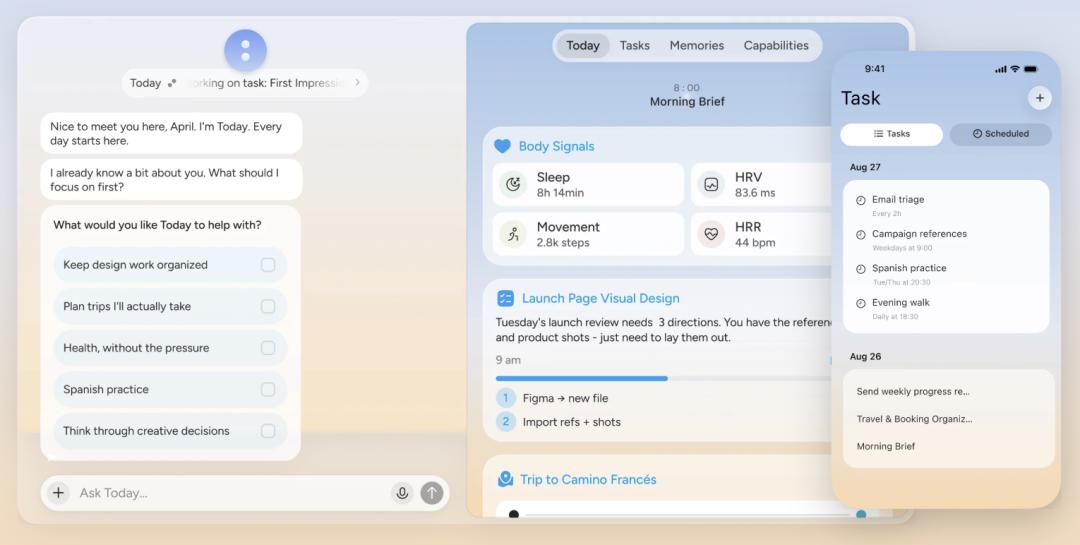
△Today AI product interface
On October 21, Today AI officially announced the completion of its first round of financing of over 200 million US dollars, with investors including IDG Capital, Tencent, 5Y Capital, Ant Group, HSG, Transsion Holdings, Tongge Venture Capital and Hanyuan Asset of Shanghai Jiao Tong University.
In the AI application circle, this is undoubtedly a remarkably large-scale investment. However, the Today AI team said that from day one, their vision is not only to build AI applications, but also to train models, so as to become a company fully born for "personalization" — by training its own interactive model, it can reduce the unit intelligence cost while making the product's tone, comprehension and execution ability closer to "a person who truly understands you".
This is a common trend among recent star AI application companies. On September 28, Manus also launched its Personal Agent product "Cue", and soon after announced a new round of financing of over 500 million US dollars. We learned that Manus is also training its own model.
Essentially, AI application companies and model companies are moving towards each other from two ends — application companies move upstream to train models to reduce unit intelligence cost, improve effect and gross profit; model companies also move downstream to build applications to find revenue outlets. As the capabilities required by both sides get closer and closer, the boundary between AI applications and models will naturally become increasingly blurred.
Another consideration for startups to raise large amounts of capital is that building Personal Agent not only requires training models, but also integrating services and ecosystems — which is by no means a smooth path for anyone.
In China, there have already been cases where AI mobile assistants were jointly blocked by various service providers for ride-hailing, shopping, food delivery and other services; while overseas, although the platform ecosystem is more decentralized, Personal AI also faces access barriers — on September 20, Amazon restricted Muse's access and shopping functions on its platform on the grounds that "unauthorized AI Agent" violated the terms of service.
For many AI application companies, 2026 is an exceptionally cold year no matter for new business directions or financing. This has made many Chinese-backed AI teams more determined in their choices, for example, putting their focus on overseas markets from day 1, and then deciding whether to enter the domestic market according to the situation.
In contrast, Today AI has adopted a bolder pace — it launched in the US region in September, followed by the domestic region two weeks later, and quickly supported platforms including Feishu, DingTalk, WeCom, and TickTick.
The Today AI team said this pace comes from their own judgment: early release itself is part of the competition, and popularity, growth and customer acquisition cannot wait until the product is "perfect enough".
"When it comes to Personal AI, startups definitely have their own battles to fight." They said. Although large tech firms have all entered this track, startups have the advantages of more concentrated talent density, faster decision-making, and the courage to place earlier and more aggressive bets on directions such as memory and initiative.
Recently, Intelligence Emergence had an in-depth exchange with the founding team of Today AI. While learning about the product, they also tried to ask the team to answer many questions that people have about Personal AI at the moment.
The following is the account of the Today AI team:
Is Personal AI a pseudo-demand?
After Today was launched, the most common voice we heard was that Personal AI is a pseudo-demand. But from a historical perspective, every round of technological development starts with a lot of doubts before it is gradually accepted, and the last Agent boom was no exception.
From our judgment, there is indeed incremental demand emerging in this round. In the past, all Agents were dealing with work-related things, but demands in daily life will definitely be covered eventually, and everyone may need an assistant.
Of course, it is still too early to draw the conclusion that we have reached a very mature PMF stage and users are already willing to pay for it — we are still verifying this ourselves. But we have no doubt about the demand itself.
The boom of Personal AI is highly related to Claude Code. Before Claude Code, the model's function call ability and instruction following ability were not sufficient, and the assistants made at that time had almost no generalization and were full of pre-set scenarios — they could not be personalized.
After Claude Code, Agent as a technology has been proven to be able to help with many things, and the model's capabilities are also being generalized.
The explosive popularity of Muse proved one thing: Personal AI can reach a large number of users in a short period of time. It exceeded 5 million downloads 22 days after launch, far exceeding the speed of ChatGPT back then — which greatly boosted the confidence of the entire track.
Muse also helped the market understand what Personal Agent really is. Before Muse, it was actually very difficult to explain to people what we meant by building an OS Agent in words. After Muse came out, people intuitively understood what Personal Agent looks like and what it can do.
We judge that the demand is real — what Personal Agent needs to handle are a large number of trivial, high-frequency things that everyone encounters every day. In the past, these things were scattered in various applications and dialog boxes, and no assistant could take full charge of them.
Apart from popularity, we think the most important thing is that download volume does not equal long-term value — whether a product is useful depends on whether users can continue to use it and stay retained, and whether context can be continuously accumulated. Whether users are still using it the next day, the next week, and the next month is the definition of being useful.
Long-term retention, the balance between initiative and disturbance, the boundary of privacy authorization, and the access of platform ecosystem are all common problems faced by the entire industry.
Without an independent App, it is difficult for users to perceive the value of Agent
To put it in one sentence: Today is your personal assistant.
Today is different from those task-centric office Agents, which start a new session for each task and archive it after the task is completed. We hope Today is like a person — you keep chatting with it in one dialog box, no need to open a new window for each task.
People's lives are continuous, and you have many important goals that require long-term companionship — learning, career growth, career planning. These are very difficult to achieve in task-centric products.
Back in March, we actually explored a direction similar to Instinct — it lives in IM and has no independent App. But we found two relatively big problems: First, without a GUI (graphical user interface), the guidance for users to explore the capabilities of Agent is very weak.
If you are an early adopter who is familiar with what such products can provide, you can certainly explore it on your own, but what we have always wanted to do is to target the mass market.
For ordinary people, the GUI at this stage is more like a map that can guide them to explore the maze of Agent full of treasures. Without an independent App, only IM and dialog boxes, users can hardly feel the difference between it and an ordinary chat assistant.
The second problem is that without a client, you cannot obtain some device permissions, and the capabilities of the Agent itself will also be limited.
After determining the form of independent App, we also need to figure out what the Agent should connect to. We quickly realized that if we want to build an OS Agent, we should not only serve a certain operating system, but connect all existing operating systems today.
More importantly behind this, we need to first figure out what problems users want to solve, and then choose the appropriate technical path. For example, helping me operate the mobile app is not my real demand, solving the travel problem is. Booking a flight ticket and helping me operate Ctrip are two different demands; booking tickets can be achieved in many ways, and there is no need to operate the Ctrip App on the mobile phone.
We should first figure out what users really want to do, and then choose the appropriate technical path, instead of redefining user demands for a certain technical path.
Therefore, Today is an OS Agent in terms of technical vision and principle, but the value delivered to users is Personal AI. Our device gateway has been designed to be scalable to more devices from the very beginning, not limited to PC, mobile phone or a certain operating system.
Build products and provide personalized services for the broadest group of users
When ordinary people face an Agent, they are actually facing a black box — they don't know what problems this Agent can solve, so they can't think of which problems they need to hand over to AI to solve.
Intentions should be generated by software, by Agent, not by people. Therefore, initiative is very important. The ideal state is that you are very proactive, based on your understanding of users, and accurately tell them that you can help them get things done, and you can really do it well.
Building products for ordinary people and the broadest user group is the direction we aligned on when Today was founded, and we have never wavered on this point.
Therefore, in product design, we want to make the Agent more like a human. For example, we have always insisted on single session, that is, only one dialog box.
In the past, many Agent products divided dialog boxes by tasks, which was actually a technical compromise when the context capability was limited — when there was too much context, immature engineering would definitely lead to confusion, and the model's attention would also be scattered.
But with the breakthrough of long-term memory and cross-session memory, we believe that in the future, Agent should be in the form of single session, so we have done a lot of engineering optimization: for example, using as small a model as possible, improving the density of Context information, reducing latency, designing a natural authorization process and profile display. And, by replying in separate bubbles to reduce the mechanical sense, to enhance the anthropomorphic feeling.
In many personal scenarios, users need to remember "which dialog box the last thing was in" and then look for it, which is an extra action in itself. The most natural way is to face the same dialog box, no need to manage a bunch of sessions by yourself.
After actual testing, for the same task, the token consumption of Agent Team running through the process is significantly higher than that of single session, and the efficiency in daily trivial matters is not necessarily better, but instead increases latency.
Agent Team does have value in professional scenarios that require mutual discussion or review, such as code review — but not for Personal AI.
What is a truly useful Personal AI?
In the past, users were unwilling to let AI do many trivial daily things, the core reason is that the delegation cost of explaining the context is higher than doing it by themselves. Scheduling, dating, recording the baby's vaccination, recording the pet's medication — these very trivial things, I never thought of using AI to do them before, because I had to explain the background all over again every time.
The key design of Today is to reduce the delegation cost.
To achieve this goal, we believe that the two most important things to build Personal AI are: memory mechanism and initiative.
We have two paths to accumulate memory: one is that users authorize Connectors to let Today enter your digital world — Feishu, health, Calendar — it will get to know you on its own; the other is to accumulate memories of your preferences and concerns through daily conversations.
For example, for a period of time I often chatted with it about memory-related papers, it found that I cared about this direction, so it would actively search for relevant papers on the Internet and push them to me.
In addition to daily trivial matters, there is also a type of long-term goals that task-centric office agents are difficult to achieve — learning, career planning, fitness, etc. Today will help you make a long-term plan in its memory, and actively remind you of the progress. For example, I delegate language learning to Today, it sends a course every noon, and improves the content in the process of interacting with me.
The core problem of initiative is that "too much initiative becomes harassment". We will adjust the frequency of active push according to user feedback: first, check whether the user really replied to the active message, second, check whether the user at least read it. If no positive signals are collected, we will consider that we are indeed harassing the user, and will actively reduce the frequency.
In the future, people's time will be more and more liberated, which is the value that Personal AI should bring — helping you reduce disturbance, load and context burden. If it can't bring this value, then the product is problematic.
However, the operating cost of Personal AI is indeed much higher than that of the previous generation of AI products, and cost is indeed a problem now. Some market surveys speculate that the daily operating cost of Instinct is around 1-3 US dollars, and calling sandbox, search, initiative mechanism, and long-term task execution are all very expensive.
Does Personal AI have barriers?
To be very honest, Personal AI is in a very homogeneous competition stage now — everyone has seen the role of memory and initiative. It is hard to name an extreme differentiation. Even if there is, the difference on one or two functional points will soon be smoothed out by competition.
What we value more is not a single point function, but the overall product direction: interacting like a human, single session, making ordinary users really use it, promoting long-term goals, and actively discovering things that users may need. All these together constitute Today's product philosophy, rather than a certain exclusive function.
In particular, many senior netizens have accumulated extremely large amounts of digital assets in their cyber world. If they give their Context to an Agent, can this Agent use this Context with higher efficiency? It is actually very difficult to truly widen the gap in this aspect.
Take email as another example, everyone will access it. Simply accessing and