It runs 8 times faster than GPT-6 Luna, and its scores on diffusion LLM benchmarks have also surpassed that of the counterpart.
Is GPT-6 Luna about to be outcompeted by diffusion LLMs?
The newly released Mercury 3 has a model scale over 40 times larger, yet its generation speed remains astonishingly fast, with the price per million output tokens as low as $0.35. Diffusion models, which used to prioritize speed, are now directly challenging mainstream large language models.
On October 19, Inception Labs, co-founded by Stanford professor Stefano Ermon, released a highly impactful performance report: Mercury 3 outperforms GPT-6 Luna and Claude Haiku 5.5 in multiple officially announced benchmark tests, with an output speed of 1068 tokens per second, up to approximately 8 times faster than GPT-6 Luna.
In fact, the first-generation Mercury already achieved a generation speed of thousands of tokens per second. What truly draws attention this time is that after the model scale has expanded by more than 40 times and its capabilities have been greatly improved, Mercury 3 still maintains this speed.
What diffusion LLMs need to prove has shifted from "I can run fast" to "I can still run fast even after I become larger and smarter".
Diffusion LLMs Begin to Compete with GPT and Claude in Capabilities
First, let's look at the performance report released by Inception.
In the officially disclosed comparison at the same tier, Mercury 3 scored 89.23 on GPQA Diamond, higher than GPT-6 Luna's 86.36 and Claude Haiku 5.5's 84.51. This test assesses professional scientific knowledge and reasoning abilities at the graduate level. When applied to tasks closer to actual development, the gap becomes even more noticeable: on SWE-Bench Atlas, Mercury 3 scored 51.08, compared to 33.33 and 32.26 of the two competing models. In the instruction following test IFBench, Mercury 3 also achieved a score of 76.84.
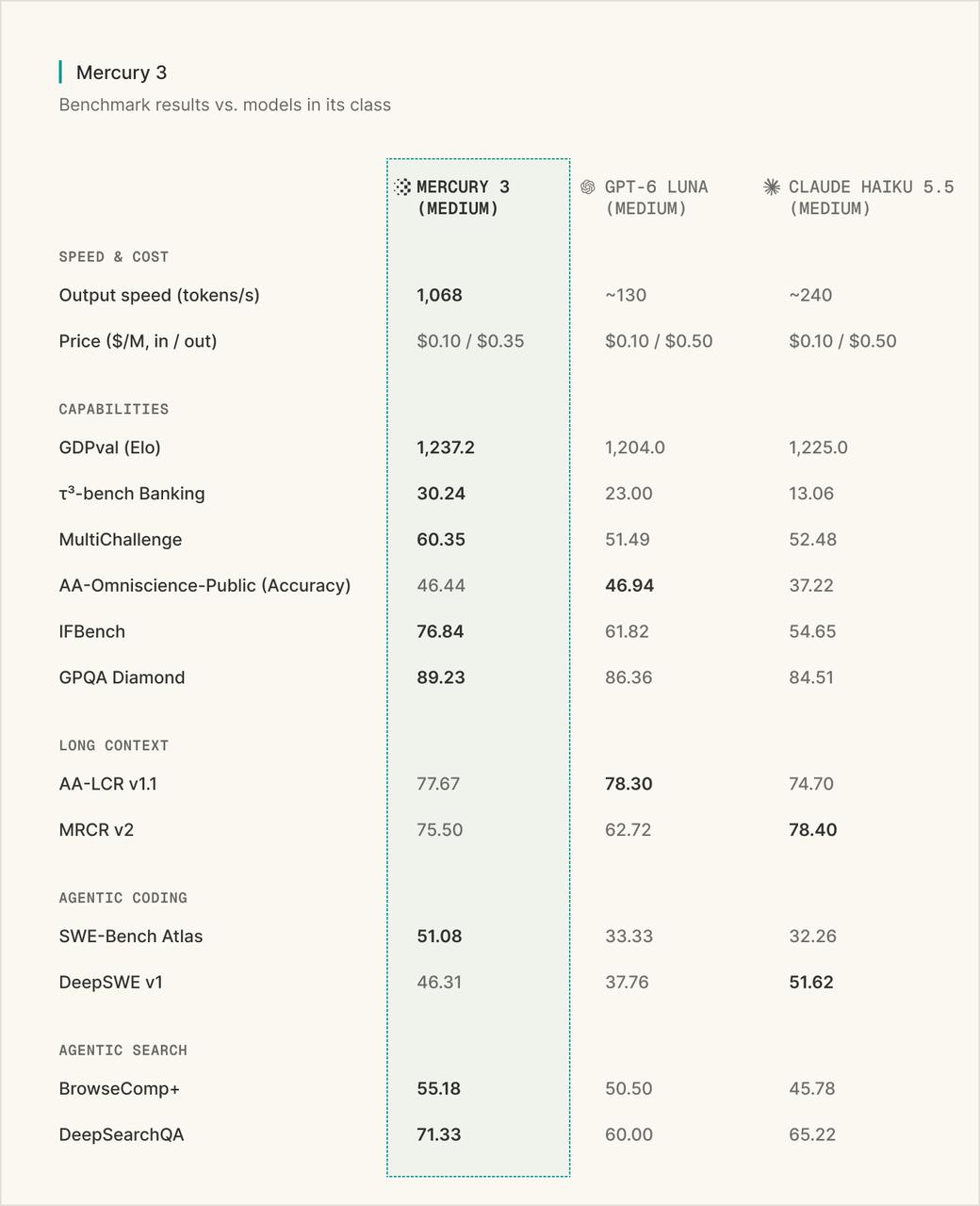
This means that Inception is not comparing a model that can only quickly output simple answers with mainstream LLMs in terms of speed. Instead, it demonstrates that the diffusion route can also handle knowledge Q&A, complex instructions and real software engineering tasks.
Then look at the speed: Mercury 3's output throughput on NVIDIA GPUs reaches 1068 tokens/s; the corresponding speeds of GPT-6 Luna and Haiku 5.5 given by Inception are approximately 130 and 240 tokens per second respectively.
Apart from capabilities and speed, there are two sets of figures worth noting. Mercury 3's context window has been expanded to 1 million tokens, compared to 260,000 tokens of the previous generation Mercury 2.5; during the launch period, the charge is $0.10 per million input tokens and $0.35 per million output tokens, while the official regular prices are $0.20 and $0.70 respectively.
With Parameter Volume Surging Over 40 Times, How Do Diffusion LLMs Maintain Their Speed Advantage?
To understand this, we first need to look at how familiar large language models generate a sentence.
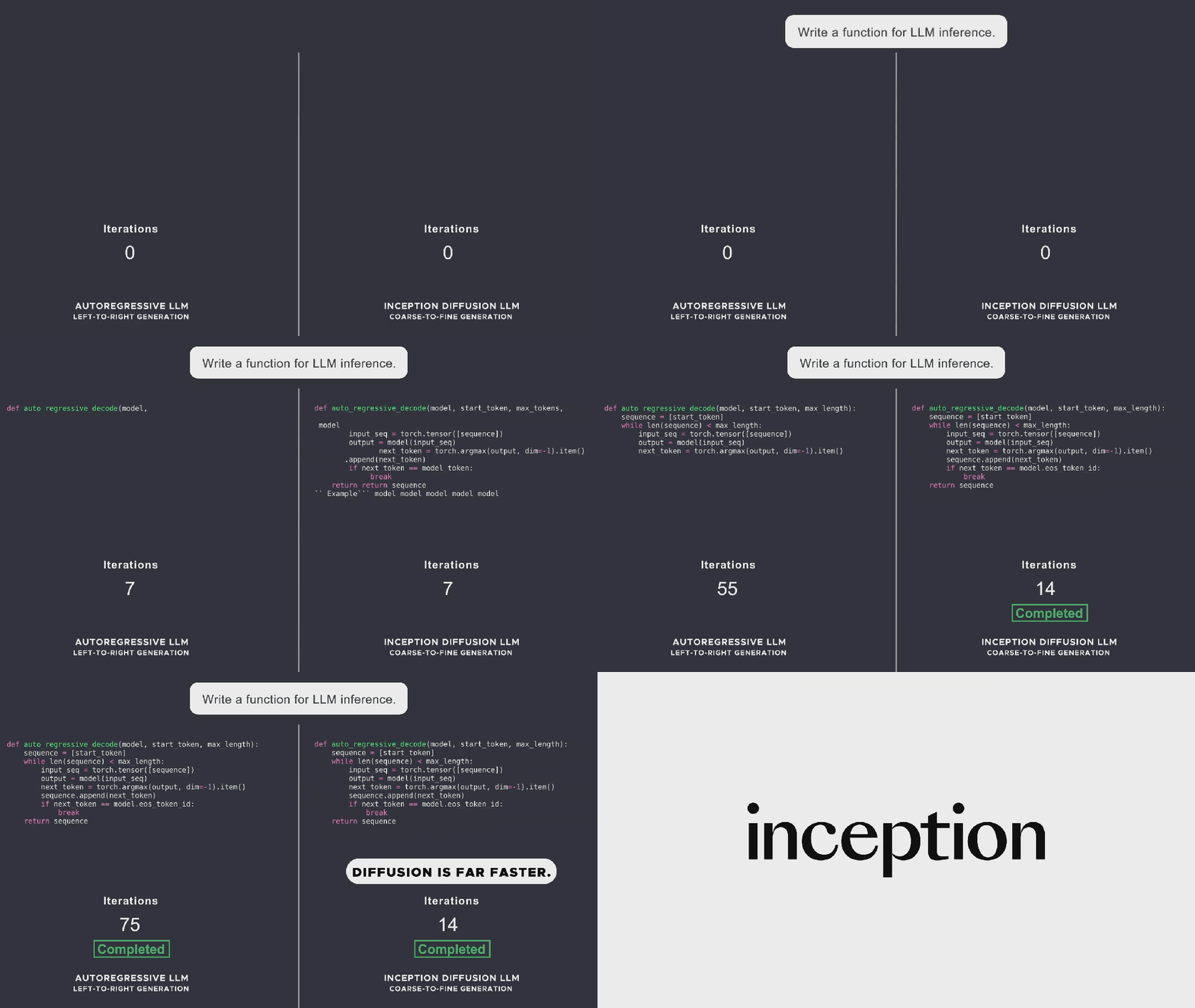
Mainstream autoregressive language models such as GPT and Claude usually predict the next token one at a time in a left-to-right order. They can only continue to predict the subsequent content after generating the previous part. Even if GPUs are good at parallel computing, this step-by-step generation chain cannot be eliminated directly. Diffusion language models adopt a different generation method: they predict the content of multiple positions at the same time, and then continuously adjust through multiple rounds of iterations to finally generate complete and coherent text.
It can be analogized to two writing modes: one is to write word by word while thinking, and the other is to draft the entire paragraph first, and then modify multiple parts at the same time. The latter also requires repeated deliberation, but each round can advance multiple positions simultaneously. This parallel processing capability is the key to the high-speed generation of diffusion language models: one forward calculation can update a batch of tokens, reducing the serial steps required to generate the entire paragraph of text. Therefore, even after multiple rounds of iterations, the overall generation speed can still exceed that of the token-by-token prediction method.
Of course, migrating image diffusion to text is not as simple as imagined. Noise in images can gradually turn into clear pixels, but language is composed of discrete tokens one by one. The model must decide which positions to confirm first and which ones need further modification. The more parallel operations are performed at one time, the faster the generation may be; but if the number of modification rounds is not enough, sentences, codes and reasoning steps are prone to conflicting with each other. What diffusion LLMs really need to solve is to find a balance between the degree of parallelism and generation quality.
As early as in the technical report of the first-generation Mercury, the team introduced the route of using Transformers to make parallel predictions at multiple text positions and complete generation from coarse to fine. The Mercury Coder Mini released in 2025 was measured by third parties to have a speed of 1109 tokens/s; but at that stage, what people remembered most about diffusion models was still their speed, and their capabilities for complex tasks were not their most prominent advantage.
After that, the Mercury series continued to iterate, from general chat models to reasoning models, and then to Mercury 2.5. Inception previously introduced a series of improvement directions, including expanding the training scale, optimizing the denoising network, training objectives, reasoning algorithms, as well as underlying operators and service engines.
For Mercury 3, the official changes are very straightforward: the total number of parameters is more than 40 times larger than that of Mercury 1, the comprehensive capability on standard benchmarks is about 3 times higher than that of Mercury 1 mini, while the generation speed remains at the level of thousands of tokens per second.
This also further verifies the scaling potential of diffusion LLMs: as the model scale expands and the capabilities for complex tasks continue to improve, the speed advantage brought by parallel generation can still be retained.
In the Agent Era, Diffusion LLMs Have Found a New Role
Faster responses are certainly welcome. But in AI Agents, speed means something different: the one that finishes the task first is the truly fast one.
Suppose you ask a browser Agent to help you find the quotations of several suppliers and organize them into a table. It needs to open web pages, search for information, judge whether the page is useful, enter the next layer of links, extract data, and may even find that the information is incomplete and go back to search again. Throughout the whole process, after each observation of the page and decision of action, you have to wait for the model to give the next judgment. After dozens of calls are superimposed, the delay of each step will turn into the waiting time that users actually feel.
The cooperation cases presented by Inception this time further demonstrate the actual performance of Mercury 3 in multi-step web operation and real-time interaction scenarios.
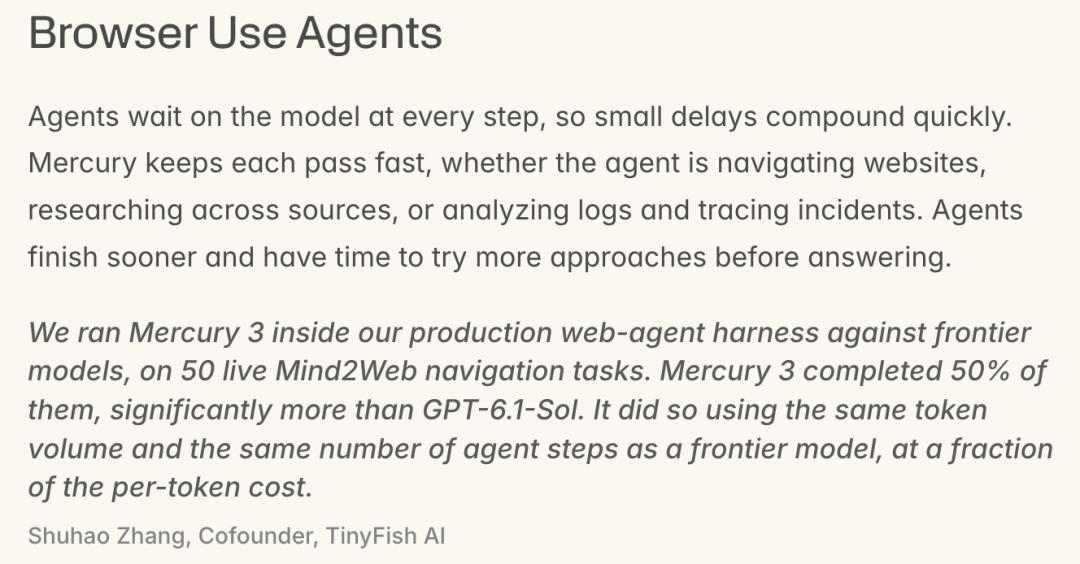
TinyFish, a browser Agent company, has integrated Mercury 3 into its production-level web proxy system, and tested it against cutting-edge models in 50 Mind2Web navigation tasks on real websites. Co-founder Shuhao Zhang revealed that Mercury 3 successfully completed 25 of these tasks, with a completion rate of 50%, significantly higher than GPT-6.1 Sol. Moreover, Mercury 3 consumes a similar number of tokens and execution steps as the comparison models, but the cost per token is much lower.
For browser Agents that need to observe web pages repeatedly and judge the next operation, faster model response means that tasks can be advanced in a shorter time, and the lower call cost also makes high-frequency, multi-round operations more economical.
Another case comes from Octen AI, a real-time search company. It provides search capabilities for scenarios such as smart glasses. In its Sense API test, the search process only takes about 80 milliseconds, and what really slows down the response is model generation. After switching to Mercury 3, the median model generation time dropped to 0.9 seconds, and the median end-to-end response time was 2.2 seconds, achieving the best balance between speed and quality among the tested high-speed models. Asking a question to smart glasses and waiting five seconds for a response, versus getting a reply in about two seconds, are two completely different experiences. The former is more like "submitting a request", while the latter starts to approximate natural conversation.
At this point, a comment from Tri Dao, the author of FlashAttention, is very interesting.
When reposting Mercury 3, he wrote that he has always wanted to combine a sufficiently smart "coordinator/architect" model with an extremely fast "executor" model; diffusion LLMs may just be able to play the latter role.
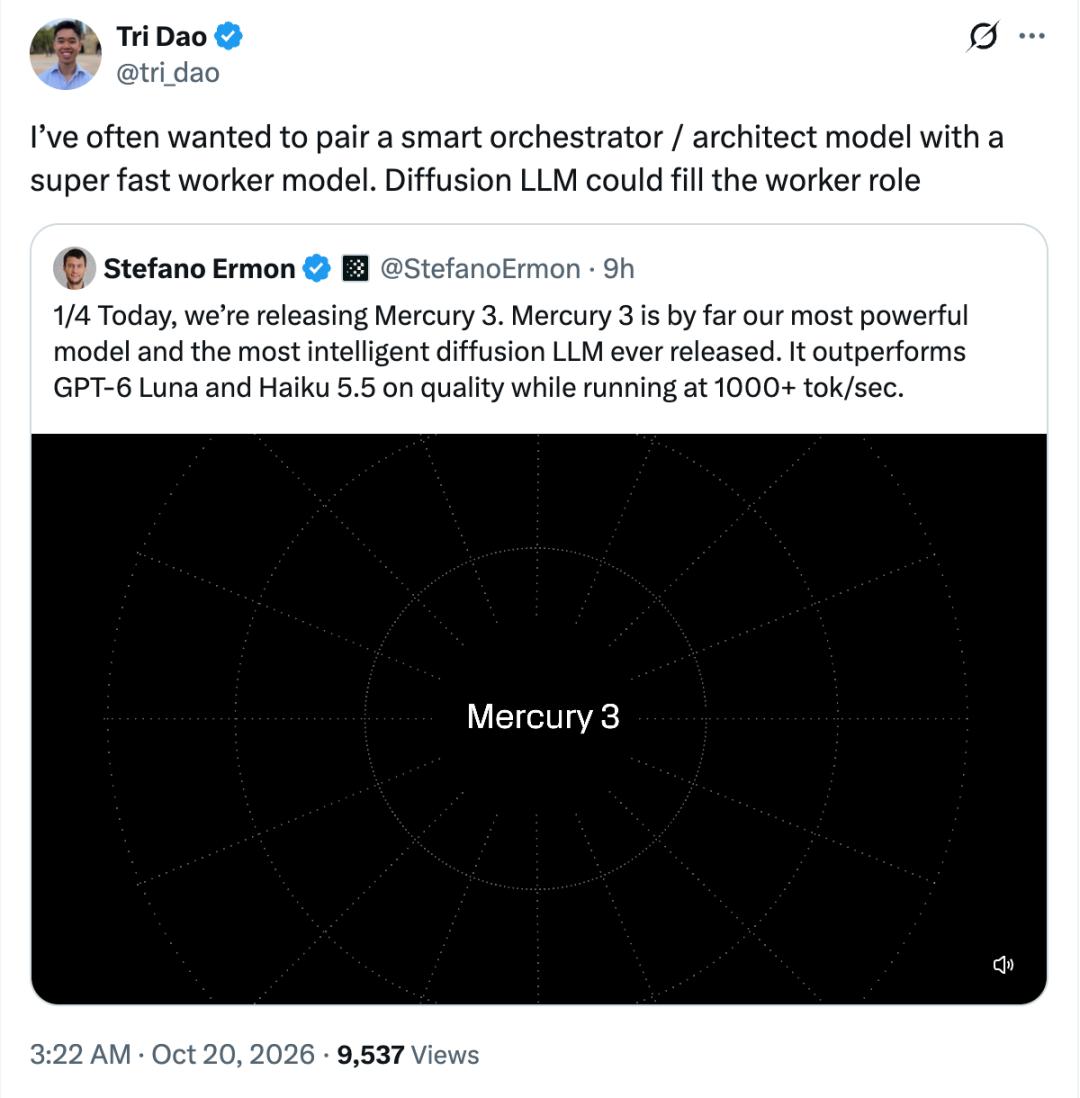
This sentence provides another perspective for looking at the competition of large language models.
In the past, when discussing new models, people were used to asking whether it could beat the smartest model and get a higher benchmark score. But a practical working Agent does not necessarily need every step to be completed by the most expensive and most powerful model in person.
The model responsible for understanding goals, breaking down difficult problems and formulating plans can prioritize capabilities; while the model responsible for retrieving information, checking pages, extracting fields and performing operations repeatedly pays more attention to response speed, reliability and cost. The former is like a project leader, and the latter is like an on-call execution team.
This also changes the way to measure "speed". When chatting, the difference between one second and three seconds may only be a matter of smoothness; if an Agent needs to continuously make 20 or 30 rounds of tool calls, the time saved in each step will eventually become the time required to complete the entire task.
In this division of labor, the positioning of Mercury 3 has gradually become clear: to become the role in the Agent system that is smart enough, can respond quickly, and continuously execute tasks.
References:
https://www.inceptionlabs.ai/blog/introducing-mercury-3
https://x.com/tri_dao/status/2112263206085554392
This article is from the WeChat official account JIQIZHIXIN (ID: almosthuman2014), written by Neo, authorized for release by 36Kr.