Prompt Engineering is Dead! The godfather of the field himself has shattered the traditional livelihood of practitioners: from now on, you no longer need to chant incantations when making queries to AI.

The man who pronounced its death sentence is none other than Riley Goodside, the very person who turned "prompt engineer" into a formal job back then.
The founding figure of this field personally wrote an obituary for his own livelihood.
This is how it happened.
On October 22, security researcher Justin Elze posted a thread on X, whose full text contained only one line: You're all prompting wrong, meaning you are all using the wrong prompting method.
The post was attached with two LinkedIn screenshots.
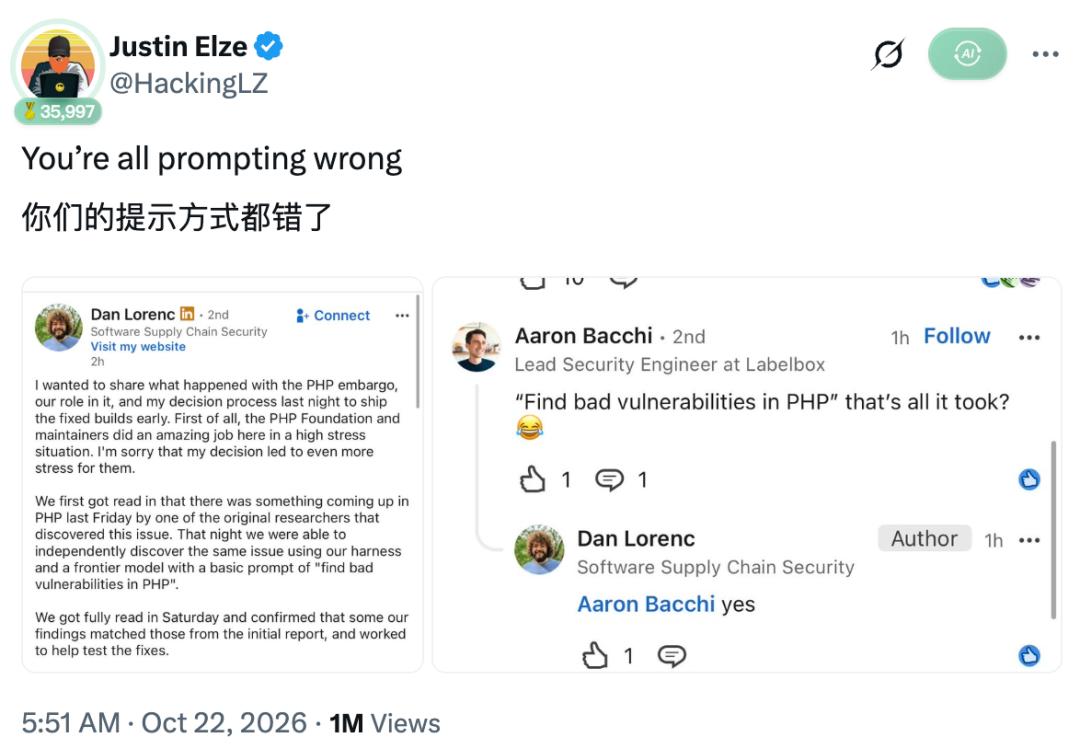
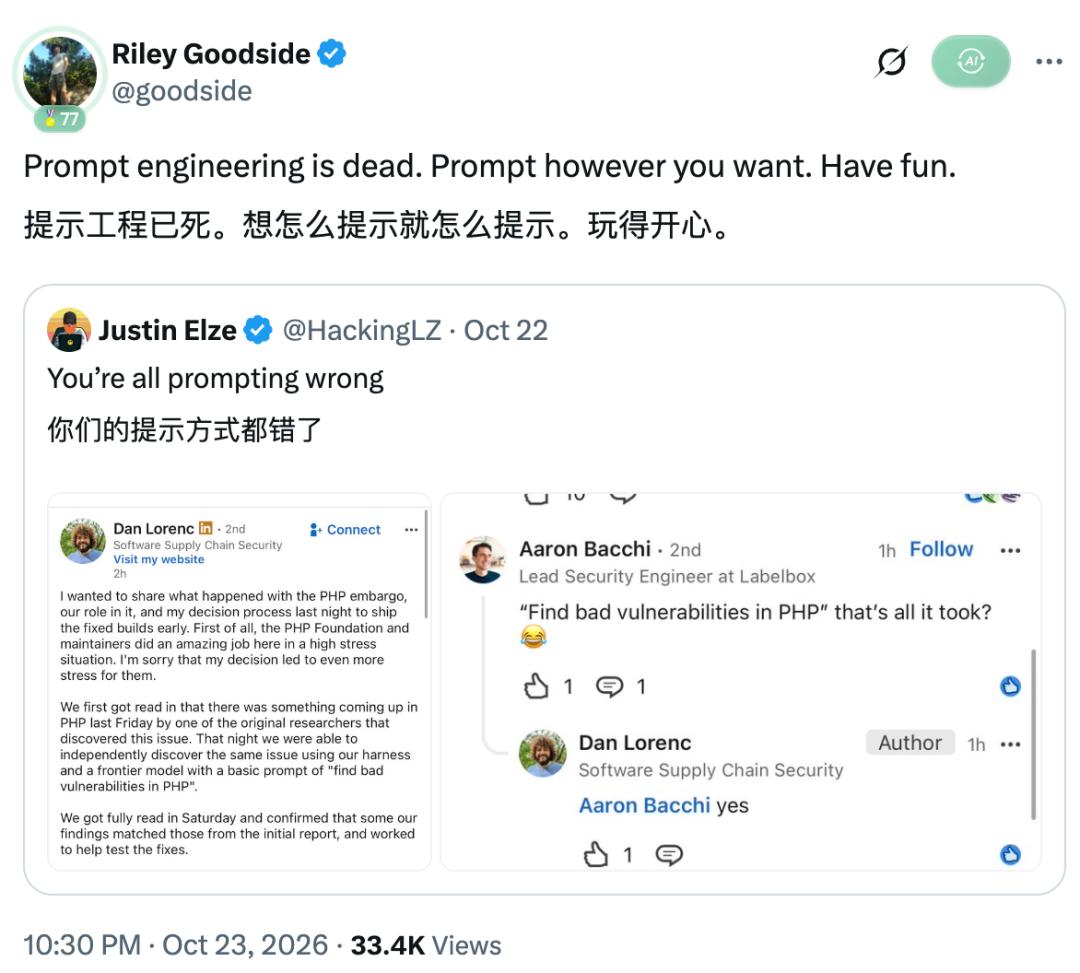
The next day, Riley Goodside reposted it, casually leaving three sentences:
Prompt engineering is dead. Prompt however you want. Have fun. Prompt engineering is dead, prompt however you like, and just enjoy yourself.
These three sentences add up to only 10 English words, yet these 10 words have caused a huge stir across the AI industry.
Not everyone can make such a statement carry this much weight.
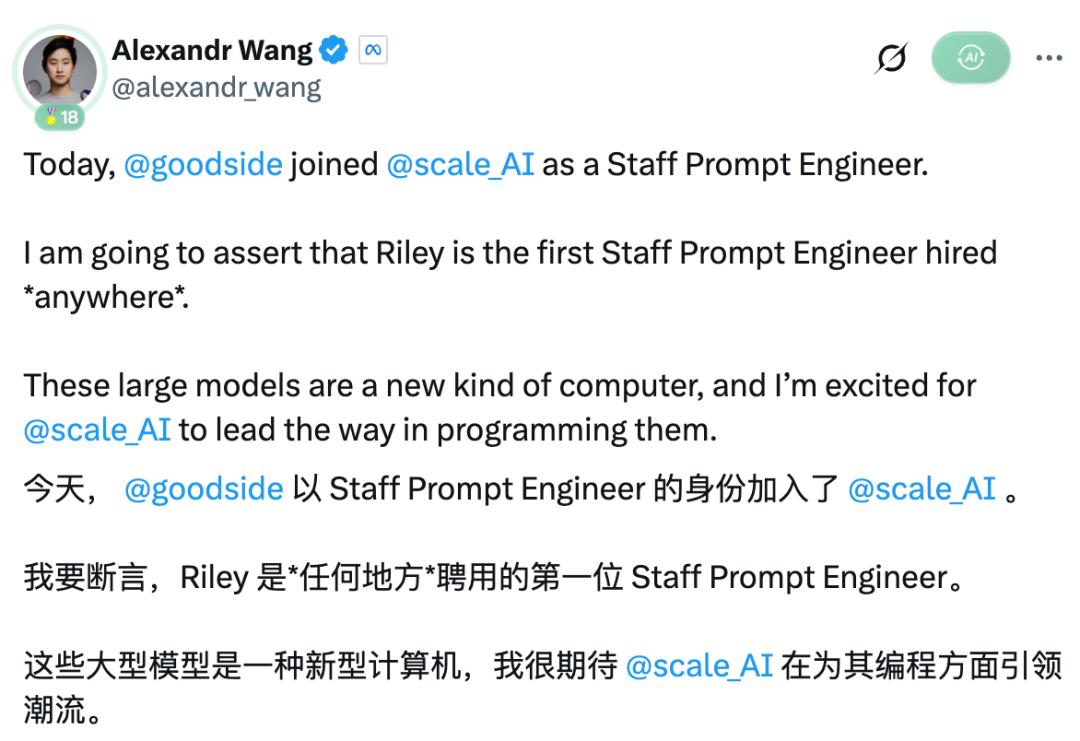
Goodside once served as the chief prompt engineer at Scale AI, and later joined Google DeepMind to continue working in this field. Alexandr Wang, CEO of Scale AI, personally stated back then that he bet Goodside was the first formally hired prompt engineer across the globe.
In his early years, he became famous for conducting public experiments that focused on how to interact with large language models. Even the security concept of "prompt injection attack" was one of the core research directions in his early career.
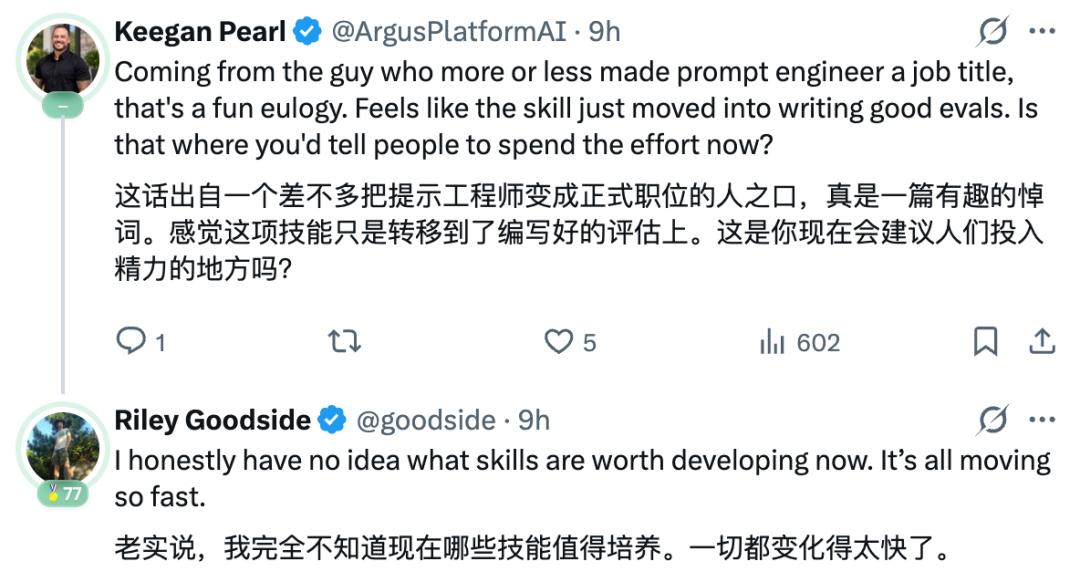
One netizen made a pointed comment: It is such an interesting eulogy coming from the person who practically created this position on his own.
The days of chanting "spells" for prompts are something you must have experienced
Let's rewind the clock a little.
When ChatGPT first went viral, who didn't keep several "universal prompt templates" in their favorites folder?
You would first assign an identity to the AI — "You are a senior XX expert", then specify the output format, add a reminder of "Please think step by step", and finally add a couple of polite remarks.
Writing such a long string of content looked just like chanting a spell, as people feared that missing a single word would make the AI stop working properly.
At that time, people truly believed in this approach.
Being able to write well-crafted prompts was a skill that could be listed on your resume, and "prompt engineer" was once the most enviable new profession across the entire internet.
It was said that the annual salary for this role could reach hundreds of thousands of US dollars, and you didn't even need to write code, you only needed to chat with AI to get the job done.
Three years later, the person who invented this set of "spells" has come forward and said: Stop chanting, it is no longer useful.
A plain natural language sentence can now get the work done that used to require expert efforts
The two screenshots attached by Justin are vivid proof of this.
The screenshots come from Dan Lorenc, CEO of Chainguard.
This company is very well-known in the field of software supply chain security.
Back in mid-October, Chainguard officially launched their AI vulnerability discovery system — a self-built execution framework paired with cutting-edge large language models for security research.
How simple is the prompt given to the model? It is basically just one sentence: Find high-risk vulnerabilities in PHP that can be exploited remotely without logging in.
There is no role-playing, no step-by-step template, no content like "You are a senior security expert, please follow the steps below...".
It is just such a plain, casual sentence.
As a result, the system successfully independently reproduced the known high-risk vulnerabilities, and also helped verify the official fix solution.
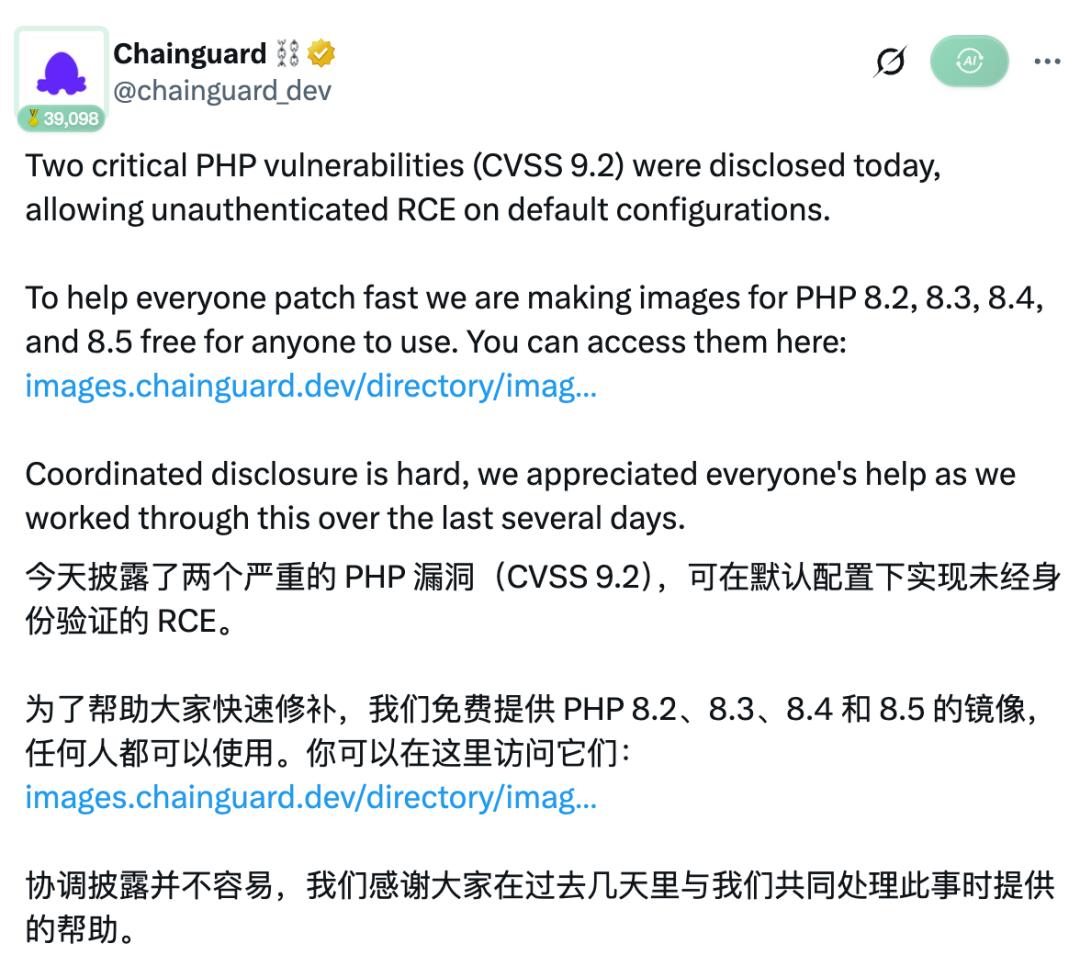
This incident caused a huge stir. The FBI even issued a public warning, the PHP Foundation released an emergency patch, and multiple government websites were affected for a period of time.
In the past, this was a task that only senior security experts would dare to take on after repeatedly polishing prompts and carefully designing multi-round conversations.
Nowadays, it can be done with one simple natural language sentence.
What has died is the fancy phrasing of prompts, while the supporting underlying system is still thriving
The hype didn't last long, and Goodside himself added the rest of the statement in the comment section.
He said he was just making a witty remark earlier.
The workload of people who write underlying prompts for systems, people who fine-tune small models, and engineers who embed prompts into applications has not decreased at all. But for ordinary users sitting in front of the screen, the upper limit of the effect that can be achieved by "asking directly" basically has no ceiling now.
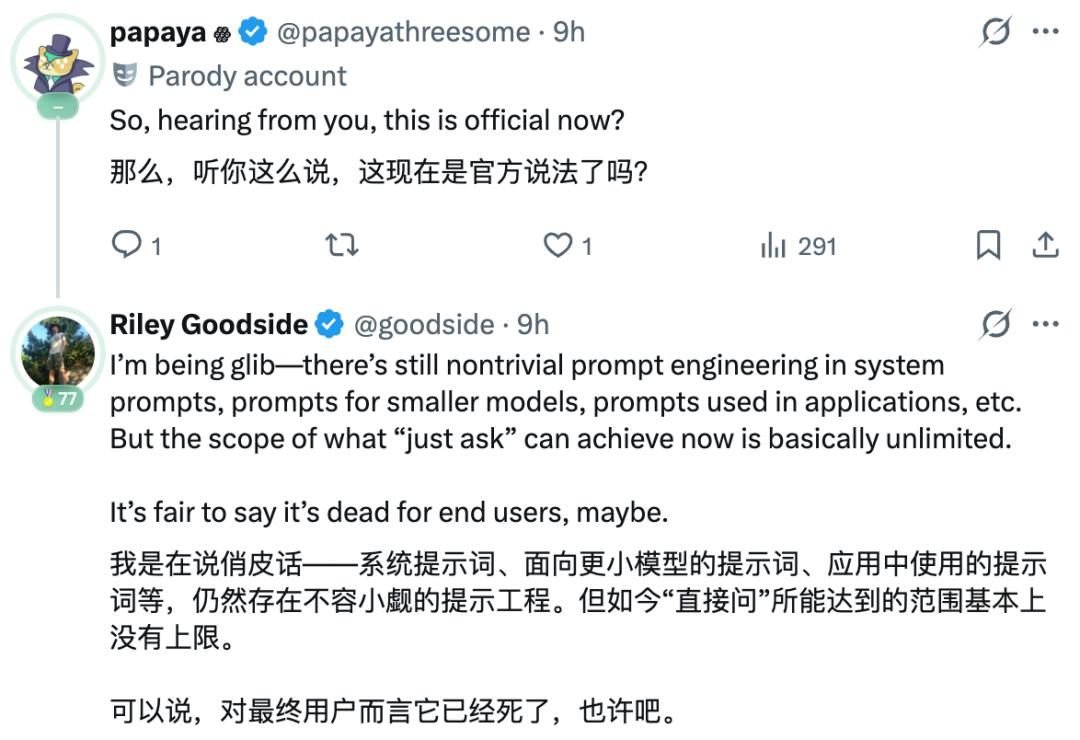
Someone followed up and asked: Which new model made you change your mind all of a sudden?
He said there was no sudden turning point. Ever since ChatGPT was launched, prompt engineering as a necessary skill for ordinary users has been slowly dying out, and this is a slow and continuous process.
One netizen pointed out the truth: "It feels like the work has just shifted from prompts to the harness." Goodside replied with two words: Exactly.
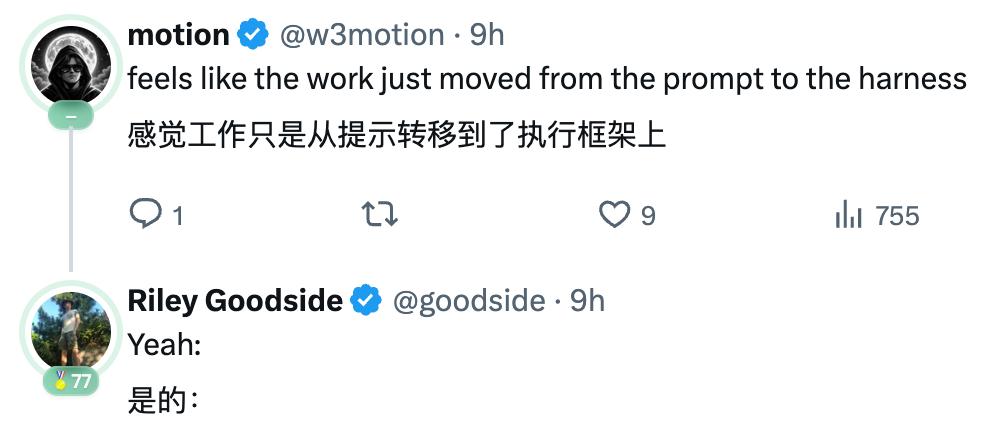
That makes perfect sense.
The reason why Dan Lorenc's sentence "find the vulnerabilities" worked is not that the sentence itself is so exquisite, but the complete system behind it that includes the sandbox environment, target source code and execution engine.
The model's contribution lies in its capabilities, while the system's contribution lies in its design.
Spells will expire, but good judgment will not
If you string together the evolution of these past few years, the development context is very clear:
At the very beginning there was Prompt Engineering, which focused on figuring out how to phrase a sentence well; later, Karpathy and other practitioners promoted Context Engineering, which studied how to feed the correct information to the model; then came Harness Engineering, which builds the dedicated operating environment for the model and sets corresponding rules and constraints; now the industry has put forward the concept of Loop Engineering, which enables the entire system to run in loops and iterate on its own.
Layer by layer, the core efforts are moving further and further away from the prompts themselves.
Ordinary users no longer need to memorize "spells" or save templates, as modern models can fully understand natural human language.
The most interesting part comes from Goodside himself. Someone asked him what skills people should focus on developing now. This founding figure answered very honestly: To be honest, I have no idea at all what skills are worth cultivating right now, everything is changing too fast.
All kinds of prompt techniques are caught up with by the latest models every few months.
The three things that have become truly important now are: Can you think clearly about the problem? Can you state clearly what you want? Can you judge whether the result given by AI is correct or not?
Reference: https://x.com/goodside/status/2113639196254671259
Editor: Solomon
This article is from the WeChat Official Account "AI-era" (ID: AI_era), written by ASI Revelation, republished with authorization from 36Kr.